OpenAI GPT-5.4 Explained: Positioning, Capabilities, Cost, and Practical Adoption (As of 2026-03-06)
On March 5, 2026, OpenAI officially released GPT-5.4. The first question many people asked was simple: is this just another small point release, or is it a real shift in how much productive work the model can finish?
If you only look at the version number, 5.4 looks like the next iteration after 5.2 and 5.3. But once you line up the official launch notes, model docs, API capability matrix, and the ChatGPT-side product updates, the core value of GPT-5.4 is not “how many more parameters it has.” The real change is that it pulls three lines of capability into a much more usable center point:
- Reasoning
- Coding and engineering execution
- Tool ecosystem coordination, including computer use
This article is based on public material from OpenAI’s official websites. It focuses on five practical questions:
- What exactly changed in GPT-5.4, in verifiable terms rather than marketing language
- How to use it through ChatGPT, the API, and Codex
- How to choose between GPT-5.4, GPT-5.4 Pro, and GPT-5 mini
- The real engineering impact of cost, latency, and context window size
- How to use GPT-5.4 in 2026 for work that actually needs to ship
1. Start with the timeline: why GPT-5.4 feels confusing to many people
The biggest misunderstanding in this phase is not that people do not know how to use the model. It is that information from different dates gets mixed together.
Key dates:
- 2026-02-13: ChatGPT retired a batch of older models, including GPT-4o, GPT-4.1, o4-mini, and the previously announced GPT-5 variants (Instant and Thinking).
- 2026-03-05: OpenAI released GPT-5.4, labeled GPT-5.4 Thinking inside ChatGPT, released GPT-5.4 Pro alongside it, and made both available through the API and Codex.
- 2026-06-05: GPT-5.2 Thinking, which remained in ChatGPT Legacy Models for three months, reached its scheduled retirement date.
That means:
- “GPT-5 was retired in February” and “GPT-5.4 launched in March” are not contradictory. They describe different generations and different product packaging choices.
- OpenAI’s 2026 strategy is quite clear: unify the consumer-facing ChatGPT experience and the developer-facing API/Codex experience around GPT-5.4 as the mainline capability.
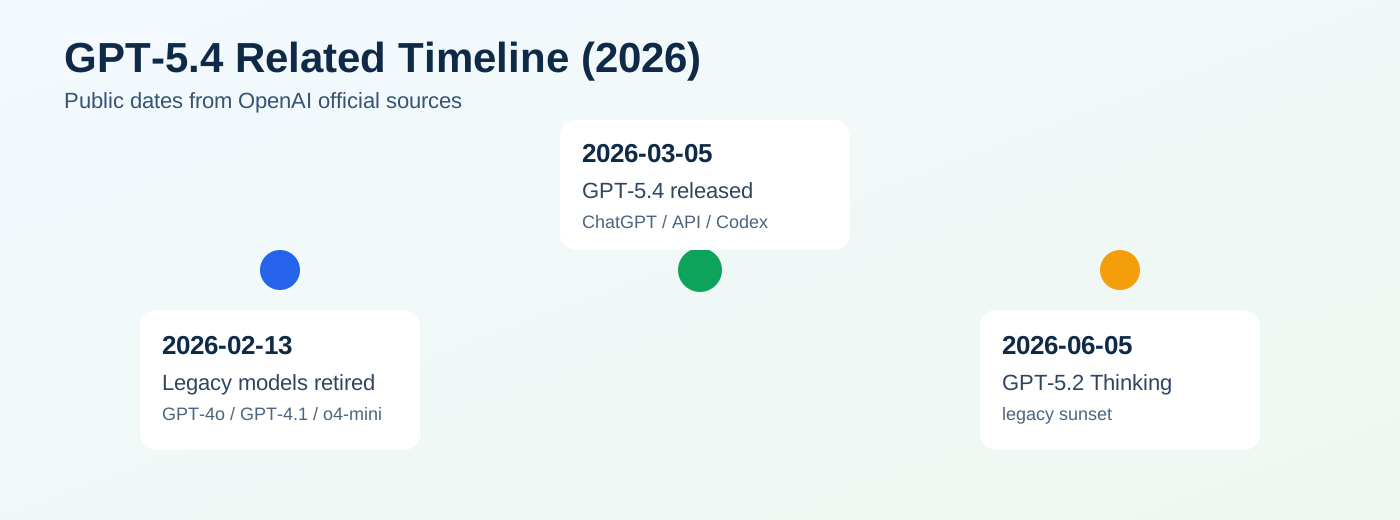
Figure 1: GPT-5.4 timeline based on OpenAI announcement dates, current through 2026-03-06.
2. GPT-5.4’s position: not the best at a single point, but the default model for professional work
In the official docs, OpenAI describes GPT-5.4 as its flagship default model for professional work. In engineering terms, that translates into three expectations:
- If you need complex reasoning, coding, tool calls, and external system interaction in the same task, this should be your first choice.
- It should give you a better balance across quality, speed, cost, and reliability.
- It does not need to dominate every isolated benchmark, but it does need to reduce rework across real multi-step tasks.
That pattern is obvious in GPT-5.4’s combined upgrade path:
- It folds the strong coding ability of GPT-5.3-Codex into the mainline model.
- It retains and improves the reasoning path that matured in GPT-5.2.
- It strengthens tool use, long-context handling, and computer interaction at the system level rather than simply adding a “can code” label.
3. Core upgrades: what got better relative to GPT-5.2
From the official launch pages and model docs, six changes matter most.
1) Higher completion rate for complex work, with fewer back-and-forth turns
OpenAI explicitly calls out coding, document understanding, tool use, instruction following, image understanding, multi-step workflow execution, and complex browsing with multi-source synthesis.
The significance here is that the model is not only better at answering questions. It is better at getting a task to a deliverable state. For companies, removing even one extra round trip can shorten the whole collaboration chain.
2) A 1M context window is now part of the mainline model
Both GPT-5.4 and GPT-5.4 Pro support roughly 1,050,000 tokens of context and up to 128,000 output tokens according to the API spec.
That matters for long-running work because it can:
- Hold large codebase slices, long document sets, and complex task traces in one run
- Reduce context fragmentation caused by aggressive chunking
- Help agent workflows preserve consistency across multiple stages
One caveat remains: once input exceeds 272K tokens, pricing shifts upward. I cover that later.
3) Native tool_search, which matters in large tool ecosystems
The most common failure pattern in tool calling used to be packing too many tool definitions directly into the prompt, which caused three problems:
- Higher token cost
- Slower responses
- Attention diluted across irrelevant tools
GPT-5.4’s tool_search mechanism delays loading the full tool definition until it is actually needed. The model first sees a searchable tool catalog, then pulls in details on demand. In medium and large enterprise environments, this matters more than “one answer is smarter,” because it directly affects throughput and per-task cost.
4) The first mainline model with native computer use
GPT-5.4 is the first OpenAI general-purpose mainline model with native computer use support. It is no longer limited to “generate instructions.” It can participate in a plan-execute-verify-repair loop inside an agent system.
OpenAI also showed large gains in computer and vision related evaluations. For example, OSWorld-Verified reportedly moved from 47.3% on GPT-5.2 to 75.0% on GPT-5.4. That is meaningful because it suggests the model is moving from demo-grade interface interaction toward something closer to production utility.
5) Better token efficiency in long task chains
OpenAI explicitly notes that GPT-5.4 can finish some tasks with fewer tokens while delivering the same or better quality. In practice, this means:
- The per-token price may be higher
- The total task token count may be lower
- End-to-end cost does not necessarily increase, and may even drop
That is also why the pricing notes emphasize the combined effect of stronger capability and lower total token use.
6) Better factual reliability compared with GPT-5.2
In OpenAI’s comparison material, GPT-5.4 reduced factual errors on de-identified samples where users had flagged misinformation:
- The probability that an individual claim was false dropped by about 33%
- The probability that a full response contained an error dropped by about 18%
That does not mean it stops making mistakes. It does mean the default trust level is higher when you need fast first drafts, analytical outlines, or structured information summaries.
4. How to read the benchmarks
Here is a compact set of the most useful metrics from the official release materials:
- GDPval: GPT-5.4 at 83.0% versus GPT-5.2 at 70.9%
- Internal investment-banking modeling task: GPT-5.4 at 87.3% versus GPT-5.2 at 68.4%
- SWE-Bench Pro (public): GPT-5.4 at 57.7% versus GPT-5.2 at 55.6%
- OSWorld-Verified: GPT-5.4 at 75.0% versus GPT-5.2 at 47.3%
- BrowseComp: GPT-5.4 at 82.7%, GPT-5.4 Pro at 89.3%
Those numbers suggest three things:
- GPT-5.4 improves the most in professional tasks that combine domain work and tools.
- Not every coding benchmark shows a dramatic gap, which reinforces the point that the model is optimized for total productivity rather than a single score.
- The Pro version is stronger on hard, deep-reasoning tasks, but it carries a much heavier cost and latency profile, so it is not the right default for everything.
The right way to use benchmark data is:
- Check whether the task structure resembles your real work
- Then evaluate stability and cost within that structure
- Finally confirm with your own internal evaluation set
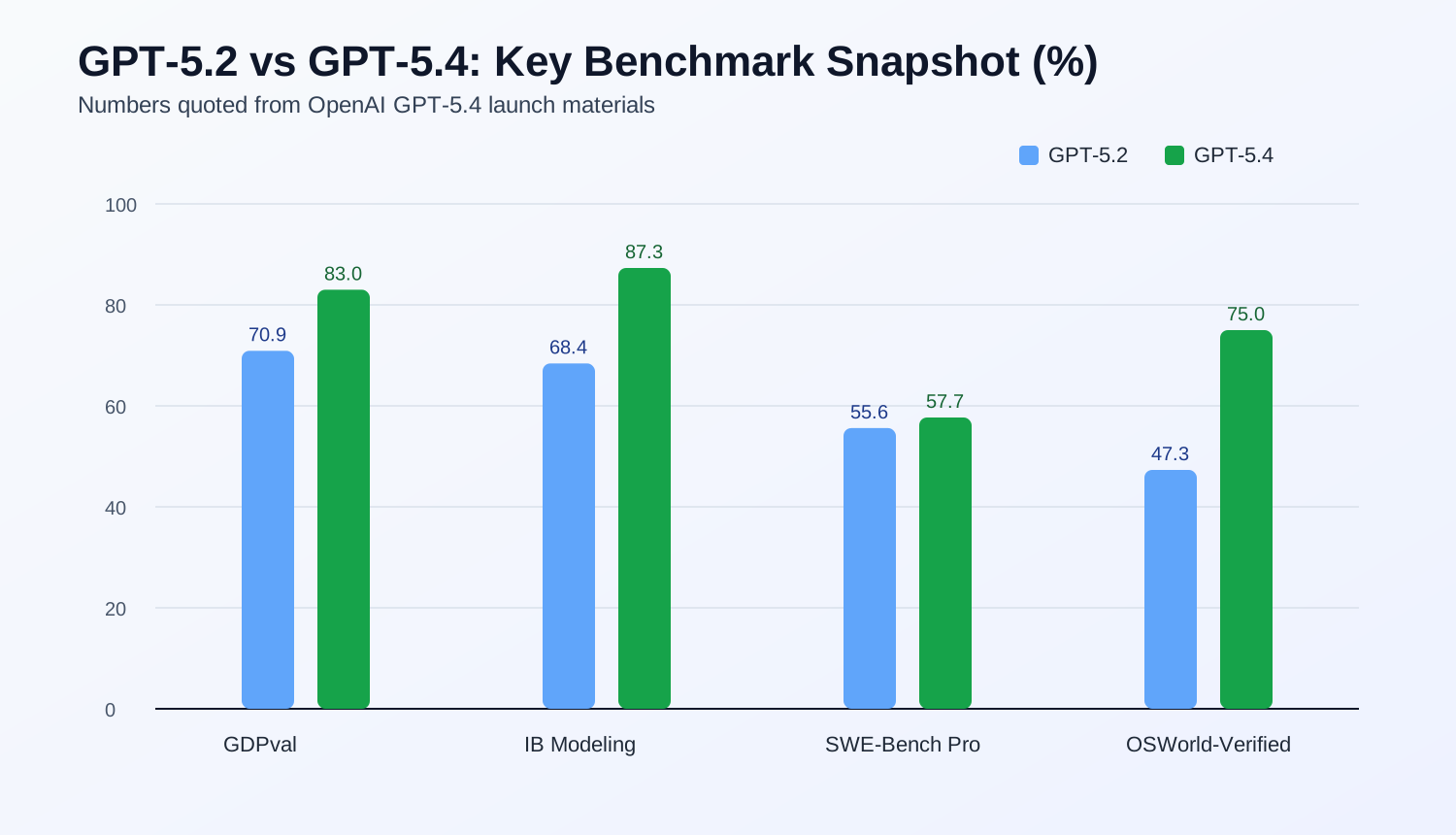
Figure 2: Selected benchmark comparisons between GPT-5.2 and GPT-5.4 based on OpenAI release material.
5. ChatGPT, API, and Codex: what changes across the three entry points
1) ChatGPT
- GPT-5.4 Thinking became available to Plus, Team, and Pro users on 2026-03-05, replacing GPT-5.2 Thinking.
- Enterprise and Edu can enable it earlier through admin controls.
- GPT-5.4 Pro is targeted at Pro and Enterprise tiers.
In product terms, OpenAI particularly emphasizes visible preambles and the ability to adjust direction during execution. That matters for complex work, because you can steer the model mid-flight instead of waiting for the full output and restarting from scratch.
2) API
- Standard model:
gpt-5.4 - High-performance model:
gpt-5.4-pro - Snapshots:
gpt-5.4-2026-03-05andgpt-5.4-pro-2026-03-05
The docs recommend using the Responses API for multi-turn complex tasks because previous_response_id can carry forward prior reasoning context, reduce repeated thinking, improve cache hit rate, and cut latency.
3) Codex
GPT-5.4 has become one of Codex’s main working models and includes experimental 1M context support. For teams that need multi-file, multi-step, verifiable coding flows, Codex plus GPT-5.4 feels much closer to real engineering than one-shot conversational coding.
6. Parameters and migration: the most common pitfalls in 2026
If you are moving from GPT-5.2 or an even older model to GPT-5.4, these points matter most.
1) reasoning.effort is the first lever to think about
GPT-5.4 supports none, low, medium, high, and xhigh, and defaults toward the lower-latency end with none. A reasonable migration strategy is:
- Start with
noneas the baseline - Move to
mediumonly if the default is not good enough - Reserve
highandxhighfor high-value hard problems
2) Parameter compatibility limits
On GPT-5.4, temperature, top_p, and logprobs are only supported when reasoning.effort: none. Otherwise the request fails.
That means old prompt templates can break immediately if you carry them over blindly. Migration now requires separating reasoning-depth control from sampling control instead of treating the old parameter block as universal.
3) Upgrade the prompt strategy before arguing about model choice
OpenAI’s migration guidance can be summarized this way:
- GPT-5.2 to GPT-5.4: you can begin with a near drop-in replacement assumption
- o3 to GPT-5.4: start at
mediumorhigh - GPT-4.1 to GPT-5.4: start from
none
The deeper point is simple: once the model changes, the best prompting strategy changes too. Just swapping the model name without adjusting the task framing usually leaves real gains on the table.
7. Cost and performance: how to decide whether it is worth it
As of 2026-03-06, the official API prices were:
- GPT-5.4: $2.50 / 1M input tokens, $0.25 / 1M cached input tokens, and $15 / 1M output tokens
- GPT-5.4 Pro: $30 / 1M input tokens and $180 / 1M output tokens, positioned for the hardest high-value tasks
Two pricing details are easy to miss:
- For the 1.05M-context models, GPT-5.4 and GPT-5.4 Pro, once input exceeds 272K tokens, the full session is billed at a higher multiplier, about 2x on input and 1.5x on output.
- Data residency and regional processing endpoints add an extra surcharge, marked by OpenAI as a 10% uplift.
So the correct cost model is not “compare price per token.” It is:
- Total tokens per task
- Number of completion rounds needed
- Number of tool calls
- Failure and rerun rate
A common real-world outcome is that GPT-5.4 can be more expensive on a single call but cheaper across the full workflow.
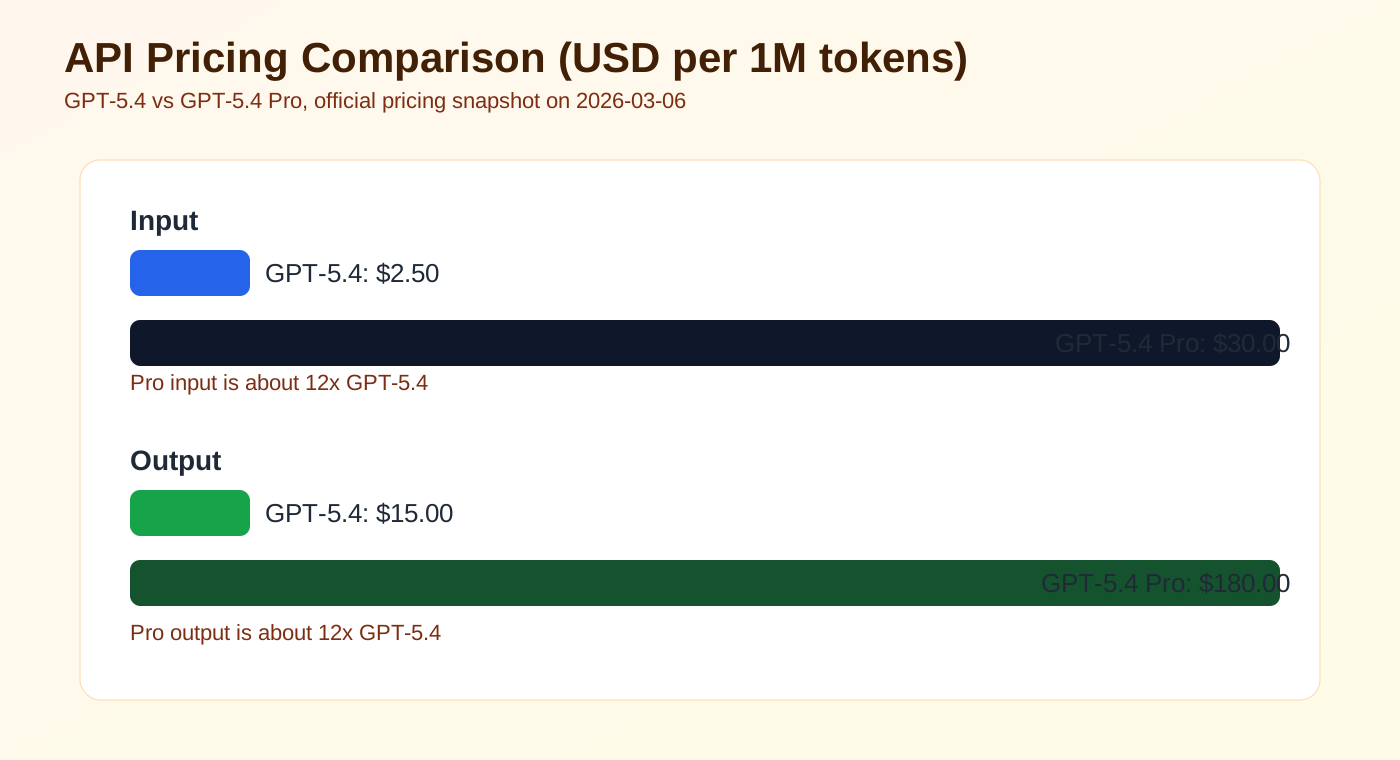
Figure 3: GPT-5.4 and GPT-5.4 Pro pricing snapshot in USD per 1M tokens, based on the official pricing page as of 2026-03-06.
8. Safety and governance: why GPT-5.4 puts special emphasis on cyber capability tiers
OpenAI classified GPT-5.4 as having high cyber capability under its Preparedness Framework and released the GPT-5.4 Thinking System Card together with the launch.
That matters because it signals three things:
- The model’s increased power clearly extends into dual-use areas, especially cybersecurity-related tasks
- The platform side is pairing that with stronger monitoring, access control, and asynchronous blocking mechanisms
- False positives are still possible in some high-risk settings
For companies, that translates into two concrete tasks:
- Do not interpret “the model is stronger” as “we can do less risk control”
- Design permissions, audit trails, human review, and sensitive-operation confirmation flows before internal rollout
9. Three practical recommendations for real adoption
Recommendation 1: separate task tiers before you choose a model
- Broad day-to-day professional work: start with
gpt-5.4 - High-value hard problems such as legal reasoning, financial analysis, or critical architecture choices: use
gpt-5.4-prowhen needed - High-throughput, lower-cost traffic: consider
gpt-5-miniorgpt-5-nano
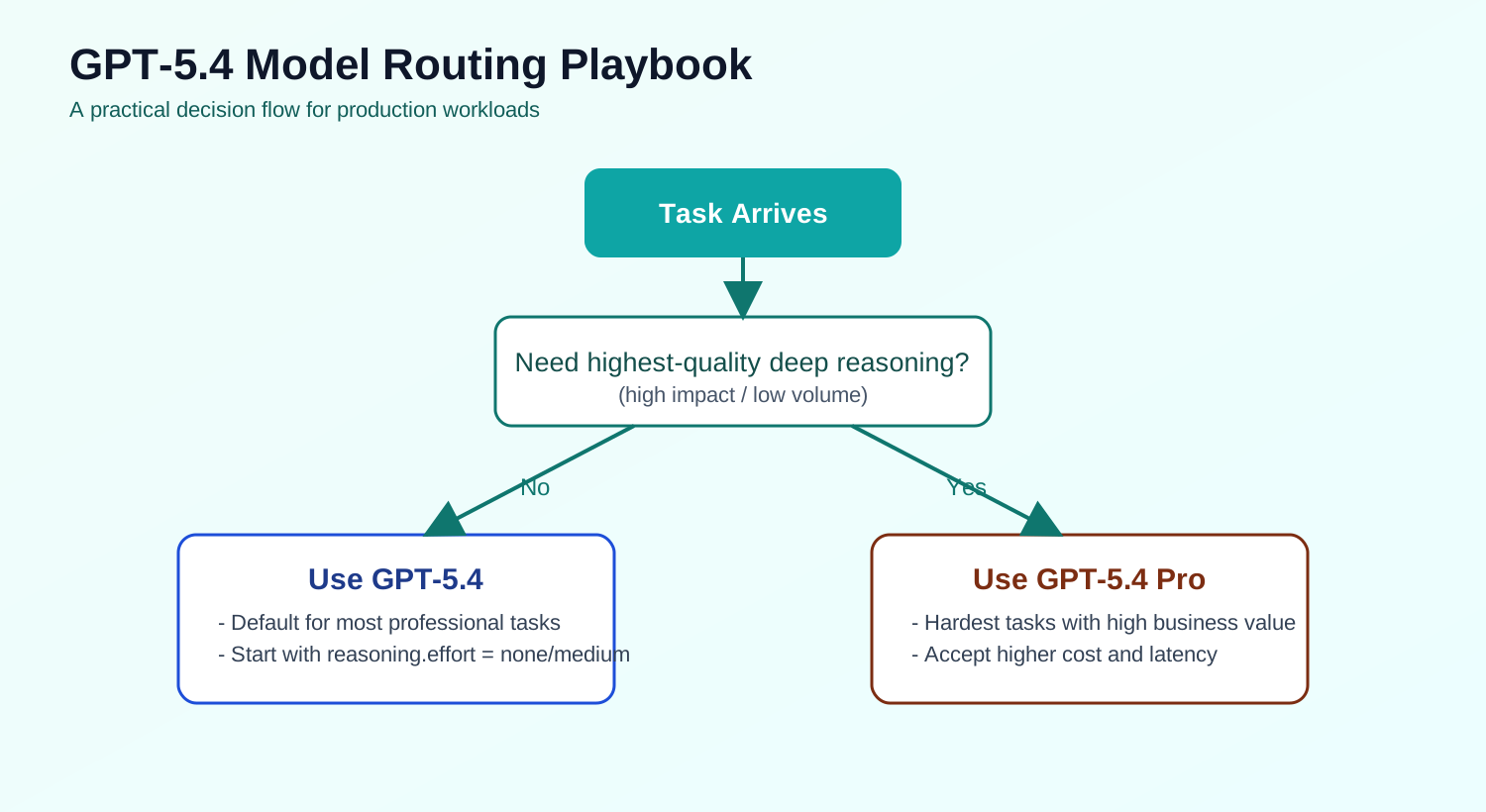
Figure 4: A practical reference routing flow for production environments. Validate the final strategy with your own evaluation set.
Recommendation 2: build replayable agent workflows
Split work into replayable steps such as plan, tool call, verification, and repair, and keep the important intermediate state. That is how you actually capture GPT-5.4’s gains in tool coordination and long execution chains.
Recommendation 3: run A/B tests on your own evaluation set
Do not rely only on public leaderboards. Use 30 to 100 representative internal tasks, track accuracy, latency, token use, and retry rate, and then decide your default routing strategy.
10. Conclusion: GPT-5.4 is valuable not because it is “smarter,” but because it is better at delivering work
In the production context of 2026, the most important change in GPT-5.4 is not that it wins one isolated capability. It is that it combines reasoning, coding, tool use, long context, and safety constraints into a more operable default foundation.
In one sentence:
- GPT-5.4 fits best as a default model for professional work
- GPT-5.4 Pro fits high-difficulty, high-value, low-volume tasks
- The real differentiator is not whether you can tweak one parameter, but whether you put the model inside a verifiable, auditable, iterative workflow
For individual developers, that means spending less time on model-selection anxiety and more time on task design and automation pipelines. For teams and companies, it means AI can move from a question-answering assistant into an execution unit inside real processes.
That is why GPT-5.4 feels like a milestone. It is not just a more impressive demo model. It is a step toward models that can actually finish work.
Official references
- OpenAI Blog: Introducing GPT-5.4 (2026-03-05)
https://openai.com/index/introducing-gpt-5-4/ - OpenAI API Docs: GPT-5.4 model page
https://developers.openai.com/api/docs/models/gpt-5.4 - OpenAI API Docs: Using GPT-5.4 guide
https://developers.openai.com/api/docs/guides/latest-model - OpenAI API Docs: GPT-5.4 Pro model page
https://developers.openai.com/api/docs/models/gpt-5.4-pro - OpenAI API Pricing
https://openai.com/api/pricing/ - OpenAI Blog: ChatGPT for Excel and new financial data integrations (2026-03-05)
https://openai.com/index/chatgpt-for-excel/ - OpenAI Help Center: Retiring GPT-4o and other ChatGPT models
https://help.openai.com/en/articles/20001051 - OpenAI Deployment Safety Hub: GPT-5.4 Thinking System Card (2026-03-05)
https://deploymentsafety.openai.com/gpt-5-4-thinking