Why Does AI Lie So Confidently? — It Is Not Thinking, It Is Playing Supercharged Word Association
The short answer
AI hallucination is not simply an occasional bug. It is a predictable risk of a system whose basic job is to generate the next likely token from context. The model can produce a fluent, confident, highly structured answer without having verified that every claim is supported by evidence.
The easiest analogy is this: a large language model is a supercharged word-association player. It is exceptionally good at continuing a sentence. It is not automatically a fact-checker.
1. The answer that looks too good to question
Ask an AI assistant: “Explain the major changes in Product X released in 2025, and give the official release date.” The answer may arrive as a polished press release: a month, a version number, a project leader, technical specifications, and customer examples.
Then you ask for the official link. The assistant gives you a perfectly formatted URL. You click it. The page does not exist.
The more dangerous version is not a completely invented story. It is a mostly true answer with one false detail: the product exists, the feature is real, but the date, version, author, or compatibility claim is wrong. Because the paragraph is grammatical and professional, the error is hard to notice.
This is what people usually mean by AI hallucination: generated content that is unsupported by reliable evidence, inconsistent with known facts, or assembled from real fragments into a false combination.
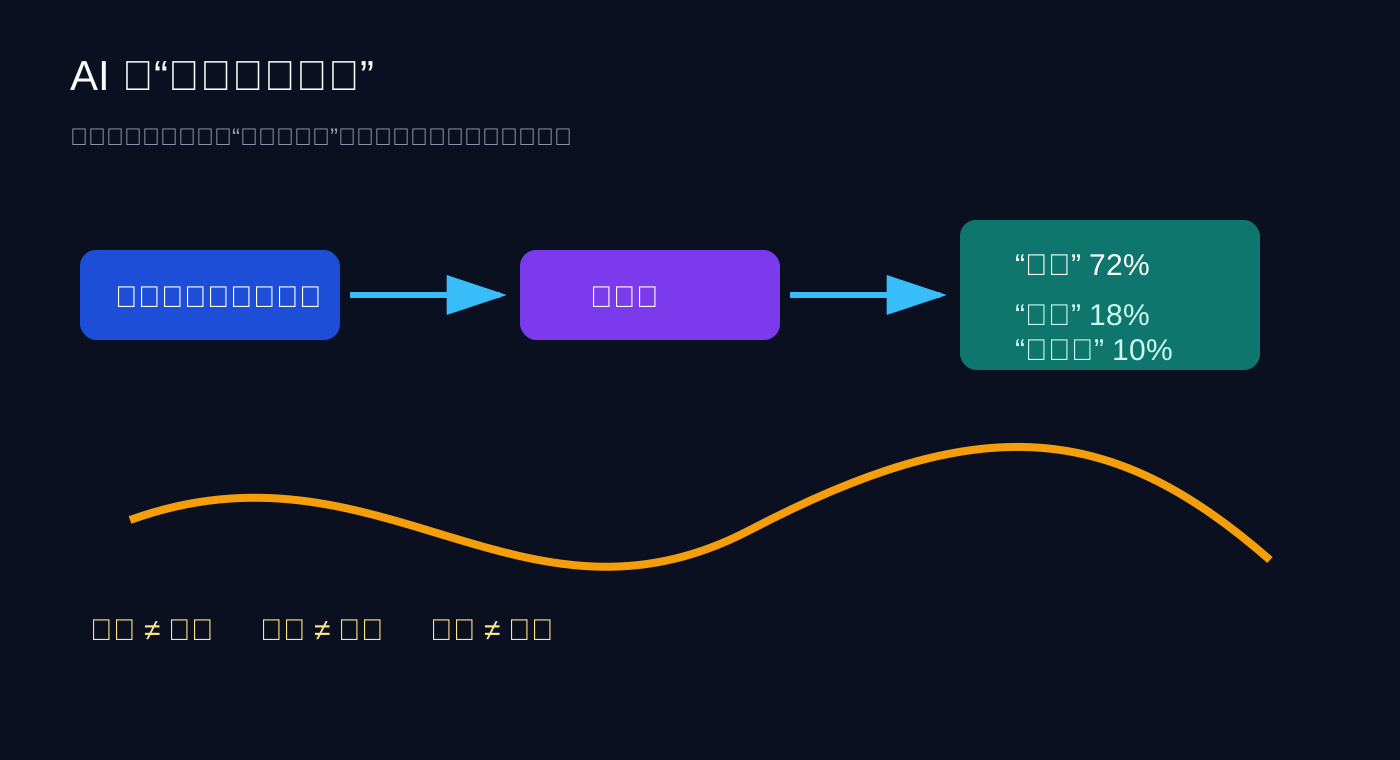
The percentages in this illustration are not a measurement. The important point is the mechanism: at each step, the model selects a plausible continuation. “Most likely continuation” is not the same as “fact already checked.”
2. Three useful categories of hallucination
Calling every mistake a hallucination is convenient but not very useful. In practice, three patterns appear again and again.
2.1 Fabrication
The model invents a paper, a product feature, a legal case, a command flag, or a citation. It may provide the author, date, journal, and DOI in a convincing format, but the source cannot be found.
Imagine a child who has seen hundreds of library cards. The child can draw a realistic-looking card for a book that is not in the library. The format is familiar; the book is not real.
2.2 Conflation
Two true statements are merged into one false statement. Person A worked at Company M. Person B led Project N. The model writes that Person A led Project N at Company M. Every ingredient sounds familiar, but the combination is false.
2.3 Staleness
The model repeats something that used to be true: an old price, a retired command, a former executive, an earlier policy, or a previous sports result. A model may have learned the old answer accurately and still be wrong today.
For information that changes over time, always attach a date. “Current” is not a magical property of a model’s memory.
3. Is the model actually thinking?
This question deserves a careful answer. Modern models can perform multi-step reasoning and solve problems in ways that look like thinking. At the mechanism level, however, the system processes a sequence of tokens and predicts a probability distribution for what should come next.
Tokens are language building blocks. A token may be a whole word, part of a word, punctuation, or a short character sequence. The model reads the context, estimates candidate continuations, chooses one, appends it to the context, and predicts again.
After “The capital of France is”, “Paris” is much more likely than “database”. After “Once upon a time”, a story-like continuation is likely. The model is using learned statistical structure, not opening a universal reference book for every sentence.

This does not mean that the model is a simple lookup table. Training teaches it patterns about language, concepts, code, and many facts. But learning patterns is not the same as verifying every output against a current source.
4. Why fluency masquerades as truth
Humans naturally infer competence from confident speech. A smooth explanation with headings, terminology, numbered steps, and links feels like it came from someone who checked the details.
Language models are extremely good at producing that surface signal:
- They can imitate formal reports and documentation.
- They can turn uncertainty into a complete sentence.
- They adapt tone and vocabulary to the user’s question.
- They do not experience embarrassment when a claim is unsupported.
Fluency is a language capability. It is not a chain of evidence.
Think of a skilled live host. A host can keep a conversation moving and make an awkward situation sound coherent. Without a recording or a source, however, the host’s speaking ability cannot prove that an event happened.
5. Randomness can make the answer drift
Models do not always select the single highest-probability token. Generation often keeps some randomness so that writing is less repetitive. A temperature-like setting changes how much lower-probability candidates are allowed into the sample.
- Lower randomness: more stable, more repetitive, not automatically more factual.
- Higher randomness: more varied and creative, with a greater chance of unusual errors.

Reducing randomness can reduce some unstable mistakes. It cannot create missing knowledge. If the model has no reliable evidence, a low-randomness answer may simply be a more consistent guess.
6. A longer context is not unlimited memory
Pasting a large document into a prompt can help, but it does not make errors impossible. Documents can contradict one another. Important facts can be buried in footnotes. Tables and images can be misread. The context can be truncated. And if the document does not contain the answer, a model may still continue writing because its job is to complete the response.
This is like asking a child to find one number in a whole workbook. More pages do not guarantee a correct result unless the page, question, and checking method are clear.
7. A reproducible test: ask the same thing twice
Try this with any chat model using a fictional name:
Explain the major changes in “Nebula File Protocol 4.2” released in 2025, and give its official release date.
Then ask:
Only state claims that you can verify from reliable sources. If you cannot verify something, say “uncertain” and do not fill in the gap.
The first prompt often invites a complete-looking answer. The second prompt usually reduces fabrication, but it does not replace external verification.
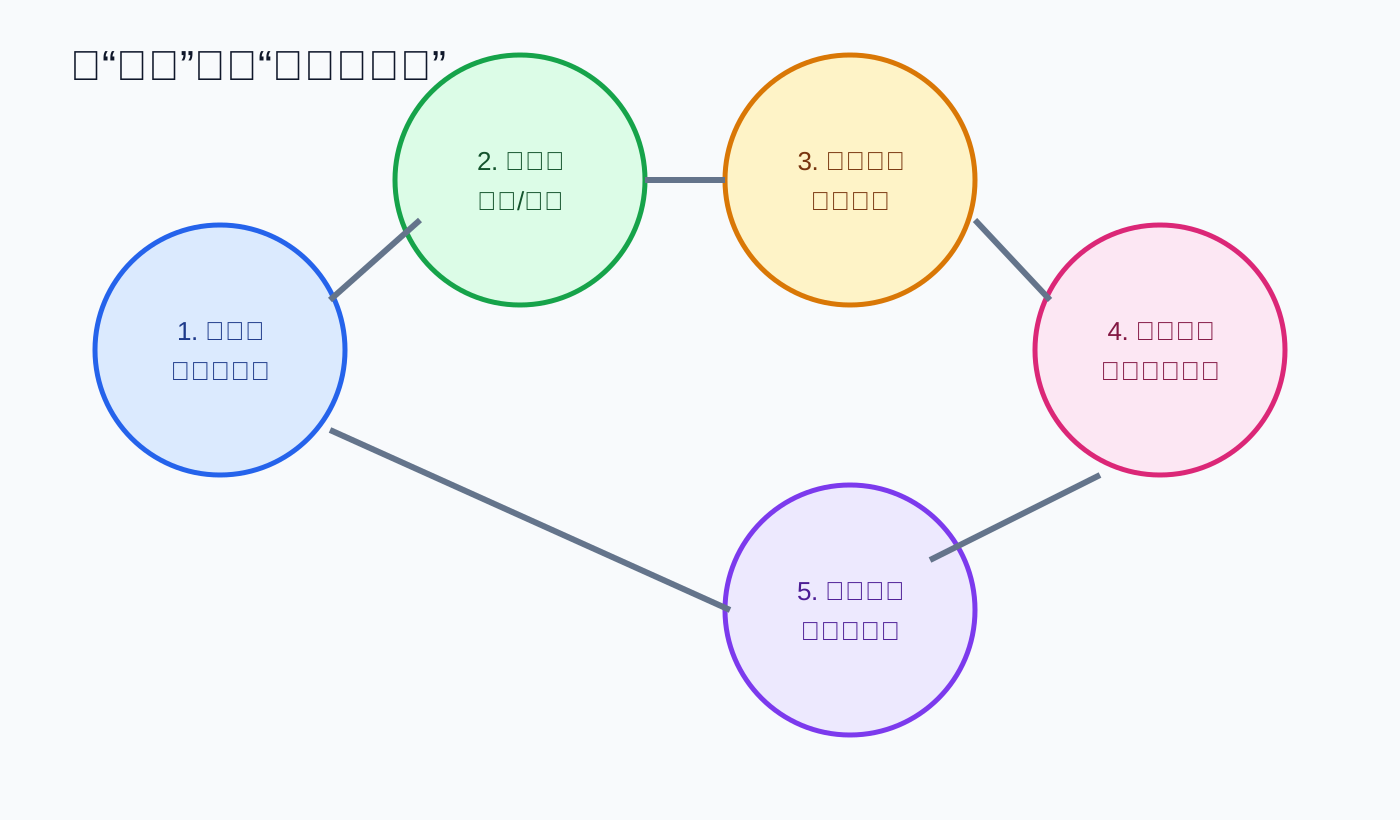
Observe three things:
- Does the answer change when the wording changes?
- Do the cited sources actually exist?
- Do those sources support each individual detail, not just the general topic?
8. Why “please include a link” is not enough
A link is useful, but the existence of a link is not proof. Build a claim-to-evidence table:
| Claim made by the AI | What the evidence must show |
|---|---|
| A product launched on a specific date | The official announcement states that date |
| A feature supports a given limit | The current specification states the limit |
| A paper reached a particular conclusion | The paper actually supports the interpretation |
| A command is safe to run | The current documentation matches the installed version |
If a source only proves that a product exists, it does not prove the release date, parameter, or compatibility claim added by the model.

RAG, or retrieval-augmented generation, helps by retrieving material before generation. It is not magic. Bad retrieval, bad chunking, bad ranking, or a misunderstood source can still produce a fluent wrong answer.
9. The fix: make the model submit evidence
A dependable AI workflow adds at least four actions.
9.1 Define the fact boundary
Separate stable knowledge from time-sensitive knowledge.
- Stable: mathematical definitions, basic syntax, classic concepts.
- Volatile: versions, prices, law, news, inventory, people, and live status.
Treat the second category as requiring current sources by default.
9.2 Require explicit uncertainty
Use a prompt such as:
Split the response into confirmed facts, reasonable inferences, and unknowns.
Give a source after every factual claim. Do not guess for completeness.
If sources conflict, preserve the conflict and explain the difference.
9.3 Make sources part of the output
Ask for the source title, publication date, the relevant passage, and the exact claim it supports. This turns “citation-shaped decoration” into an auditable record.
9.4 Add a human brake for high-risk actions
Deleting data, changing production systems, submitting legal text, giving medical advice, or making an investment decision should not be delegated to an AI system without human approval.
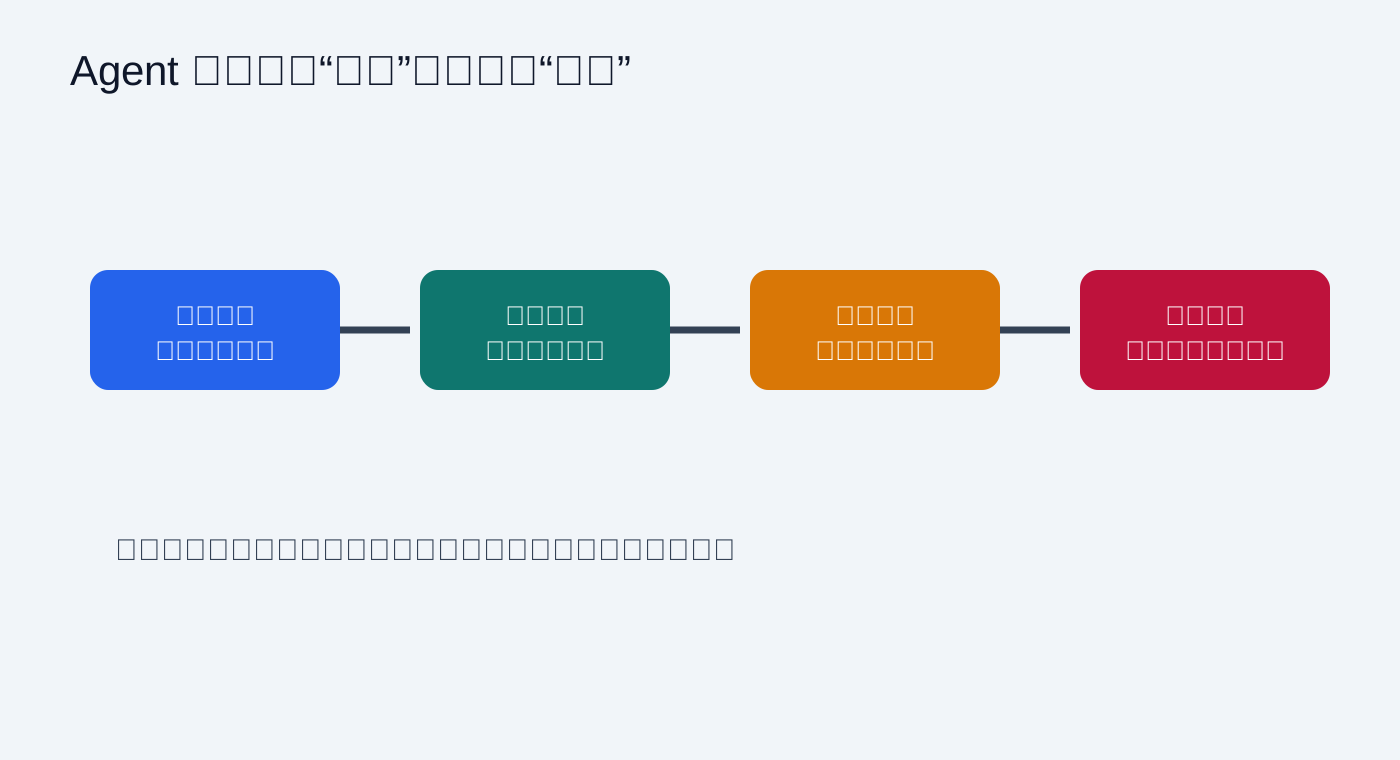
The right goal for an Agent is not “finish everything automatically.” It is “know when to pause, show the evidence, and request approval.”
10. Risk matters more than the label “hallucination”
Not every error has the same cost.
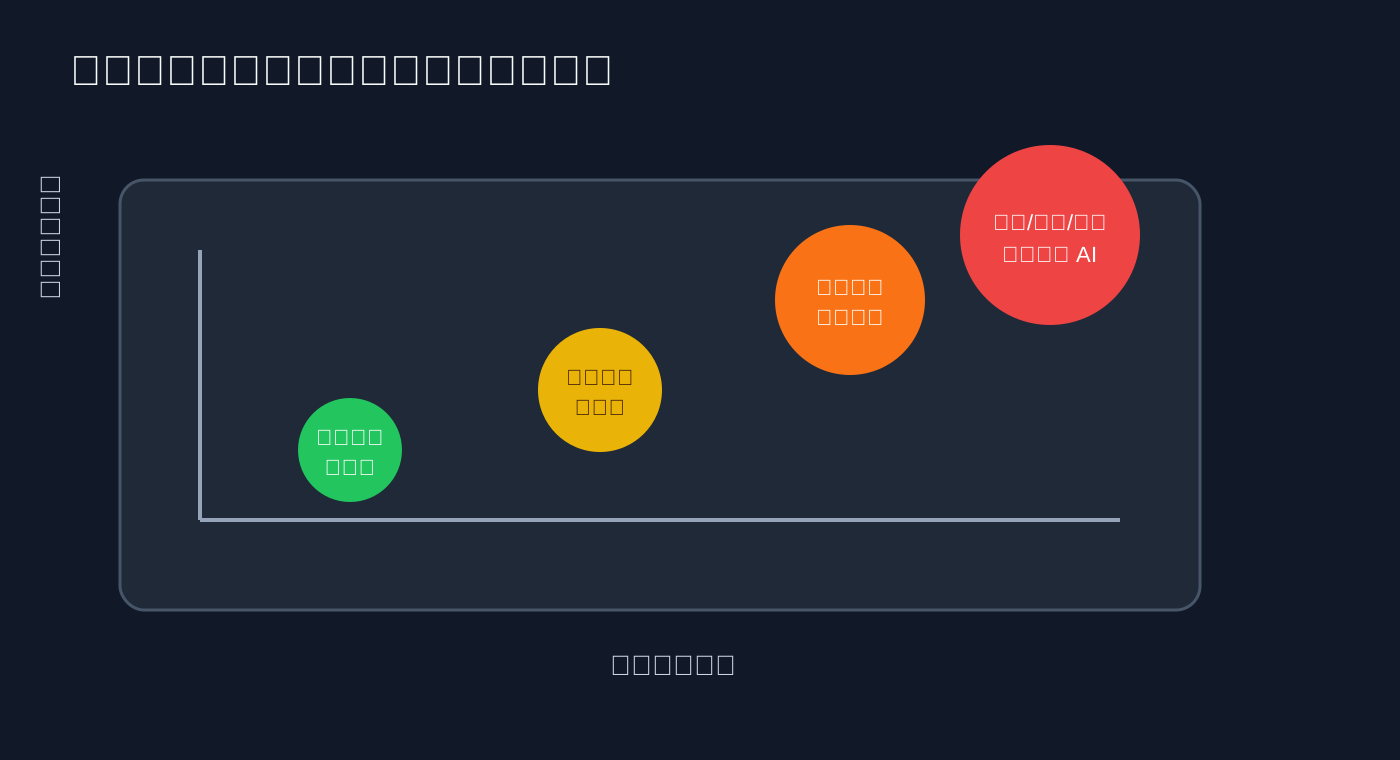
- Headline ideas and creative writing: allow creativity and edit the result.
- Technical articles: check versions, commands, and links.
- Operations plans: test each command in a safe environment.
- Medical, legal, and financial work: use AI for organization, not final judgment.
The practical question is not “Can AI be used here?” It is “Can I afford the consequences if this sentence is wrong?”
11. A five-minute check for ordinary users
When an answer matters, use this checklist:
- Extract concrete details: dates, versions, authors, institutions, URLs.
- Prefer first-party sources: official documentation, announcements, and original papers.
- Compare line by line: does the source support the exact claim?
- Ask the question again in a different way and look for contradictions.
- Check the date: has the information changed?
If you cannot find evidence in five minutes, do not forward the sentence as a fact.
12. A general rule for Agents
The following rule can be placed in an Agent’s system instructions:
Distinguish facts, inferences, and recommendations.
Assume that dates, versions, prices, laws, medical information, financial information,
people, and live status may be stale.
Never invent links, numbers, people, or events when no verifiable source is available.
If sources conflict, stop and list the conflict for human review.
Before deleting, writing, publishing, paying, or changing production systems,
show the plan, impact, and rollback path, then wait for approval.
This will not make a model infallible. It will make unsupported claims easier to notice and prevent a guessed answer from immediately becoming an irreversible action.
13. Q&A
Does hallucination make AI useless?
No. A calculator can produce a wrong result when the input is wrong, but we do not discard calculators; we check the input. AI is useful for organizing, rewriting, explaining, brainstorming, comparing possibilities, and assisting research. Important facts still require evidence.
Does setting temperature to zero remove hallucination?
No. It can make output more deterministic. Repeating the same unsupported claim consistently is still an error.
Does connecting a search engine solve the problem?
No. Search results can be outdated, misleading, or misunderstood. Source quality and claim-to-evidence checking still matter.
Why does the model not simply say “I don’t know”?
Because its generation objective rewards producing a useful-looking continuation. Unless the prompt, tools, and workflow explicitly reward uncertainty and pausing, the model is encouraged to keep the conversation going.
What is the one sentence to remember?
AI is a powerful language generator, not an automatic judge of reality. Let it write the first draft; do not let it sign the final line without evidence.
14. Sources
- Ji et al., Survey of Hallucination in Natural Language Generation, arXiv:2306.04341.
- Brown et al., Language Models are Few-Shot Learners, arXiv:2005.14165.
- Lewis et al., Retrieval-Augmented Generation for Knowledge-Intensive NLP Tasks, arXiv:2005.11401.
- OpenAI Platform Documentation, Tokens and Prompt engineering.
- Google for Developers, Introduction to Large Language Models.
These references cover how language models generate text, why fluency is not factuality, and why retrieval, citations, cross-checking, and human approval belong in a serious workflow.
15. Final takeaway
AI hallucination is not a single bug that disappears when a model becomes “smart enough.” It follows from a basic mismatch: the model is predicting language, while humans often treat language as reality.
Calling the model a “supercharged word-association player” is not an insult. It is a useful operating model. The system can produce a coherent draft quickly and explain difficult ideas clearly. When the question requires evidence about the real world, add retrieval, citations, cross-checking, and human approval.
Let AI generate. Let evidence prove. Let a human make the final decision.