Black Friday 2026 Reality Check: Which AI Token Plans & VPS Deals Are Actually Worth Buying?
Let us start with the money-saving truth: today is Black Friday, November 27, 2026, and tech feeds are flooded with screaming banners promising “lowest prices of the year.” Yet if you open the actual vendor billing pages one by one, you quickly discover a stark divide—roughly 80% of the hype is affiliate noise, while genuine holiday markdowns come from a very specific handful of providers.
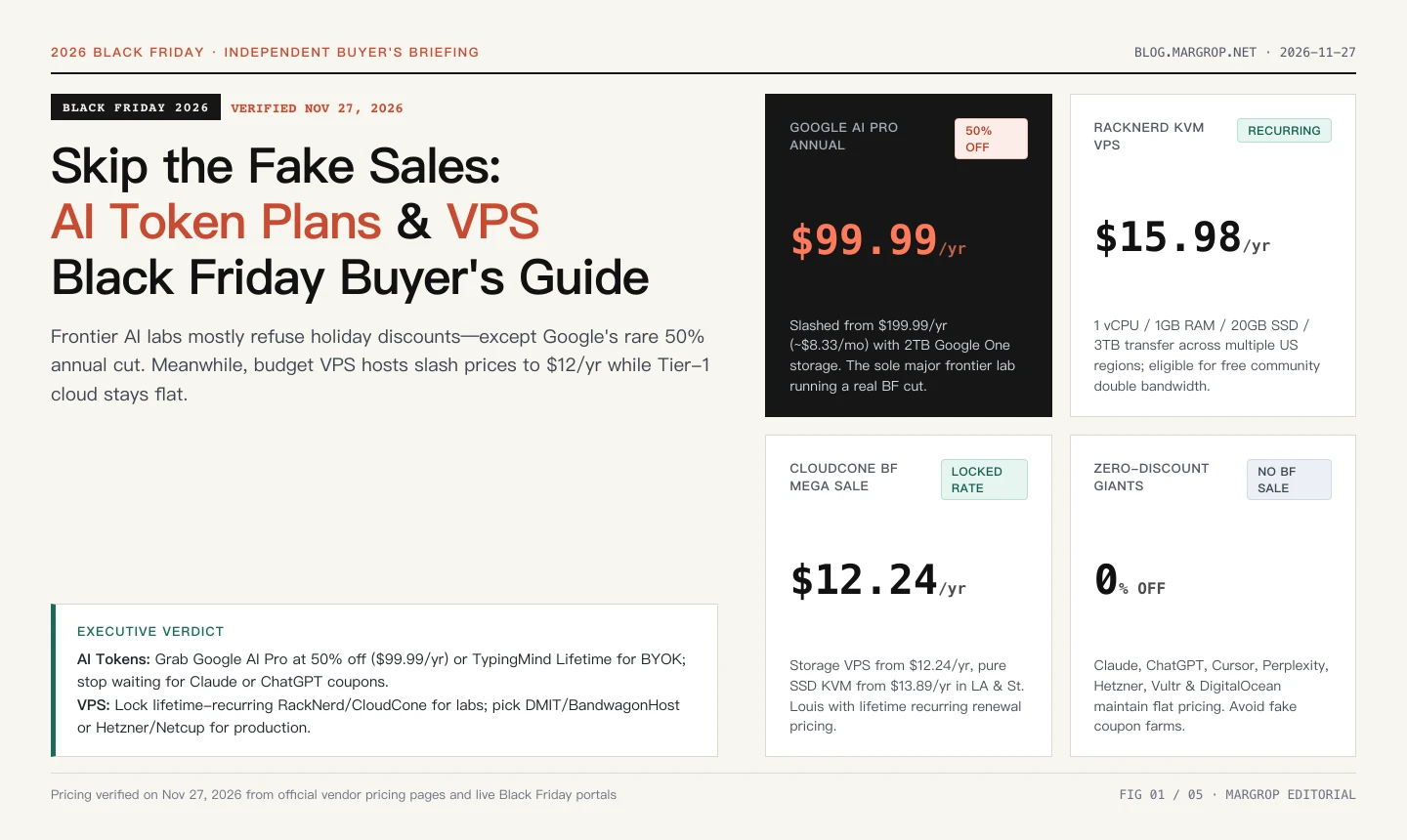
In the AI Token and Subscription market, frontier heavyweights like Anthropic (Claude), OpenAI (ChatGPT), Cursor, and Perplexity have not even bothered putting up a holiday banner—their Black Friday discount stands firmly at 0%. The glaring exception is Google, which slashed its annual Google AI Pro plan in half from $199.99/year down to $99.99/year (50% OFF), complete with 2TB of Google One storage. Meanwhile, in the VPS market, budget KVM specialists like RackNerd ($15.98/yr), CloudCone ($12.24/yr), and Netcup are running full-blown lifetime-recurring blowouts, premium routing hosts like DMIT and BandwagonHost are guarding scarce trans-Pacific transit, and developer cloud staples (Hetzner, Vultr, DigitalOcean) remain completely flat year-round.
This guide skips affiliate fluff and recycled coupon spam. Backed by live screenshots captured directly from official pricing portals today (November 27, 2026), we use everyday analogies simple enough for a fifth-grader to grasp—without sacrificing engineering rigor—to explain AI billing economics, why two Los Angeles VPS servers can differ 10x in price, what is genuinely worth buying today, and the four Black Friday traps that drain wallets every November.
1. The Market Split: Why Black Friday 2026 Is a Tale of Two Extremes
If you are shopping for AI compute or cloud servers during Black Friday for the first time, it is natural to assume that if winter coats go 50% off, your favorite coding assistant or cloud host must have a secret promo code waiting too.
Not in 2026. Checking the live pricing pages across the industry today reveals two completely opposite camps:
- The Flat-Rate Giants (0% Off): Anthropic Claude, OpenAI ChatGPT, Cursor, Perplexity, Hetzner, Vultr, and DigitalOcean. They share one trait: either their GPU clusters are already capacity-constrained, or their everyday pricing already sits razor-close to bare-metal hardware costs.
- The Strategic Discounters (Real Cuts): Google AI Pro (50% off annual), TypingMind Lifetime (60% off), RackNerd, CloudCone, and Netcup. They discount strategically to lock in annual ecosystem loyalty or monetize spare host capacity and standard transit bandwidth upfront.
Most buyers waste money on Black Friday for two simple reasons: first, they confuse paying for frontier intelligence with paying for an idle monthly subscription; second, they look at two “Los Angeles VPS” plans—one at $15/year and one at $170/year—without understanding the underlying network routing, ending up either frustrated by evening packet loss or overpaying for premium Asian transit on a US-only side project.
2. AI Tokens & Subscriptions: Buffet Pass, Grocery Scale, or Peak-Hour Gym Card?
By late 2026, paying for AI is no longer a simple “$20/month or nothing” choice. Developers and power users now navigate three distinct billing models. Think of them like three everyday tickets:
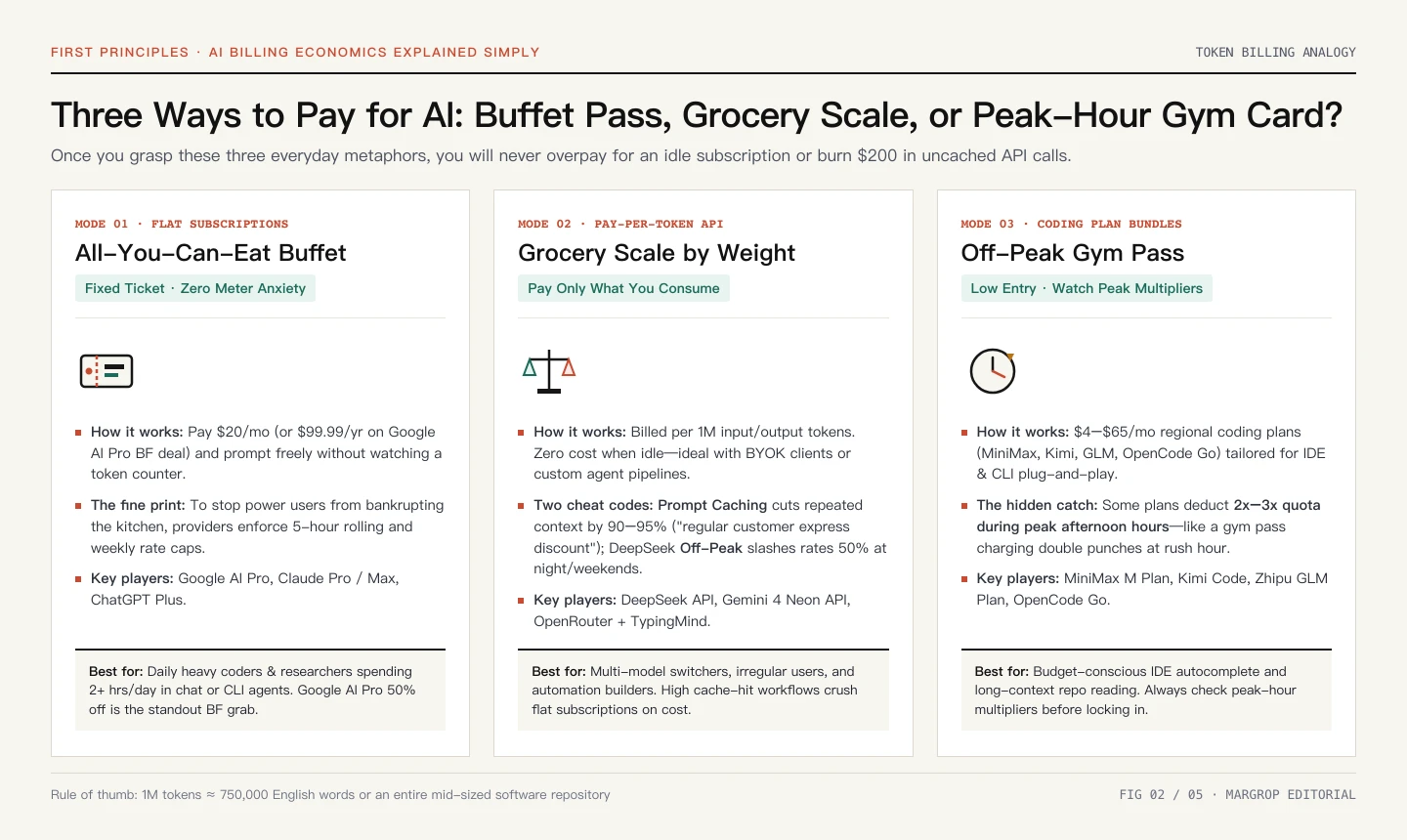
- Flat Subscriptions = An All-You-Can-Eat Buffet Pass: Pay a predictable flat ticket ($20/month, or $99.99/year on Google's Black Friday deal) and prompt without watching a meter. To stop heavy users from bankrupting the kitchen, providers enforce 5-hour rolling windows and weekly caps—just like getting back in line for the most popular ride at a theme park.
- Pay-per-Token API = A Grocery Scale by Weight: You pay strictly per million input/output tokens; when you take a week off, your bill is $0.00. Better yet, 2026 APIs come with two massive cost multipliers in your favor: Prompt Caching (cutting repeated context costs by 90–95%, like a regular-customer express discount) and DeepSeek's Off-Peak Pricing (50% off during UTC night windows plus all weekends and public holidays—like a half-price night market).
- Regional Coding Plans = An Off-Peak Gym Card: Low monthly entry tiers (such as MiniMax M Plan, Kimi Code, Zhipu GLM Coding Plan, or OpenCode Go) designed for plug-and-play IDE and CLI integration. The catch? Several plans apply 2x to 3x quota multipliers during busy afternoon hours—like a gym card punching twice whenever you show up at rush hour.
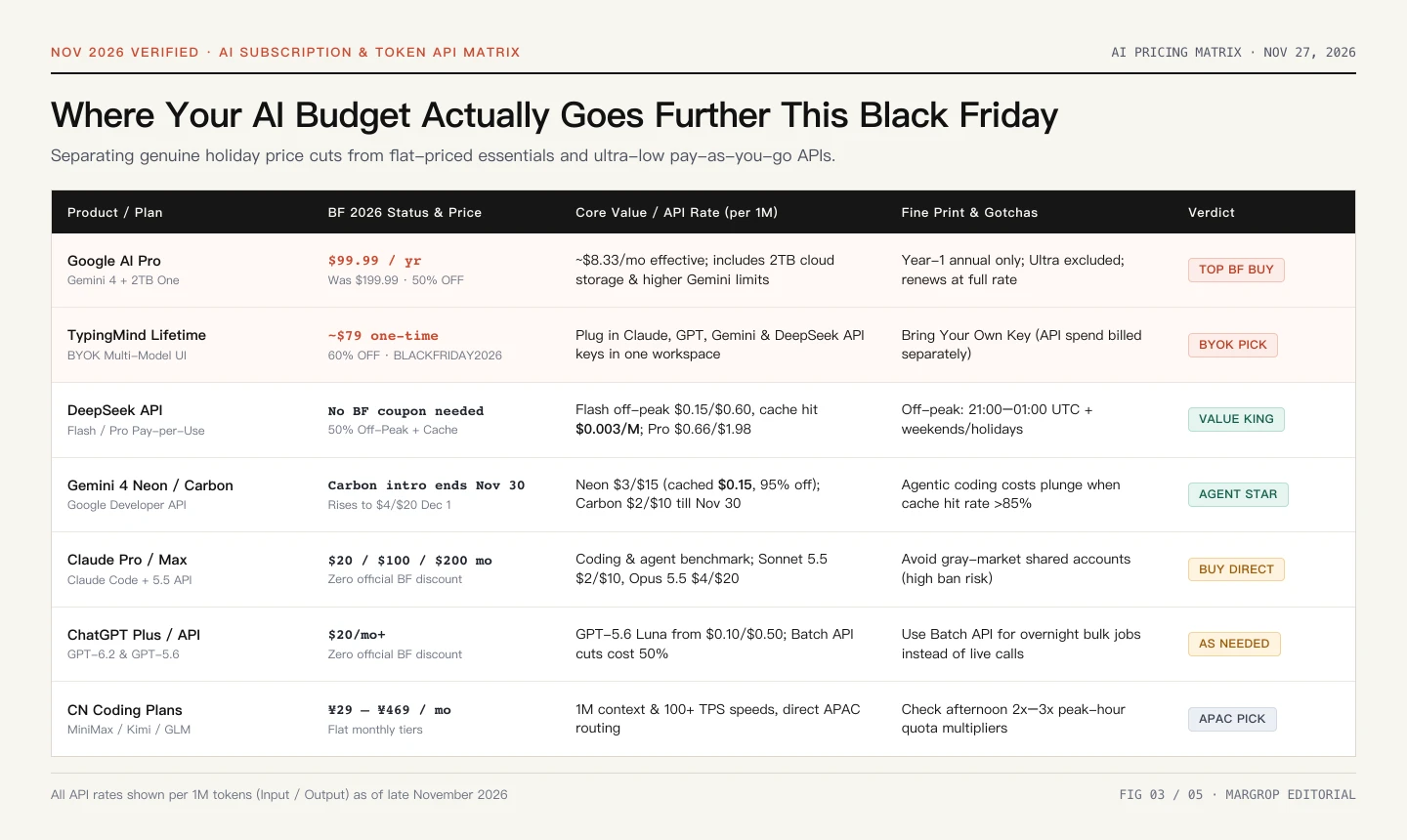
With that mental model locked in, here is how the actual November 27, 2026 AI landscape stacks up:
1. The Standout Frontier Deal: Google AI Pro at 50% Off ($99.99/year)
Google is the sole major frontier AI lab delivering a real Black Friday price cut in 2026. Opening widely on November 27, the annual Google AI Pro plan drops from $199.99/year to $99.99/year—an effective rate of just $8.33/month.
Do the math: Google AI Pro already bundles 2TB of Google One cloud storage (which normally costs $99.99/year on its own). In other words, if you already pay for Google cloud storage or photos backup, you are essentially getting a full year of upgraded Gemini access for free.
Two caveats to note: First, the top-tier Google AI Ultra plan is explicitly excluded from the sale. Second, the 50% discount applies strictly to Year 1 on annual billing—Year 2 renews at the regular $199.99 rate, so set a calendar reminder for November 20, 2027 right after subscribing.
2. Stop Waiting for Discounts: Claude, ChatGPT, and Cursor
Our live checks of Anthropic’s and Cursor’s official pricing portals today confirm zero Black Friday promo codes or markdowns.
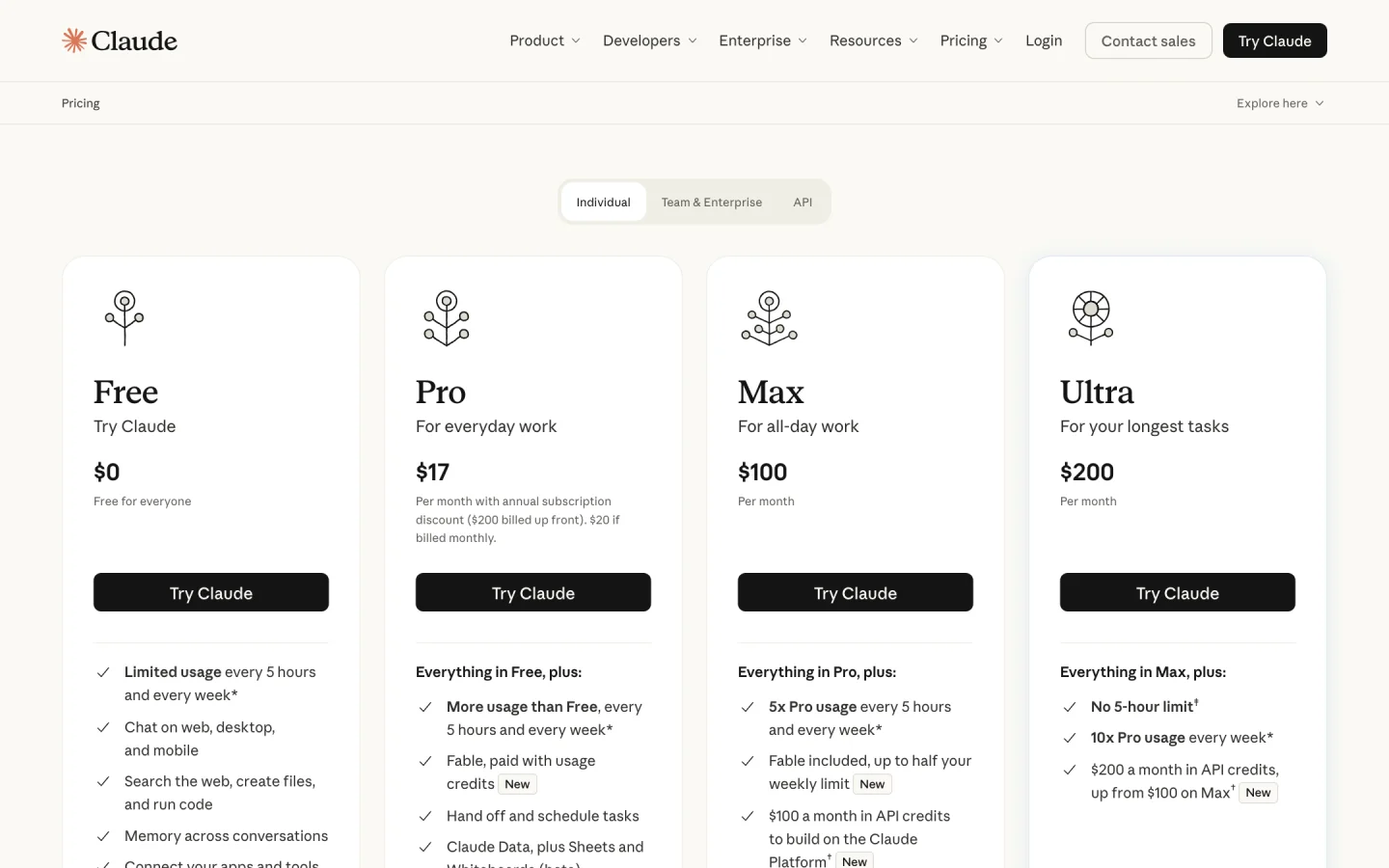
As shown on Anthropic’s live page, Claude’s individual tiers stand at Pro ($17/mo billed annually at $200, or $20/mo monthly), Max ($100/mo with 5x Pro usage, Fable access, and $100/mo in API credits), and Ultra ($200/mo with no 5-hour cap, 10x weekly usage, and $200/mo in API credits). If Claude Code is central to your daily engineering workflow, buy direct—avoid gray-market “discounted shared accounts,” which routinely trigger automated bans and wipe your session history.
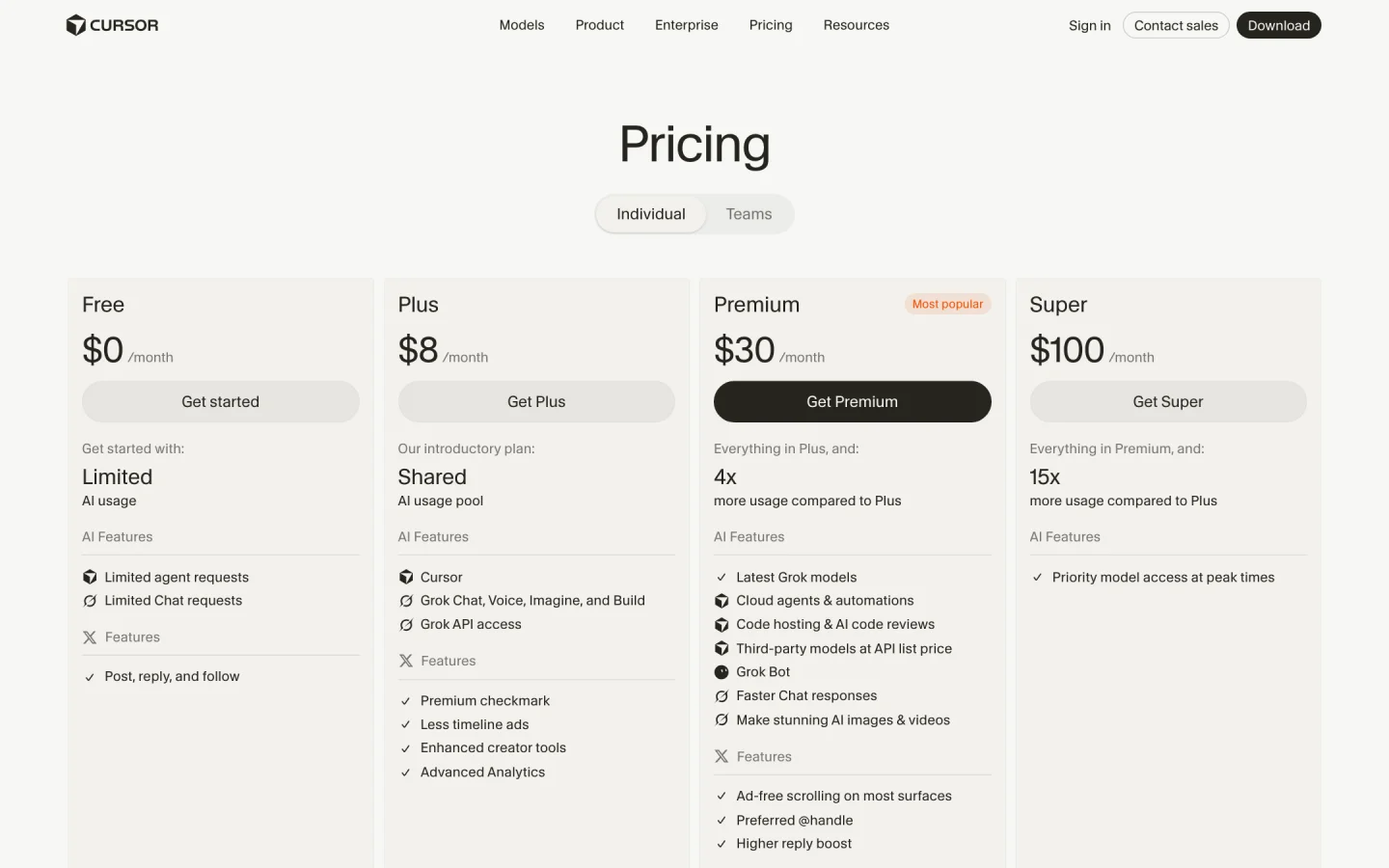
Similarly, Cursor maintains its standard pricing lineup (Free $0, Plus $8/mo, Premium $30/mo with 4x usage and cloud agents, and Super $100/mo with 15x usage and peak priority) with no Black Friday reduction.
3. The Smart Developer’s Black Friday Stack: BYOK + Low-Cost APIs
If you refuse to pay $60–$100/month across three overlapping chatbots, Black Friday 2026 is the ideal moment to assemble a BYOK (Bring Your Own Key) workflow:
- One-Time Multi-Model Workspace (TypingMind): Running a 60% OFF Lifetime Premium promotion with code
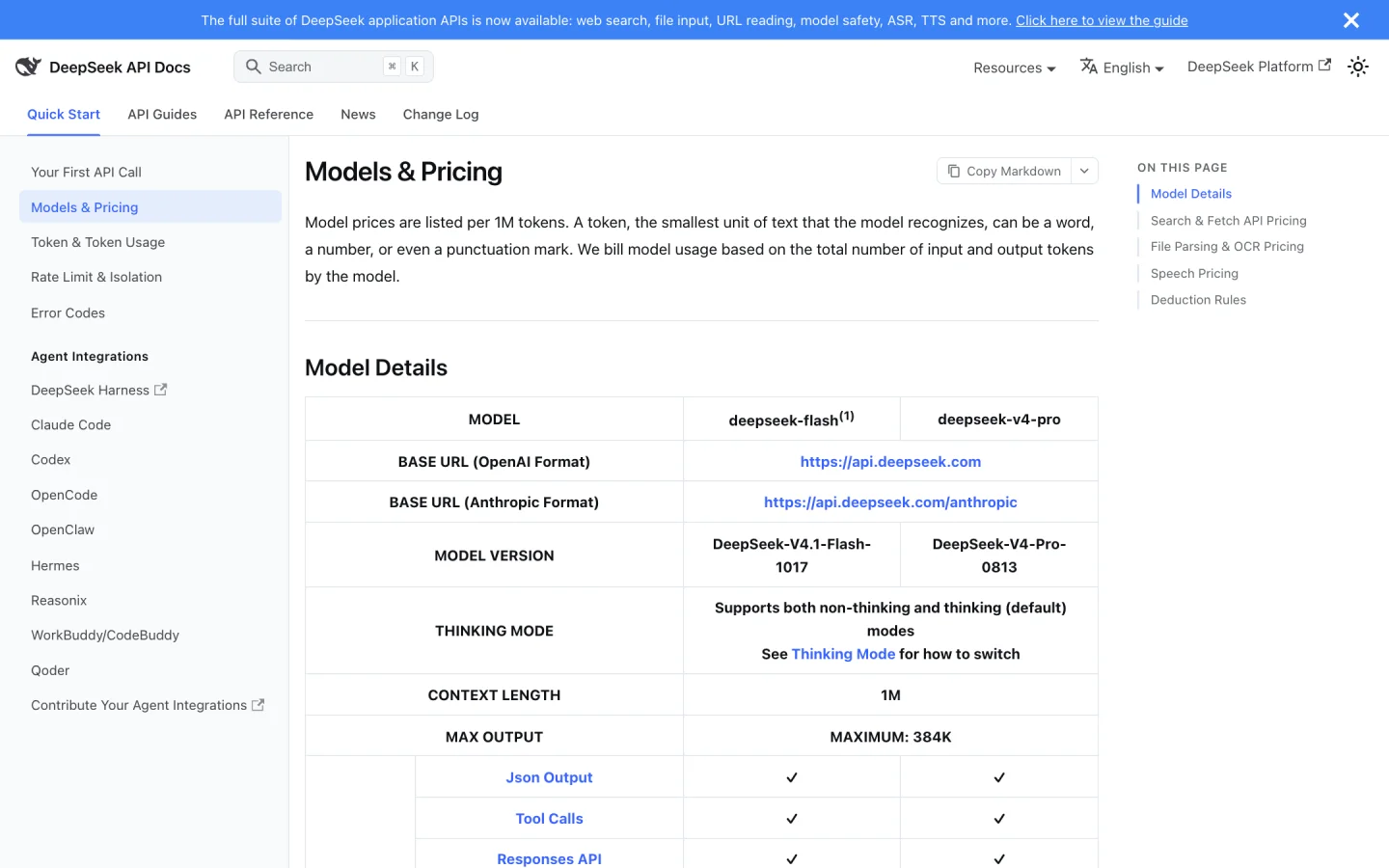
BLACKFRIDAY2026(~$79 one-time). Plug in your own API keys for Claude, OpenAI, Gemini, and DeepSeek into a single interface with prompt libraries and plugins—zero recurring UI fee. - Everyday Value Engine (DeepSeek API): As captured live from DeepSeek's API documentation today, DeepSeek-V4.1-Flash and DeepSeek-V4-Pro both ship with a 1M context window, 384K max output, and native dual endpoints (OpenAI and Anthropic formats, plugging straight into Claude Code, Codex, and OpenCode). Combine 50% off-peak rates (21:00–01:00 UTC plus weekends) with cache hits down to $0.003/M tokens, and everyday automation costs pennies.
- Frontier Agentic Value (Gemini 4 Neon & Carbon): Google's newly launched Gemini 4 Neon ($3/$15 per 1M tokens, with a massive 95% cache read discount down to $0.15/M) is a powerhouse for long-running coding agents. Also note a hard deadline right around the corner: Gemini 4 Carbon's introductory $2/$10 rate expires on November 30, 2026, rising to $4/$20 on December 1—so finish any heavy batch document or codebase migrations over the next three days.
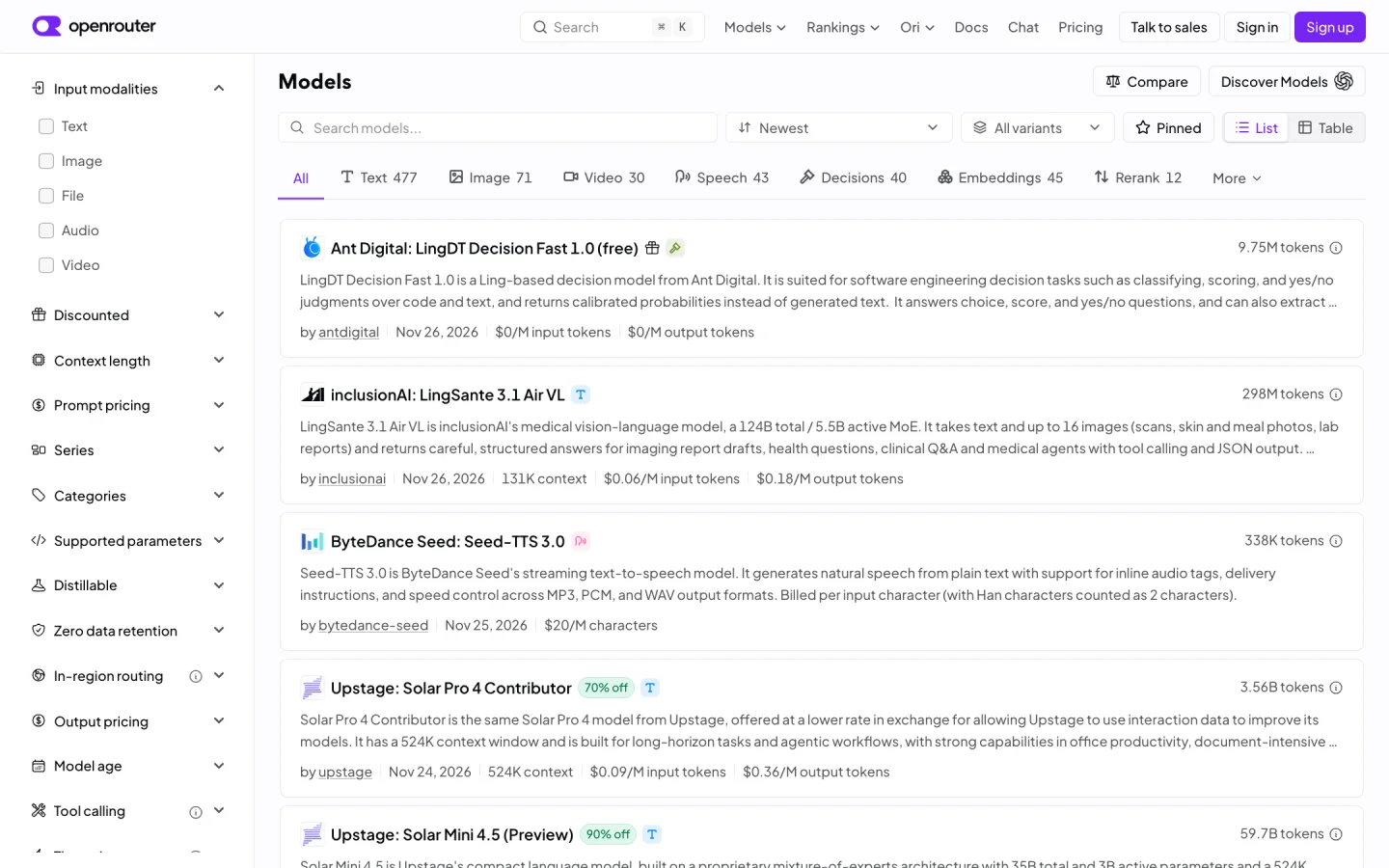
- Aggregator & Discount Radar (OpenRouter): While OpenRouter has no sitewide Black Friday coupon, its live model directory constantly surfaces subsidized and free tiers—today's live capture shows freshly listed models running 70%–90% off contributor pricing alongside zero-cost decision models ideal for routing and classification.
3. VPS Market Deep Dive: Why Two Los Angeles Servers Cost $15/yr vs $170/yr
Now let us switch to the other classic Black Friday arena: VPS hosting.
Self-hosting newcomers constantly ask: “Why does a 1 vCPU / 1GB RAM Los Angeles VPS cost $15.98/year at RackNerd, while a similar spec in the exact same city costs $80 to $170+/year at DMIT or BandwagonHost? Are the CPUs made of gold?”
No. Use a highway analogy and the mystery vanishes in five seconds: CPU and RAM determine how fast your car is; network routing determines which trans-oceanic road you are allowed to drive on.
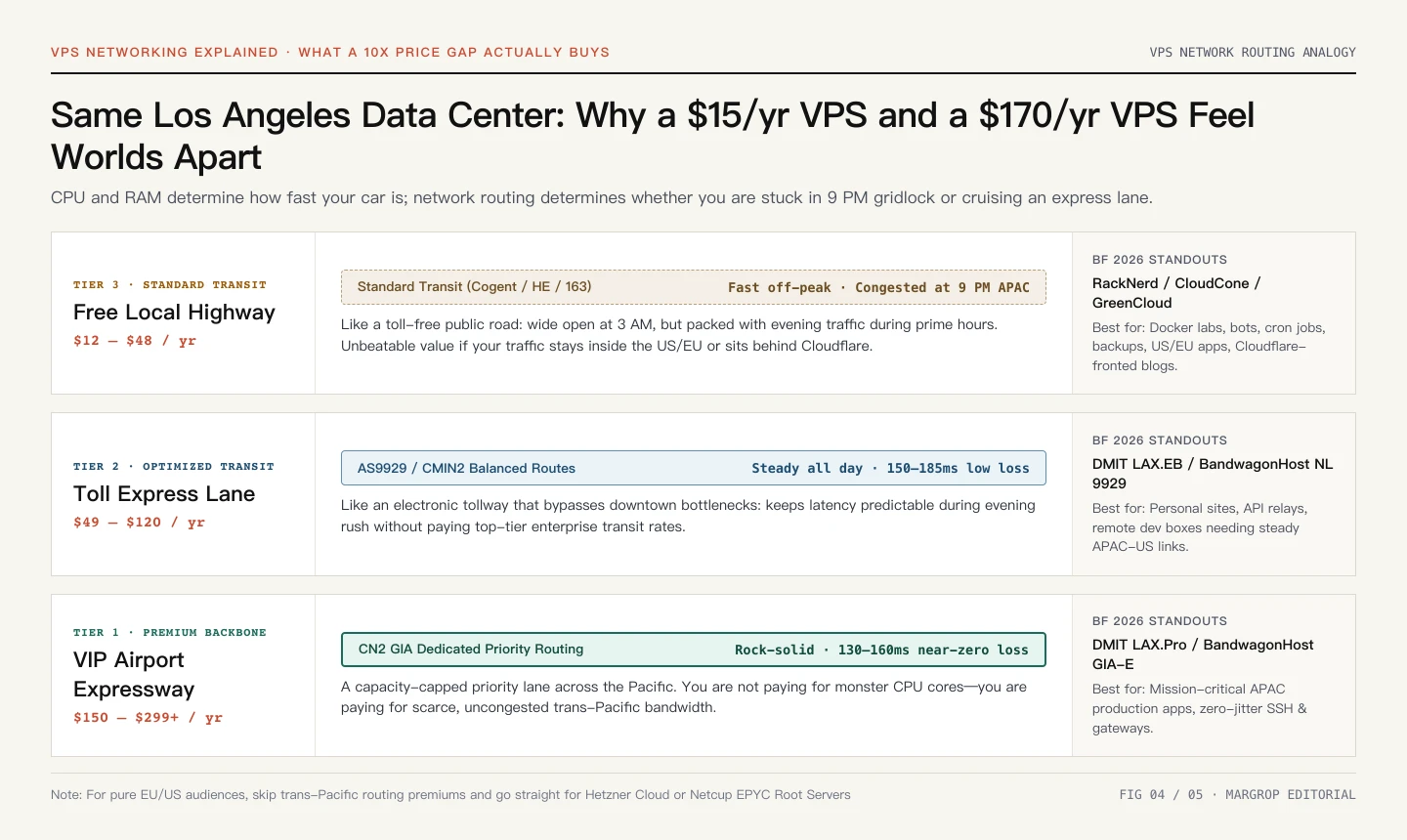
- Standard Public Transit (Cogent / HE / 163) = A Toll-Free Local Highway: Wide open at 3 AM and unbeatable for local US/EU traffic or Cloudflare-fronted apps. During 9 PM APAC peak hours, however, everyone piles onto the same free road, pushing latency past 250ms with packet loss.
- Optimized Transit (AS9929 / CMIN2) = An Electronic Toll Express Lane: Bypasses the worst downtown bottlenecks, keeping evening latency steady around 150–185ms at a mid-tier price.
- Premium Backbone (CN2 GIA) = A Capacity-Capped VIP Airport Expressway: Providers pay steep recurring fees for priority trans-Pacific bandwidth. Even during peak congestion, latency stays locked at 130–160ms with near-zero loss. Roughly 90% of the price premium buys that uncongested lane.
With that lens, Black Friday 2026 VPS deals fall cleanly into three actionable tiers:
Tier 1: Lifetime-Recurring Budget Kings (RackNerd & CloudCone)
For Docker homelabs, monitoring probes, Discord/Telegram bots, staging environments, or blogs fronted by Cloudflare, RackNerd and CloudCone remain the safest low-end bets:
- RackNerd Black Friday 2026: Entry KVM VPS starts at $15.98/year (1 vCPU, 1GB RAM, 20GB SSD, 3TB transfer, 1Gbps port); mid-tier hits $27.98/year (2 vCPU, 2.5GB RAM, 30GB SSD, 6TB transfer); the popular power tier sits at $47.98/year (4 vCPU, 4GB RAM, 60GB SSD, 10TB transfer). All lock in lifetime recurring rates across multiple US datacenters and qualify for free double bandwidth by posting your order invoice on LowEndTalk.
- CloudCone Black Friday Mega Sale: Hosted in Los Angeles and St. Louis with lifetime recurring pricing. SSD-cached Storage VPS starts at $12.24/year (1 vCPU, 1GB RAM, 55GB storage, 4TB transfer), pure SSD KVM starts at $13.89–$14.48/year, and SC2 cloud instances with automated backups, snapshots, and managed firewall start at $29.82/year.
Tier 2: Premium APAC & Trans-Pacific Routing (DMIT & BandwagonHost)
When your users sit across Asia-Pacific or you require jitter-free SSH and production uptime without CDN workarounds, look here:
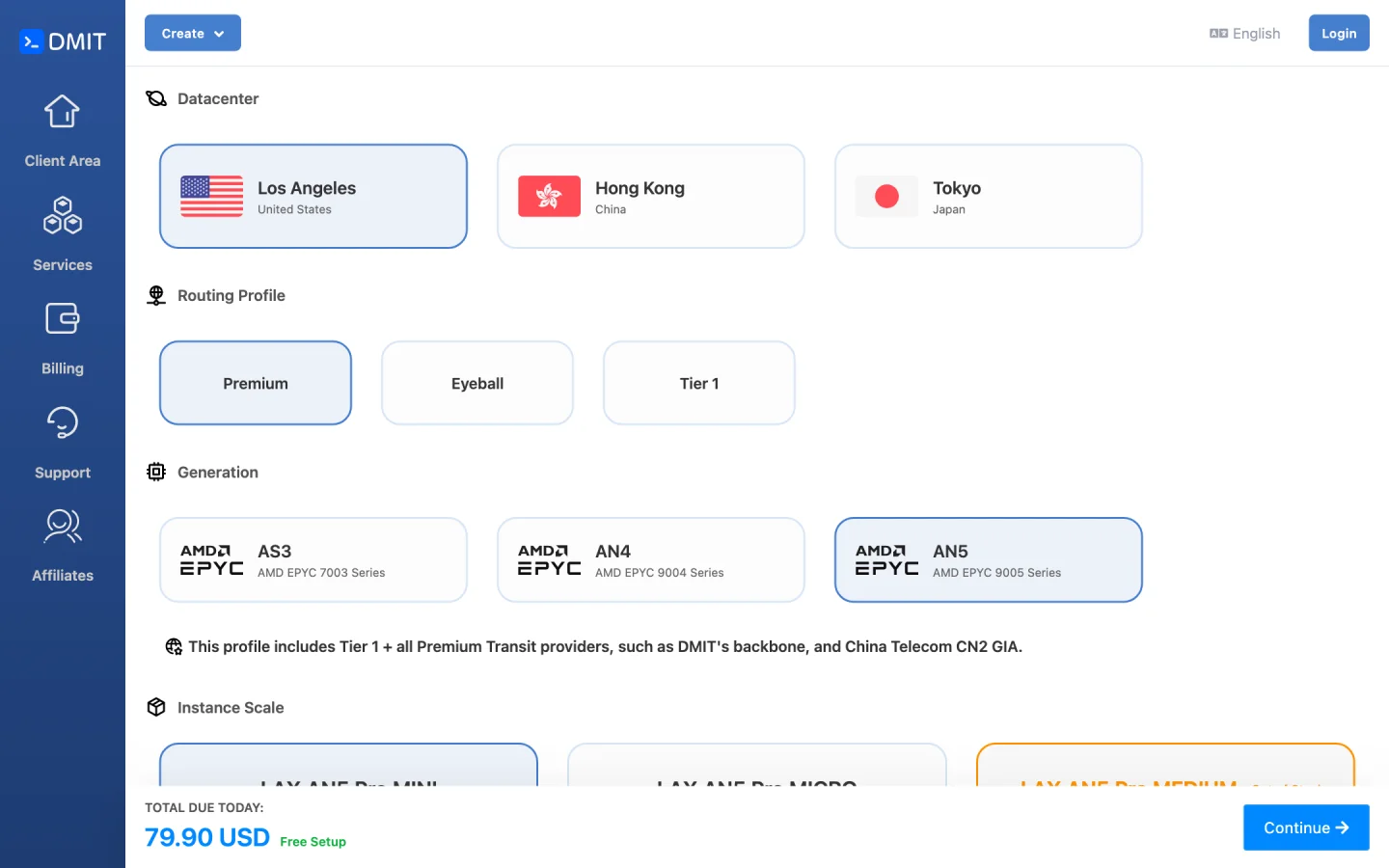
- DMIT: As captured from DMIT's live configurator today, their Los Angeles lineup now runs on latest-generation AMD EPYC 9005 (AN5) silicon, neatly split into Premium (CN2 GIA), Eyeball (AS9929/CMIN2 balanced), and Tier 1 profiles. Watch for Black Friday Pro-series account credit rebates or non-monthly recurring promos on LAX.EB.
- BandwagonHost (IT7): Famous for rock-solid CN2 GIA-E, Tokyo SoftBank, and Netherlands 9929 lines. BandwagonHost rarely runs deep sitewide Black Friday slashes—expect standard ~6.77% recurring coupons (e.g.,
NODESEEK2026) stacked onto annual billing savings (~15–17%), while keeping an eye out for sudden Limited Edition restocks between Black Friday and Cyber Monday.
Tier 3: Raw Compute & EU/US Workhorses (Netcup, Hetzner, Vultr, DigitalOcean)
If your traffic is local to Europe or North America, never pay extra for trans-Pacific routing:
- Netcup Black Friday / Cyber Week: Germany's perennial Black Friday favorite rolls out zero-setup-fee AMD EPYC Root Servers and VPS packages with doubled NVMe storage or boosted DDR5 ECC RAM at permanent recurring rates (just remember their 31-day cancellation notice policy).
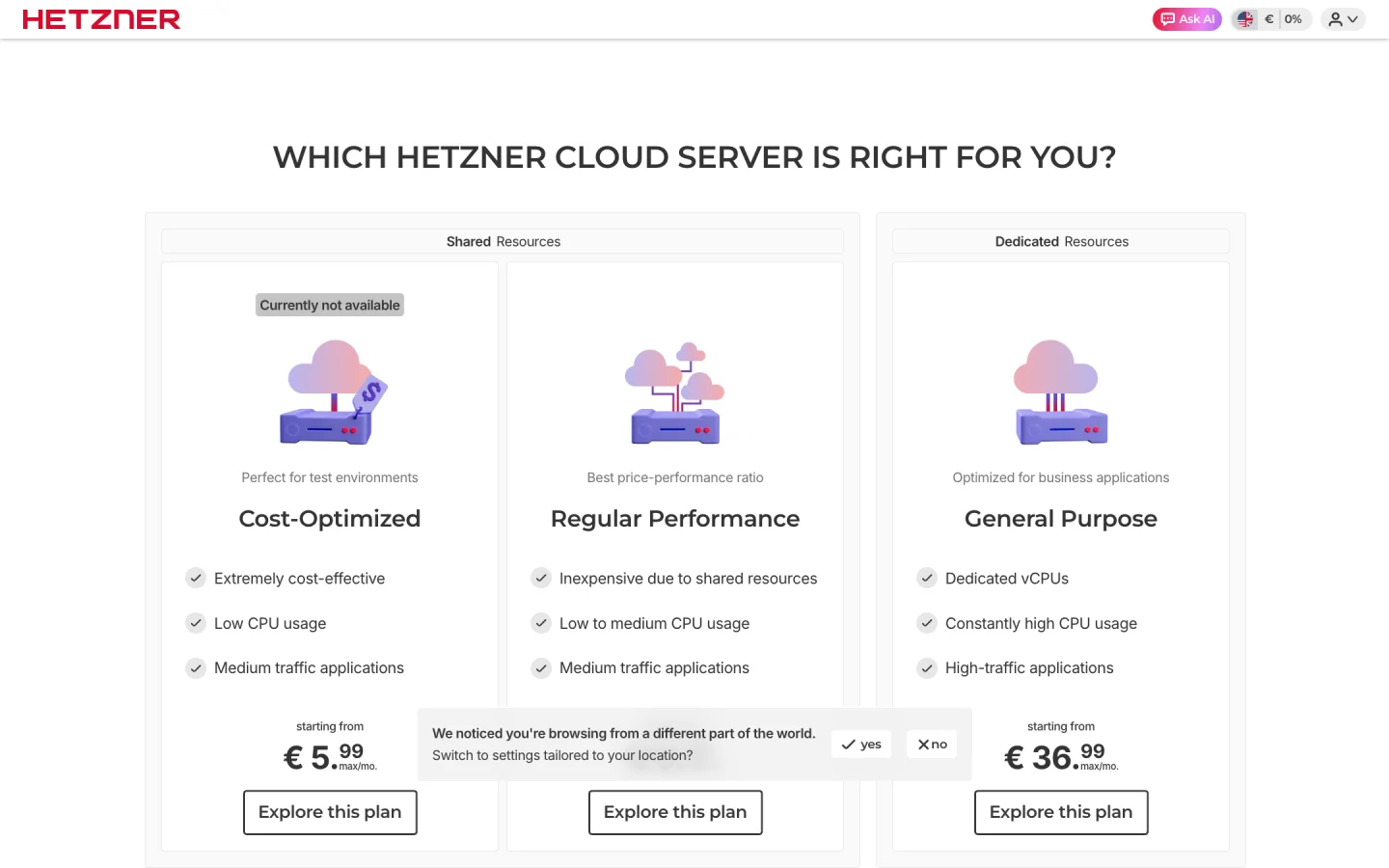
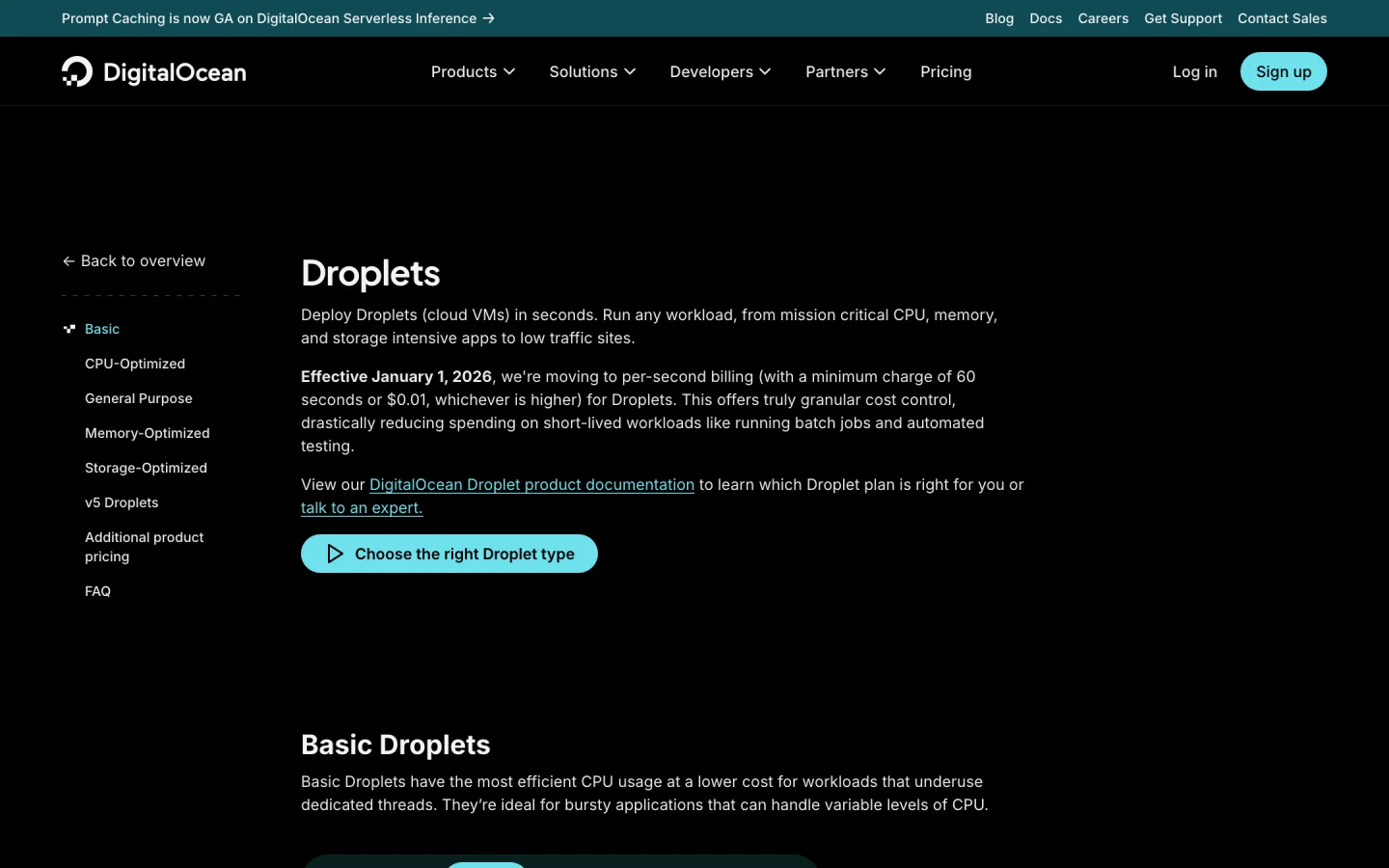
- Hetzner, Vultr, and DigitalOcean (Flat Pricing Year-Round): Our live captures of Hetzner Cloud and DigitalOcean today confirm zero Black Friday discounts. Hetzner's everyday pricing (Shared from €5.99/mo, Dedicated General Purpose from €36.99/mo) already crushes most holiday "sales," while DigitalOcean's move to per-second billing (60-second or $0.01 minimum) makes it ideal for bursty CI/CD and short-lived batch jobs.
4. Root Cause: Why Do Frontier Labs Refuse Discounts While Budget Hosts Go Wild?
The underlying economics are straightforward:
- AI inference has real marginal GPU cost. Unlike traditional desktop software that costs $0 to copy, every prompt burns real electricity and scarce HBM memory bandwidth. When OpenAI and Anthropic are already rationing peak capacity, slashing prices would simply amplify compute losses. Google is the unique outlier because its vertically integrated TPU fleet lowers unit cost and bundling 2TB Google One locks users into the broader Google ecosystem for years.
- Budget VPS thrives on statistical multiplexing. Packing 200 light-duty homelab containers onto a dense enterprise node works brilliantly when average CPU usage hovers under 2% (enforced by strict fair-use CPU policies). What cannot be multiplexed cheaply is priority subsea cable capacity—which is why a $15/year standard-transit VPS is sustainable, while a $15/year CN2 GIA box is mathematically impossible.
5. Buyer’s Playbook: 4 Winning Combos & 4 Black Friday Traps to Dodge
Match your actual workload to one of the four profiles below, and run every checkout cart through the four red-flag checks at the bottom:
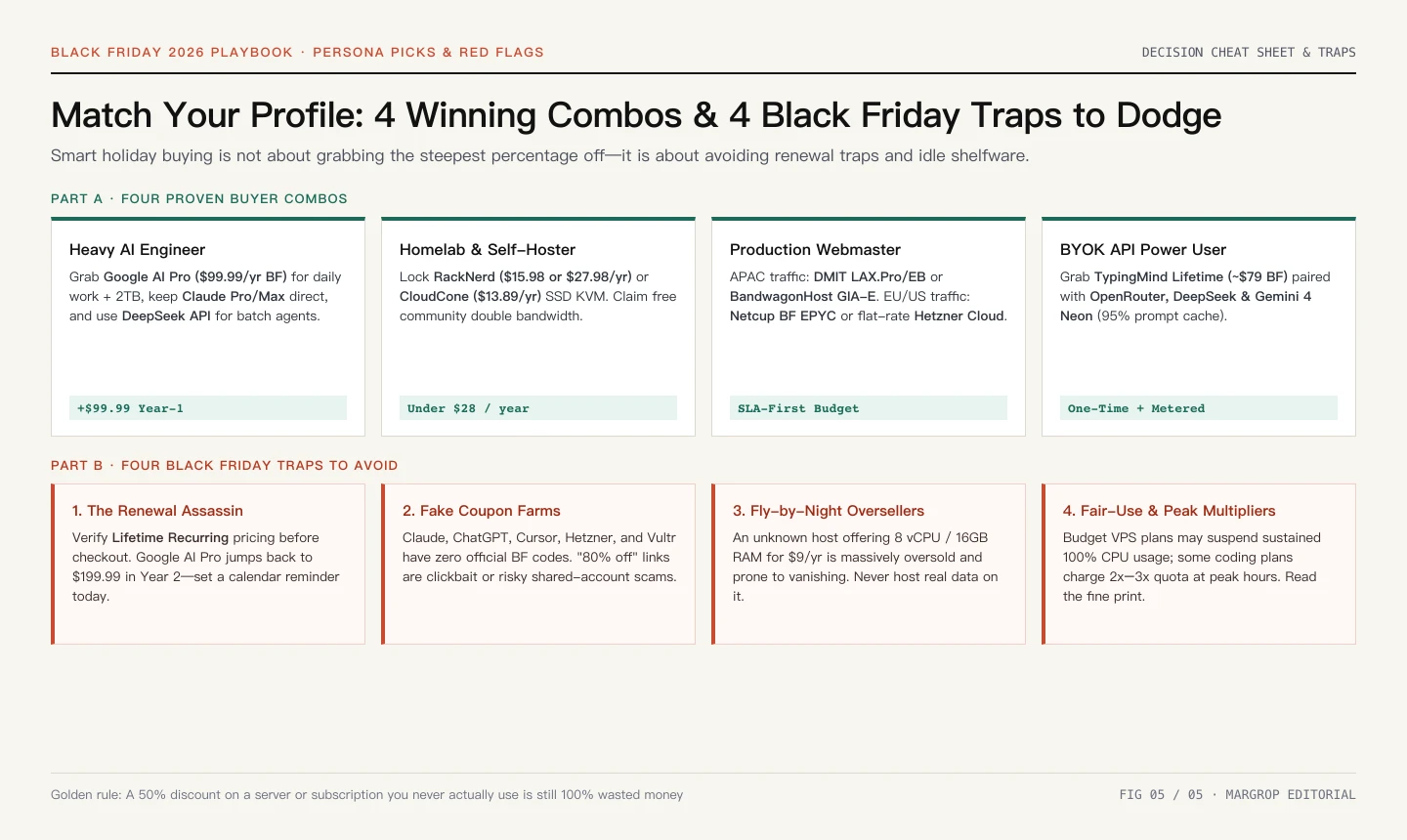
- Trap 1 — The Renewal Assassin: Always confirm
Lifetime Recurringon VPS checkouts. For Year-1-only promos like Google AI Pro ($99.99 → $199.99), set a cancellation/review reminder the exact minute you pay. - Trap 2 — Fake Coupon Farms: Because Claude, ChatGPT, Cursor, Hetzner, and Vultr have zero official Black Friday codes, any site promising "80% off Claude Max" is either clickbait ad-farming or hawking high-risk stolen/shared accounts.
- Trap 3 — Fly-by-Night Oversellers: An unknown 3-month-old host offering 8 vCPU / 16GB RAM for $9/year will suffer massive CPU steal and often vanishes before spring. Never place unbacked production data there.
- Trap 4 — Hidden Fair-Use & Peak Multipliers: Read the CPU fair-use clause on budget VPS plans (sustained 100% load can trigger auto-suspension) and verify peak-hour quota multipliers on regional AI coding plans.
6. Quick Q&A: 6 Common Black Friday 2026 Questions
Q1: Can existing Google One subscribers claim the 50% off Google AI Pro deal?
A: Check your Google One plan management dashboard and toggle to annual billing. Google rolled out early access to existing paid members before opening broadly on November 27; eligibility varies slightly by region and current billing cycle.
Q2: I only ask AI a few questions a week—should I grab a Black Friday subscription anyway?
A: Skip subscriptions completely. Load $5–$10 onto DeepSeek API or OpenRouter and pair it with an open-source client (or the discounted TypingMind Lifetime license). Light users stretch $10 across six months effortlessly.
Q3: RackNerd vs. CloudCone—which budget VPS should a beginner pick?
A: Both have solid multi-year track records on LowEndTalk and lock lifetime renewal rates. Pick RackNerd ($15.98 or $27.98/yr) for wider US datacenter selection and free double bandwidth via community invoice posts; pick CloudCone ($12.24 storage or $29.82 SC2) if you want built-in snapshots, automated backups, and managed firewall controls.
Q4: My $15/yr VPS feels sluggish to APAC visitors in the evening—how do I fix it for free?
A: Put your domain behind Cloudflare’s free CDN and aggressively cache static assets (or deploy a static site generator like Hugo to edge nodes). Offloading static reads to the edge hides standard-transit evening congestion completely.
Q5: Should I pre-fund Gemini 4 Carbon API credits before its December 1 price increase?
A: API billing charges the live rate at request execution time, not when you top up. Instead, run any queued bulk analysis or codebase migration jobs before November 30 while Carbon is still $2/$10—then switch daily agent workloads to Gemini 4 Neon ($3/$15, $0.15 cached) or DeepSeek-V4 afterward.
Q6: What if a VPS deal sells out before I see this?
A: Do not panic-buy inferior hardware. Most VPS promotions restock or rotate fresh batches all the way through Cyber Monday (November 30). Above all, remember the golden rule of holiday tech shopping: a 50% discount on a server or subscription you never actually use is still 100% wasted money.