One Missing operator.write Took Down the Gateway: The OpenClaw Fallback Failure That Wasn't a Model Problem
This incident looked like a model-provider outage at first. OpenClaw had just received three NewAPI-backed fallback models, but gateway-based model calls started failing with a provider authentication error. After peeling back the outer message, the real error was much more specific:
missing scope: operator.write
That string changed the direction of the investigation. The provider key was not the root problem. The NewAPI endpoint was not the root problem. The model names were not the root problem either. The failure lived inside OpenClaw’s gateway authorization path: when a model override was used, the gateway call switched into a backend/gateway-client mode, but did not force the request to use the already paired stored device identity. The device had operator.write; the request simply did not carry the identity that could prove it.
The shortest version is this: the badge existed, but this entrance did not scan it.
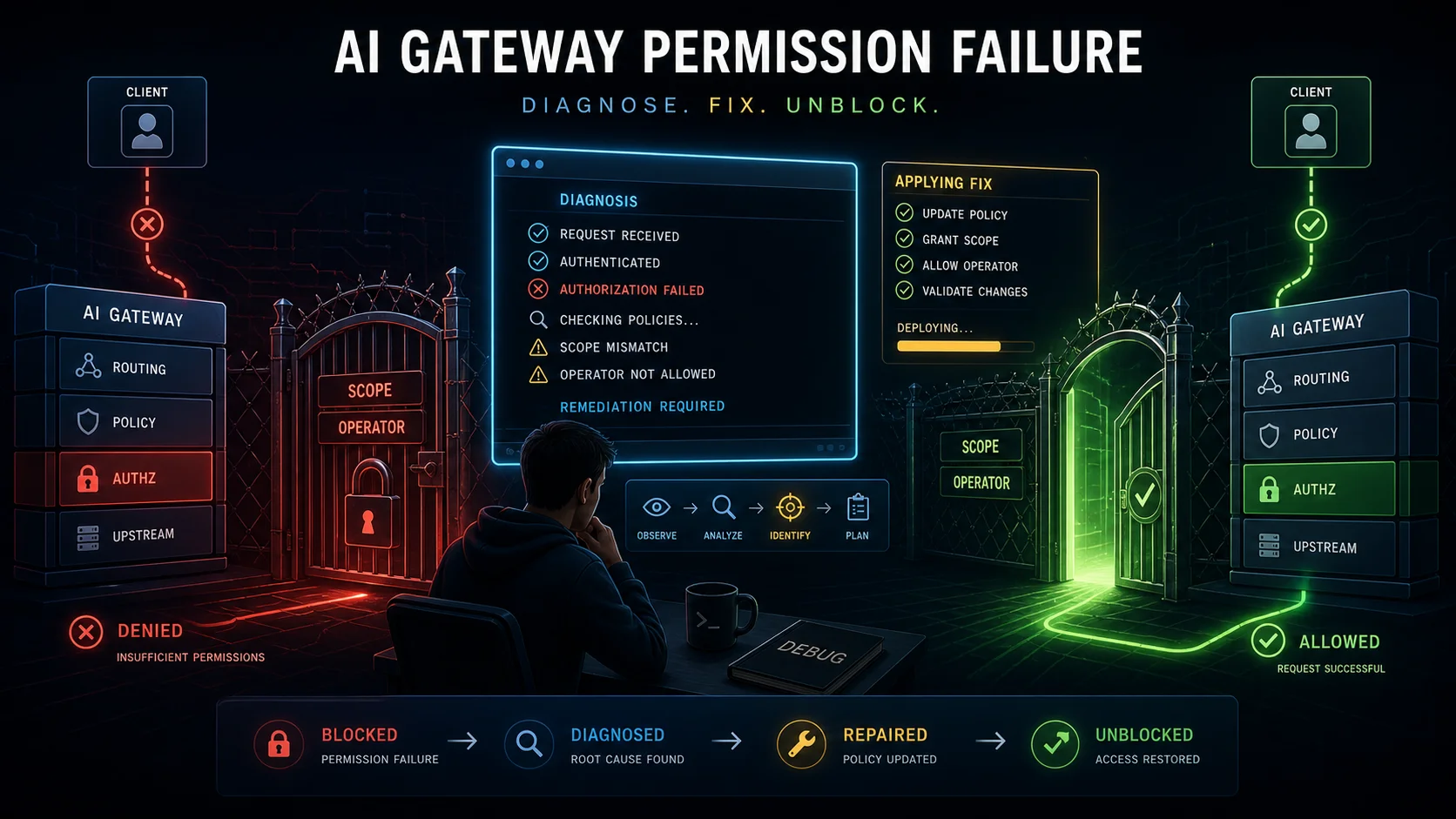
1. The Background: It Was “Just” a Fallback Model Change
The original task was routine: add several NewAPI-backed fallback models so that OpenClaw and adjacent agents would not stop responding when the primary model became unavailable. The local model path worked. The provider configuration looked valid. A direct NewAPI model call returned normally.
Then the gateway path failed.
The first visible message was Provider authentication failed, which naturally points people toward API keys, base URLs, model aliases, and upstream provider availability. But the deeper gateway error was missing scope: operator.write, and that meant the request had crossed from provider authentication into local authorization.
The screenshot below is sanitized. It keeps the important command shape and error text, but removes private addresses, host names, device identifiers, and secrets.
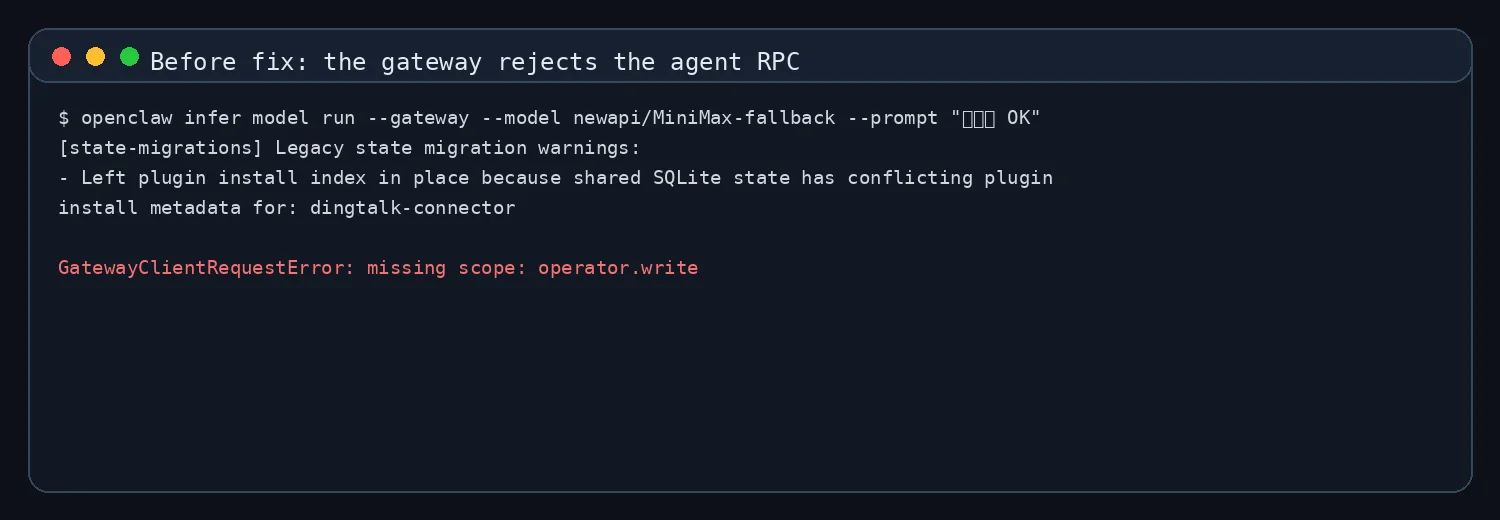
This kind of error is easy to misread because both layers are present. The outer wrapper says provider authentication. The inner failure says local operator scope. If you only follow the first message, you rotate keys. If you only follow the second message, you may re-pair devices unnecessarily. The useful move is to compare call paths.
2. First, Prove It Is Not a Provider Problem
Before changing code, I split the investigation into three checks:
- Call the NewAPI-backed model directly and confirm the provider accepts the key and model name.
- Call the same model through OpenClaw’s local path.
- Call the same model through OpenClaw’s gateway path.
Only the third path failed. That narrowed the fault from “provider authentication” to “authorization context in the gateway path.”
The difference matters. If both local and gateway calls fail, the provider configuration is still suspect. If local succeeds while gateway fails with operator.write, the provider is probably fine and the gateway request is not carrying the right OpenClaw identity.
An everyday analogy helps: imagine you are allowed into an office building and you own the correct employee badge, but one side entrance lets you in with a temporary visitor slip and never scans your badge. When you reach a restricted room, the door says you do not have access. You do have access in the company database; you just did not bring the proof through that route.
3. What Is a Scope, and Why Can It Block a Model Call?
scope is not an OpenClaw-only idea. OAuth 2.0 uses scopes to describe the access range requested by a client and granted by an authorization server. The relevant standard text is RFC 6749 section 3.3: https://www.rfc-editor.org/rfc/rfc6749#section-3.3. Bearer token usage also defines an insufficient-scope style failure, documented in RFC 6750 section 3.1: https://www.rfc-editor.org/rfc/rfc6750#section-3.1.
In this incident, operator.write represented an OpenClaw operator-level write permission. A model gateway call may look like “send a prompt and receive text”, but internally it can travel through an agent RPC path that performs an operation. That path requires more than read access.
The authorization design is reasonable. The OWASP Authorization Cheat Sheet recommends least privilege and deny-by-default thinking: https://cheatsheetseries.owasp.org/cheatsheets/Authorization_Cheat_Sheet.html. The bug was not that OpenClaw was too strict. The bug was that a valid device identity was not used by one special gateway branch.
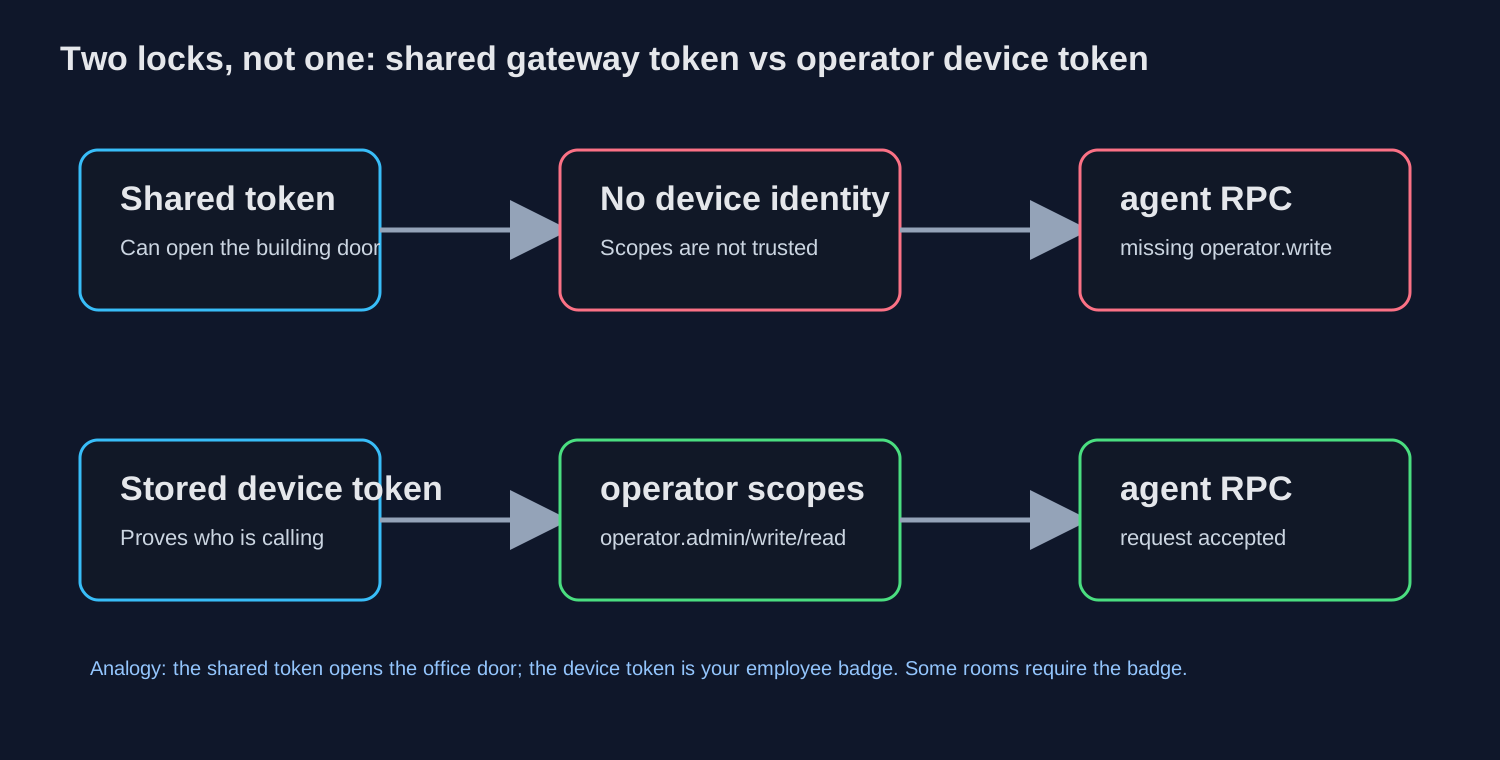
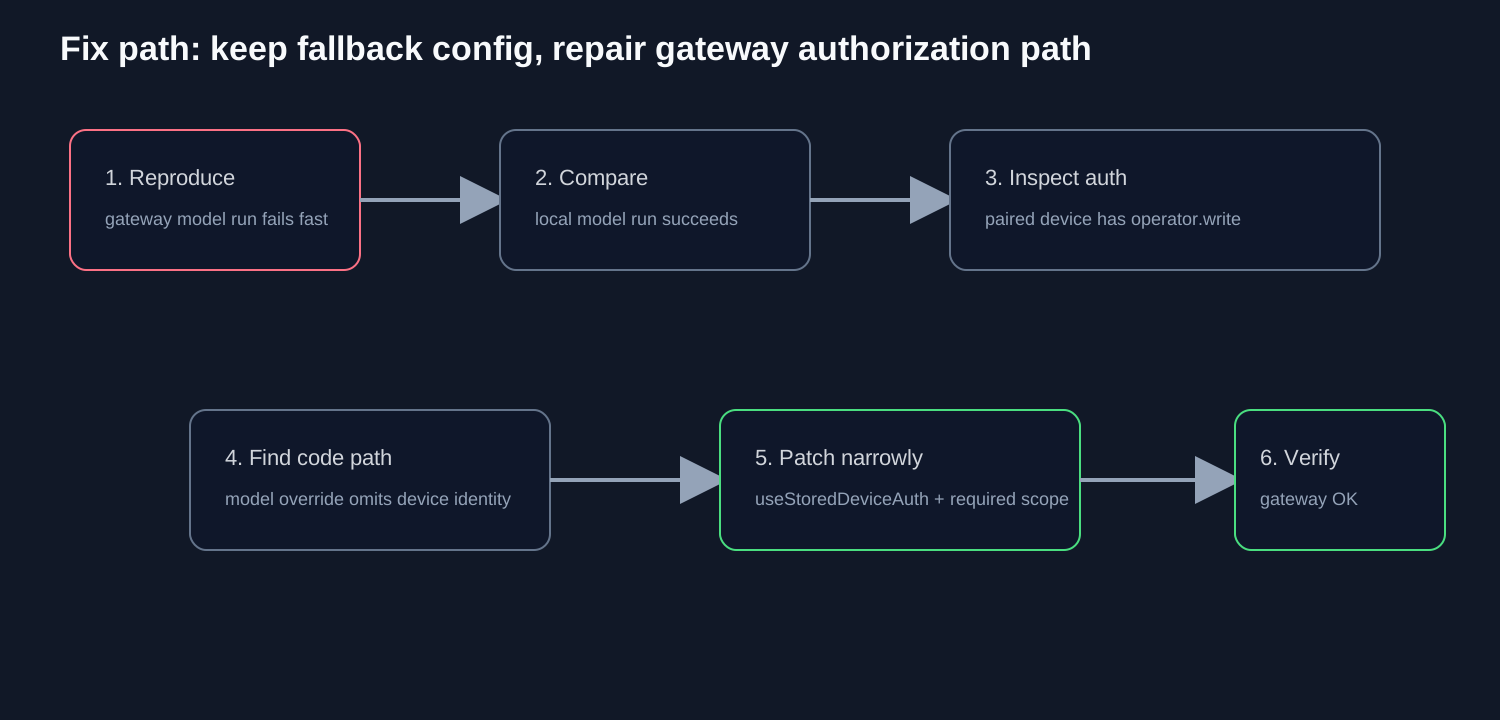
The diagram is intentionally simple:
- The provider lock is NewAPI’s base URL, key, and model identifier.
- The OpenClaw lock is the operator scope carried by the local authenticated identity.
The outer error made it tempting to keep turning the first key. The locked door was actually the second one.
4. The Strange Part: The Device Already Had operator.write
The next step was to inspect paired devices. If the operator device lacked operator.write, the fix would be re-authorization or re-pairing. But the paired operator device already had a complete set of scopes, including:
operator.readoperator.writeoperator.adminoperator.approvalsoperator.pairingoperator.talk.secrets
That changed the investigation. The device was authorized. The request was not using that authorized device identity.
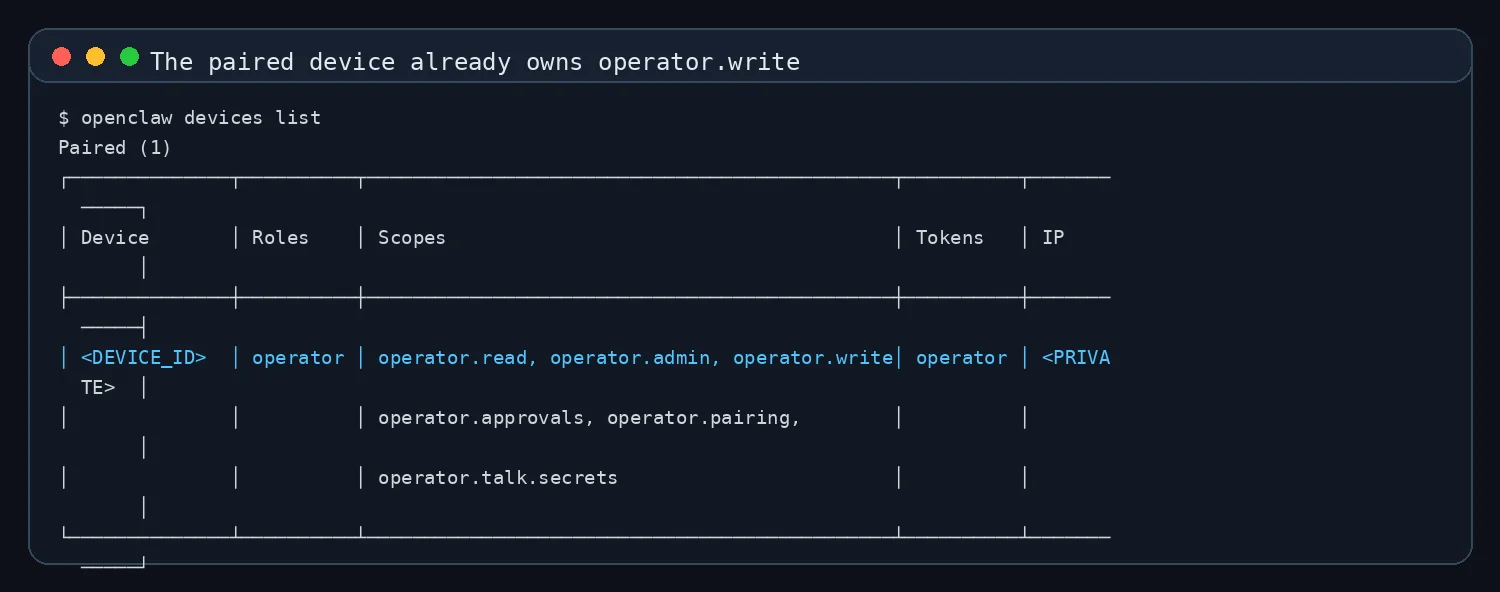
This is the part that often wastes the most time. A missing-scope error does not always mean the database lacks the scope. It can also mean the active request did not bind to the entity that owns the scope.
Tracing the gateway code showed a helper that decides whether a gateway call should omit device identity. The intent is understandable: certain loopback backend calls authenticated by a shared token or password may not need a full device identity. But the model override path was being classified in a way that triggered the identity omission while still needing operator authorization later.
In practical terms, when a command explicitly selected a model such as newapi/glm-latest, the CLI followed a model override branch. That branch called the gateway as a gateway client in backend mode and requested admin scope, but it did not explicitly say: use stored device authentication for this call. The server then treated the request as unbound, cleared unbound scopes, and the later agent RPC reached the authorization check without operator.write.
5. Root Cause: Stored Device Auth Was Not Required in the Override Path
The root cause can be summarized in one sentence:
The model override gateway branch asked for admin scope, but did not require stored device authentication, so the request lost the operator identity needed by the downstream agent RPC.
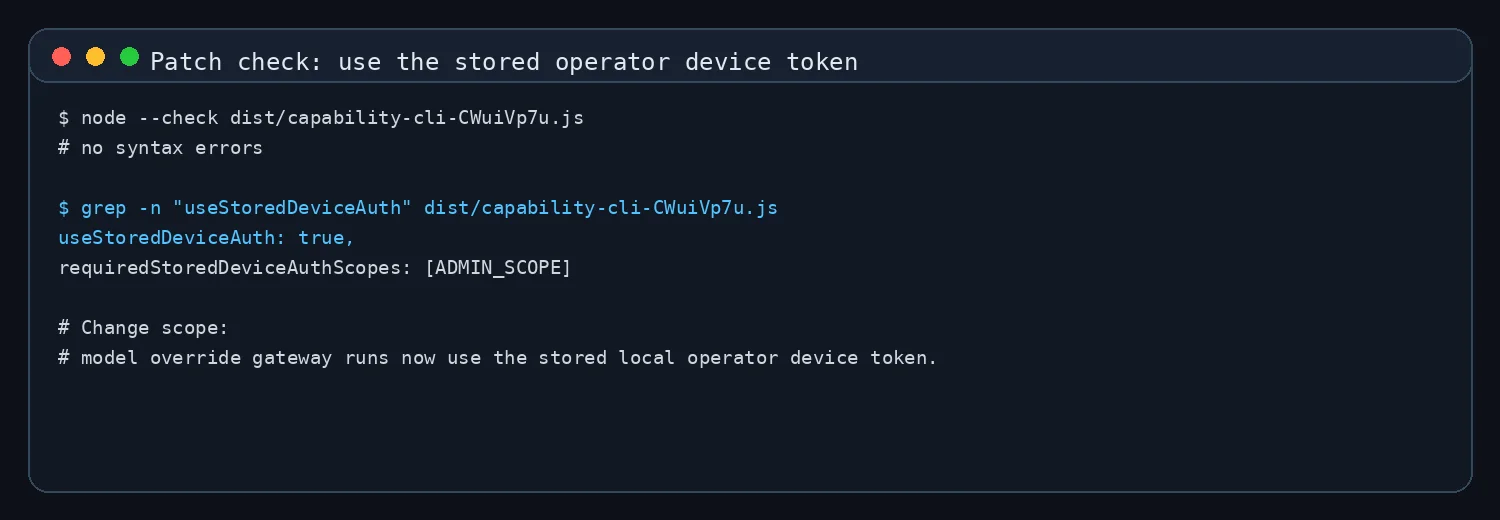
The actual patch was small. The branch kept the existing admin scope and added two flags telling the call to use stored device auth and require admin-capable stored device auth.
The shape of the change is:
 ...hasModelOverride ? {
-    scopes: [ADMIN_SCOPE]
+    scopes: [ADMIN_SCOPE],
+    useStoredDeviceAuth: true,
+    requiredStoredDeviceAuthScopes: [ADMIN_SCOPE]
 } : {}
After changing a compiled JavaScript bundle, a syntax check is mandatory. A tiny patch can still break runtime loading if it leaves a comma or bracket wrong.
6. Manual Fix Procedure
Do not start by editing files. First confirm that your system has the same shape of failure.
Check local and gateway behavior:
openclaw infer model run --local --model newapi/glm-latest --prompt "reply OK only"
openclaw infer model run --gateway --model newapi/glm-latest --prompt "reply OK only"
Then check device scopes:
openclaw devices list
If the operator device does not include operator.write, fix device authorization first. If the device does include operator.write and only the gateway path fails, back up the relevant bundle before patching:
OPENCLAW_DIST="<openclaw-install>/dist"
BACKUP_DIR="$HOME/.openclaw/backups/operator-write-scope-$(date +%Y%m%d-%H%M%S)"
mkdir -p "$BACKUP_DIR"
cp "$OPENCLAW_DIST"/capability-cli-*.js "$BACKUP_DIR"/
Find the model override gateway call in capability-cli-*.js and expand:
scopes: [ADMIN_SCOPE]
into:
scopes: [ADMIN_SCOPE],
useStoredDeviceAuth: true,
requiredStoredDeviceAuthScopes: [ADMIN_SCOPE]
Then verify syntax and the original symptom:
node --check "$OPENCLAW_DIST"/capability-cli-*.js
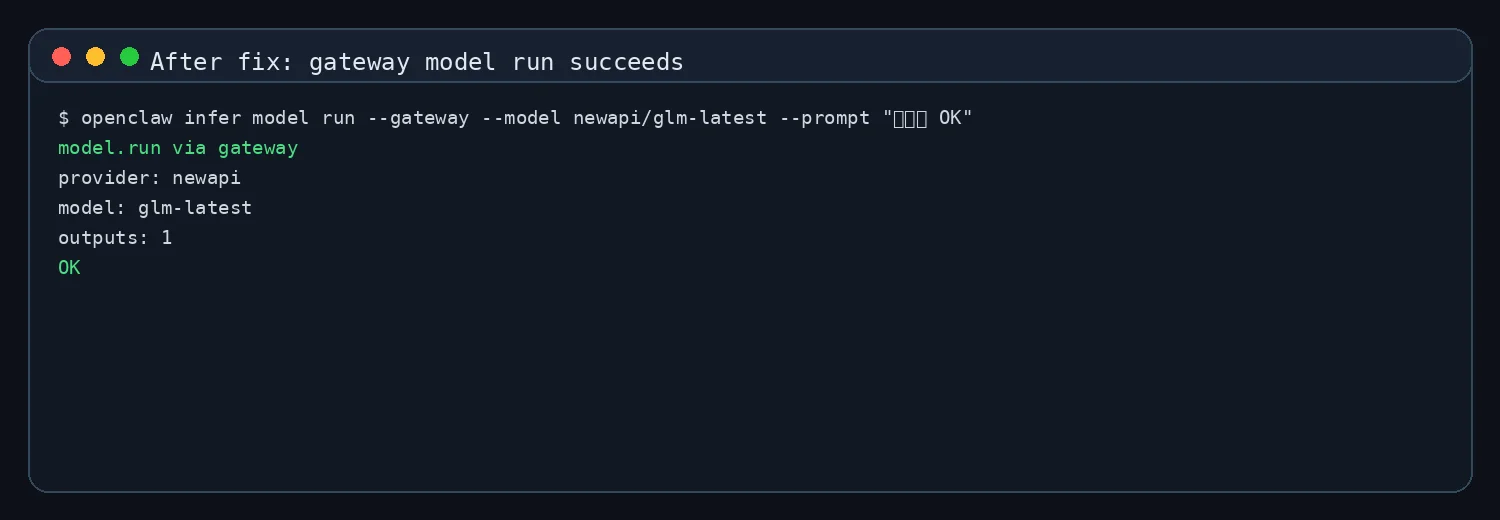
openclaw infer model run --gateway --model newapi/glm-latest --prompt "reply OK only"
In my environment, the gateway path returned OK after the patch.
7. One-Click Script for Windows 11
This PowerShell script uses only built-in PowerShell behavior plus Node. It searches common global npm locations, creates a backup, patches the bundle, runs node --check, and verifies one gateway call.
$ErrorActionPreference = "Stop"

$candidates = @(
  "$env:APPDATA\npm\node_modules\openclaw\dist",
  "$env:ProgramFiles\nodejs\node_modules\openclaw\dist",
  "$env:ProgramFiles\node_modules\openclaw\dist"
) | Where-Object { Test-Path $_ }

if ($candidates.Count -eq 0) {
  throw "OpenClaw dist directory not found. Set OPENCLAW_DIST and rerun."
}

$dist = $env:OPENCLAW_DIST
if (-not $dist) { $dist = $candidates[0] }

$file = Get-ChildItem $dist -Filter "capability-cli-*.js" | Select-Object -First 1
if (-not $file) { throw "capability-cli bundle not found in $dist" }

$stamp = Get-Date -Format "yyyyMMdd-HHmmss"
$backup = Join-Path $env:USERPROFILE ".openclaw\backups\operator-write-scope-$stamp"
New-Item -ItemType Directory -Force -Path $backup | Out-Null
Copy-Item $file.FullName $backup

$text = Get-Content $file.FullName -Raw
$old = "scopes: [ADMIN_SCOPE]"
$new = "scopes: [ADMIN_SCOPE], useStoredDeviceAuth: true, requiredStoredDeviceAuthScopes: [ADMIN_SCOPE]"

if ($text -notlike "*$old*") {
  throw "Patch anchor not found. OpenClaw bundle may have changed."
}
if ($text -notlike "*useStoredDeviceAuth*") {
  $text = $text.Replace($old, $new)
  Set-Content -Path $file.FullName -Value $text -Encoding UTF8
}

node --check $file.FullName
openclaw infer model run --gateway --model newapi/glm-latest --prompt "reply OK only"
8. One-Click Script for Ubuntu 26.04
#!/usr/bin/env bash
set -euo pipefail

DIST="${OPENCLAW_DIST:-}"
if [[ -z "$DIST" ]]; then
  for p in \
    /usr/local/lib/node_modules/openclaw/dist \
    /usr/lib/node_modules/openclaw/dist \
    /opt/openclaw/dist; do
    [[ -d "$p" ]] && DIST="$p" && break
  done
fi

[[ -n "$DIST" && -d "$DIST" ]] || {
  echo "OpenClaw dist directory not found. Set OPENCLAW_DIST." >&2
  exit 1
}

FILE="$(find "$DIST" -maxdepth 1 -name 'capability-cli-*.js' | head -n 1)"
[[ -n "$FILE" ]] || { echo "capability-cli bundle not found" >&2; exit 1; }

BACKUP="$HOME/.openclaw/backups/operator-write-scope-$(date +%Y%m%d-%H%M%S)"
mkdir -p "$BACKUP"
cp "$FILE" "$BACKUP/"

python3 - "$FILE" <<'PY'
from pathlib import Path
import sys

p = Path(sys.argv[1])
text = p.read_text(encoding="utf-8")
old = "scopes: [ADMIN_SCOPE]"
new = "scopes: [ADMIN_SCOPE], useStoredDeviceAuth: true, requiredStoredDeviceAuthScopes: [ADMIN_SCOPE]"
if "useStoredDeviceAuth" not in text:
    if old not in text:
        raise SystemExit("Patch anchor not found. OpenClaw bundle may have changed.")
    text = text.replace(old, new, 1)
    p.write_text(text, encoding="utf-8")
PY

node --check "$FILE"
openclaw infer model run --gateway --model newapi/glm-latest --prompt "reply OK only"
9. One-Click Script for macOS 26
#!/usr/bin/env bash
set -euo pipefail

DIST="${OPENCLAW_DIST:-}"
if [[ -z "$DIST" ]]; then
  NPM_PREFIX="$(npm prefix -g 2>/dev/null || true)"
  for p in \
    "$NPM_PREFIX/lib/node_modules/openclaw/dist" \
    /opt/homebrew/lib/node_modules/openclaw/dist \
    /usr/local/lib/node_modules/openclaw/dist; do
    [[ -d "$p" ]] && DIST="$p" && break
  done
fi

[[ -n "$DIST" && -d "$DIST" ]] || {
  echo "OpenClaw dist directory not found. Set OPENCLAW_DIST." >&2
  exit 1
}

FILE="$(find "$DIST" -maxdepth 1 -name 'capability-cli-*.js' | head -n 1)"
[[ -n "$FILE" ]] || { echo "capability-cli bundle not found" >&2; exit 1; }

BACKUP="$HOME/.openclaw/backups/operator-write-scope-$(date +%Y%m%d-%H%M%S)"
mkdir -p "$BACKUP"
cp "$FILE" "$BACKUP/"

perl -0pi -e 's/scopes: \[ADMIN_SCOPE\]/scopes: [ADMIN_SCOPE], useStoredDeviceAuth: true, requiredStoredDeviceAuthScopes: [ADMIN_SCOPE]/ if index($_, "useStoredDeviceAuth") < 0' "$FILE"

node --check "$FILE"
openclaw infer model run --gateway --model newapi/glm-latest --prompt "reply OK only"
10. Agent-Based Automatic Configuration
If you ask an agent to apply this fix, do not simply say “fix OpenClaw.” Give it a bounded runbook:
Investigate OpenClaw gateway model calls failing with missing scope: operator.write.
Do not reveal private addresses, host names, device identifiers, or secrets.
Steps:
1. Compare local model calls with gateway model calls.
2. Check whether the paired operator device includes operator.write.
3. Back up any file before editing it.
4. If the model override gateway branch does not use stored device auth, patch only that branch.
5. Run node --check after editing.
6. Verify gateway calls for newapi/MiniMax-fallback, newapi/glm-latest, and newapi/glm-fallback.
7. Summarize the changed file, backup location, and verification result with all sensitive values redacted.
The important part is not that an agent edits the file. The important part is that the agent follows evidence: reproduce, narrow the failing path, back up, make the smallest change, and verify the original symptom.
11. Fallback Verification
After the patch, I verified all three NewAPI fallback models through the gateway:
newapi/MiniMax-fallbacknewapi/glm-latestnewapi/glm-fallback
The status output showed the configured fallback list and a healthy gateway probe.
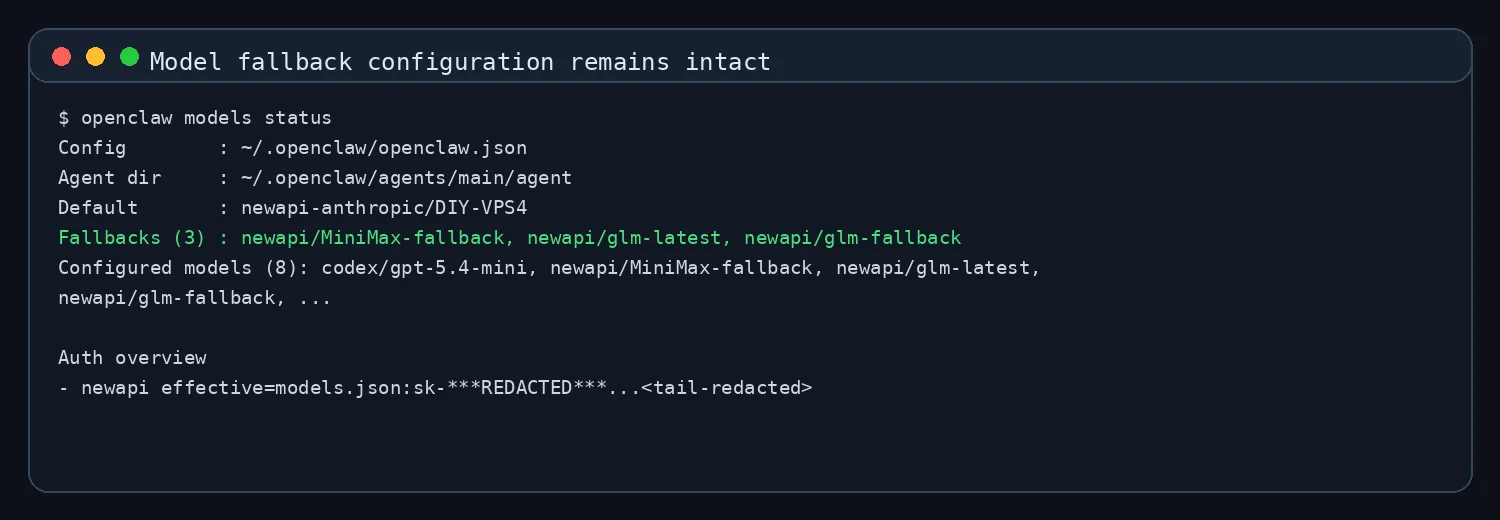
This is the broader lesson: a fallback model is not truly usable just because its name appears in configuration. It is usable only when the provider authentication, model alias resolution, gateway identity, and local operator authorization all succeed together.
12. Q&A
Q: If the UI says provider authentication failed, should I rotate the API key first?
Not automatically. First compare local and gateway calls. If local succeeds and gateway fails with operator.write, rotating the provider key is probably noise.
Q: Why can a device have operator.write while the request still misses it?
Because ownership and presentation are different. You can own the correct badge and still be denied if you enter through a path that never scans it.
Q: Is this patch universal for every OpenClaw version?
No. It matches the bundle structure observed in this incident. If your OpenClaw version has a different gateway implementation, inspect the actual branch before patching.
Q: Why not give the shared gateway token broader permissions?
Because that expands the blast radius. A better fix is to bind the request to the already paired device identity that legitimately owns the operator permissions.
Q: Is this a security vulnerability?
It is best described as an authorization-context propagation bug. The authorization check did its job by denying an unbound request. The broken part was that a legitimate device identity was not carried into a specific gateway path.
13. Final Takeaway
The patch was small, but the debugging lesson is larger:
- Do not trust the outer error message blindly.
- Compare local and gateway execution paths.
- Confirm whether the device actually owns the missing scope.
- Trace where the request loses the device identity.
- Patch the smallest branch that drops the identity.
- Verify every fallback model through the same path that originally failed.
Many authorization bugs are not about permissions being absent. They are about permissions failing to travel with the request. In this case, operator.write existed. The gateway just needed to bring the stored device identity along for the ride.