Why Do Batteries Swell? Are Power Banks Really Safe?
The short version
A power bank is not safe merely because it still charges a phone. Its safety depends on the cell, protection circuit, charger, enclosure, and environment working together. A bulging case, unusual heat, chemical odor, cracking, smoke, or intermittent charging is a stop-using signal—not a reason to “get a few more cycles out of it.”
Swelling does not mean the pack will definitely explode in the next second. It does mean that something inside the cell has changed and should no longer be treated as normal. Squeezing, puncturing, opening, or continuing to charge a swollen pack can turn a warning into an emergency.
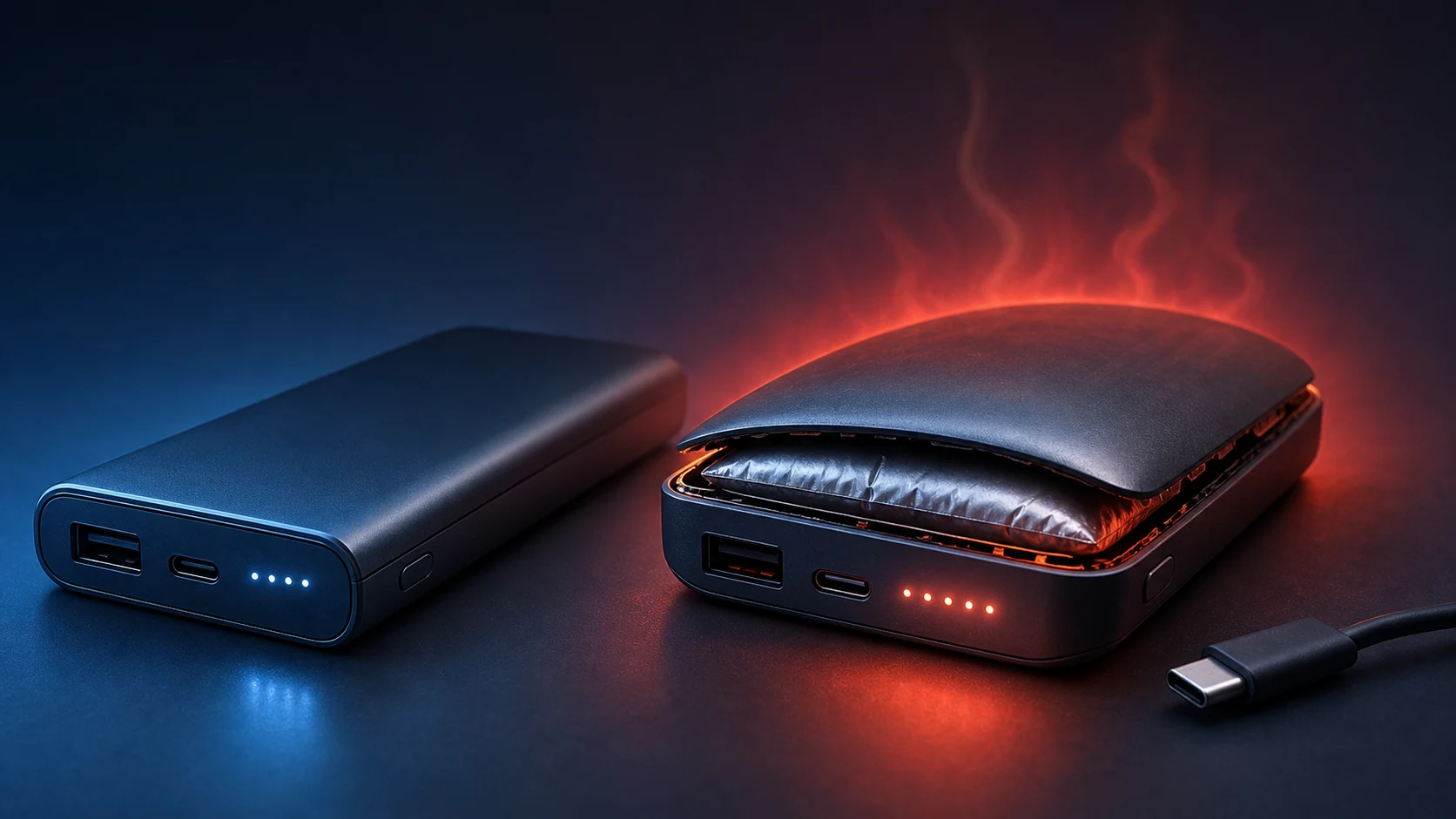
Illustration: swelling is not just a cosmetic change; it is an internal warning becoming visible through the enclosure.
The visible deformation starts with an internal change
Most portable power banks use lithium-ion cells. During normal operation, lithium ions move between the electrodes while electrons travel through the external circuit. The process depends on stable electrode materials, separator, electrolyte, packaging, and protection electronics.
When a cell ages, overheats, is overcharged, is damaged, or contains a manufacturing defect, side reactions can increase. Electrolyte and electrode decomposition can generate gas. A pouch cell has a flexible laminate enclosure rather than a rigid metal can, so the gas gradually pushes the cell outward and produces the familiar pillow-like bulge.
That is why “the case is only a little deformed” is a poor diagnosis: the case is usually the easiest evidence to see, not the place where the problem began.
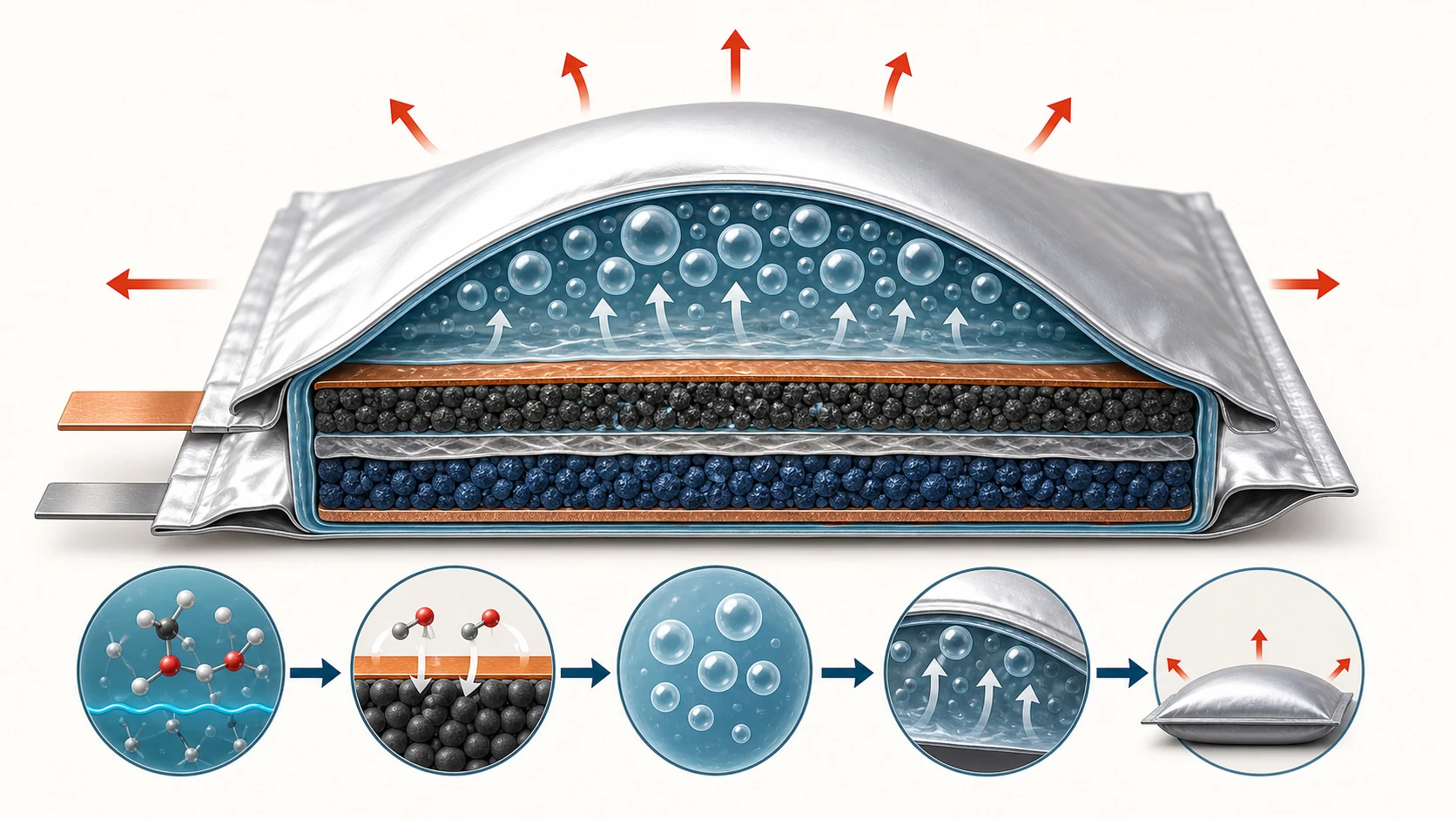
Illustration: gas generation and rising internal pressure push a flexible pouch outward. This is a simplified educational diagram, not a teardown of a specific model.
Why a lithium-ion battery swells
Aging increases resistance and side reactions
After many charge and discharge cycles, electrode structures and interface layers change. Internal resistance rises, heat increases, and side reactions may become more significant. An aged cell may not swell immediately, but it usually has less tolerance for heat, deep discharge, and high current.
Heat accelerates reactions
Leaving a power bank on a car dashboard, in direct sunlight, under bedding, or in a poorly ventilated bag can make heat dissipation worse. Higher temperature can accelerate electrolyte decomposition and other side reactions; those reactions can generate more heat in return.
“Slightly warm during high-power conversion” is not the same as “uncomfortably hot and getting hotter.” The latter calls for stopping use and checking for odor, noise, smoke, or deformation.
Overcharge, over-discharge, or failed protection
Quality products use protection and power-management circuits to keep cells within their operating window. But “it has a protection board” is not proof that every failure mode is impossible. Components can fail, cells can be mismatched, and low-quality products can have design or quality-control problems.
The fact that a pack charged normally last month does not prove that it is safe today.
Mechanical damage can compromise the separator
A cell that has been crushed, punctured, or sharply bent may have separator damage or an altered internal insulation path. A short circuit may not produce an immediate spark; it can first appear as abnormal heat, rapid self-discharge, interrupted charging, or later swelling.
Manufacturing defects can remain invisible
Metal particles, burrs, packaging defects, poor welds, or inconsistent cells can surface only after some use. Battery safety is not only a matter of careful user behavior; it also depends on traceable design, testing, and manufacturing quality.
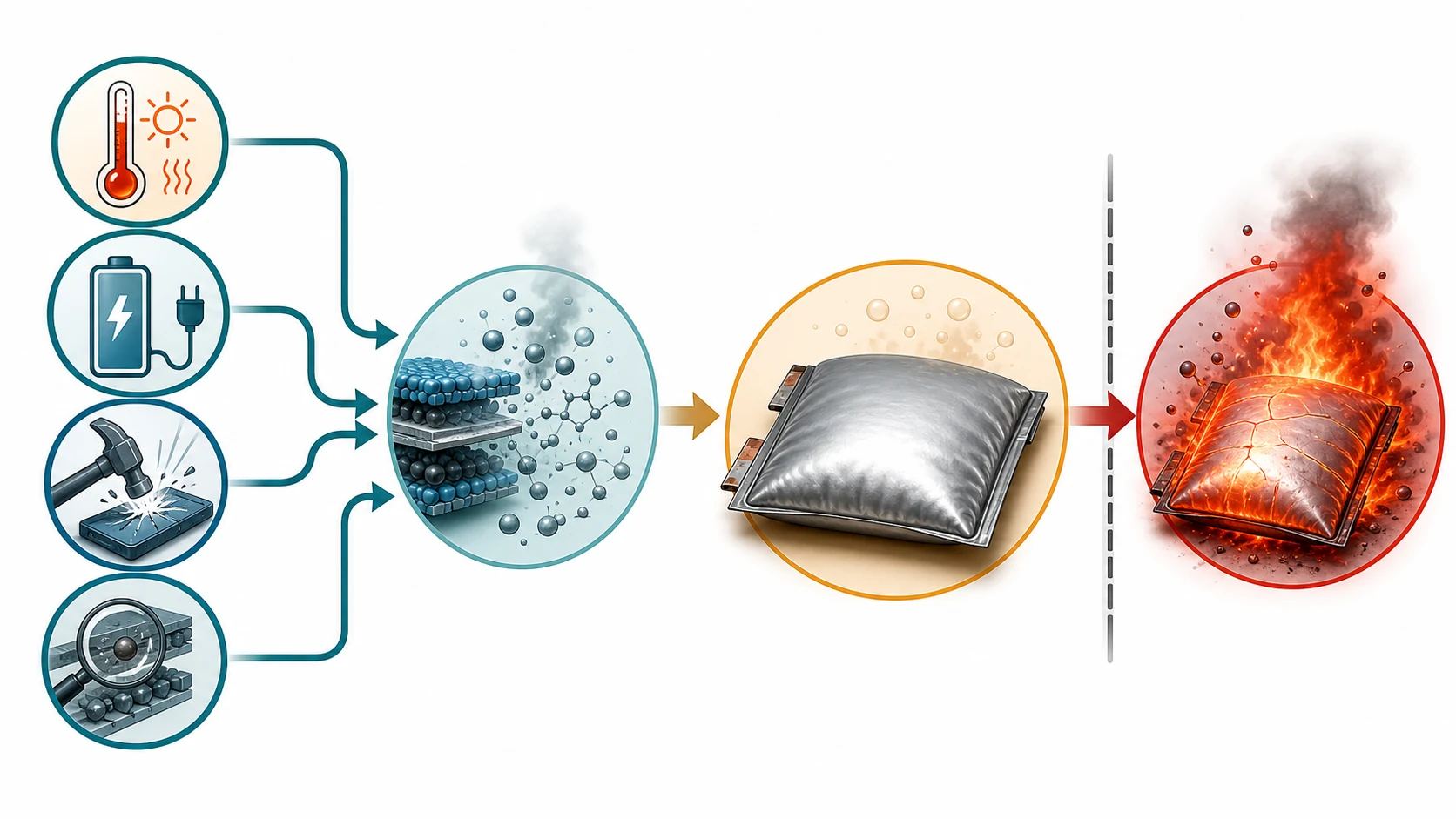
Illustration: swelling can be the result of several factors acting together. It is a warning node in a risk chain, not a cosmetic defect to ignore.
What the warning signs mean
You do not need to wait for every symptom. One clear abnormal sign is enough to stop treating the device as an ordinary power bank.
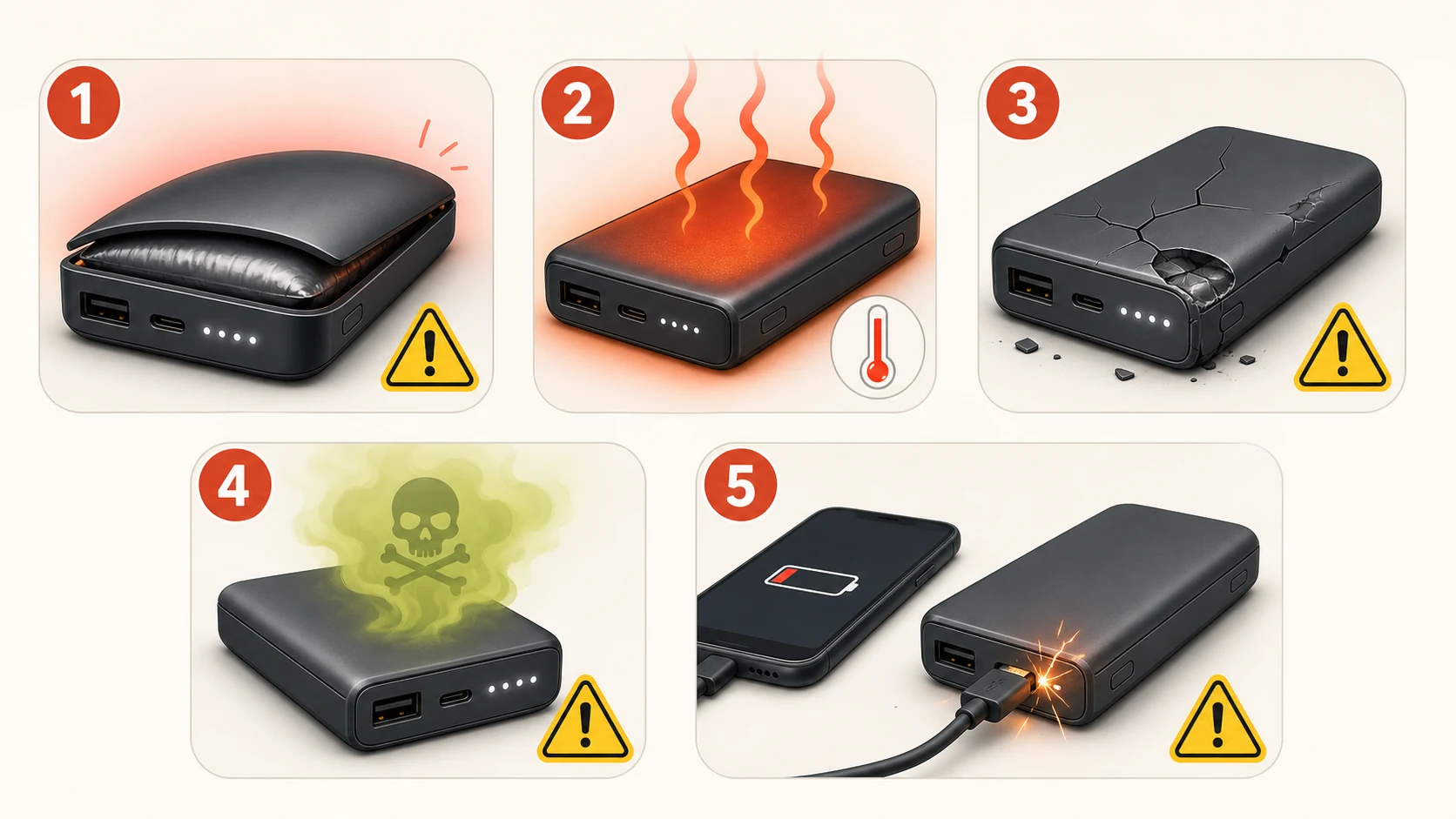
Illustration: swelling, abnormal heat, physical damage, odor, and charging irregularities all deserve attention.
- A bulging case or widening seam: treat it as a damaged battery; do not press it flat or seal it with tape.
- Significant heat at low load: possible internal leakage, short circuit, protection failure, or cell degradation.
- A sharp, sweet, or solvent-like odor: do not keep sniffing it and do not continue charging.
- Cracks, leakage, smoke, or hissing: move people away and call local emergency services if it is smoking or burning. Do not approach to take photos or dismantle it.
- Repeated disconnects or sudden capacity loss: it may be a cable problem in isolation, but combined with heat, swelling, or damage, treat it as a battery fault.
Are power banks safe at all?
The useful answer is not a binary yes or no. The question is whether the device is in a controlled, normal state.
A traceable product with a healthy cell, complete markings, intact housing, and reasonable ventilation can be designed and used with manageable risk. It is not inherently more dangerous than the lithium-ion batteries inside phones and laptops.
But power banks are often squeezed in bags, may contain multiple cells, can heat up while charging and discharging at the same time, and hide the cells from the user. Once abnormal behavior appears, the benefit of continued use is small while the risk can rise quickly.
Practical boundaries for everyday use
- Do not charge one under a pillow, blanket, clothes, or inside a tightly packed laptop bag.
- Avoid hot cars, direct sunlight, and damp storage.
- Replace damaged or loose cables and chargers, but do not assume every abnormal battery is “just the cable.”
- Do not open the enclosure or replace cells yourself. Insulation, welding, and protection can all be compromised.
- Do not leave a pack in a sealed space while it is charging and delivering high power to multiple devices.
- Inspect the case, ports, temperature, and charge behavior periodically. Stop using it when anything changes.
What to do when you find a swollen pack
Treat it as a potentially damaged lithium-ion battery, not ordinary electronic waste.
Stop using and charging it. If it is charging but not hot, smoking, or burning, disconnect power without tugging or squeezing the cable. If it is already very hot, smoking, hissing, or on fire, evacuate people and contact local emergency services rather than attempting close-range handling.
Remove nearby combustibles only if it is safe. If the pack is stable and cool enough to handle without bending or pressing it, place it on a non-combustible surface away from paper, clothing, wood, and bedding. Do not risk carrying it through a crowded space just to reach a balcony.
Do not puncture, cut, crush, or soak it. These actions do not reliably remove the risk and can damage the separator or create a short circuit.
Use an appropriate recycling route. Contact a qualified battery-recycling or hazardous-waste collection point, the manufacturer, or a local service channel, and clearly say that the cell is swollen or damaged. Do not mix it with regular combustible trash or ordinary metal recycling.
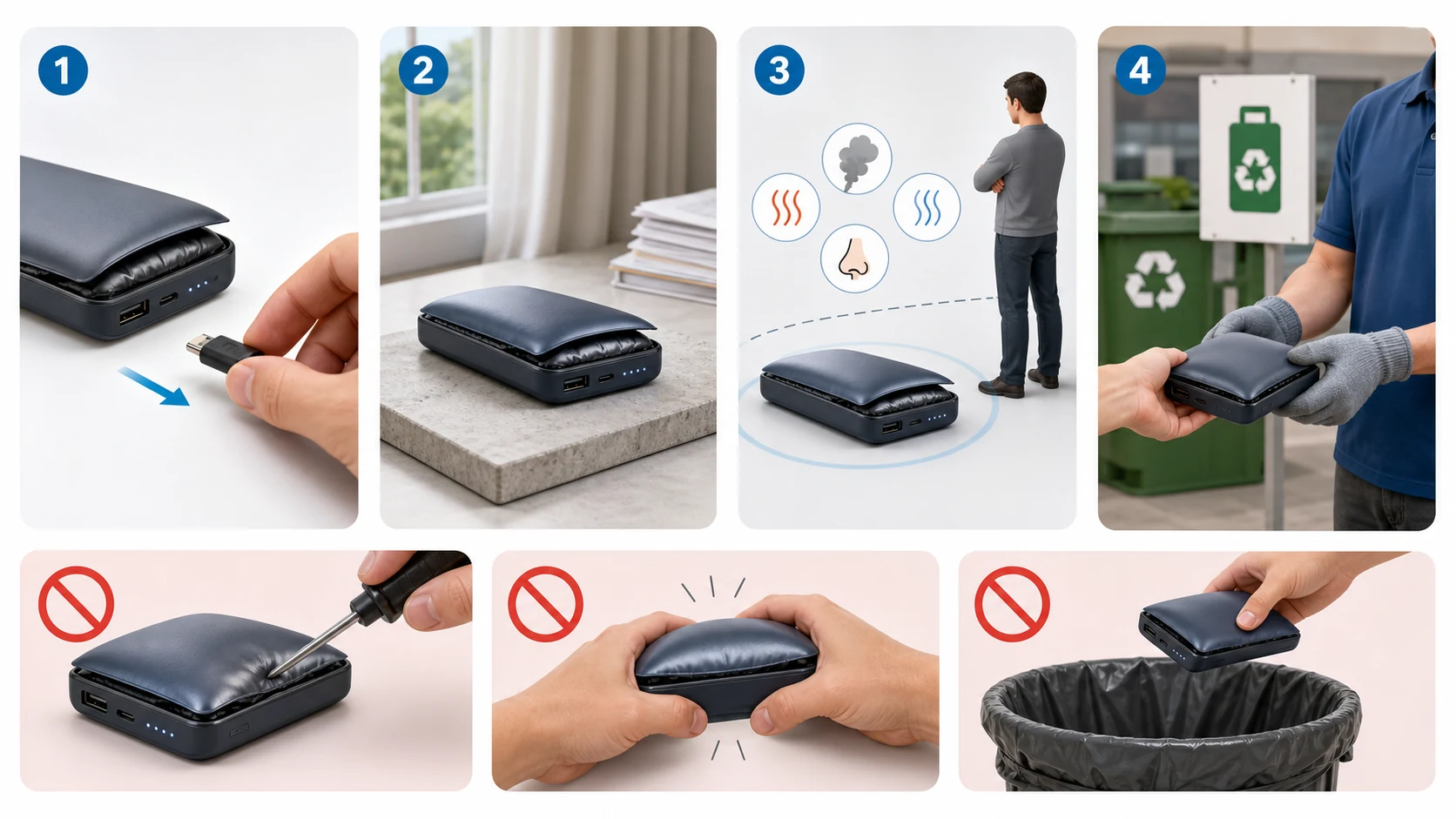
Illustration: stop, isolate, keep away from combustibles, and hand it to an appropriate collection channel.
Choosing a power bank: look beyond capacity
A larger capacity or higher fast-charge rating does not automatically mean better safety. Check at least the following:
- Is the model, manufacturer, rated capacity, and energy value clearly marked?
- Can certification, recall, and safety information be found through an official channel?
- Is the price implausibly low, or do the package and electrical specifications contradict each other?
- Does the design document over-current, over-voltage, over-charge, over-discharge, temperature, and short-circuit protection?
- Is the enclosure free of seams, dents, loose ports, or unexplained heat?
- Is there a receipt, warranty, and identifiable seller? If nobody can be reached after a failure, the safety cost has been shifted to the user.
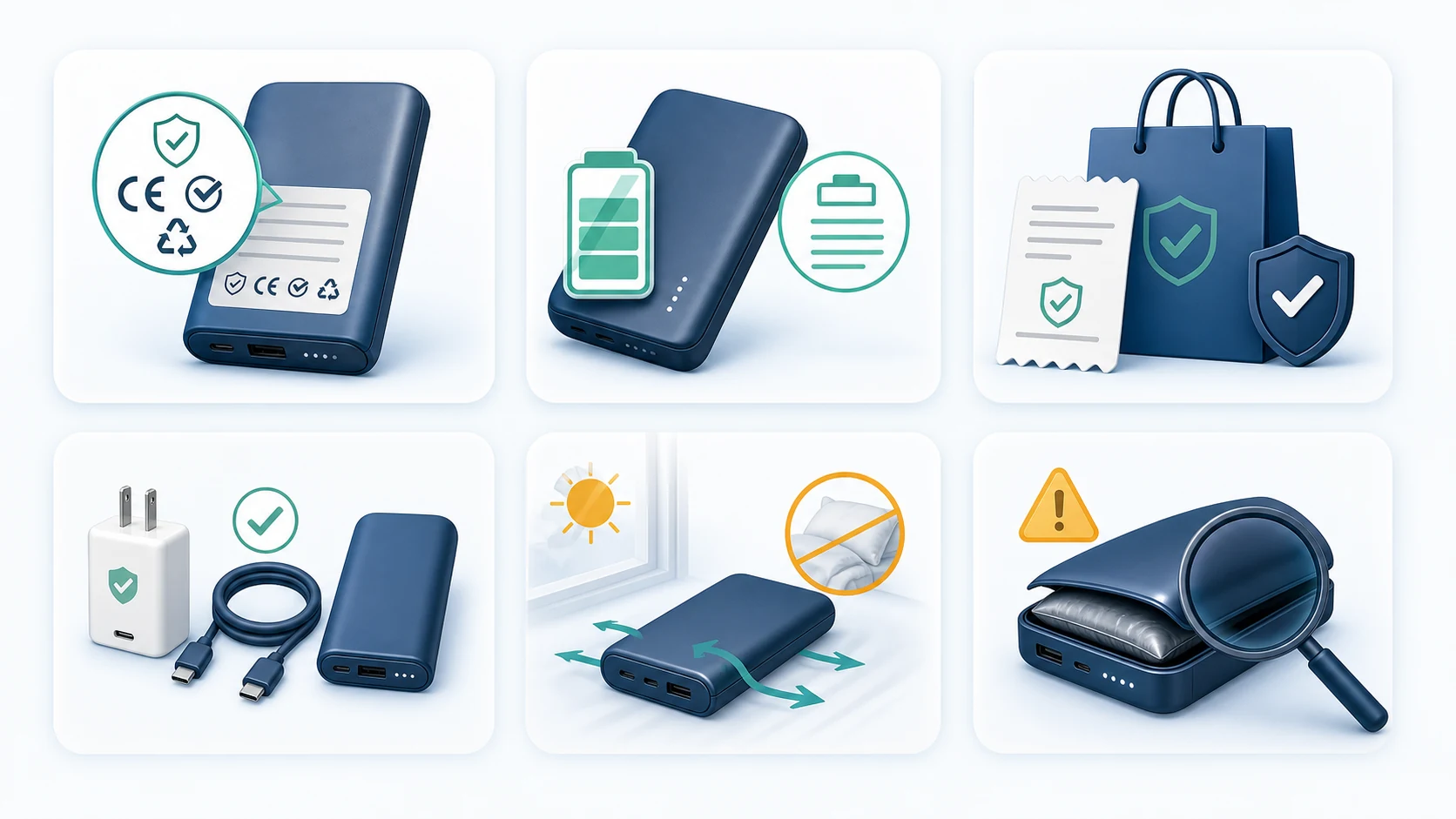
Illustration: traceability, clear markings, complete protection, and a reasonable environment matter more than one impressive number.
Air travel is a separate rule set
Air transport restrictions on lithium batteries are generally stricter than everyday-use guidance. Requirements can vary by country, airport, airline, route, capacity, quantity, and whether the device must be carried in the cabin. Check the latest notice from the departure airport and operating airline.
A common safety principle is to keep power banks and spare lithium batteries in carry-on baggage rather than checked baggage, protect terminals from metal contact, and never bring a swollen, damaged, recalled, or unidentifiable battery onto an aircraft. Do not treat an old online travel tip as a current boarding guarantee.
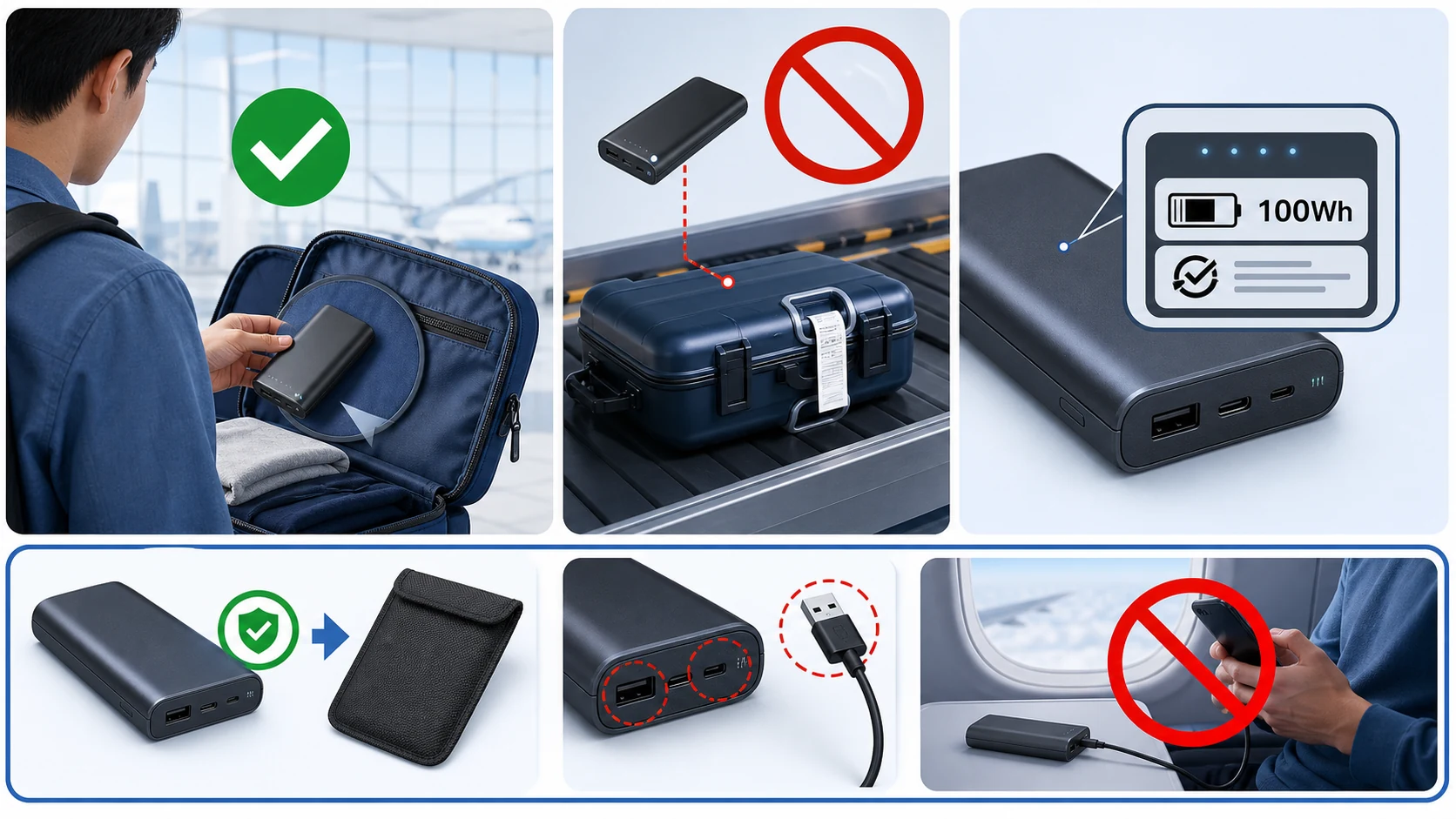
Illustration: airline rules change; verify the latest requirements before departure.
Q&A
Can I use a swollen pack until it is empty?
It is not recommended. Swelling is a stop-using signal. Continued charging and discharging add heat and electrochemical activity. “Just one more charge” is not a safety test.
Is a warm power bank normal?
Some temperature rise can come from conversion losses, especially at high power. But a pack that heats while idle, keeps getting hotter, or becomes uncomfortable to touch—especially with odor, disconnects, or swelling—should be retired.
Can I put it in a refrigerator?
No. Condensation creates moisture risk, and low temperature is not a repair method. Stop using it, keep it away from combustibles, and let an appropriate service handle it.
Can I use water on a power-bank fire?
If it is smoking or burning, do not approach to run an experiment or rescue belongings. Move people away and contact local emergency services. Lithium-ion thermal runaway can reappear after flames seem to disappear.
Why are cell capacity and rated capacity different?
The cell is usually specified at its internal nominal voltage, while USB output requires conversion and has losses. Rated capacity is closer to what can be delivered under specified output conditions. Compare energy value, output conditions, and traceability—not a single large number.
How do I check for a recall?
Record the brand, model, batch, and seller. Check the manufacturer site, retailer notices, market-surveillance recall information, and airline notices. If the model or condition cannot be confirmed, treat it as an abnormal battery and do not fly with it.
The one-line rule
A normal power bank can be used. An abnormal lithium-ion battery should not be gambled on.
Swelling is not a question of whether you can squeeze out a few more cycles. It is a warning that the cell is no longer fully under control. Stop using it, avoid pressure and heat, keep it away from combustibles, and use a proper collection route.
References
- U.S. Consumer Product Safety Commission, Lithium-Ion Battery Safety: https://www.cpsc.gov/s3fs-public/Lithium-Ion-Battery-Safety.pdf
- Federal Aviation Administration, PackSafe — Batteries: https://www.faa.gov/hazmat/packsafe/batteries
- U.S. Environmental Protection Agency, Used Household Batteries: https://www.epa.gov/recycle/used-household-batteries
- Civil Aviation Administration of China: check current passenger guidance before travel: https://www.caac.gov.cn/