Raking in 69% Margins and Still Hiking Prices? .COM Domains Rise Nov 1, 2026: Inside Verisign's Monopoly Cash Machine & The 10-Year Lock-In Guide (Cross-Platform Automated Toolkits Included)
Executive Summary & Urgent Alert: If you hold one or more .COM domain names, log into your registrar console immediately before November 1, 2026, at 04:00 UTC! A global wave of digital real estate inflation is hitting hundreds of millions of developers, webmasters, and enterprises worldwide:
- The November 1 Deadline: Registry Wholesale Climbs to New Highs: Verisign, the exclusive global registry operator for all .COM domains, has confirmed that effective November 1, 2026, the wholesale fee charged to registrars increases from $10.26 to $10.97 (a ~6.9% jump);
- Retail Markup Cascade Hits General Users Hard: Major registrar NameSilo blasted out emergency customer notices that standard retail renewal prices will surge to $19.99/year, while legacy providers like GoDaddy continue charging upwards of $24.99/year;
- Inside the Ultimate Cash Machine: Verisign's Q1 2026 earnings reveal a staggeringly profitable enterprise: $429 million in quarterly revenues against $294 million in operating profit, translating to a jaw-dropping 68.5% operating margin — far exceeding Apple (30%), Alphabet (32%), and Microsoft (44%);
- Everyday Analogy for Elementary Students: We break down the complex ICANN-Verisign triangle using the vivid analogy of ‘The Municipal Water Plant (Registry) vs Corner Grocery Stores (Registrars) vs Thirsty Tenants (Domain Owners)’, making institutional mechanics 70%+ understandable to anyone;
- Self-Defense Engineering: 10-Year Lock-In & Cross-Platform Toolkits: By leveraging ICANN's contractual 10-year maximum registration ceiling prior to November 1, paired with seamless transfers to at-cost providers like Cloudflare Registrar or Porkbun, domain owners can bypass multiple future price compounding cycles. Complete native toolkits for Windows 11 (PowerShell 7), Ubuntu 26.04 (Bash), and macOS 26 (Zsh) are provided for both interactive auditing and silent AI Agent integration.

1. Background: A Late-Night Pricing Notice Sends Shockwaves Across the Tech Community
Over the past week, developers, webmasters, and infrastructure teams across the globe received an urgent notification in their inboxes from NameSilo titled: NAMESILO | DOMAIN PRICING NOTICE - Important .COM Price Update.
The notice carried clear and sobering instructions: Because Verisign, the sole registry operator for all .COM top-level domains, is increasing wholesale costs, NameSilo will officially update its .COM pricing structure on November 1, 2026, at 04:00 UTC.
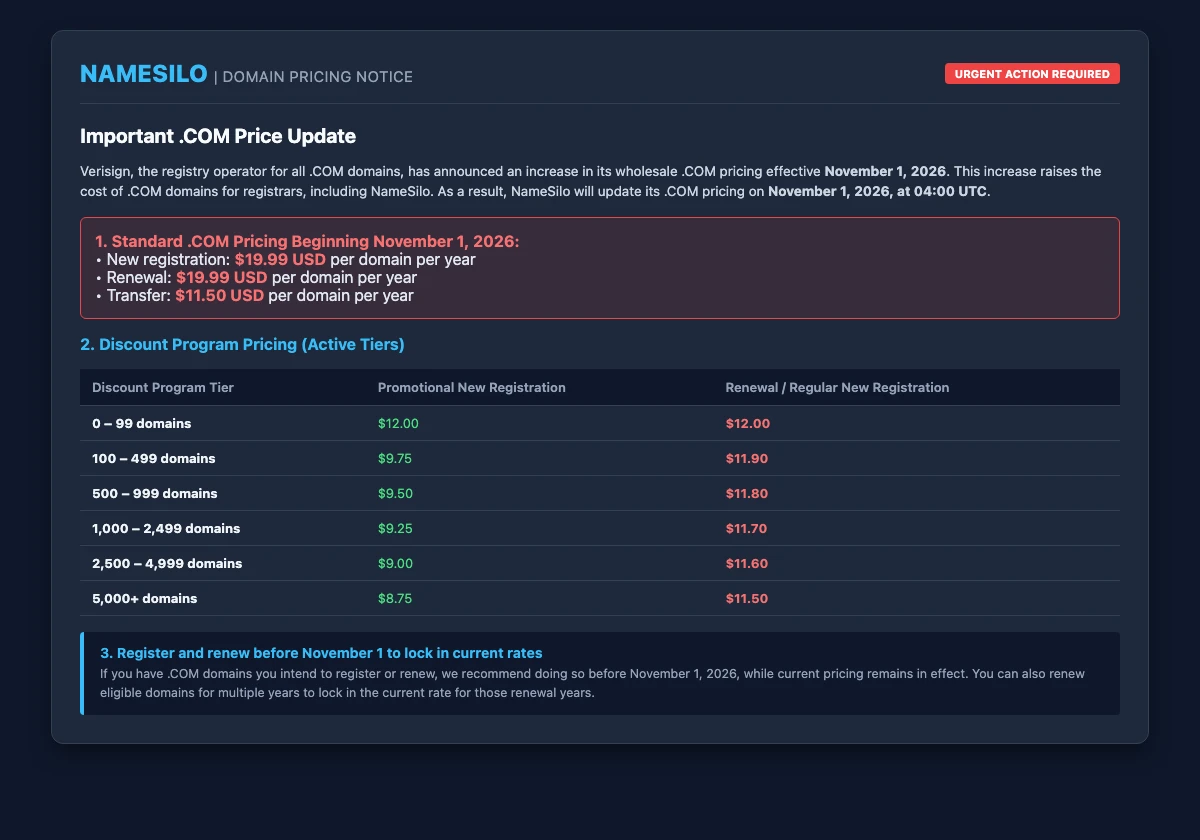
The breakdown revealed severe retail implications:
- Standard Retail Tier (0–99 domains): Both new registrations and renewals are hiked to $19.99 USD/year; renewals under promotional periods still sit at $12.00 USD/year;
- Transfers: Registry-level base fee adjusted to $11.50 USD/year;
- Urgent Call to Action: “If you have .COM domains you intend to register or renew, we recommend doing so before November 1, 2026, while current pricing remains in effect. You can also renew eligible domains for multiple years to lock in the current rate for those renewal years.”
This is far from an isolated registrar decision. It traces back directly to Verisign's (NASDAQ: VRSN) official First Quarter 2026 financial earnings release issued on April 23, 2026:
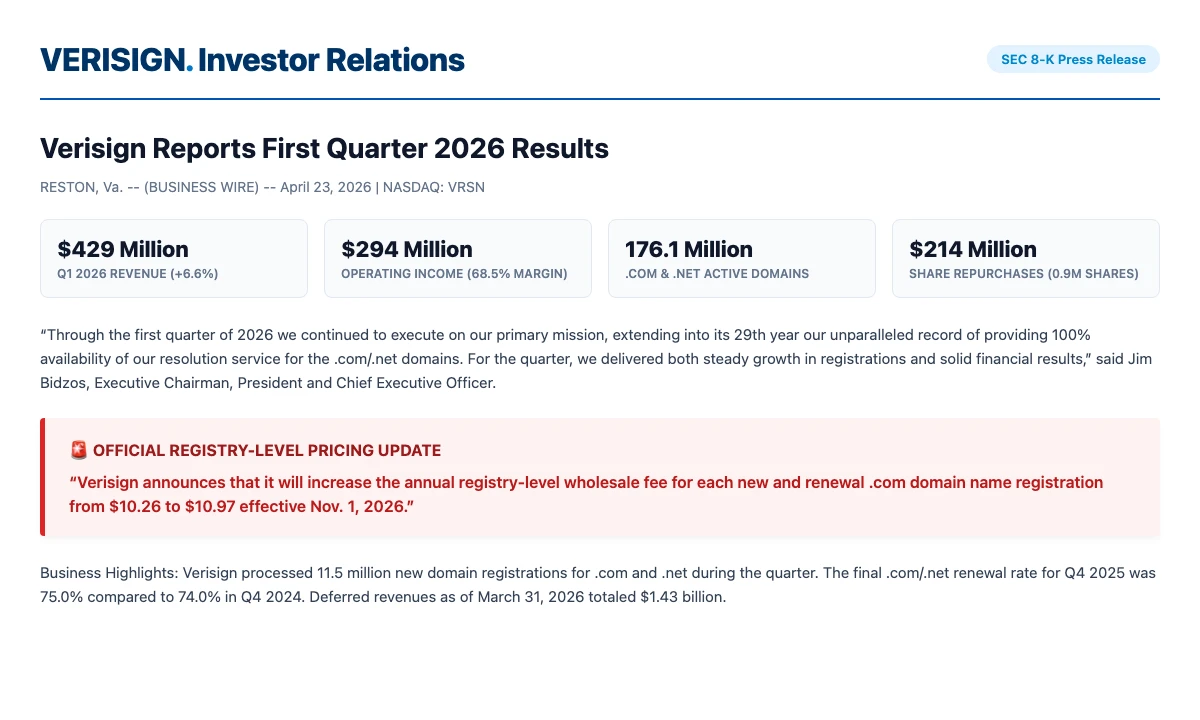
Line 63 of Verisign's business highlights plainly stated: “Verisign announces that it will increase the annual registry-level wholesale fee for each new and renewal .com domain name registration from $10.26 to $10.97 effective Nov. 1, 2026.”
While an increase of 71 cents (~6.9%) might appear modest on paper, when compounded across more than 176.1 million active .COM and .NET domains and multiplied by downstream registrar retail markups, it translates into hundreds of millions of dollars extracted annually from global internet operators.
2. Manifestation: $1 Baiting, $25 Renewal Traps, and the 'Domain Hostage' Dilemma
Over the past decade, almost every independent developer, enterprise architect, and self-hoster has encountered registrar traps. With the November 1 price hike imminent, several structural dysfunctions in the domain market have resurfaced with vengeance:
1. Pain Point 1: The 'First-Year $1 Bait, Second-Year $25 Gouge'
The oldest trick in domain retail is the loss-leader acquisition funnel. Certain legacy registrars (most notably GoDaddy) spend millions on ads promoting “Register your .COM for just $0.99 or $4.99!”
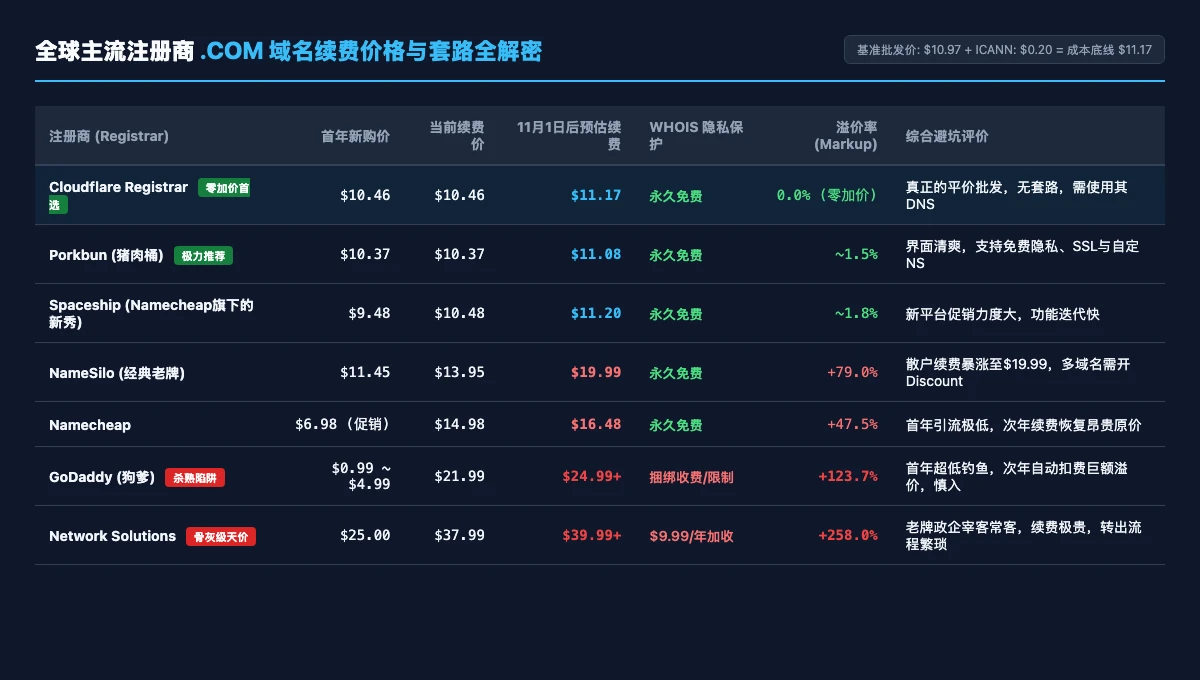
Unsuspecting newcomers celebrate the bargain and link their credit cards. However, once the initial 12-month honeymoon expires, auto-renewal invoices quietly strike at $21.99 or $24.99+ per year. With Verisign's wholesale floor climbing to $10.97 on November 1, these retail renewals are poised to march toward the $28–$30 ceiling.
2. Pain Point 2: The Domain Hostage Crisis
Domains represent a unique category of digital assets characterized by virtually infinite switching costs:
- Your corporate brand, trademark, and marketing assets are permanently etched with your .COM address;
- Years of accumulated search engine reputation and domain authority (SEO) cannot simply be swapped to another string;
- All corporate email infrastructure (MX records, DKIM, SPF, DMARC), single sign-on (SSO) configurations, and OAuth redirects rely entirely on that root domain;
- Mobile apps and distributed API clients globally depend on authoritative DNS resolution for that name.
You cannot easily abandon it. Registrars and registries understand that established domain owners will pay virtually any price demanded, creating a textbook case of inelastic captive demand.
3. Pain Point 3: Sneaky Add-Ons and WHOIS Privacy Extortion
Beyond baseline renewal fees, legacy registrars frequently bill an extra $9.99/year for WHOIS privacy protection (keeping personal phone numbers, physical addresses, and emails unexposed). Furthermore, when users attempt to transfer out (Transfer Out), some registrars intentionally introduce multi-day verification delays, obscure authorization codes (EPP / Auth Code), or invoke artificial security holds hoping the domain enters the expensive redemption grace period.
3. The Everyday Analogy: Elementary-School Guide to Water Utilities, Groceries, and Tenants
To demystify how ICANN, Verisign, NameSilo, GoDaddy, and Cloudflare interact — and why a simple web address demands recurring annual rent — let us examine the ecosystem through the lens of a Municipal Water Utility System:

1. ICANN: The Municipal City Planning Board
The city council regulates public utilities and manages community blueprints. It awarded the exclusive perpetual franchise for drinking water supply (the .COM top-level zone) to a single private contractor under a structured pricing agreement.
2. Verisign (The Registry): The Exclusive Municipal Water Plant
Verisign owns the physical water filtration and root distribution infrastructure for .COM:
- Every household and restaurant in town requiring water (domain resolution) must draw from this single water plant;
- Its marginal operational cost is negligible (the pipes were laid decades ago; ongoing costs are just routine maintenance and modest electricity);
- Yet because it holds the government-backed exclusive concession, it never faces competition. It simply issues an annual decree stating: ‘Wholesale water rates increase by 7% starting next month’, and the entire city must pay without recourse.
3. NameSilo, GoDaddy, Cloudflare (The Registrars): Neighborhood Grocery Outlets
The water plant does not interface with individual residents; it sells wholesale to retail stores:
- The Fair-Trade Merchant (Cloudflare Registrar): Adopts an uncompromising ‘at-cost’ policy. If the water plant charges $11, Cloudflare puts it on the shelf for exactly $11 with zero retail markup, using fair pricing to attract shoppers into its cloud services ecosystem;
- The Corner Price-Gouger (GoDaddy): Hands out free trial bottles on day one, but charges triple once your kitchen plumbing is permanently hooked into its supply line;
- The Traditional Distributor (NameSilo): Passes the wholesale increase directly onto standard customers, escalating renewal fees from $13.95 to $19.99.
4. Developers and Webmasters (The Registrants): The Commercial Tenant
When you register a domain, you never purchase the freehold property outright — you merely lease the land year by year. Because your storefront, signs, and customers are rooted at that address, you are locked into paying the landlord's escalating rent.
4. Analysis & Root Cause: The ICANN '4-in-6 Years' Loophole & Verisign's 68.5% Margin
Why is Verisign allowed to systematically hike wholesale fees year after year? Who engineered the legal architecture underpinning this digital toll booth?
1. The 2018 Turning Point: Amendment 35 to the Cooperative Agreement
Between 2012 and 2018, the wholesale price of .COM was legally frozen at $7.85 USD. The U.S. Department of Commerce's National Telecommunications and Information Administration (NTIA) strictly capped prices to safeguard public internet stability.
However, in October 2018, under the Trump administration, the NTIA approved Amendment 35 to the Cooperative Agreement, dismantling the price ceiling. In 2020, ICANN codified this change into the official .COM Registry Agreement:
‘Verisign is permitted to increase the wholesale price of .COM domain registrations and renewals by up to 7% in four out of every six years of the contract cycle.’
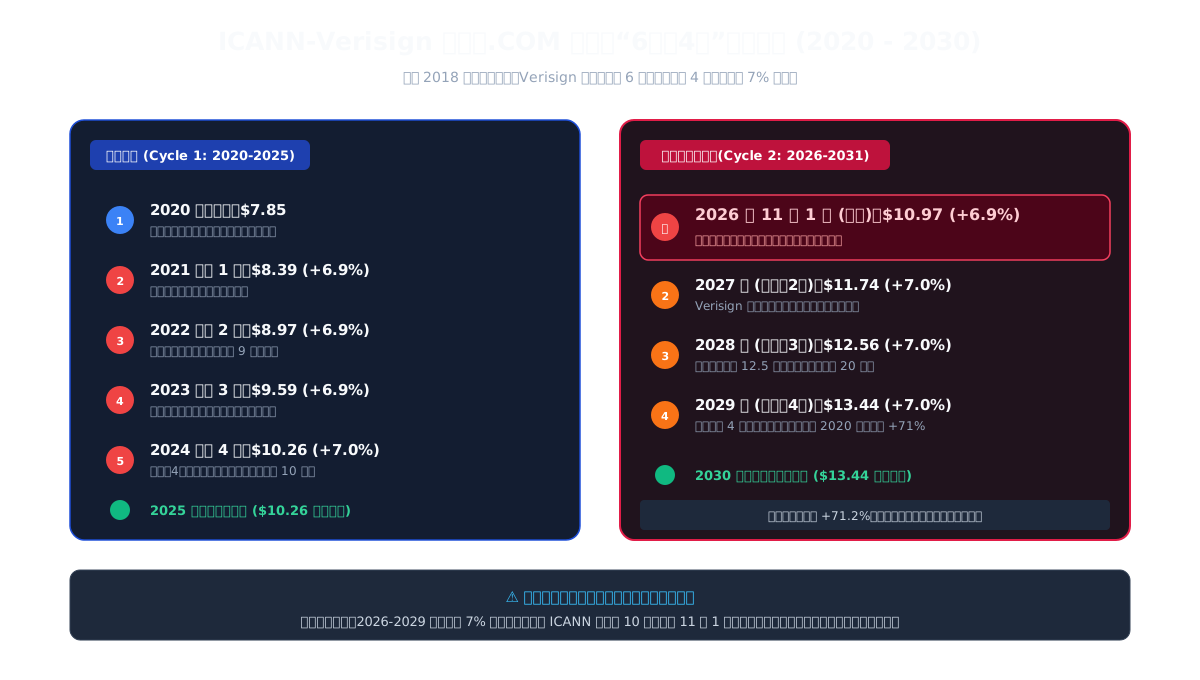
The mechanics operate with clockwork predictability:
- Cycle 1 (2020–2025): Verisign exercised its full contractual allowance, hiking prices consecutively in 2021 ($8.39), 2022 ($8.97), 2023 ($9.59), and 2024 ($10.26). With four allowances exhausted, 2025 served as the mandatory contractual ‘freeze year’;
- Cycle 2 (2026–2031): In 2026, the moment the new 6-year window opened, Verisign immediately triggered its first allowance, raising wholesale rates on November 1, 2026, to $10.97;
- The Compounding Trajectory: History indicates Verisign will likely enforce the remaining three 7% hikes in 2027 (projected $11.74), 2028 (projected $12.56), and 2029 (projected $13.44). By 2029, the baseline wholesale cost will have risen by over 71% compared to 2020!
2. The Anatomy of an Internet Toll Booth: 68.5% Operating Margins
Verisign's SEC Form 10-Q filing for Q1 2026 illustrates the staggering financial power of natural monopoly:
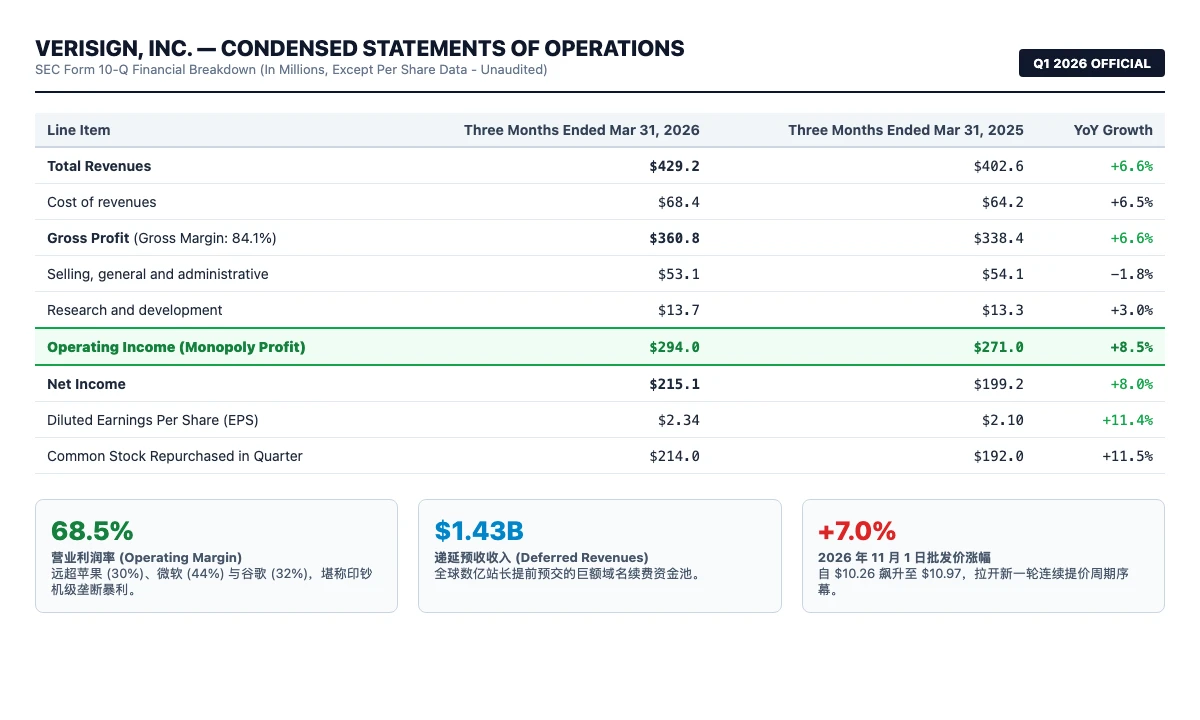
- Quarterly Net Revenue: $429.2 million (up 6.6% year-over-year);
- Cost of Revenues: A mere $68.4 million (yielding an 84.1% gross margin);
- Operating Income: $294.0 million, clocking an astonishing 68.5% operating margin;
- Capital Allocation: Verisign channeled $214.0 million in Q1 alone toward repurchasing its common stock, alongside cash dividends of $0.81 per share.
To contextualize: Apple operates at roughly 30% operating margins, Google Alphabet at 32%, and Microsoft at 44%. Verisign extracts near-70% operating margins on essential digital infrastructure without technological displacement risk.
5. Dissecting the Bill: Where Does Every Dollar of Your .COM Invoice Actually Go?
With Verisign setting the base wholesale price at $10.97, plus ICANN's mandatory $0.20 regulatory fee, the absolute bare-minimum wholesale cost of a .COM domain is $11.17 USD per year.
How does that baseline transform into the varying prices offered by retail providers?
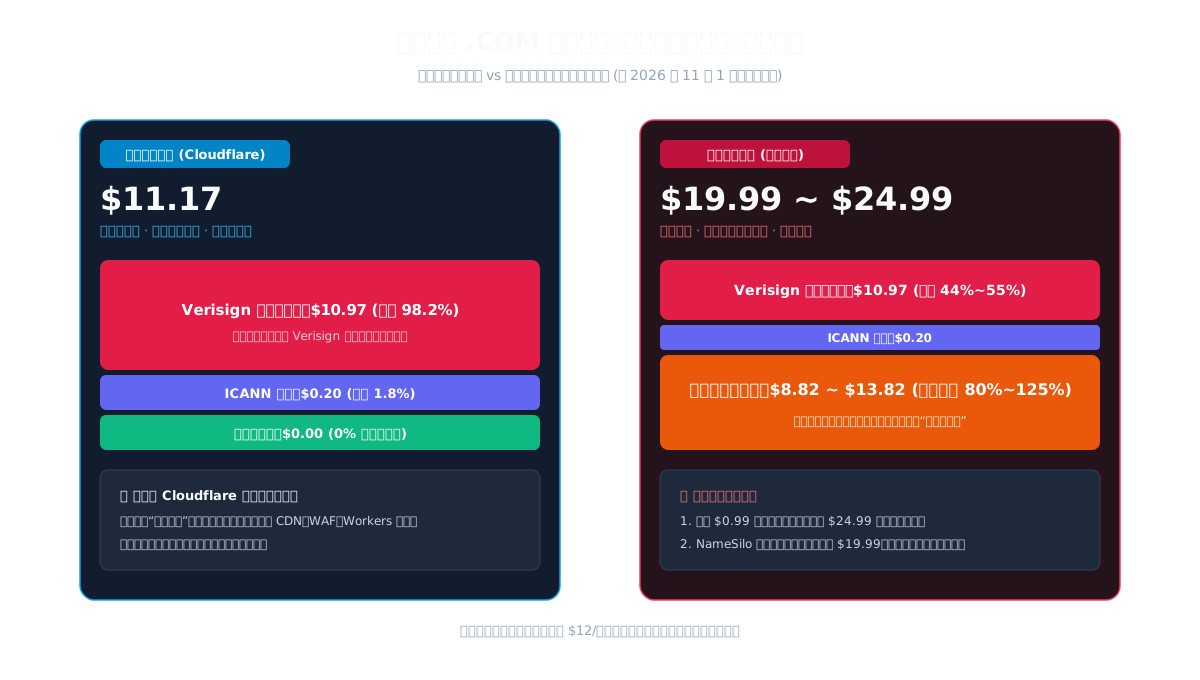
1. At-Cost Wholesale: Cloudflare Registrar
Cloudflare revolutionized the registrar sector by introducing zero-markup retail:
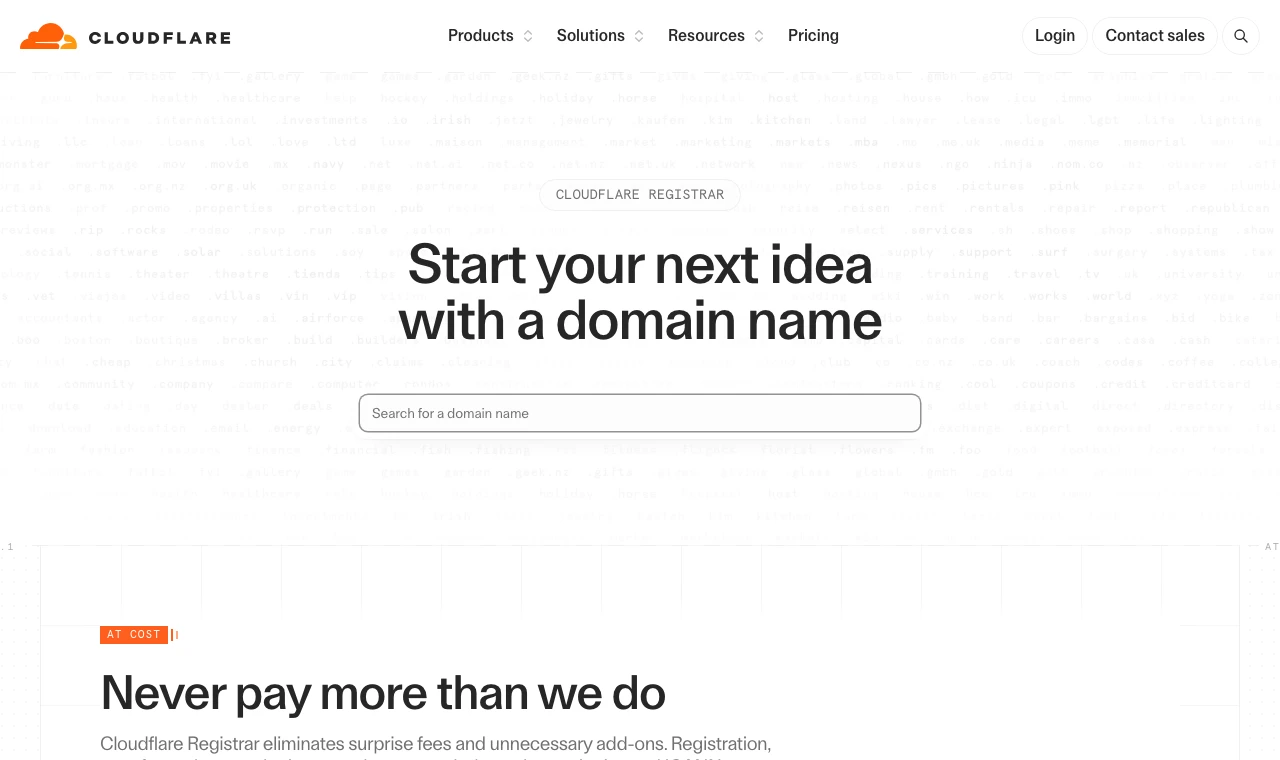
- Pricing Structure: Passes wholesale directly to users: currently $10.46 ($10.26 wholesale + $0.20 ICANN), adjusting on November 1 to exactly $11.17/year;
- Included Features: Two-factor authentication enforcement, zero-cost WHOIS privacy, and single-click DNSSEC;
- Requirement: Authoritative DNS must point to Cloudflare nameservers (a benefit for most modern infrastructure stacks).
2. Lean & Independent: Porkbun and Spaceship
- Porkbun: A beloved indie registrar maintaining razor-thin 1%–2% markups ($10.37 currently, adjusting to ~$11.08 post-Nov 1). Allows custom third-party nameservers with free privacy and SSL;
- Spaceship: Modern, lightweight interface with aggressive transfer subsidies.
3. Margin Inflation: NameSilo Standard Tier
Once a haven for budget-conscious domain holders, NameSilo's latest pricing structure bifurcates users. Regular accounts holding fewer than 100 domains jump to $19.99/year renewals, reserving competitive rates solely for bulk portfolio holders.
4. Heavy Extraction: GoDaddy & Network Solutions
GoDaddy renewal rates exceed $21.99–$24.99/year, while Network Solutions routinely bills an astonishing $37.99+/year plus auxiliary privacy fees. Leaving assets on these platforms represents unnecessary operational waste.
6. Solutions: The 10-Year Max Lock-In Strategy & Transfer Arbitrage
How can developers and engineering teams insulate budgets against the November 1 price hike and subsequent 7% annual compounding? Three proven architectural strategies provide immediate relief:
Strategy 1: The 10-Year Max Lock-In Strategy
Under ICANN's foundational registry specifications, any .COM domain can hold a maximum active registration lifespan of 10 years (120 months).
If your domain currently expires in 2027, you can immediately renew it forward by 8 to 9 years, pushing the expiry date out to 2036:
- Compounding Math: Renewing before November 1 locks in the pre-hike rate and, more critically, completely immunizes that domain against the 2027, 2028, and 2029 compounding 7% hikes;
- Over a decade, forward lock-in yields $20 to $45 in savings per domain on fair registrars, and upwards of $120 to $150 per domain when migrating away from legacy providers.
Strategy 2: Registrar Transfer Arbitrage
ICANN transfer protocols dictate that every completed registrar transfer automatically incorporates a mandatory 1-year registration extension.
Migrating domains from GoDaddy, Network Solutions, or standard NameSilo accounts to Cloudflare Registrar or Porkbun achieves two simultaneous wins:
- Unlock the domain and generate an EPP/Auth code at your current registrar;
- Initiate transfer at Cloudflare for the current $10.46 cost rate;
- Your domain gains a full extra year of validity while severing legacy billing ties.
Strategy 3: Portfolio Slimming
Every engineering team accumulates speculative project domains that never saw a production deploy. Conduct an audit and prune inactive assets before November 1.
7. Automated Toolkits: Windows 11, Ubuntu 26.04 & macOS 26
To eliminate manual registrar lookups and spreadsheet calculations, we developed an open, zero-dependency .COM Domain Lock-In & Cost Arbitrage Inspector:
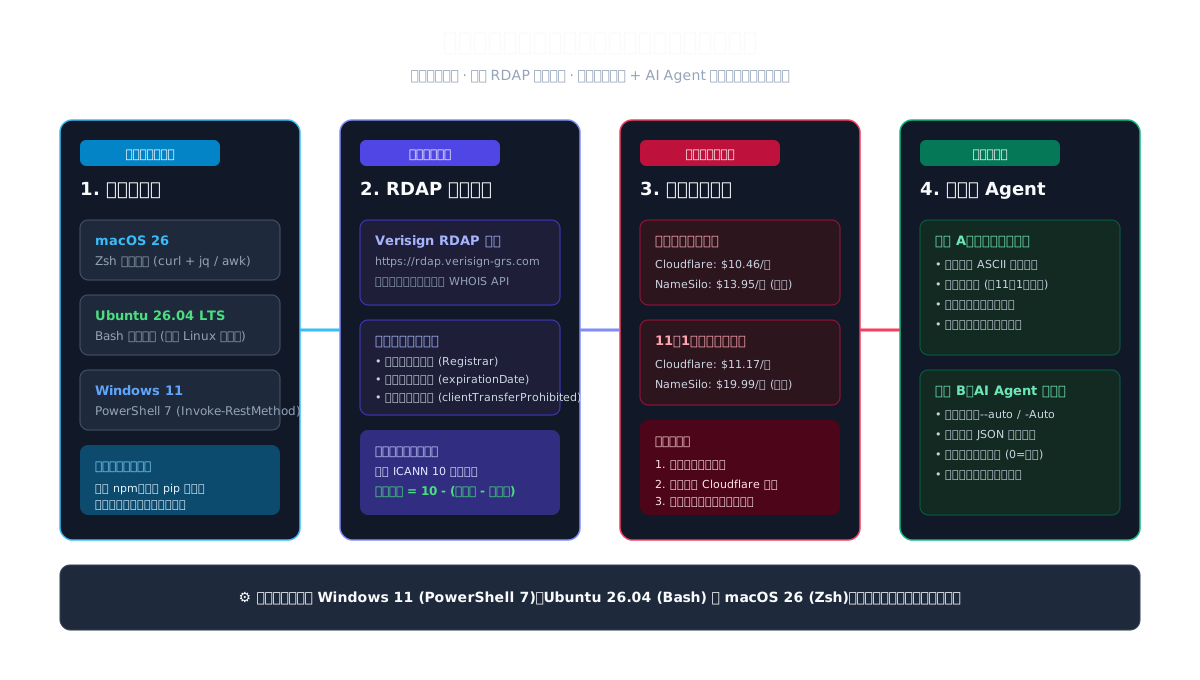
Key Engineering Tenets:
- Authoritative RDAP Integration: Queries Verisign's official RDAP endpoint (
https://rdap.verisign-grs.com/domain/{domain}) directly via HTTPS JSON without third-party API keys or rate limits; - Pure Native Implementations: Native PowerShell 7 for Windows 11, Bash for Ubuntu 26.04, and Zsh for macOS 26. No external pip or npm packages required;
- Dual Execution Architecture: Supports both interactive color terminal output and declarative silent AI Agent execution (
--auto) producing structured JSON reports.
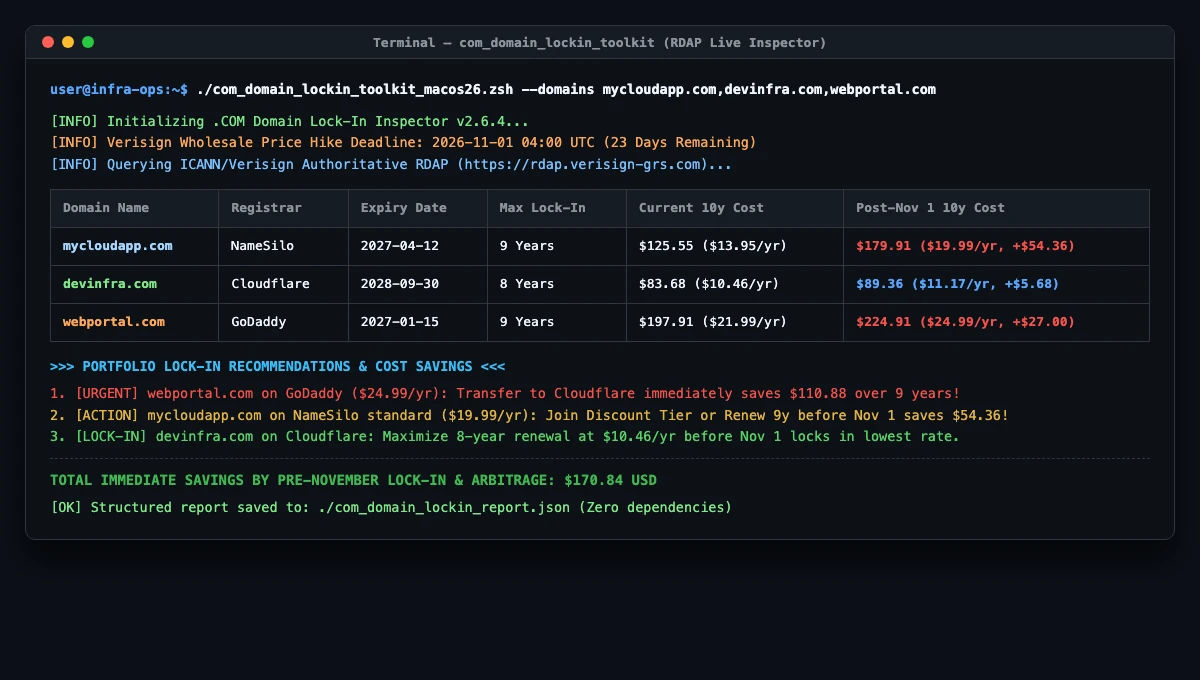
1. macOS 26 Native Zsh Deployment
# 1. Download and set permissions
curl -sSL -O https://blog.margrop.net/post-images/verisign-com-domain-price-hike-and-renewal-lock-in-guide/com_domain_lockin_toolkit_macos26.zsh
chmod +x com_domain_lockin_toolkit_macos26.zsh

# 2. Mode A: Interactive Developer Inspection
./com_domain_lockin_toolkit_macos26.zsh --domains mycloudapp.com,devinfra.com,webportal.com

# 3. Mode B: Autonomous AI Agent Execution (Outputs com_domain_lockin_report.json)
./com_domain_lockin_toolkit_macos26.zsh --auto --domains mycloudapp.com,devinfra.com
2. Ubuntu 26.04 LTS Native Bash Deployment
# 1. Download script
curl -sSL -O https://blog.margrop.net/post-images/verisign-com-domain-price-hike-and-renewal-lock-in-guide/com_domain_lockin_toolkit_ubuntu2604.sh
chmod +x com_domain_lockin_toolkit_ubuntu2604.sh

# 2. Mode A: Manual Run
./com_domain_lockin_toolkit_ubuntu2604.sh --domains mycloudapp.com,webportal.com

# 3. Mode B: Automated Scheduled Cron / Agent Pipeline
./com_domain_lockin_toolkit_ubuntu2604.sh --auto
3. Windows 11 (PowerShell 7) Deployment
# 1. Download PowerShell 7 toolkit
Invoke-WebRequest -Uri "https://blog.margrop.net/post-images/verisign-com-domain-price-hike-and-renewal-lock-in-guide/com_domain_lockin_toolkit_windows11.ps1" -OutFile "com_domain_lockin_toolkit_windows11.ps1"

# 2. Mode A: Interactive Console Inspection
pwsh -ExecutionPolicy Bypass -File .\com_domain_lockin_toolkit_windows11.ps1 -Domains "mycloudapp.com,devinfra.com"

# 3. Mode B: Agent Silent Batch Execution
pwsh -ExecutionPolicy Bypass -File .\com_domain_lockin_toolkit_windows11.ps1 -Auto -Domains "mycloudapp.com,devinfra.com"
4. Machine-Readable Agent Report Sample (com_domain_lockin_report.json)
The toolkit generates standardized JSON payloads, enabling downstream agents to trigger automated renewal workflows:
{
  "generated_at": "2026-10-09T08:15:30Z",
  "deadline": "2026-11-01T04:00:00Z",
  "days_remaining": 23,
  "total_savings_usd": 170.84,
  "domains": [
    {
      "domain": "mycloudapp.com",
      "registrar": "NameSilo",
      "expiry_date": "2027-04-12",
      "max_lockin_years": 9,
      "current_10y_cost": 125.55,
      "post_nov1_10y_cost": 179.91,
      "savings_at_registrar": 54.36,
      "arbitrage_savings_vs_cf": 54.36,
      "action": "Transfer to Cloudflare & Lock 10y"
    }
  ]
}
8. Q&A: Crucial Edge Cases & Tactical Guidance
Q1: If I renew for 10 years now, can Verisign retroactively bill me for price hikes later?
A: Never. Domain registrations operate on strict prepaid contract terms. Once payment settles prior to November 1, registry wholesale fees are fully cleared. Even if Verisign hikes rates to $50/year in the future, your pre-funded years remain fully intact.
Q2: Does transferring my domain preserve its remaining years?
A: Yes, all remaining time transfers over seamlessly and an additional year is appended. For example, if your domain has 3 years left at GoDaddy and you transfer to Cloudflare today for $10.46, your new expiration date at Cloudflare will be 4 years from now.
Q3: What about alternative TLDs like .NET, .ORG, .AI, or .IO?
A: .NET is also operated by Verisign without price caps and experiences regular increases. .AI wholesale fees were doubled following the LLM boom, pushing renewals above $70–$90/year. .IO faces geopolitical sovereignty debates regarding the Chagos Archipelago treaty. .COM remains the indisputable gold standard of global internet trust and stability, making proactive 10-year lock-in an unmatched defensive strategy.
Q4: Why not simply wait for Black Friday domain sales in late November?
A: Avoid this critical calendar trap. Black Friday promotions occur in late November, long after Verisign's November 1 global wholesale deadline. Any promotional coupons offered will be calculated against the new, higher wholesale baseline. Forward lock-in before November 1 delivers far superior net savings.
9. Conclusion & Downloadable Engineering Assets
While the modern web is built on the ideals of open collaboration, its top-level address layer remains governed by concession monopolies. While individual developers cannot rewrite ICANN treaties, we possess the engineering agency to optimize our operations: Audit your assets, eliminate markups, and lock in current rates for the next decade.
📦 Production Toolkits & Downloadable Archives
The complete native cross-platform .COM domain lock-in and RDAP audit suite is ready for deployment:
- macOS 26 Native Zsh Suite: com_domain_lockin_toolkit_macos26.zsh
- Ubuntu 26.04 Native Bash Suite: com_domain_lockin_toolkit_ubuntu2604.sh
- Windows 11 Native PowerShell 7 Suite: com_domain_lockin_toolkit_windows11.ps1
- Universal Multi-Platform Zip: com-domain-lockin-toolkit.zip
- SHA256 Cryptographic Checksums: SHA256SUMS.txt