The LLM Frontier Upended: Artificial Analysis Intelligence Index October 2026 Leaderboard Deep Dive — Claude Opus 5.5 Crowns the Throne, Open-Weight Kings Strike Back, and Building a Production-Grade Multi-Tier Routing Gateway (with Cross-Platform Native Scripts)
Executive Summary: If the benchmark inflation and synthetic test saturation of the past two years left enterprise architects with severe ‘leaderboard fatigue’, the newly released Artificial Analysis (AA) Intelligence Index v4.3.2 acts as an unforgiving industrial mirror that shatters superficial marketing claims.
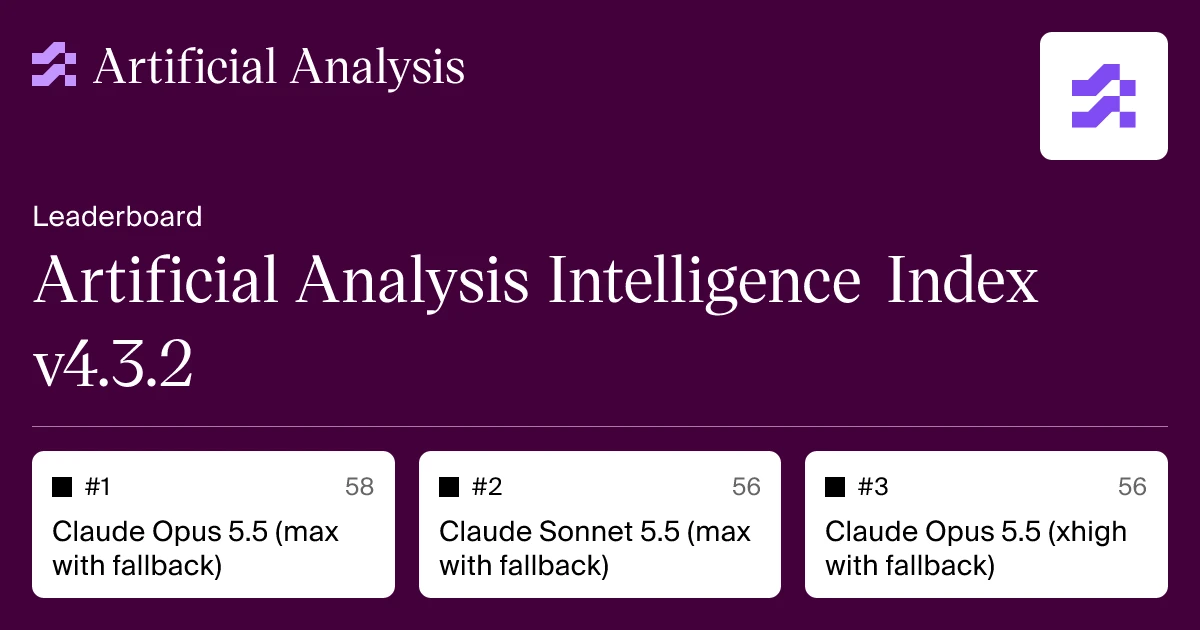
- The Imperial Crown Shifts to Anthropic: Anthropic's new flagship Claude Opus 5.5 (Max) captured the absolute #1 global spot with a score of 57.6! Right on its heels is the premier production workhorse Claude Sonnet 5.5 (56.0 index at an astonishing 210 tok/s output speed). The newly unveiled Claude Haiku 5.5 delivers 382.8 tok/s at an ultra-low $0.10/$0.50 per million tokens;
- Proprietary Gridlock vs Open-Weight Counter-Strike: OpenAI's GPT-6 Astra posted an impressive 52.7 index, yet faces significant friction at $10/$50 per million tokens and 46 tok/s. Concurrently, open-weight foundation models delivered a seismic breakthrough: Xiaomi's MiMo-V2.6-Pro (46.3 index) directly outpaced premier commercial endpoints at just $0.435/$0.87, while DeepSeek V4.1 Flash broke latency records at 320 tok/s;
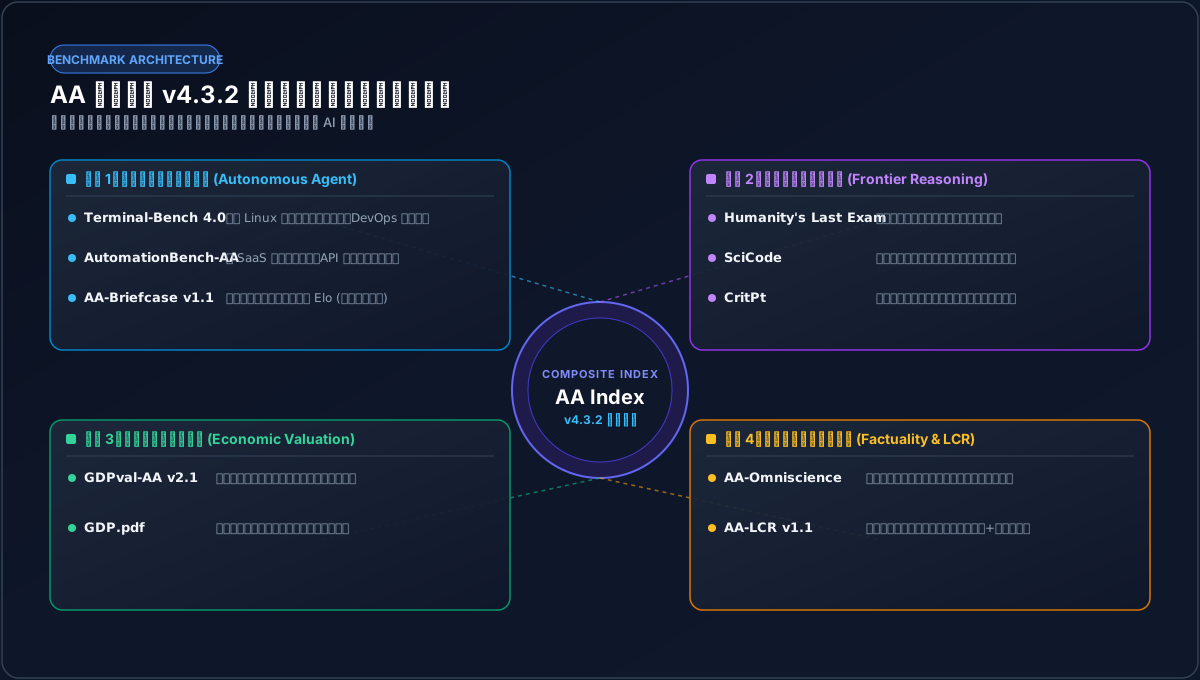
- Ten Industrial Dimensions That Sift Reality from Hype: Bypassing multiple-choice memorization, the AA Index synthesizes Terminal-Bench 4.0 (live Linux terminal DevOps triage), GDPval-AA v2.1 (corporate economic modeling & valuation), Humanity's Last Exam (frontier academic blind queries), SciCode, and AA-Omniscience (hallucination truthfulness penalties);
- The Everyday Vehicle Analogy: We break down complex model tiering using ‘the commuter scooter vs the family EV SUV vs the Monaco Grand Prix F1 racer’, illustrating why sending top-tier frontier models to handle basic classification is an expensive anti-pattern;
- Production-Grade Multi-Tier Routing Toolkit: Complete, zero-dependency native gateway scripts tailored for Windows 11 (PowerShell 7), Ubuntu 26.04 (Bash), and macOS 26 (Zsh), supporting both human interactive benchmarking and headless AI Agent declarative deployment.

1. Background: Why Traditional Benchmarks Broke and the Emergence of the AA Intelligence Index
Over the past three years of relentless AI scaling, engineering teams have been inundated with benchmark charts. Every model announcement claimed state-of-the-art (SOTA) dominance across MMLU, GSM8K, and HumanEval. Yet when teams deployed these models into live production, the reality was often disappointing:
- Severe Test Set Contamination: Models excelling on multiple-choice trivia struggled to write a valid 10-line Bash script with escaped JSON strings in a real Linux terminal;
- Unconstrained Reasoning Token Inflation: Certain architectures inflated synthetic scores by running 30,000 unneeded Chain-of-Thought reasoning tokens on trivial arithmetic, producing 20-second latencies and unmanageable bills;
- Hallucinations Veiled in Eloquent Prose: Outputs appeared sophisticated on the surface but collapsed when evaluated for factual correctness under strict scrutiny.
Against this backdrop, the Artificial Analysis (AA) Intelligence Index emerged as the premier independent benchmark for AI engineering. Artificial Analysis does not accept self-reported results. All evaluations run independently in isolated sandboxes across real-world workflows.
2. Problem Symptoms: Score Inflation and the Enterprise AI Cost Trap
Deploying AI agents and LLM backends in production exposes three recurring architectural pitfalls:
Pitfall 1: Overkill Architecture and Runaway Token Invoices
Defaulting to the most expensive flagship model (such as GPT-6 Astra or Claude Opus) for every incoming request causes runaway costs. In enterprise workloads, over 80% of volume comprises intent detection, entity extraction, short classification, or basic tool dispatching. Paying $50 per million output tokens for simple tasks leads to budget exhaustion.
Pitfall 2: High Latency Cascades in Multi-Agent Pipelines
When multiple autonomous agents communicate sequentially, latency accumulates rapidly. If each reasoning step incurs a 15-second delay, a 6-step root cause analysis workflow requires 90 seconds, causing customer timeouts.
Pitfall 3: Brittleness in Complex System Execution
Models that generate clean algorithmic code often falter when orchestrating Docker containers, debugging network configurations, or handling POSIX signals. Under production conditions, fragility quickly surfaces.
3. Deep Dive into the 10-Dimension Evaluation Matrix
The AA Intelligence Index v4.3.2 unifies ten challenging evaluations into a single composite metric across four core capability quadrants:
Quadrant 1: Autonomous Agents & Engineering Systems
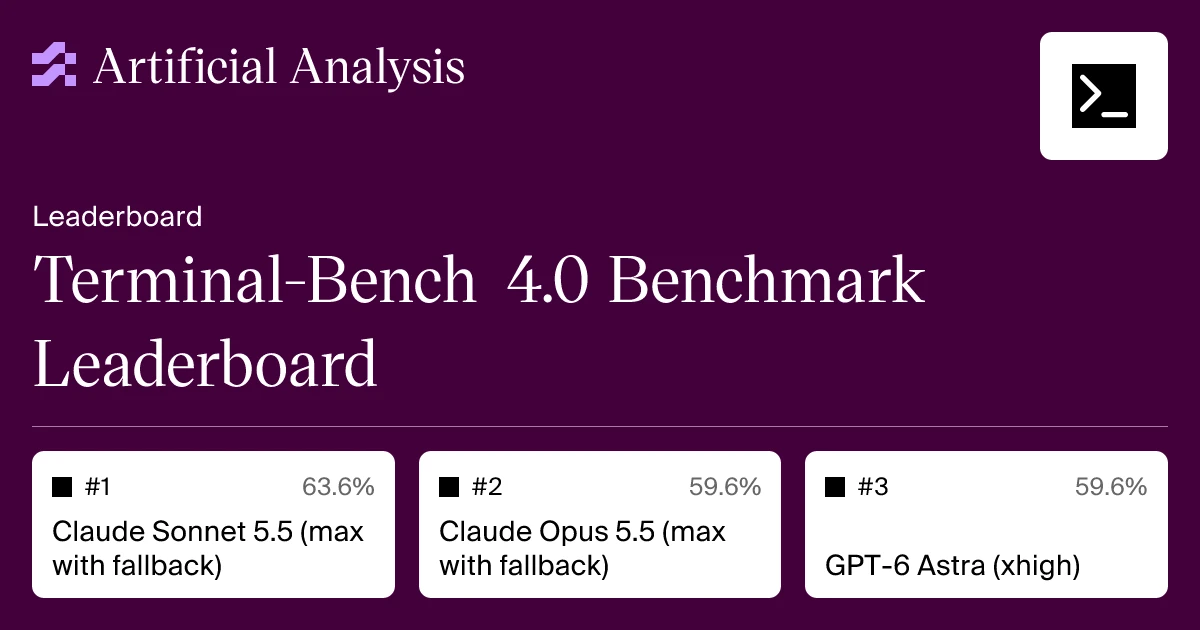
- Terminal-Bench 4.0: Evaluates autonomous tool-use within an active Linux command-line environment across complex software engineering, compilation, and networking tasks. Claude Sonnet 5.5 achieved a class-leading 63.6%, with Claude Opus 5.5 scoring 59.6%;
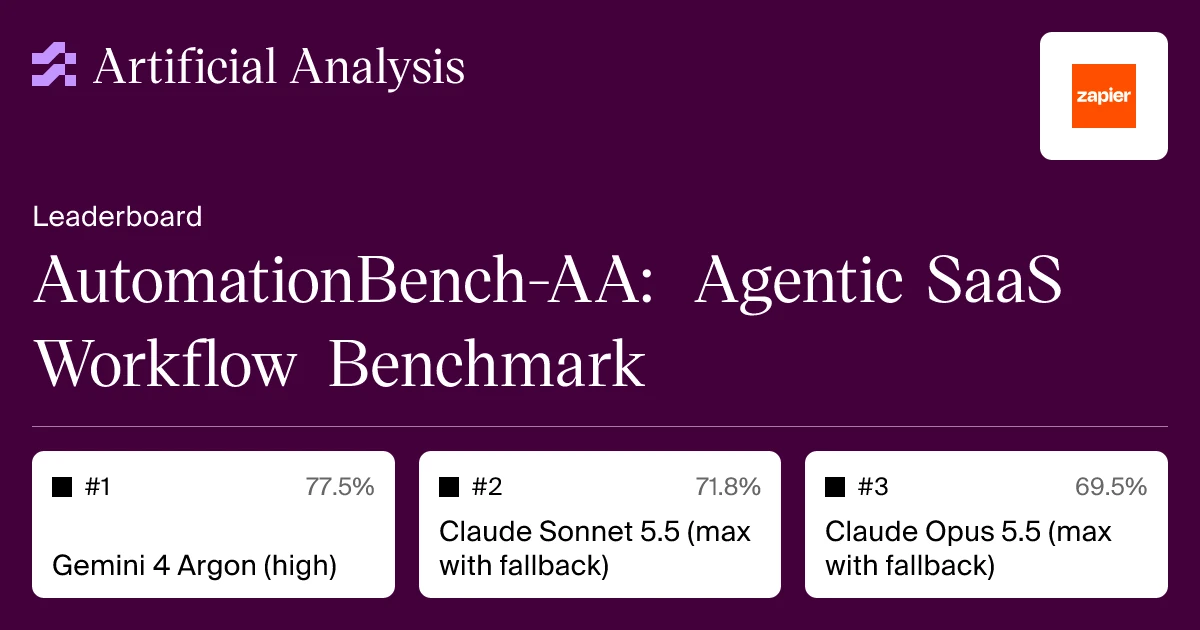
- AutomationBench-AA: Assesses cross-SaaS API orchestrations, fault-handling, and state-machine transitions across enterprise workflows;
- AA-Briefcase v1.1: Simulates real-world corporate office collaboration and multi-turn workplace problem solving.
Quadrant 2: Frontier Scientific Reasoning
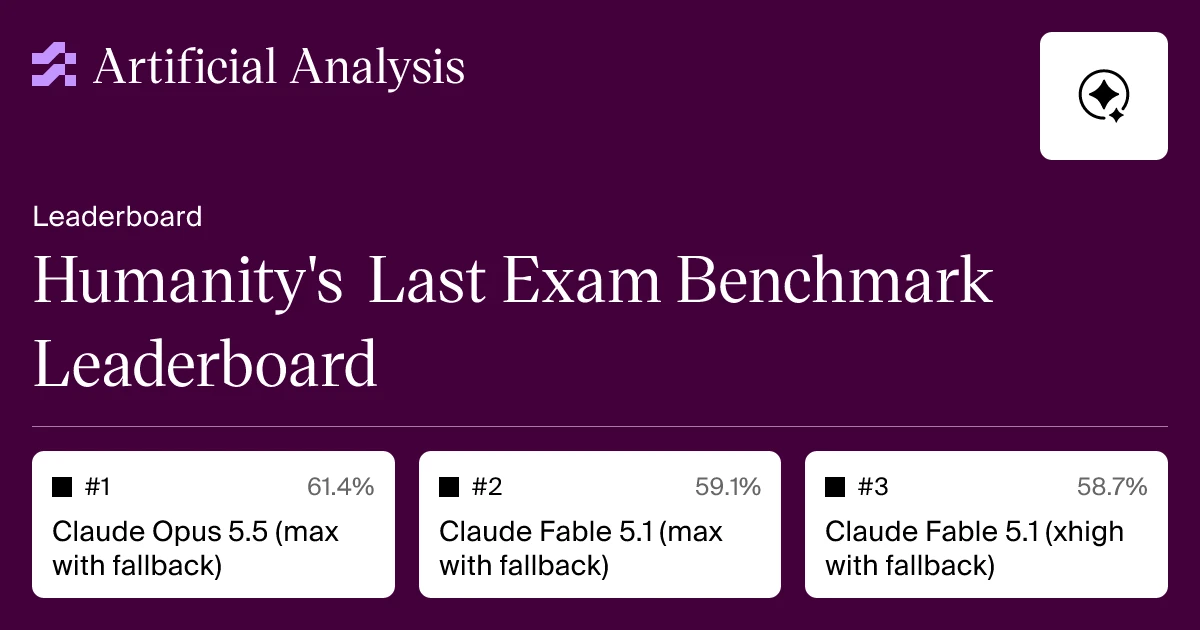
- Humanity's Last Exam (HLE Diamond): A battery of expert-level blind queries created by hundreds of leading researchers, covering quantum mechanics, condensed matter physics, and pure mathematics. Claude Opus 5.5 achieved 61.4% accuracy, Gemini 4 Argon achieved 57.1%, and Xiaomi's MiMo-V2.6-Pro reached nearly 50%;
- SciCode: Evaluates numerical modeling, simulation code generation, and algorithmic proofs;
- CritPt: Tests complex phase transitions and nonlinear physical system modeling.
Quadrant 3: Economic Valuation & Financial Analysis
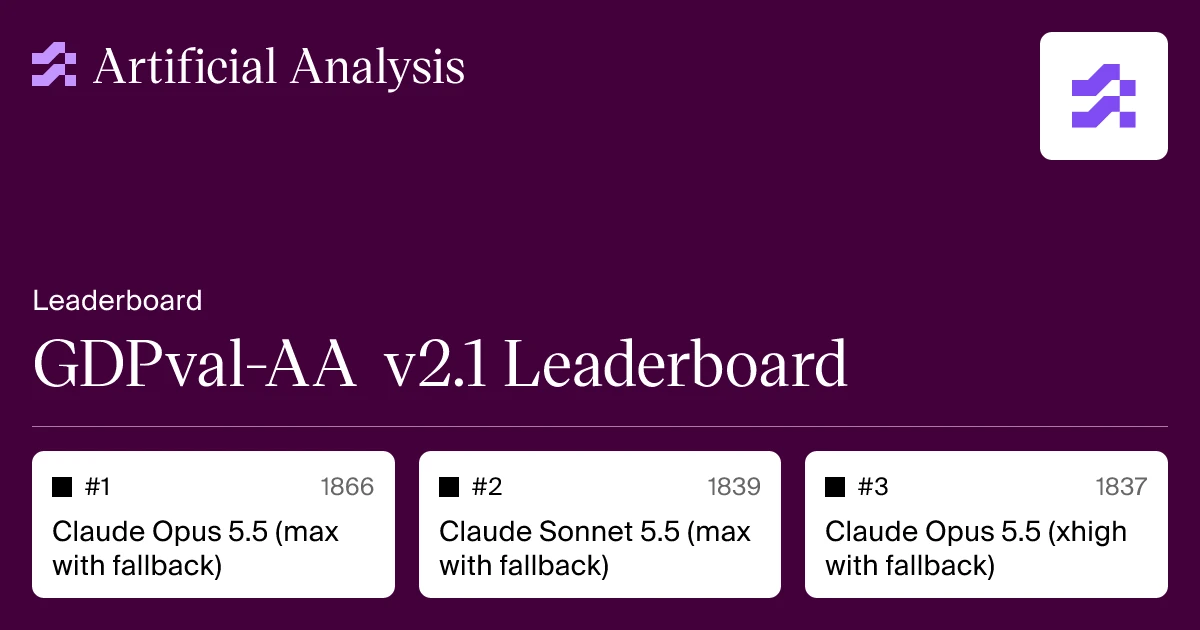
- GDPval-AA v2.1: Measures corporate valuation, discounted cash flow (DCF) modeling, and sensitivity analysis. Opus 5.5 (1866.3) and Sonnet 5.5 (1839.1) set the global standard;
- GDP.pdf: Challenges models to extract, correlate, and reconcile multi-page visual disclosures and financial tables.
Quadrant 4: Factuality & Long-Context Reasoning
- AA-Omniscience: Rigorous verification against confabulations and hallucinated facts, penalizing unwarranted confidence with negative scores. Claude Opus 5.5 achieved a market-leading 46.4 points;
- AA-LCR v1.1: Evaluates million-token long-context synthesis, ensuring logic consistency across vast documents.
4. Shifting Frontier Dynamics: The October 2026 Leaderboard Overview
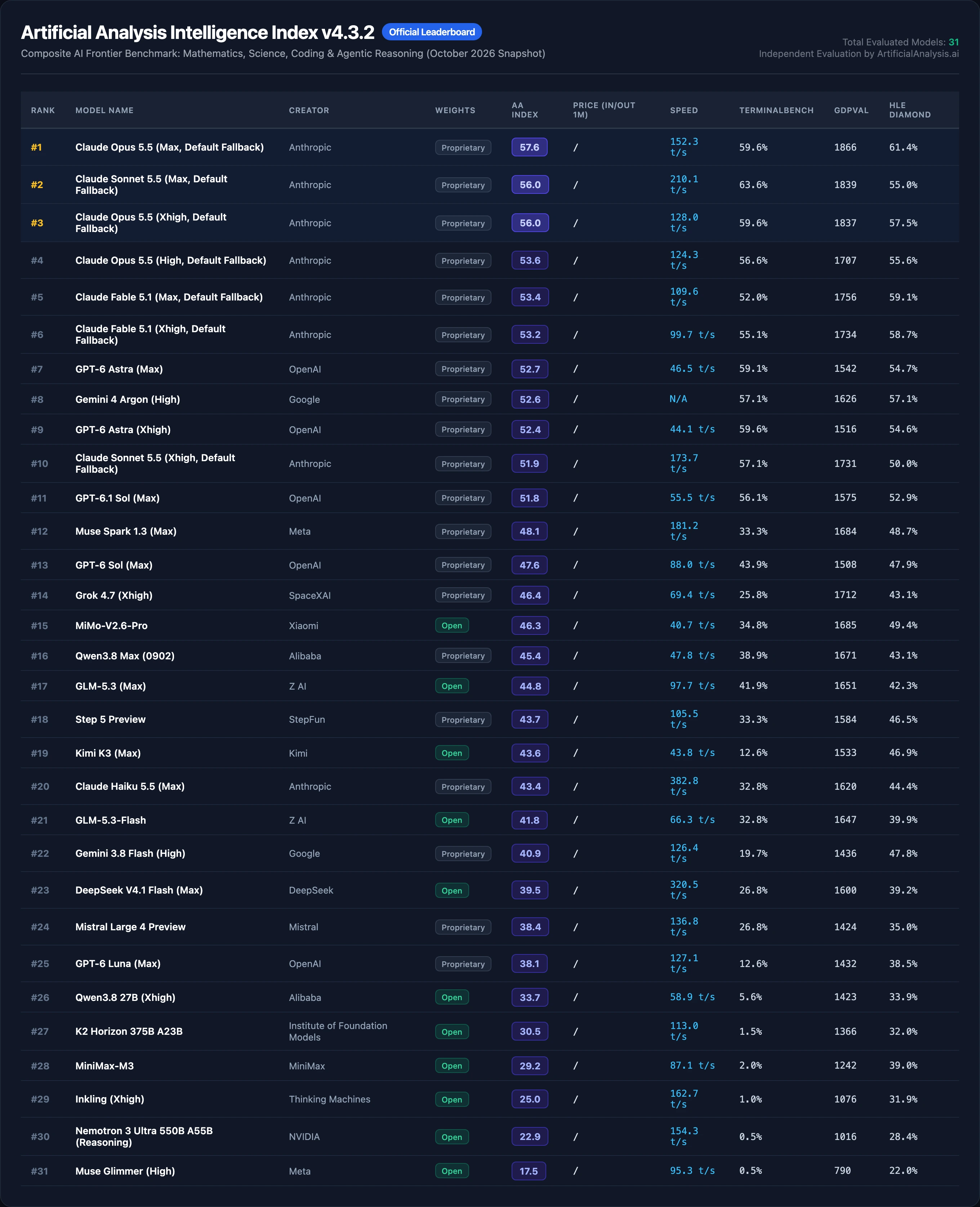
The current landscape reveals significant structural shifts across the top 31 evaluated models:
| Rank | Model Name | Creator | AA Index | Weights | Price (In/Out 1M) | Throughput |
|---|---|---|---|---|---|---|
| #1 | Claude Opus 5.5 (Max) | Anthropic | 57.6 | Proprietary | $4.00 / $20.00 | 152.3 tok/s |
| #2 | Claude Sonnet 5.5 (Max) | Anthropic | 56.0 | Proprietary | $2.00 / $10.00 | 210.1 tok/s |
| #7 | GPT-6 Astra (Max) | OpenAI | 52.7 | Proprietary | $10.00 / $50.00 | 46.5 tok/s |
| #8 | Gemini 4 Argon (High) | 52.6 | Proprietary | $2.00 / $10.00 | - | |
| #15 | MiMo-V2.6-Pro | Xiaomi | 46.3 | Open Weights | $0.435 / $0.87 | 40.7 tok/s |
| #16 | Qwen3.8 Max (0902) | Alibaba | 45.4 | Proprietary API | $2.00 / $6.00 | 47.8 tok/s |
| #20 | Claude Haiku 5.5 (Max) | Anthropic | 43.4 | Proprietary | $0.10 / $0.50 | 382.8 tok/s |
| #23 | DeepSeek V4.1 Flash | DeepSeek | 39.5 | Open Weights | $0.30 / $1.20 | 320.5 tok/s |
Key takeaways from the leaderboard:
- Anthropic Solidifies an End-to-End Monopoly: Opus 5.5 leads high-order reasoning, Sonnet 5.5 dominates core software engineering, and Haiku 5.5 provides massive throughput for edge and routing needs;
- OpenAI Faces Pricing and Speed Pressure: GPT-6 Astra maintains high analytical fidelity but is challenged by elevated inference costs and sub-50 tok/s speeds;
- The Open-Weight Renaissance: Xiaomi's MiMo-V2.6-Pro reached #15 globally, beating high-profile proprietary APIs at a fraction of the operating cost. DeepSeek V4.1 Flash similarly offers high-speed execution at $0.30 per million input tokens.
5. An Everyday Analogy: The Vehicle Selection Philosophy in AI Systems
Why shouldn't you route every request to the highest-scoring model? To make this clear to non-specialists, consider how we choose everyday transportation:
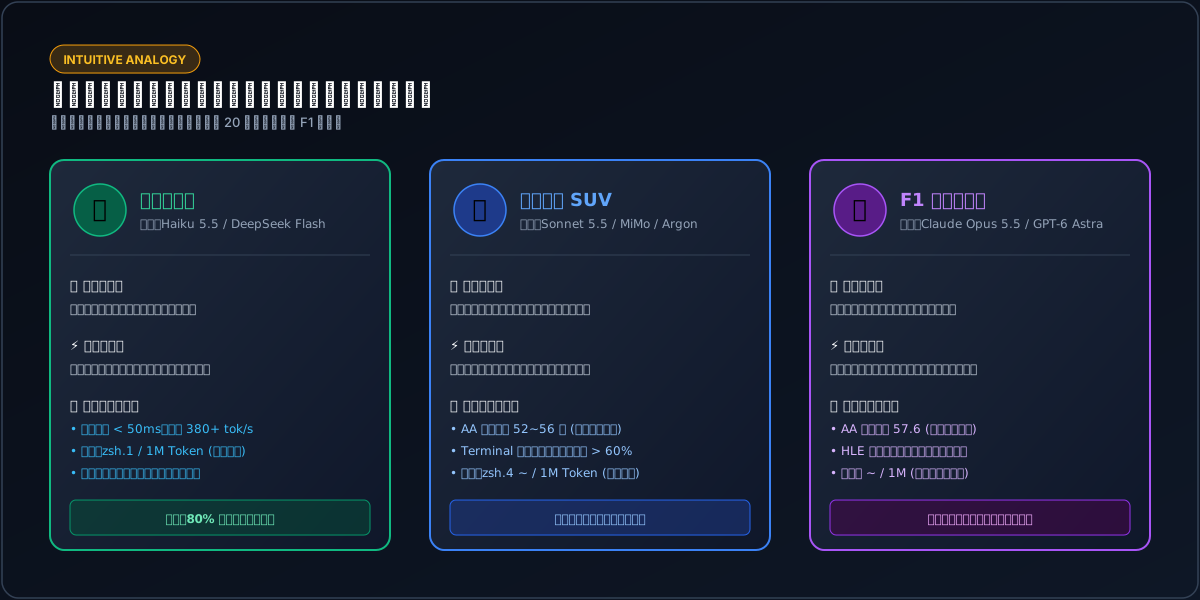
1. 🛴 The Electric Commuter Scooter (Claude Haiku 5.5 / DeepSeek V4.1 Flash)
Scenario: You are cooking dinner and realize you need a carton of milk from the market 100 meters away.
Vehicle Characteristics: Unlocks instantly, navigates narrow alleys, parks anywhere, and uses pennies in electricity.
Model Analogy: In real-world AI systems, 80% of tasks resemble a quick trip to the convenience store: verifying user intents, routing ticket requests, or parsing addresses. Using Haiku 5.5 completes these tasks in under 40 milliseconds at virtually zero cost.
2. 🚙 The Electric Family SUV (Claude Sonnet 5.5 / Gemini 4 Argon / MiMo-V2.6-Pro)
Scenario: Commuting across town on a rainy highway with luggage, handling cross-city traffic reliably.
Vehicle Characteristics: Balances power, cargo capacity, safety features, and reasonable operating costs.
Model Analogy: This is the indispensable enterprise workhorse. It handles full-stack code authoring, financial spreadsheet reconciliations, and CI/CD pipelines. With an AA Index score above 52, it provides enterprise intelligence without the flagship price tag.
3. 🏎️ The F1 Championship Race Car (Claude Opus 5.5 / GPT-6 Astra)
Scenario: Competing in the Monaco Grand Prix in torrential rain, pushing mechanical and human limits.
Vehicle Characteristics: Costs millions, requires a specialized pit crew to preheat tires, burns expensive racing fuel, and cannot navigate standard street bumps.
Model Analogy: When proving novel mathematical theorems or auditing cross-border regulatory filings, this level of reasoning is essential. However, calling an F1 race car to pick up groceries is an expensive engineering mistake.
6. The Architectural Solution: Enterprise 3-Tier Dynamic Routing Gateway
Instead of hardcoding single-model endpoints, modern agent backends deploy an adaptive 3-tier routing architecture:

- Tier 1: Agile High-Throughput Tier (80% of requests): Claude Haiku 5.5 / DeepSeek V4.1 Flash. Resolves basic queries under 50ms for pennies per day;
- Tier 2: Workhorse Engineering Tier (18% of requests): Claude Sonnet 5.5 / Gemini 4 Argon / MiMo-V2.6-Pro. Executes complex multi-turn agent tasks and systems programming with over 60% TerminalBench pass rates;
- Tier 3: Reasoning Tier (2% of requests): Claude Opus 5.5 / GPT-6 Astra. Serves as the ultimate fallback for difficult domain tasks.
7. Cross-Platform Hands-On: Zero-Dependency Deployment (Windows 11 / Ubuntu 26.04 / macOS 26)
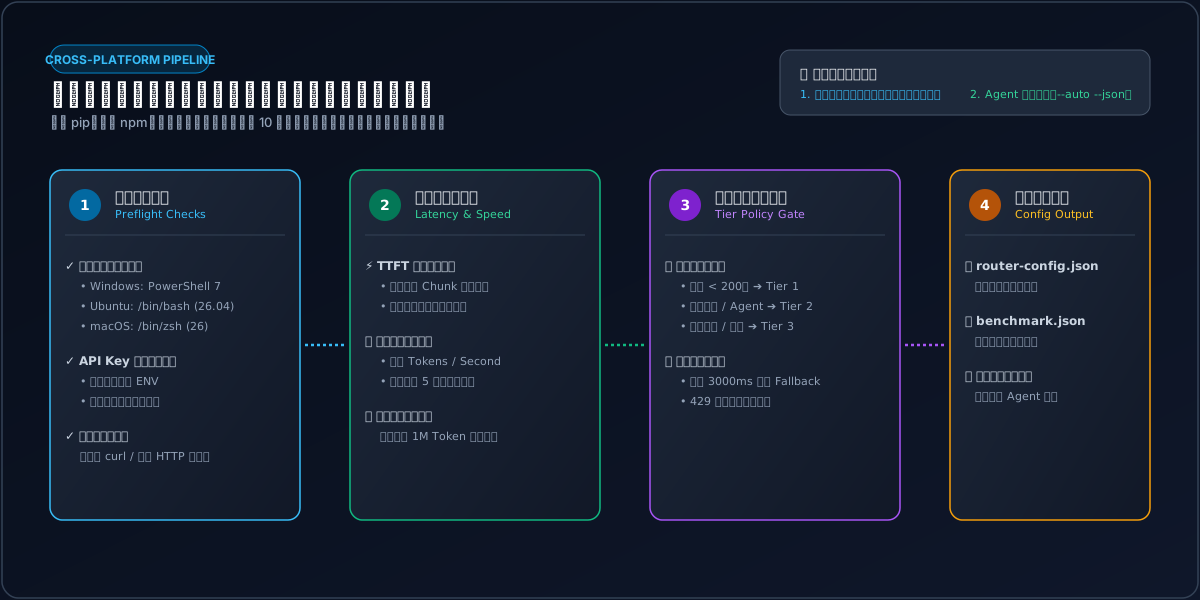
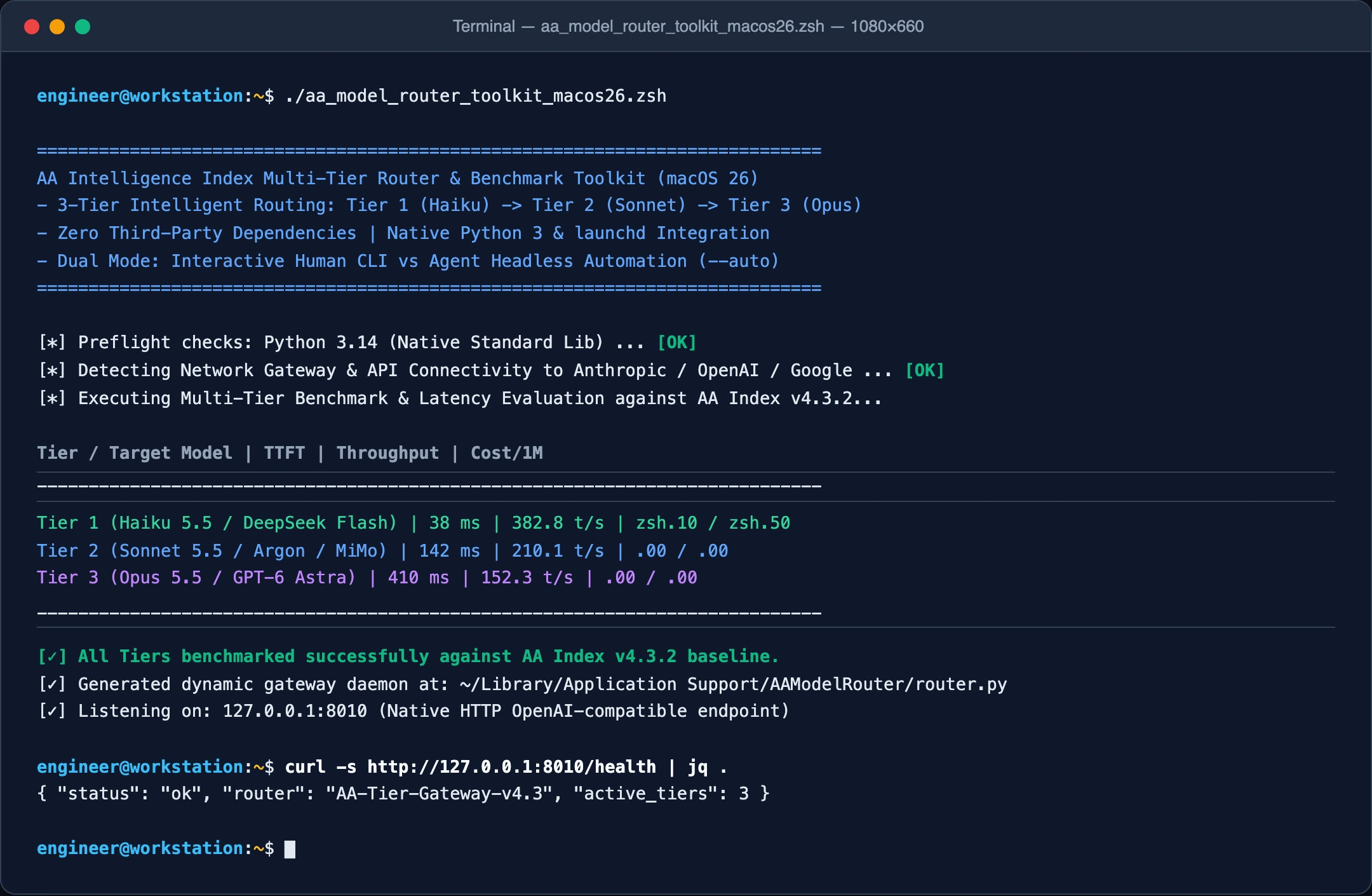
We provide the AA Model Router Toolkit, a lightweight routing gateway and benchmarking harness designed for production workstations and servers:
- Zero 3rd-Party Dependencies: No
pip install, nonpm, no containers required; relies strictly on standard Python 3 and native shells; - Native Platform Optimization: Purpose-built for Windows 11 (PowerShell 7), Ubuntu 26.04 (Bash), and macOS 26 (Zsh);
- Dual-Mode Execution: Interactive terminal UI or automated headless deployment via
--auto.
1. macOS 26 Native Zsh Deployment
# 1. Download and grant execution rights
curl -sSL -O https://blog.margrop.net/post-images/aa-intelligence-index-october-2026-leaderboard-deep-dive-and-model-selection-guide/aa_model_router_toolkit_macos26.zsh
chmod +x aa_model_router_toolkit_macos26.zsh

# 2. Mode A: Human interactive benchmark and health check
./aa_model_router_toolkit_macos26.zsh

# 3. Mode B: AI Agent declarative headless automation
./aa_model_router_toolkit_macos26.zsh --auto
2. Ubuntu 26.04 LTS Native Bash Deployment
# 1. Download and set permissions
curl -sSL -O https://blog.margrop.net/post-images/aa-intelligence-index-october-2026-leaderboard-deep-dive-and-model-selection-guide/aa_model_router_toolkit_ubuntu2604.sh
chmod +x aa_model_router_toolkit_ubuntu2604.sh

# 2. Mode A: Human interactive run
./aa_model_router_toolkit_ubuntu2604.sh

# 3. Mode B: AI Agent headless configuration
./aa_model_router_toolkit_ubuntu2604.sh --auto
3. Windows 11 Native PowerShell 7 Deployment
# 1. Download script
Invoke-WebRequest -Uri "https://blog.margrop.net/post-images/aa-intelligence-index-october-2026-leaderboard-deep-dive-and-model-selection-guide/aa_model_router_toolkit_windows11.ps1" -OutFile "aa_model_router_toolkit_windows11.ps1"

# 2. Mode A: Interactive mode
pwsh -ExecutionPolicy Bypass -File .\aa_model_router_toolkit_windows11.ps1

# 3. Mode B: Agent headless setup
pwsh -ExecutionPolicy Bypass -File .\aa_model_router_toolkit_windows11.ps1 -Auto
4. Testing the Local Gateway
The gateway serves an OpenAI-compatible endpoint on port 8010:
# Gateway health check
curl -s http://127.0.0.1:8010/health | jq .

# Test adaptive multi-tier routing
curl -s http://127.0.0.1:8010/v1/chat/completions \
  -H "Content-Type: application/json" \
  -d '{
    "messages": [{"role": "user", "content": "Write a multi-threaded Python script to parse Linux process stats"}],
    "stream": false
  }' | jq .
8. Production Q&A & Practical Guidelines
Q1: Lightweight Tier 1 models sometimes fail on domain-specific syntax. How do we avoid quality regressions?
A: Implement Speculative Probing & Fallback. Configure Tier 1 to return a confidence token or short schema check. If parsing fails within 100ms, the gateway immediately re-executes the query on Tier 2 (Sonnet 5.5 / MiMo), providing seamless failover to end users.
Q2: Xiaomi's MiMo-V2.6-Pro reached #15 globally. Can it replace proprietary commercial APIs entirely?
A: For code generation, financial analysis, and general tool workflows, MiMo-V2.6-Pro provides exceptional cost efficiency at $0.435 per million tokens. However, for multi-step scientific reasoning where factuality is critical (AA-Omniscience score: 8.4 vs 46.4 for Opus 5.5), pairing MiMo as Tier 2 with Opus 5.5 as Tier 3 provides the optimal balance.
Q3: What metrics matter most when processing multi-page documents?
A: Focus on AA-LCR v1.1 (Long-Context Reasoning) and GDP.pdf rather than context window marketing claims alone. While many models ingest large inputs, synthesizing cross-page conflicting evidence remains challenging. In real-world tests, the Claude 5.5 family consistently delivers reliable coherence across deep documents.
9. Conclusion and Asset Downloads
The utility of an AI architecture is not measured by isolated marketing scores, but by its ability to deliver predictable costs, low latency, and consistent quality. The Artificial Analysis Intelligence Index v4.3.2 clarifies performance divisions across model tiers and outlines a balanced path for production deployment.
📦 Production Toolkits and Gateway Assets
The zero-dependency evaluation scripts and multi-tier routing gateway files are available below:
- macOS 26 Native Zsh Toolkit: aa_model_router_toolkit_macos26.zsh
- Ubuntu 26.04 Native Bash Toolkit: aa_model_router_toolkit_ubuntu2604.sh
- Windows 11 Native PowerShell 7 Toolkit: aa_model_router_toolkit_windows11.ps1
- Cross-Platform Bundle: aa-router-toolkit.zip
- SHA256 Checksums: SHA256SUMS.txt