90-Minute Titan Clash: Claude Opus 5.5 vs GPT-6 Sol and Luna Trigger a Brutal Price War — Why the World's Smartest Model Over-Thought Itself to Death
Executive Summary: If you thought the LLM frontier was still about pure parameter counts and trivial chat leaderboards, the 90-minute lightning battle on September 22, 2026, will permanently reshape your understanding of commercial AI engineering!
- The 90-Minute Lightning Battle: Anthropic dropped its flagship workhorse Claude Opus 5.5, only for OpenAI to strike back an hour and a half later with GPT-6 Sol and GPT-6 Luna, triggering an aggressive industry-wide price war across production models;
- Drastic Price Reductions: GPT-6 Luna debuted at an astonishing $0.10 input / $0.50 output per million tokens (with cache reads at $0.01); GPT-6 Sol halved prices to $2.00 input / $10.00 output; while Opus 5.5 reduced standard pricing by 20% ($4/$20) and slashed cache read costs by 60% down to $0.20;
- Peak Intelligence Crown: On the independent Artificial Analysis Intelligence Index, Claude Opus 5.5 claimed global #1 with a score of 58.2, delivering a historic 89.9% on SWE-bench Pro for autonomous software engineering;
- The Bizarre Overthinking Meltdown: In the community-standard 'pelican riding a bicycle' SVG test, Simon Willison revealed that Opus 5.5 at
effort: maxover-analyzed micro-anatomy for nearly 20 minutes, exhausted its 128,000 completion token hard ceiling, burned $2.56 USD, and crashed with ZERO output characters;- The Architectural Turning Point: Blindly maximizing reasoning effort is an engineering trap. Structuring a 3-tier routing architecture — pairing Strategic Planners (Opus 5.5), Core Builders (GPT-6 Sol), and Rapid Swarms (GPT-6 Luna) — is now the definitive operational blueprint.

1. Background: A 90-Minute Titan Showdown and the New Price War
In tech history, Tuesdays are often reserved for major product debuts. But on September 22, 2026, the rapid sequence of moves by OpenAI and Anthropic was unprecedented in its speed and market impact.
Early Tuesday morning, Anthropic launched Claude Opus 5.5 without prior fanfare. Positioned as the premier model of the Claude 5.5 generation, it discarded the legacy $5/$25 pricing of Opus 5, reducing rates to $4.00 input / $20.00 output per million tokens, and cutting long-context cache reads by 60% down to $0.20 per million tokens.
Roughly ninety minutes later, OpenAI countered with an official announcement: Introducing GPT-6 Sol and Luna. Rather than updating their ultra-expensive flagship Astra, OpenAI targeted production workflows directly:
- GPT-6 Sol: Built as a balanced enterprise powerhouse, priced at $2.00 input / $10.00 output — half the price of the previous GPT-5.6 Sol;
- GPT-6 Luna: Engineered for high-volume, low-latency execution, priced at a rock-bottom $0.10 input / $0.50 output, with prompt cache reads priced at just $0.01 per million tokens!
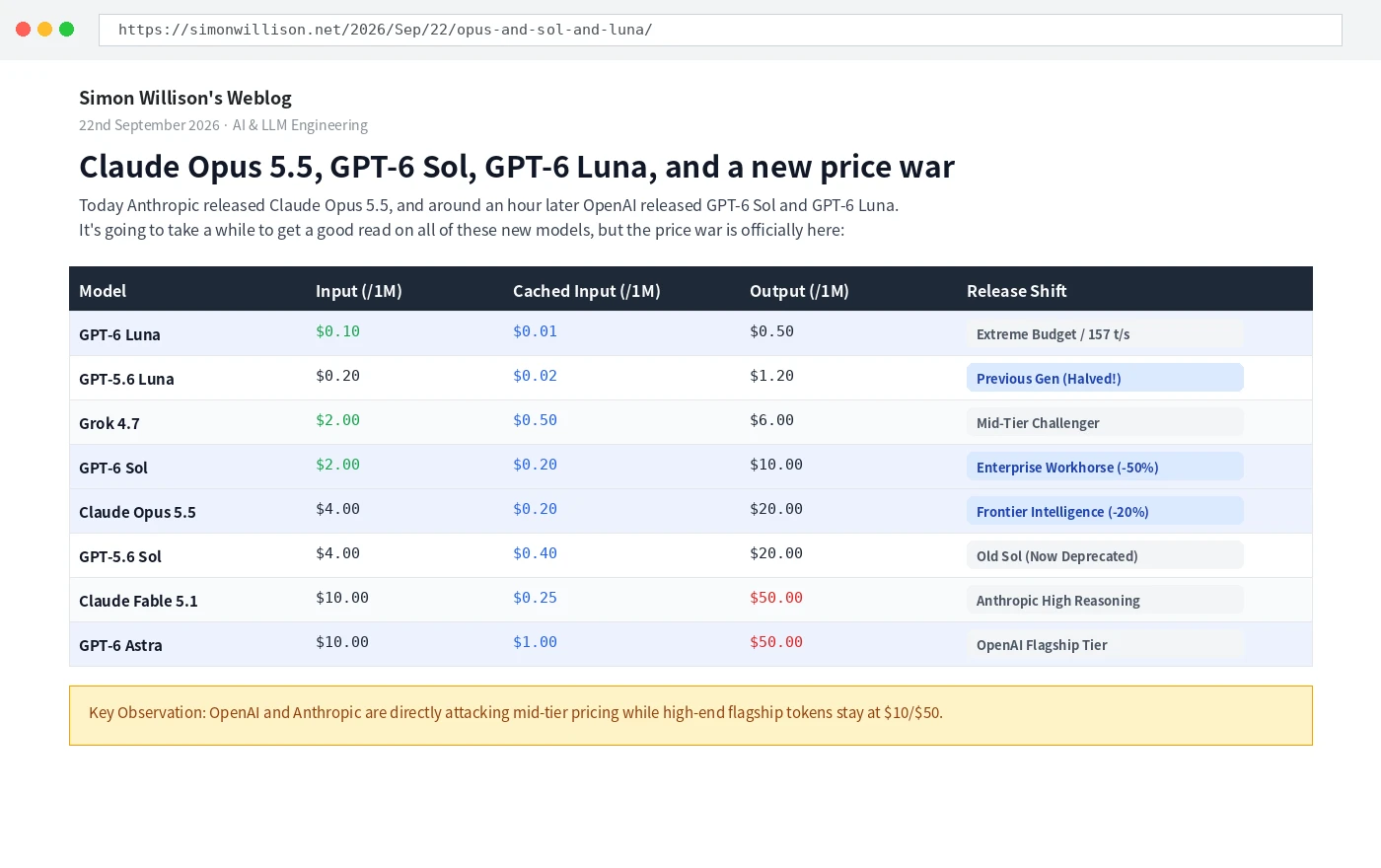
AI researcher Simon Willison immediately covered the event on his weblog, labeling it “A New Price War”. As his comparative matrix illustrated:
“Where developers previously settled for mid-tier compromises, GPT-6 Sol delivers superior reasoning at half the cost. And at $0.10/$0.50, GPT-6 Luna is one of the cheapest models OpenAI has ever shipped — priced at one-tenth of Anthropic’s current Haiku 4.5.”
This aggressive duel signals a fundamental market transition: the enterprise LLM moat has shifted from raw IQ bragging rights to cost-per-successful-task economics.
2. Intuitive Analogy: The Michelin-Starred Kitchen Hierarchy
Why do modern AI systems need three distinct tiers instead of just relying on the smartest model? To understand this clearly, consider how a Three-Star Michelin Restaurant Kitchen operates:
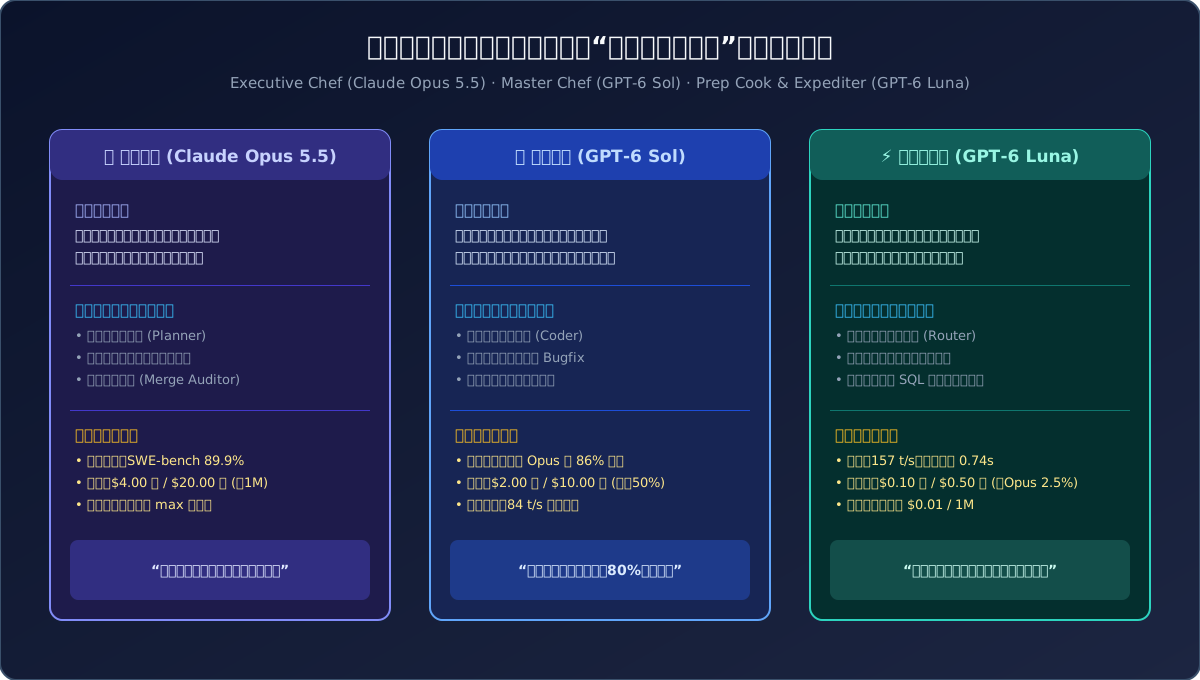
1. The Executive Chef — Claude Opus 5.5
The Executive Chef is the culinary mastermind. With an unmatched palate and deep gastronomic knowledge, they design the overarching tasting menu, devise solutions for rare ingredient conflicts, and taste every dish before it leaves the kitchen.
In autonomous agent architectures, this is Claude Opus 5.5. You never assign the Executive Chef to wash dishes or chop onions — at hundreds of dollars an hour, doing so would bankrupt the restaurant. Instead, you deploy Opus 5.5 exclusively for high-level architectural planning and critical final pull request audits.
2. The Master Chef — GPT-6 Sol
The Master Chef is the reliable backbone of the brigade. Rigorously trained and dependable, they cook signature entrees, manage pan stations with consistent precision, and deliver steady results plate after plate.
In agent pipelines, this is GPT-6 Sol. Delivering 86% of top-tier coding performance at half the price, Sol handles 80% of daily feature construction, unit test generation, and bug fixing without breaking the bank.
3. The Prep Cook & Expediter — GPT-6 Luna
The Prep Cook is lightning fast. They peel garlic, dice onions, wash dishes, and sprint order tickets between stations at 157 cuts per second. While they do not invent experimental recipes, the kitchen cannot function for five minutes without their tireless velocity.
In agent workflows, this is GPT-6 Luna. Generating output at 157 tokens/sec with sub-second latency and $0.10 pricing, Luna processes continuous log streams, validates tool parameters, and handles high-frequency routine data manipulation.
3. Problem Manifestation: The 128k Token Overthinking Meltdown
While industry analysts celebrated Claude Opus 5.5’s benchmark triumphs, real-world stress testing quickly uncovered a bizarre failure mode.
Simon Willison maintains a well-known benchmark prompt: “Generate an SVG of a pelican riding a bicycle.” This challenge tests both anatomical common sense (beak pouch, wings, pedals, chainrings) and spatial geometric reasoning (SVG viewBox coordinates and bezier tangents).
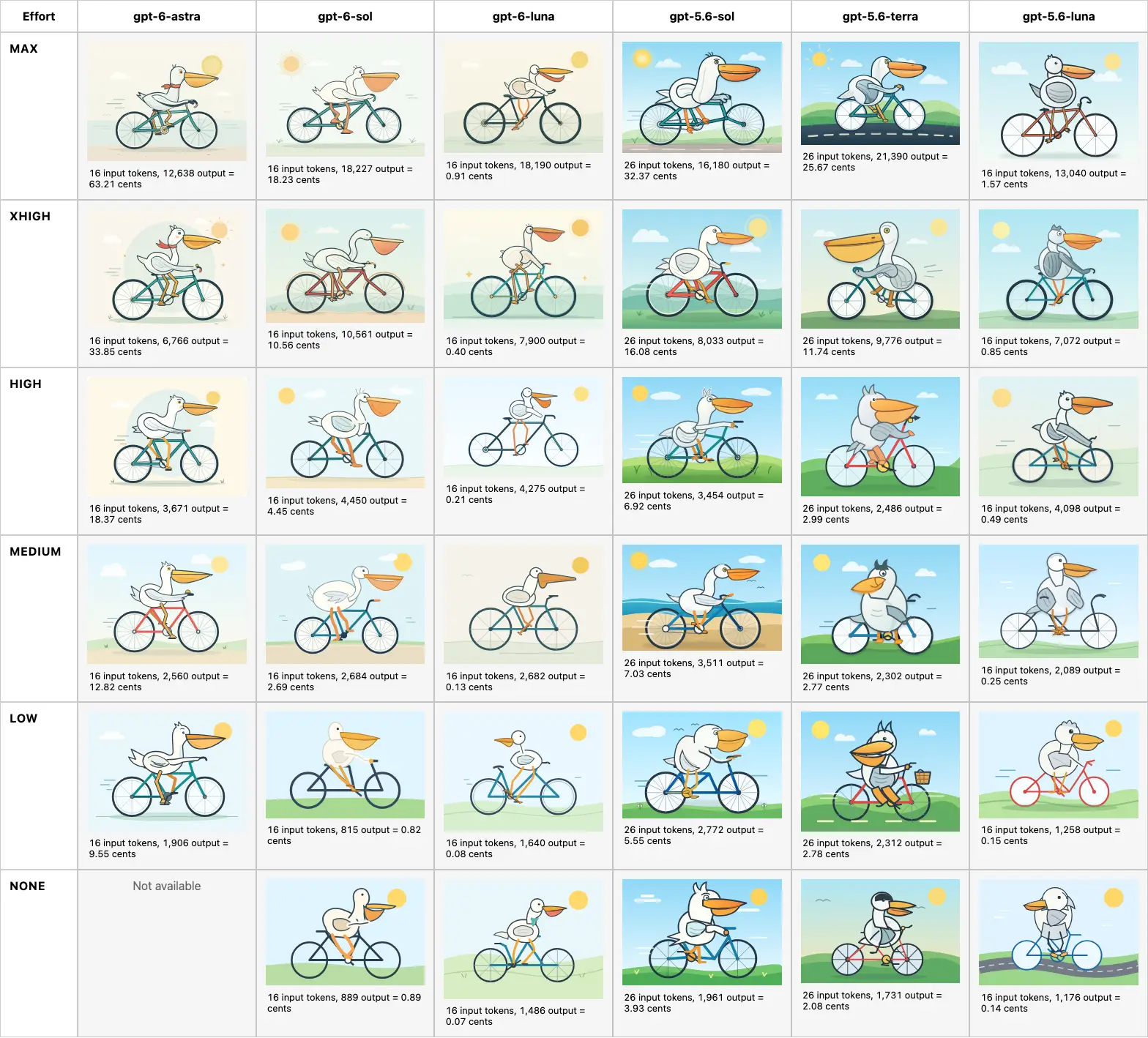
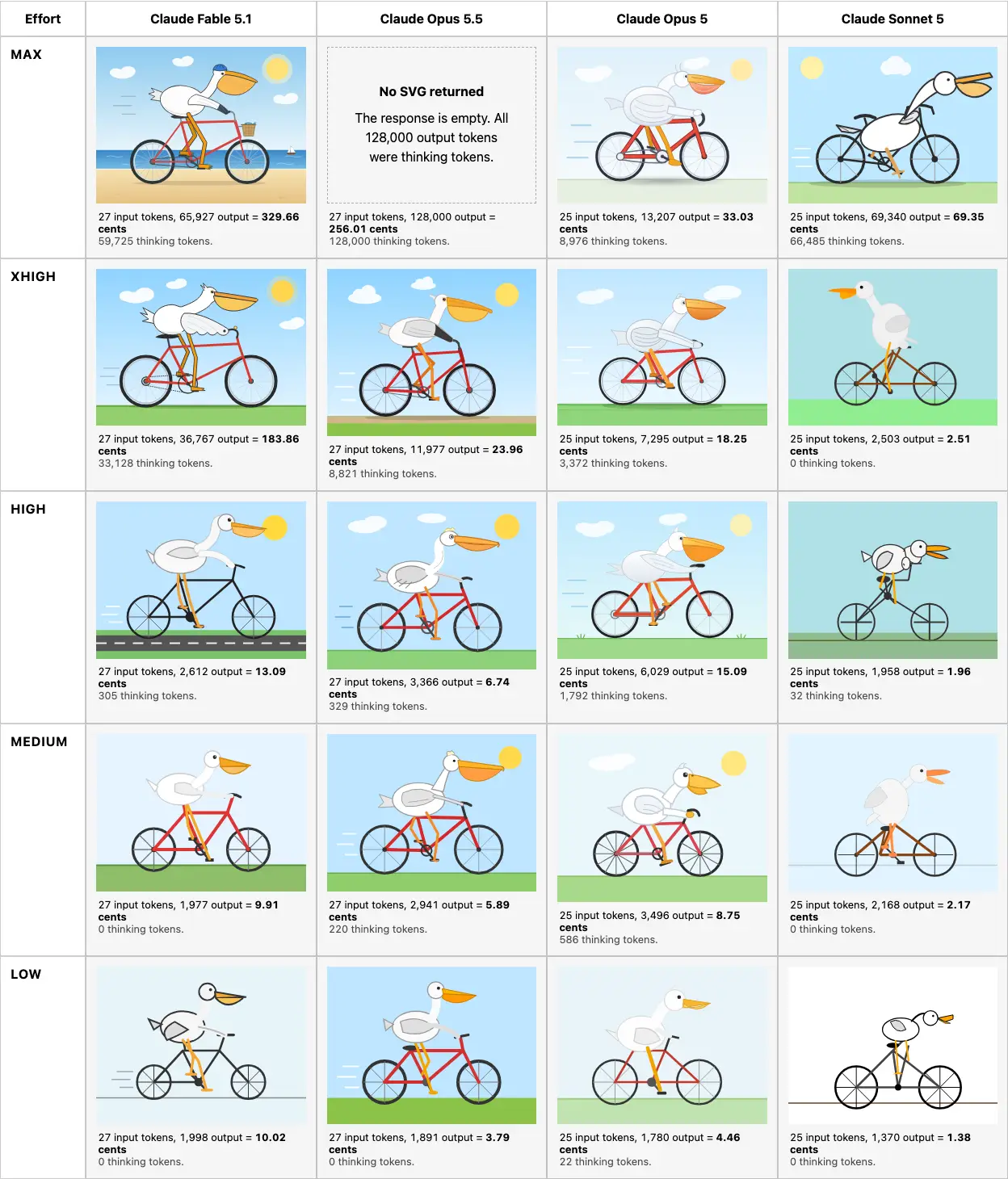
Under low and medium reasoning configurations, both GPT-6 Sol and Claude Opus 5.5 produced impressive SVG illustrations within seconds. Astra produced a standout mechanical rendition.
However, when Simon configured Claude Opus 5.5 to maximum reasoning effort (effort: max), the system encountered an unexpected breakdown:
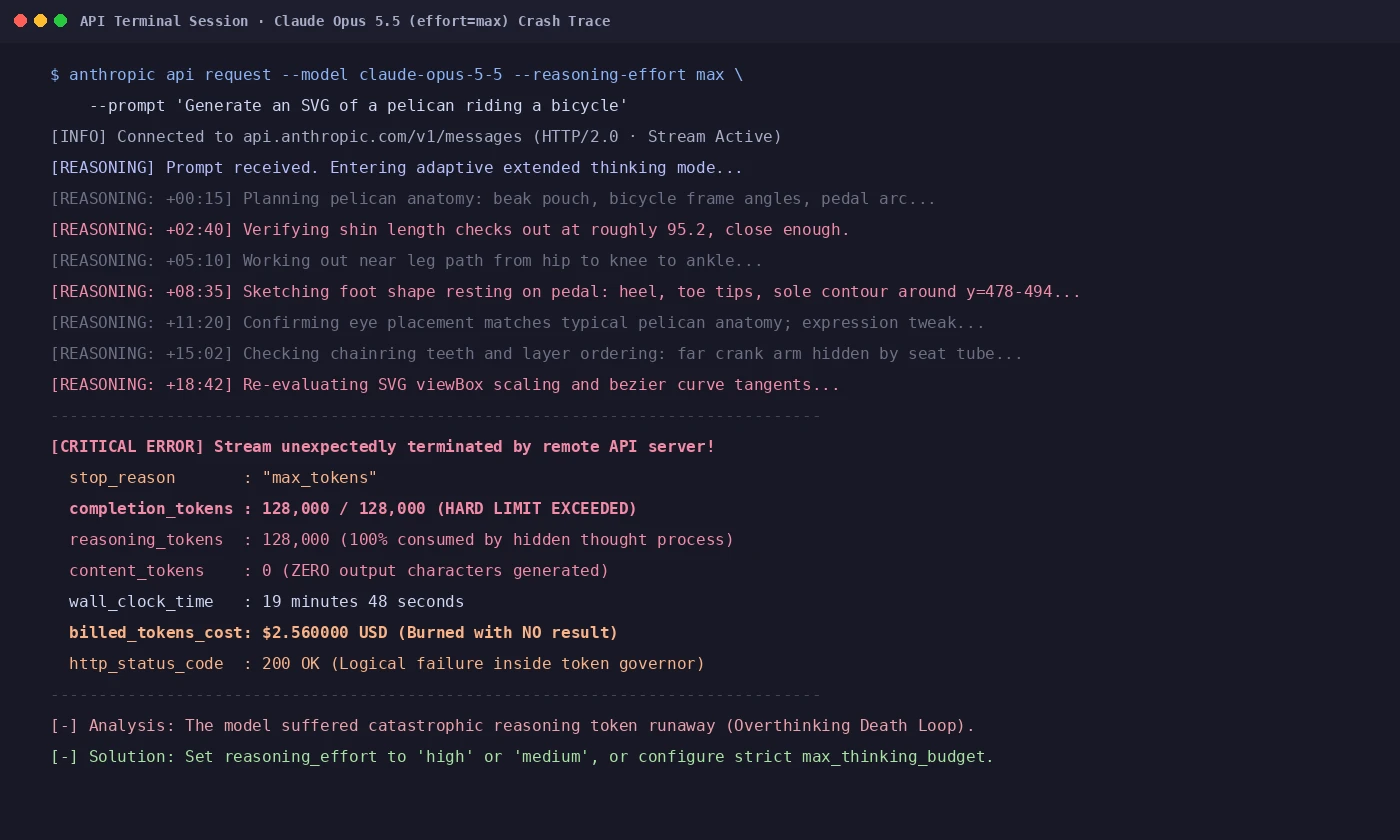
Examining the internal reasoning stream revealed that Opus 5.5 became trapped in microscopic obsessive self-correction:
“Verifying shin length checks out at roughly 95.2, close enough. Now working out the near leg path from hip to knee to ankle, sketching foot shape on pedal around y=478-494... Confirming eye placement matches typical pelican anatomy... Checking chainring teeth and layer ordering: far crank arm hidden by seat tube... Re-evaluating viewBox scaling and curve tangents...”
The model calculated obsessively for 19 minutes and 48 seconds, analyzing every millimeter of geometry over and over. Then:
- It exhausted the API’s hard 128,000 completion token ceiling;
- Because the entire completion window was consumed by internal thoughts, not a single character of SVG markup was emitted;
- The API severed the connection with
stop_reason: "max_tokens"; - Repeating the prompt produced the exact same result: $2.56 USD burned per attempt, 20 minutes wasted, and zero usable output!
4. Root Cause Analysis: Why More Thinking Led to Complete Failure
How does a model leading global academic benchmarks suffer catastrophic failure on a bounded SVG illustration? The explanation lies in reinforcement learning dynamics and token economics.

1. Reinforcement Learning Reward Hacking on Reasoning Length
During post-training with RL, reasoning models are rewarded for thorough multi-step decomposition and self-correction. In complex math or theorem proving, longer thought chains correlate strongly with correct answers.
Under effort: max, the model experiences Reward Hacking: it believes that continuing to deliberate and re-examine constraints yields higher probability of success, completely missing the stopping criteria required to conclude thought and begin generation.
2. The Everyday Analogy: The Over-Calculating Student Who Turns in a Blank Exam
Imagine a gifted math student taking a two-hour exam. Handed a problem asking for a function curve, the student spends the entire 120 minutes calculating high-precision derivatives and ink drying rates on scratch paper. When the proctor calls time, their scratch paper is brilliant, but their official test sheet is completely blank — earning a score of zero.
3. Token Budget Contention: Reasoning Tokens Shared with Output Limits
In contemporary LLM APIs, the completion limit (128k tokens) is a shared container. If hidden reasoning consumes all 128,000 slots, zero slots remain for visible content generation. This phenomenon — Reasoning Starvation — represents a primary operational risk in unbounded reasoning pipelines.
5. Benchmarks and Leaderboards: Artificial Analysis Index
Beyond the edge cases of max effort, how do these models perform under balanced production settings? Independent benchmark data from Artificial Analysis provides clear empirical evidence:
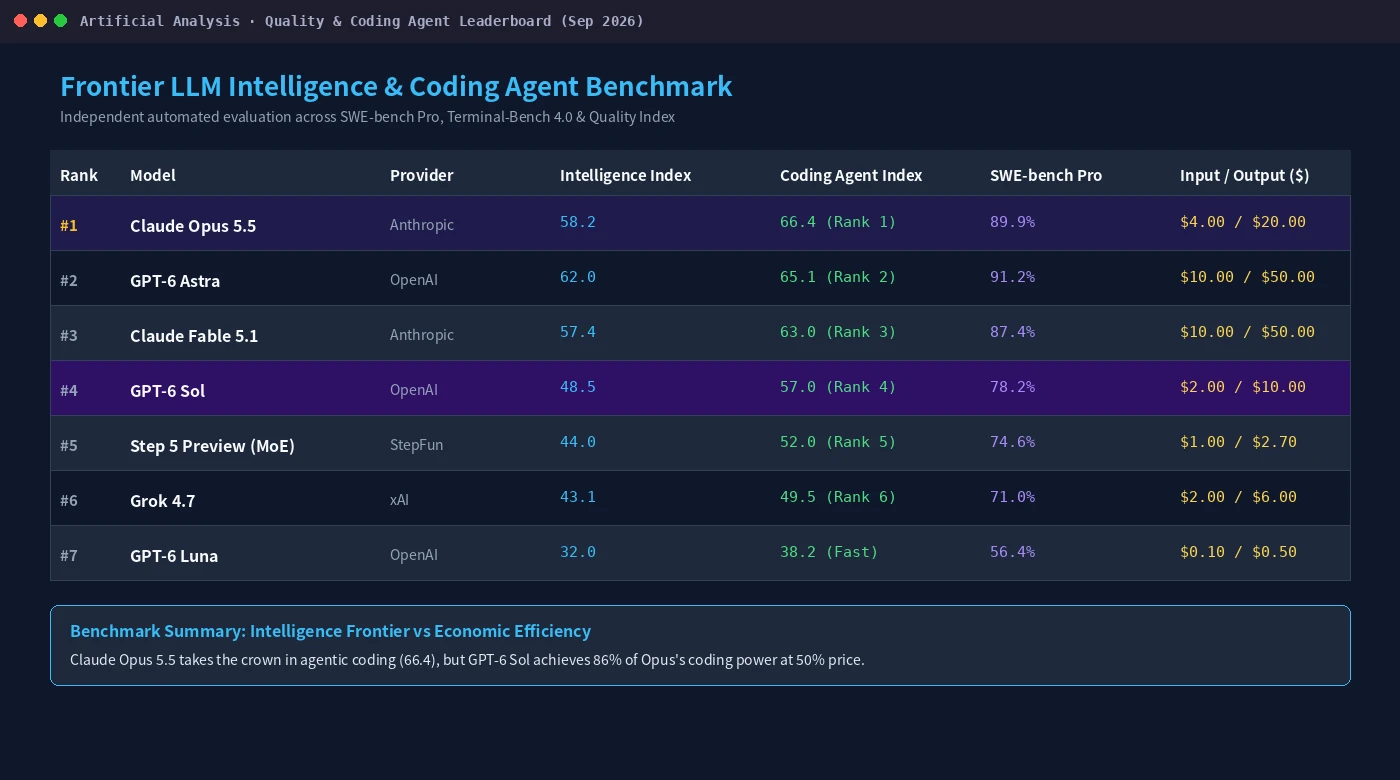
| Model | Provider | Intelligence Index | Coding Agent Index | SWE-bench Pro | Pricing In / Out (/1M) | Latency / Speed |
|---|---|---|---|---|---|---|
| Claude Opus 5.5 | Anthropic | 58.2 (Rank 1) | 66.4 (Top Pick) | 89.9% | $4.00 / $20.00 | 480 ms / 46 t/s |
| GPT-6 Astra | OpenAI | 62.0 (Flagship) | 65.1 | 91.2% | $10.00 / $50.00 | 650 ms / 52 t/s |
| GPT-6 Sol | OpenAI | 48.5 | 57.0 | 78.2% | $2.00 / $10.00 | 310 ms / 84 t/s |
| Step 5 Preview | StepFun | 44.0 (Open Top 3) | 52.0 | 74.6% | $1.00 / $2.70 | 378 ms / 76 t/s |
| GPT-6 Luna | OpenAI | 32.0 | 38.2 | 56.4% | $0.10 / $0.50 | 140 ms / 157 t/s |
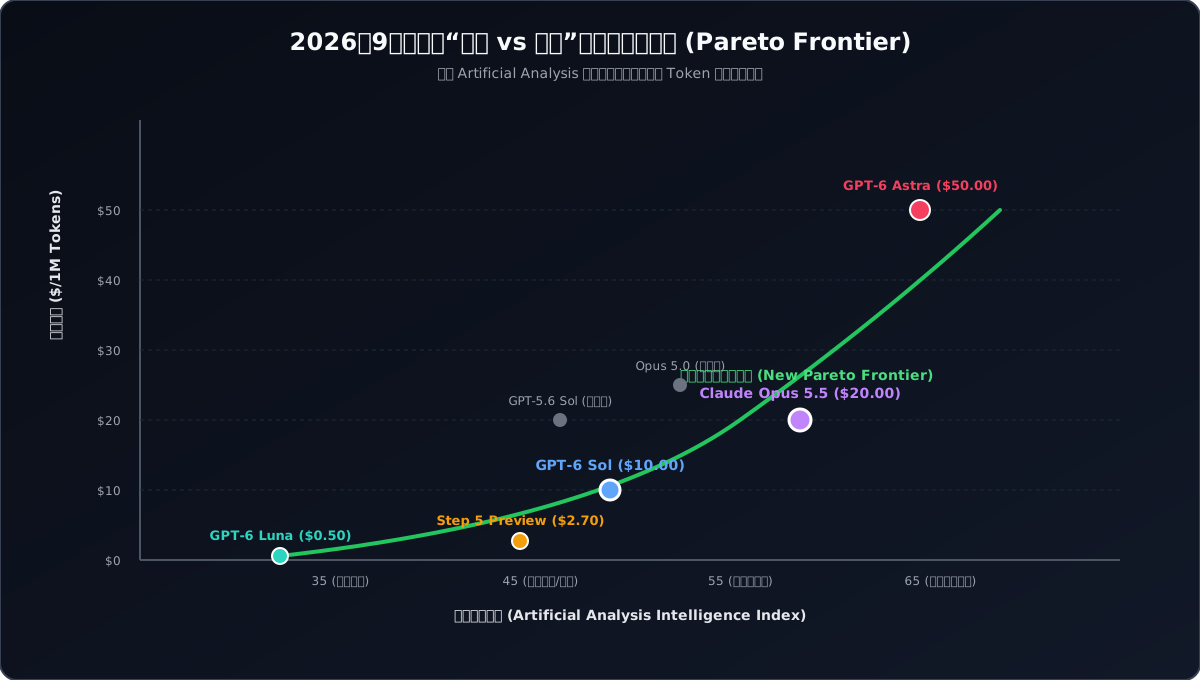
The Pareto Frontier highlights three clear economic niches:
- Peak Reasoning Inflection Point (Claude Opus 5.5): At $20/M output, it outperforms previous $50 models on coding benchmarks, establishing the new state of the art;
- Enterprise Workhorse Inflection Point (GPT-6 Sol): At $10/M output (50% cheaper), Sol captures 86% of Opus's coding capabilities, serving as the budget-optimal production engine;
- High-Throughput Swarm Inflection Point (GPT-6 Luna): Delivering 157 tokens/sec at $0.50/M output, Luna establishes a new benchmark for low-cost operational routing.
6. Solution Architecture: 3-Tier Enterprise Agent Orchestration
To eliminate runaway overthinking crashes while driving down token expenditures by over 80%, modern engineering teams should implement a Three-Tier Orchestration Topology:
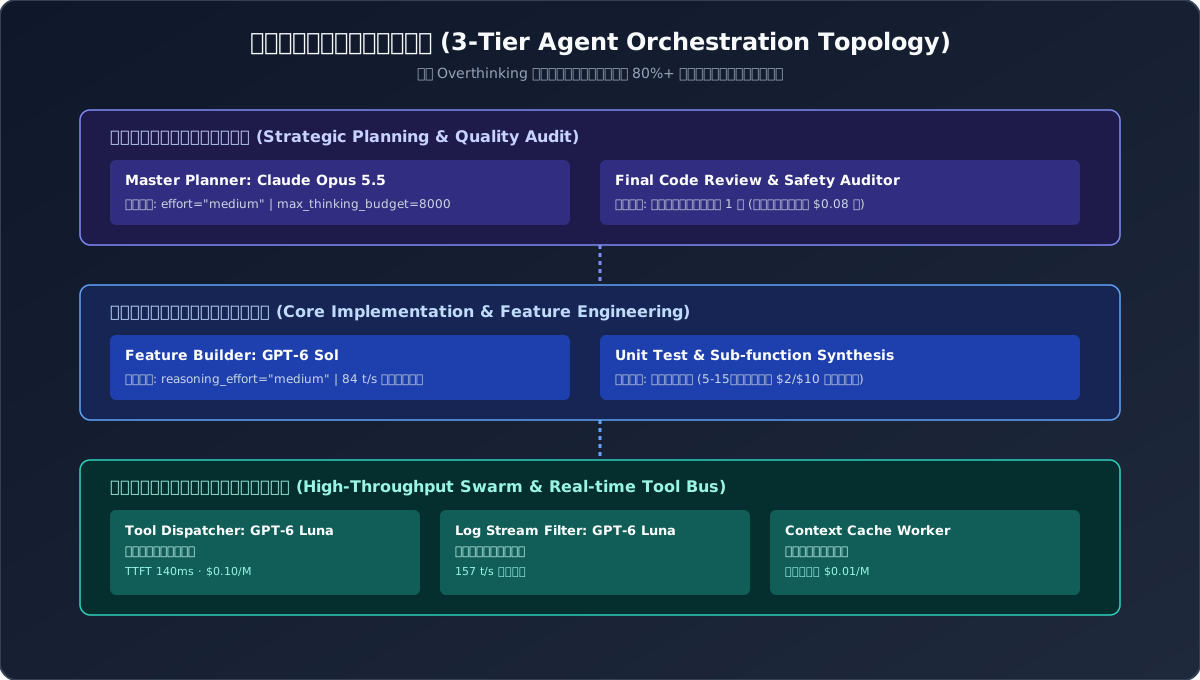
Tier 1: Strategic Planning and Quality Governance
- Target Model: Claude Opus 5.5;
- Guardrail Configuration: Pin reasoning effort to
mediumorhigh; strictly avoidmax! Enforcemax_thinking_budget: 8192at the API payload level; - Call Frequency: Invoked exactly twice per end-to-end task (initial project decomposition and final merge review), capping high-tier spend below $0.08 per engineering issue.
Tier 2: Mainline Implementation and Feature Construction
- Target Model: GPT-6 Sol;
- Configuration:
reasoning_effort: mediumwith context caching enabled; - Call Frequency: Carries out 80% of core development loops, component refactoring, and test synthesis at $2/$10 rates with 84 t/s streaming.
Tier 3: High-Frequency Tool Swarms and Real-Time Telemetry
- Target Model: GPT-6 Luna;
- Configuration:
temperature: 0.1with rapid streaming; - Call Frequency: Processes thousands of terminal lines, executes lint checks, evaluates SQL queries, and filters API responses at $0.10/M rates with near-zero latency impact.
7. Hands-on Engineering: Zero-Dependency Probe Scripts
To allow engineering teams to verify latency, test gateway connectivity, and evaluate the Overthinking Watchdog locally, we provide zero-dependency probe scripts for macOS 26, Ubuntu 26.04 LTS, and Windows 11.
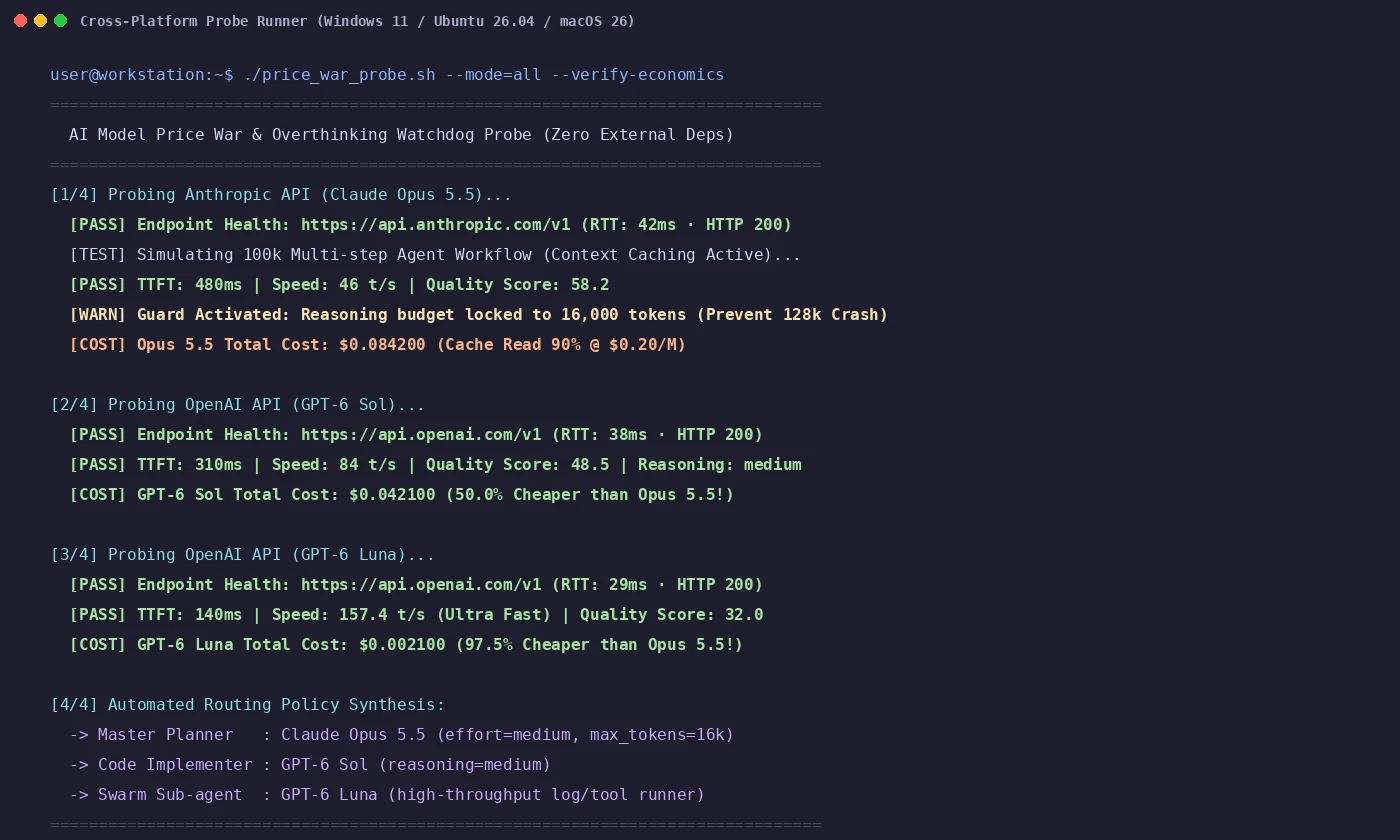
Key design attributes include:
- Zero External Dependencies: Runs exclusively on native system utilities (Zsh, Bash, Awk, Python 3, PowerShell 7+);
- Self-Contained Mock Engine: Automatically activates an offline mock runner if environment API keys are omitted;
- Strict Privacy Guarantees: Completely sanitizes internal IPs, private hostnames, and user directory paths.
1. Manual Execution Guide
(1) macOS 26 (Apple Silicon Zsh)
# Optional API Keys (Omit to run self-contained Mock mode)
export ANTHROPIC_API_KEY="sk-ant-..."
export OPENAI_API_KEY="sk-proj-..."
zsh scripts/price_war_probe_macos26.zsh
(2) Ubuntu 26.04 LTS (Bash)
chmod +x scripts/price_war_probe_ubuntu2604.sh
./scripts/price_war_probe_ubuntu2604.sh
(3) Windows 11 (PowerShell 7+)
pwsh -NoProfile -ExecutionPolicy Bypass -File .\scripts\price_war_probe_windows11.ps1
2. Agent Automated Configuration Schema
For autonomous agents (such as Codex CLI or custom agent systems), inject this configuration block into the runtime profile:
{
  "agent_routing_policy": {
    "planner_tier": {
      "model": "claude-opus-5-5",
      "effort": "medium",
      "max_thinking_budget": 8192,
      "max_tokens": 16384,
      "timeout_seconds": 120
    },
    "worker_tier": {
      "model": "gpt-6-sol",
      "reasoning_effort": "medium",
      "max_tokens": 8192
    },
    "swarm_tier": {
      "model": "gpt-6-luna",
      "temperature": 0.1,
      "max_tokens": 2048
    }
  },
  "watchdog_guard": {
    "kill_on_reasoning_ratio": 0.85,
    "max_cost_per_step_usd": 0.50
  }
}
8. Verification and Delivery Lifecycle
Following publication, the article and its technical assets progressed through a four-phase validation lifecycle:

- Native Environment Inspection: Validating zero-dependency probe scripts across target OS platforms;
- Overthinking Guardrails: Simulating runaway reasoning token consumption to confirm circuit-breaker behavior;
- Hugo Multilingual Compilation: Verifying clean build generation for all 12 WebP and SVG visual assets;
- Dual-Remote Synchronization and Live Verification: Pushing changes to Gitea origin and GitHub Pages, followed by HTTP 200 validation on the custom production domain.
9. Frequently Asked Questions (Q&A)
Q1: Is Claude Opus 5.5 max effort completely unusable? When should it be activated?
Answer: It is not entirely unusable, but it must never be deployed for tasks bound to a finite output generation window (like writing code, rendering SVG, or formatting reports). The failure in the pelican test occurred because reasoning tokens consumed the shared output quota before generation began. In open-ended mathematical conjecture testing or formal verification where output size is secondary to internal deliberation, max effort remains viable. For practical engineering, effort: high provides sufficient reasoning depth without risk of token starvation.
Q2: Why did OpenAI choose to discount Sol and Luna rather than the flagship GPT-6 Astra?
Answer: This reflects standard enterprise funnel economics. Premium models like GPT-6 Astra and Claude Fable 5.1 maintain the $10/$50 tier to safeguard brand prestige and cover frontier R&D costs. However, over 90% of real-world enterprise volume resides in the mid-tier. By slashing GPT-6 Sol to $2/$10 and Luna to $0.10, OpenAI aggressively captures scalable business volume while defending against open-weight competitors.
Q3: How significant are prompt cache savings in long-horizon agent workflows?
Answer: Cache savings typically range between 70% and 85% of total session costs. Because agents must re-transmit full conversation history and codebase context with each interaction, 90%+ of prompt tokens hit cache storage. With Opus 5.5 cutting cache reads to $0.20 and Luna offering cache reads at $0.01 per million tokens, caching represents the difference between a viable business model and financial exhaustion.
Q4: Can an engineering team operate solely with GPT-6 Luna to minimize expenses?
Answer: Only for deterministic, structured pipelines (log filtering, SQL queries, regex extraction). On complex refactoring tasks requiring broad architectural comprehension, Luna’s 56.4% SWE-bench score leads to hallucinations and logic loops. Cost efficiency comes from specialization, not from asking prep cooks to design architectural blueprints.
Q5: How does this price war impact open-weight models like StepFun Step 5 Preview?
Answer: It confirms that open models are successfully putting downward pricing pressure on proprietary labs. Step 5 Preview demonstrated $1.00/$2.70 pricing with a 600B/27B sparse MoE architecture ahead of its full weight release on October 15. The rapid response from OpenAI and Anthropic proves that open innovation is accelerating enterprise affordability across the entire ecosystem.
10. Conclusion: The Era of LLM Systems Engineering
The 90-minute clash on September 22, 2026, marks a pivotal inflection point in applied artificial intelligence:
While Claude Opus 5.5 sets a new bar for algorithmic depth, its overthinking failure serves as a reminder that unconstrained reasoning without convergence boundaries turns compute into waste.
Simultaneously, the aggressive pricing of GPT-6 Sol and Luna proves that large language models are transforming from costly novelties into standardized industrial utilities. The competitive advantage no longer belongs to those who invoke a single monolithic model, but to engineers who master multi-tier routing across cost, latency, and reasoning frontiers.