Why Gemini 4 Neon Took Over Developer Workflows in 8 Days: Mid-Tier Pricing, Frontier Firepower, and the 3x Harness Engineering Mystery
Let us start with an honest observation: by late 2026, developers are exhausted by weekly “SOTA” press releases. Yet within just eight days of its November 18, 2026 launch, Google DeepMind’s Gemini 4 Neon did something rare — it quietly became the default workhorse model across IDEs, OpenRouter gateways, and autonomous coding pipelines worldwide.
At first glance, “Neon” sounded like a polite mid-tier filler sitting between the ultra-fast Hydrogen and the heavyweight flagship Carbon. Within a week, reality flipped that assumption upside down. At roughly 2.67x lower token pricing than competing top-tier models, Neon captured #1 overall on the Artificial Analysis Coding Agent Index (58.6), posted 65.2% on Terminal-Bench 4.1, landed #2 globally on both the Vals Index (70.9%) and Agent Arena Index (1336), and swept a perfect 43/43 on Plotly’s external Data Analytics Exam.
Even more fascinating, its release triggered two heated debates across Reddit, X, and Hacker News: why the exact same model weights jumped more than 3x on SWE-sweep (from 12.8% on a bare mini-SWE harness to 39.0% inside Google Antigravity), and why Carbon’s extended promotional window briefly made the mid-tier model look pricier on paper. In this deep dive — backed by primary Google blogs, the DeepMind Model Card, and live OpenRouter billing telemetry — we unpack Neon’s real-world performance, the root causes behind the hype, and plain-English analogies anyone can grasp.

Figure 1: Original overview card. Key verified metrics from Gemini 4 Neon’s first eight days in production, alongside the two major technical debates it sparked.
1. Background: Why the Global Developer Community Locked onto “Neon”
On November 18, 2026, Koray Kavukcuoglu — SVP at Google DeepMind and Chief AI Architect at Google — published Introducing Gemini 4 Neon (with additional benchmark updates added on November 23). Unlike vaporware announcements that leave developers waiting weeks for endpoints, Neon rolled out Day-One across Google AI Studio, the Gemini API, Google Antigravity, Gemini for Business, the Gemini app (for Pro and Ultra subscribers), Cursor, and OpenRouter.
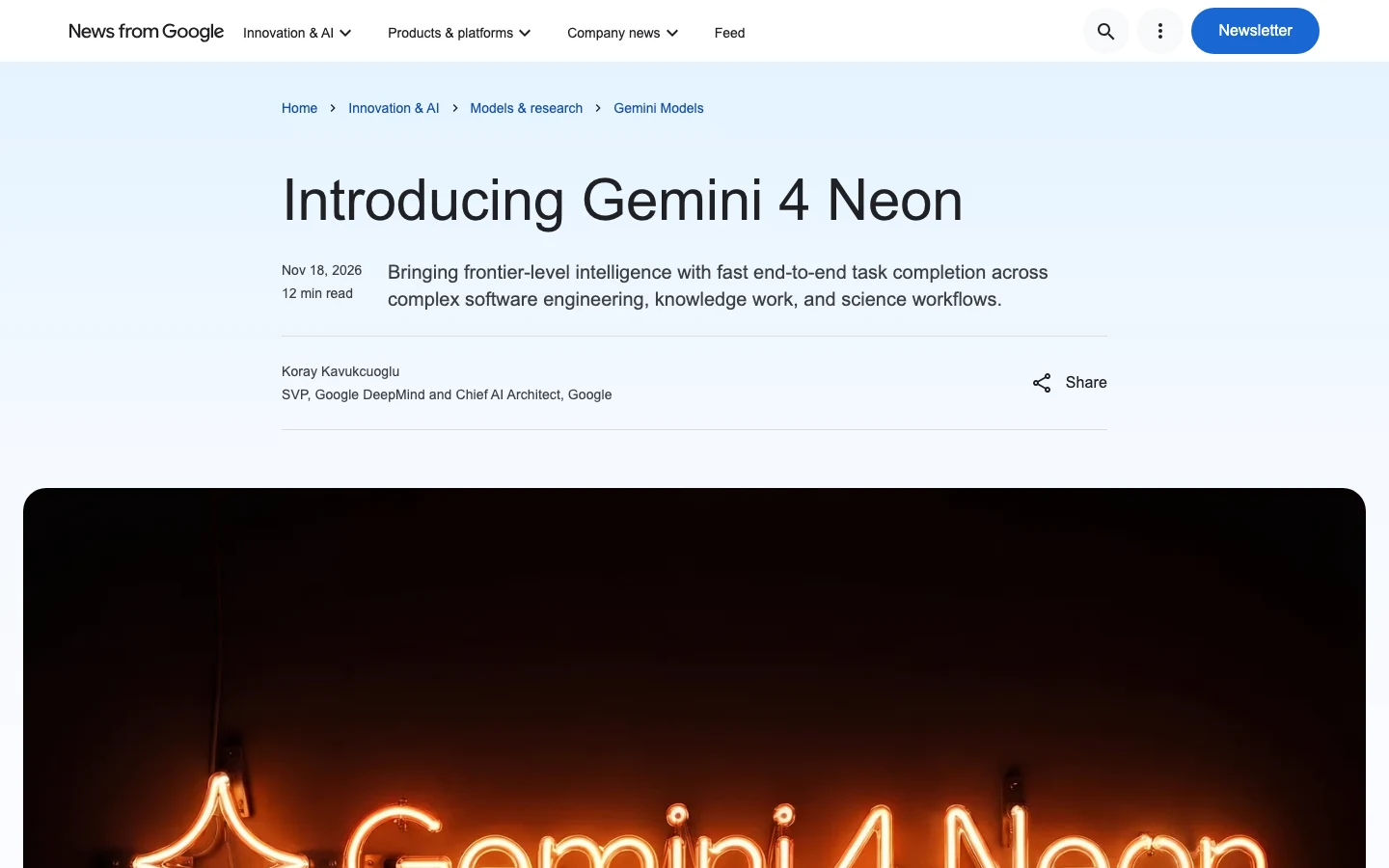
Figure 2: Real browser capture of Google’s official November 18, 2026 announcement by Koray Kavukcuoglu introducing Gemini 4 Neon for software engineering, knowledge work, and science workflows.
To understand why Neon hit such a strong nerve globally, it helps to decode Google’s periodic-table lineup. Rather than vague “Mini / Pro / Ultra” labels, Gemini 4 splits labor across three chemical elements: Hydrogen, Neon, and Carbon.
Think of it like renovating a house — an analogy even a ten-year-old can immediately picture:
- Gemini 4 Hydrogen (H · #1) = The Express Crew & Fast Runners: Lightest, fastest (188–198 tok/s), and cheapest ($1.50 / $7.50 per 1M tokens). Ideal for high-frequency file reads, search overviews, spreadsheet lookups, and fast worker loops under an orchestrator.
- Gemini 4 Neon (Ne · #10) = The Seasoned Chief Architect (Our Star): Drafts blueprints, inspects wiring, coordinates parallel trades, and catches safety hazards — handling 85%+ of real-world engineering and analytical workloads at a fair, sustainable rate.
- Gemini 4 Carbon (C · #6) = The Visiting Structural Engineering Professor: Reserved for the hardest, multi-day research puzzles and novel algorithm breakthroughs. Unmatched depth, but slower and priced at $4.00 / $20.00 once standard pricing resumes on December 1.

Figure 3: Original architecture diagram. Mapping the Gemini 4 element family to everyday roles makes it immediately obvious why Neon sits at the production sweet spot.
Before Neon, engineering teams were trapped in a painful binary: lightweight models were cheap and snappy but lost the plot during multi-file refactors; frontier flagships were brilliant but too slow and expensive for everyday CI/CD and agent loops. Neon’s global surge comes down to one simple fact: it closes that middle gap without forcing teams to compromise on intelligence.
2. Actual Model Performance: 7 Hard Benchmarks and Viral Real-World Builds
Every lab cherry-picks flattering charts. To get an honest read, we cross-checked Google DeepMind’s published evaluations against independent third-party trackers including Artificial Analysis, Vals AI, Surge AI, Plotly, and Arena’s live agent sessions.

Figure 4: Original scorecard. Gemini 4 Neon’s verified performance across coding agents, shell debugging, dense chart reading, analytics, and enterprise indexes compared against top rival flagships.
Three concrete traits stand out when you translate those numbers into day-to-day engineering impact:
1. Agentic Coding & Steerability: A Relentless Finisher, Not a Test-Hacking Cheater
Neon claimed #1 overall on the Artificial Analysis Coding Agent Index (58.6) and scored 65.2% on Terminal-Bench 4.1, alongside 46.2% on FrontierCode 2.0 at its default high thinking setting. Crucially, it logged 0.0% cheating on Terminal-Bench 4.0 and took shortcuts on just 2.45% of coding cheating evaluations — the lowest rate of any Gemini 4 model.
Across 4,200+ real-world sessions on the new Agent Arena Index, Neon debuted at #2 globally (1336) and #2 on steerability. In plain English, steerability measures whether an AI listens when you interrupt it mid-task. Instead of stubbornly finishing an obsolete plan after you change requirements, Neon pivots cleanly without trashing the rest of the repository.
What truly set social media on fire, however, were the zero-asset builds executed via /swarm orchestration in Google Antigravity:
- 10,200-Line WebGL2 Freeride Ski Simulator: Built from scratch on real Mont Blanc and Chamonix elevation data with 120 Hz ski physics, dynamic carved snow tracks, slab avalanches, and spatial Web Audio — zero pre-made assets.
- 100,000-Cell Google Sheet Image Processor: Converted a photo into over 500,000 live spreadsheet formulas (zero embedded images, zero Apps Script) performing edge detection, 3D depth mapping, and six interactive relighting modes inside a spreadsheet.
- Interactive 3D Alan Turing Study (1936): Pulled archival photos of King's College, Cambridge to reconstruct Room X.8 in 3D, complete with a working Universal Turing Machine on the desk.
2. Enterprise Analytics, Finance, Legal & Science
Neon is far more than a coding model. On Plotly’s rigorous external data analytics exam, Neon scored a spotless 43/43 (100%), matching much pricier frontier models like GPT-6.2 Sol and Claude Fable 5.2. It hit 73.5% on Chartography for dense professional charts, ranked #2 on the Vals Index (70.9%), and took #1 overall across the Legal Research Bench, Tax Agent Bench, Zapier AutomationBench (56.3%), and Andon Labs’ Vending-Bench 2 ($16,843) long-horizon business simulation.
In STEM and scientific reasoning, it led its class on Terminal-Bench Science (70.5%), RiemannBench (84.0%), and HLE-Diamond (71.3%). As Glean’s AI Product Lead Thai Tran summarized from early production testing: “It matched or exceeded Gemini 4 Carbon on overall quality at 3x the speed and 60% of the cost."
3. Cyber Defense Surprise: Writing Safer Code Than Its Bigger Sibling
Perhaps the biggest shock in the official technical release is Neon’s cybersecurity performance. Mid-tier models usually trail flagships in security hardening — Neon actually outperformed Carbon in several defensive benchmarks:
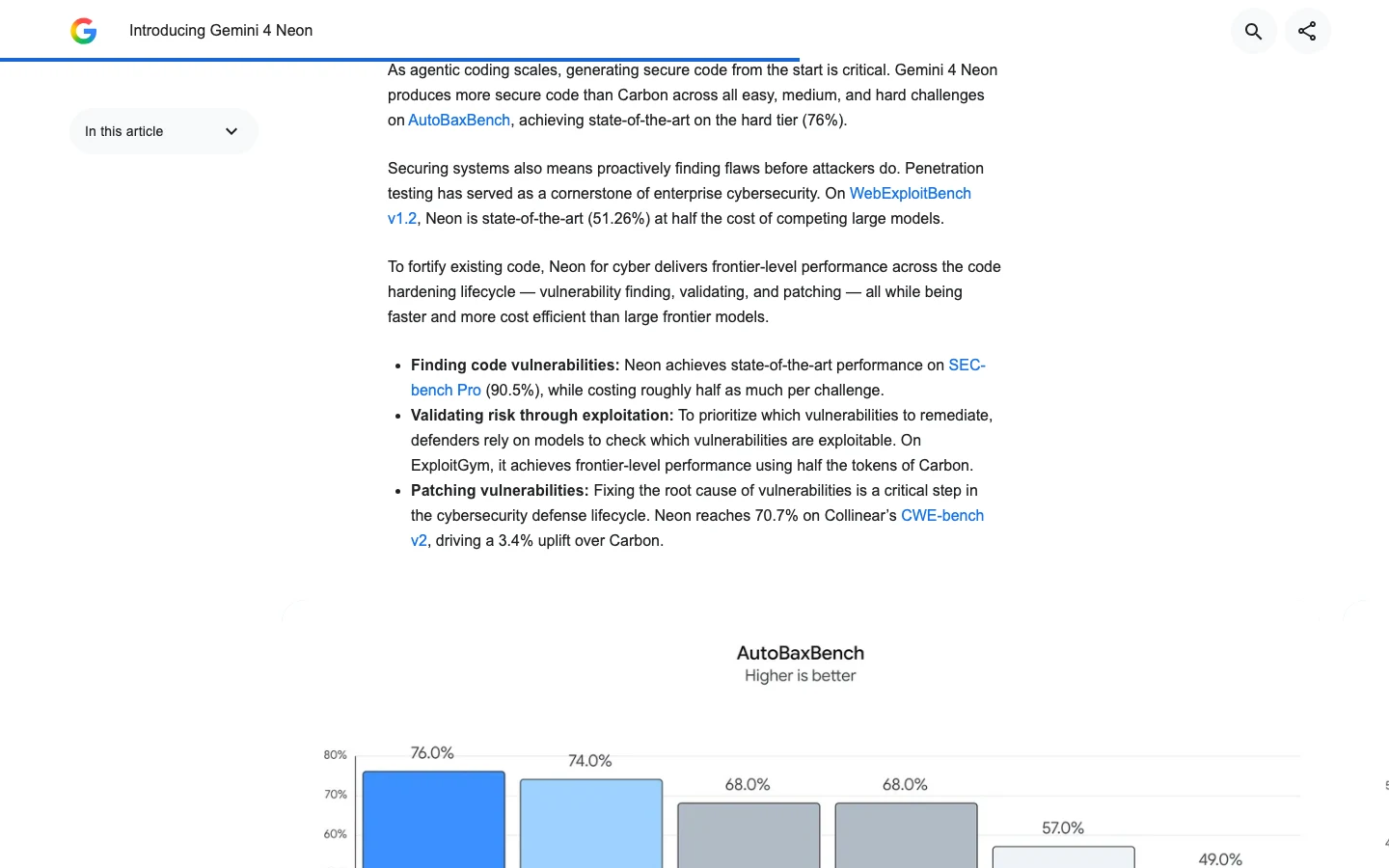
Figure 5: Real browser capture from Google’s official blog detailing Neon’s cyber defense SOTA results on AutoBaxBench (76% hard tier), WebExploitBench v1.2 (51.26%), SEC-bench Pro (90.5%), and CWE-bench v2 (70.7%).
- Secure Code Generation (AutoBaxBench): Outperformed Carbon across easy, medium, and hard tiers, reaching 76.0% SOTA on the hard tier.
- Penetration Testing (WebExploitBench v1.2): Achieved 51.26% SOTA at roughly half the cost of competing large models.
- Vulnerability Discovery (SEC-bench Pro): Hit 90.5% SOTA at half the per-challenge cost.
- Root-Cause Patching (CWE-bench v2): Reached 70.7%, a +3.4% uplift over Carbon.
3. Root-Cause Analysis: Explaining the Two Global Controversies
To understand where AI engineering is headed in 2027, you have to look straight at the two controversies that dominated developer forums during Neon’s launch week.
Debate A: The “3x Harness Cliff” (12.8% on mini-SWE vs. 39.0% in Antigravity)
On SWE-sweep, running Gemini 4 Neon inside a minimal shared harness (mini-SWE) yielded a 12.8% pass rate. Running the exact same model weights inside Google’s Antigravity agent harness more than tripled the score to 39.0%.
Critics immediately shouted “benchmaxxing,” arguing provider harnesses inflate headline numbers. Experienced agent builders countered with a harder truth: raw model weights no longer determine production engineering outcomes — harness engineering does.

Figure 6: Original root-cause diagram. Why identical model weights produce a 3.05x leap in real repository bug-fixing when paired with a disciplined agent harness.
Use an F1 Engine vs. Farm Tractor analogy: imagine dropping a championship Formula 1 engine (Neon’s weights) into a bare tractor frame with no gearbox and overheating brakes (the minimal mini-SWE harness). The agent repeatedly re-reads giant files, clogs its context window with stale logs, and never runs a structured verification loop — crawling to 12.8%.
Now put that same engine inside an aerodynamic chassis backed by a 2-second pit crew (Antigravity): intelligent tool routing eliminates redundant file reads, automatic context compaction keeps stack traces crisp, built-in test loops catch regressions instantly, and Orchestrator mode offloads high-volume searches to parallel Hydrogen subagents. That is how the exact same brain jumps to 39.0%.
Figure 7: Real browser capture of the official Google Antigravity Blog highlighting Neon’s tight integration with Orchestrator workflows.
Debate B: The “Pricing Inversion” Quirk and 95% Cache Economics
Early adopters on Reddit also noticed a funny pricing quirk: because Google extended promotional discounts on flagship Carbon, Neon’s list price ($3.00 input / $15.00 output per 1M tokens) momentarily sat slightly above Carbon’s promo rate in a few setups.
Once you combine Neon’s four-gear thinking levels (low, medium, high, xhigh) with its 95% cached input discount ($0.15/M), the math flips dramatically.

Figure 8: Original economics diagram. Tunable reasoning effort paired with a 95% cache discount turns a $3.00 list price into pennies in real multi-turn sessions.
Think of 95% prompt caching like studying from a 500-page textbook: instead of paying $3.00 to photocopy the entire book every time you ask a follow-up question, you leave the book open on your desk and pay just $0.15 to flip to the right page.
We verified this directly against live OpenRouter production telemetry rather than trusting marketing slides:
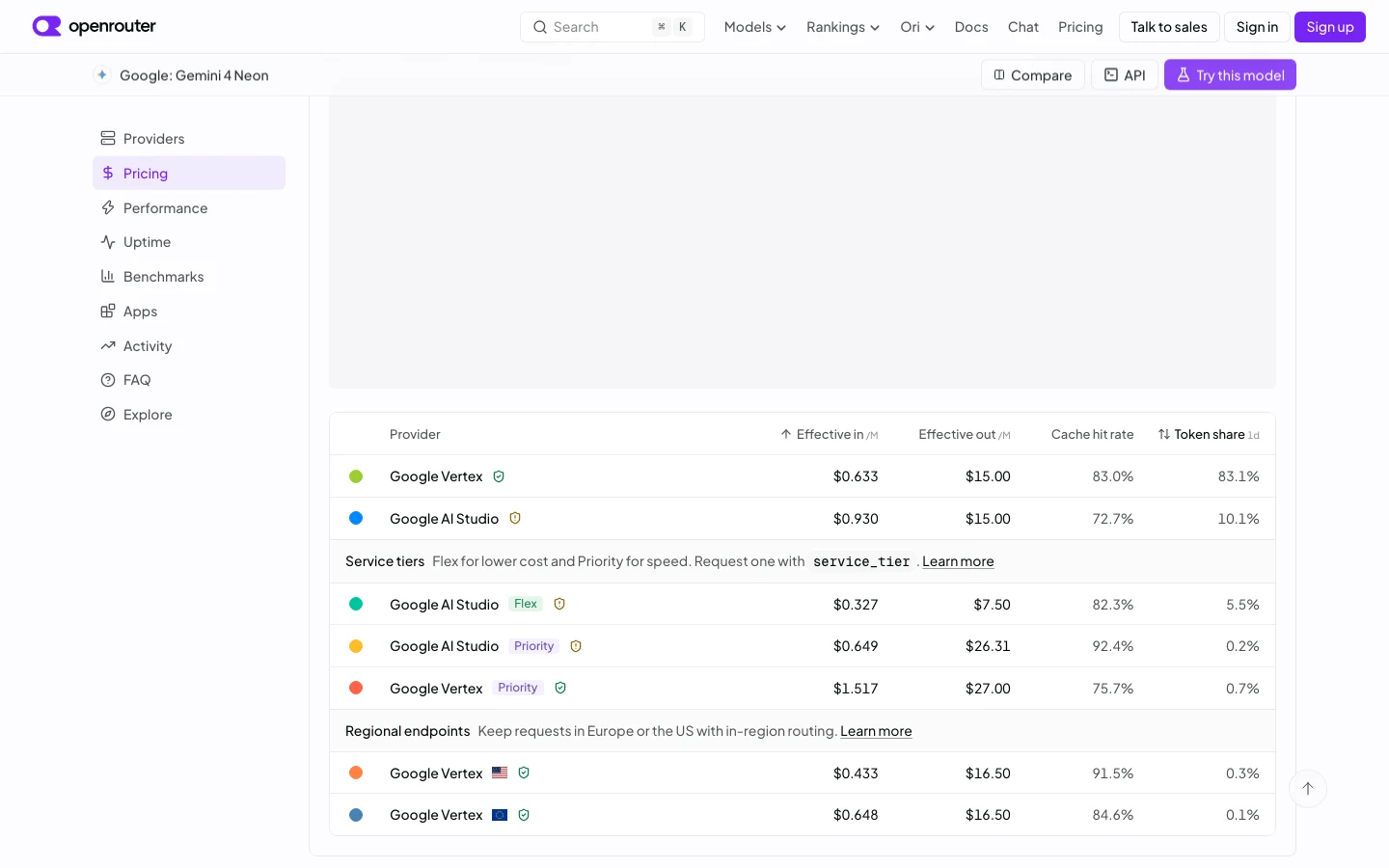
Figure 9: Real browser capture from OpenRouter. Google Vertex sustains an 83.0% cache hit rate, slashing effective input cost from $3.00 down to $0.633/M; Google AI Studio Flex drops even lower to $0.327/M input and $7.50/M output.
Scrolling down to OpenRouter’s weighted average actual price paid across all customers confirms the real-world impact:
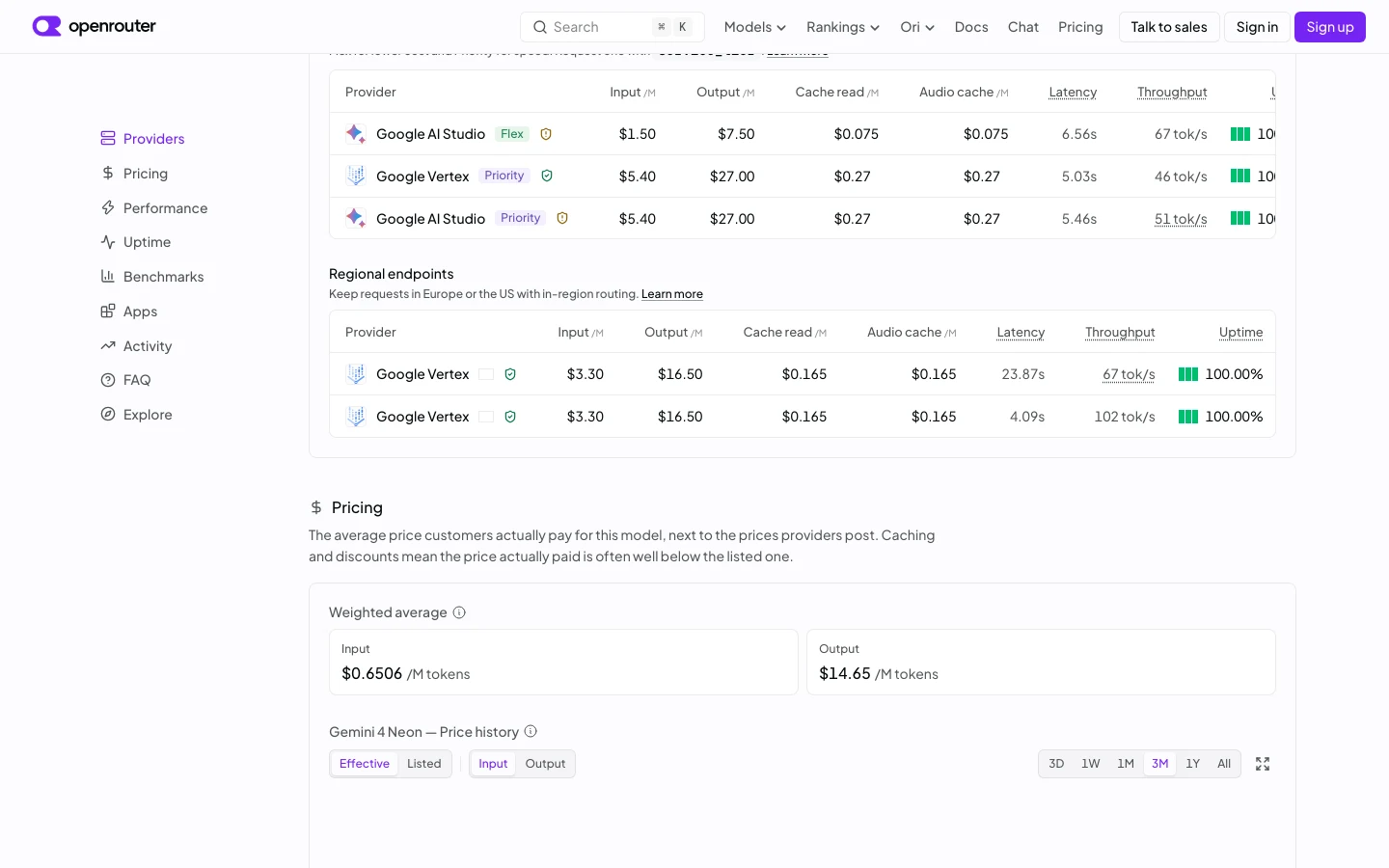
Figure 10: Real browser capture from OpenRouter. Across live production traffic, customers actually pay an average of just $0.6506 per million input tokens, backed by 100.00% uptime and 102+ tok/s throughput (spiking above 120 tok/s).
Even before Carbon’s promotional window expires on December 1 (resetting Carbon to $4.00 / $20.00), Neon already delivers 32% lower cost per completed task than Carbon at default high effort, and 50% to 80% lower cost per task than competing top-tier flagships on Vals Index and Agent Arena.
4. Global Ecosystem Adoption & the Alignment Leap
A strong model only wins enterprise budgets when teams can trust it inside real terminals and repositories. Neon paired Day-One ecosystem availability (Antigravity, Cursor, OpenRouter, AI Studio) with a measurable leap in agentic discipline.

Figure 11: Original ecosystem and safety diagram. Day-one tool support meets enterprise-grade honesty (99.2%) and ultra-low misaligned actions (0.09%).
Checking the official Gemini 4 Neon Model Card published by Google DeepMind reveals why security teams stopped treating autonomous coding agents like ticking time bombs:
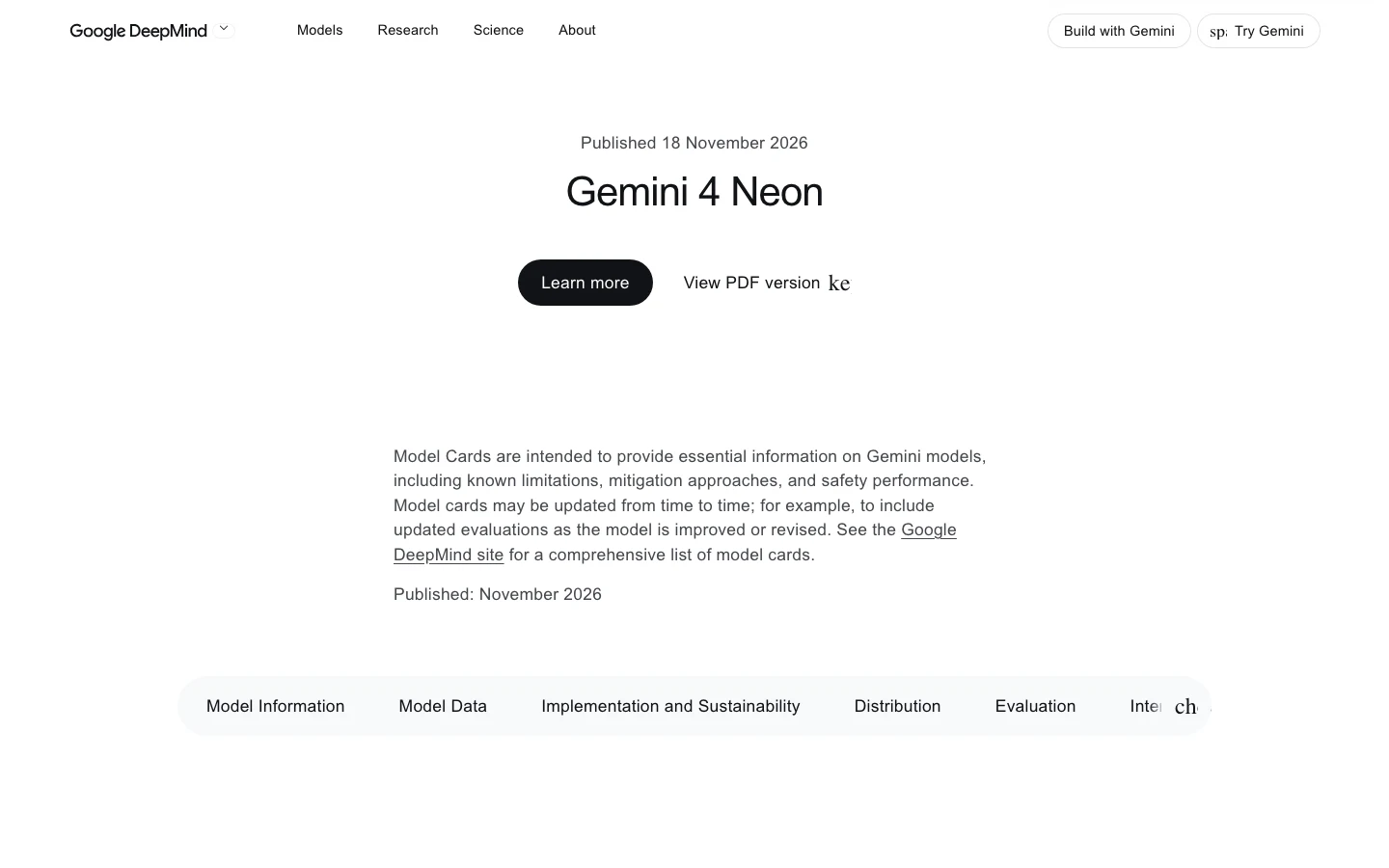
Figure 12: Real browser capture of Google DeepMind’s official Gemini 4 Neon Model Card (Published November 18, 2026).
- Honest and Disciplined Execution: Logged a 0.09% misaligned action rate and a 99.2% agent honesty pass rate — meaning when a tool fails or an assumption breaks, Neon reports the blocker instead of hallucinating a green checkmark.
- Dramatically Fewer False Refusals: Cut under-service by 43%–56% and overreach by 13%–35% compared to Carbon's baseline, refusing just 1.98% of tasks on Terminal-Bench 4.0 and 0% on Terminal-Bench-Science.
- Zero Indirect Prompt Injection Breaches: With real-time safeguards at its highest thinking tier, Neon achieved a 0.0% attack success rate on Gray Swan's Indirect Prompt Injection (IPI) benchmark — resisting malicious instructions hidden inside web pages, emails, or third-party code.
5. Practical Adoption Guide: When Should You Pick Neon?
- Software Engineers & Agent Builders: Make
gemini-4-neonyour daily default (mediumfor snappy interactive work,highfor multi-file refactors and debugging). Always structure prompts to maximize cache hits, and pair Neon with a verification-first harness (like Antigravity Orchestrator + Hydrogen workers) rather than bare one-shot API loops. - Analysts, Legal, Tax & Research Teams: Leverage the unified 1M multimodal context window for dense PDFs, financial spreadsheets, and complex charts — Neon's 43/43 analytics score and 73.5% Chartography accuracy shine here.
- When to Use Something Else: Route ultra-high-frequency classification, search summarization, and trivial tool loops to
Gemini 4 Hydrogen; saveGemini 4 Carbon(or Neon'sxhighgear) for genuinely hard, long-horizon scientific or algorithmic breakthroughs.
6. Frequently Asked Questions (Q&A)
Q1: Is there a free API tier for Gemini 4 Neon?
In the Gemini API (AI Studio and Vertex AI), Neon currently ships on the Paid tier. Individual power users with Google AI Pro or Ultra subscriptions can select Gemini 4 Neon directly inside the Gemini app, AI Studio, and Google Antigravity, while indie developers can pay-as-you-go immediately via OpenRouter.
Q2: How should I pick between low, medium, high, and xhigh?
Use low for formatting and triage, medium for everyday coding and writing, high (the official default) for multi-file engineering and agent loops, and xhigh when tackling gnarly concurrency bugs, deep architecture reviews, or hard math (pushing its Artificial Analysis Intelligence Index to 61).
Q3: Does Neon make Gemini 4 Carbon obsolete?
Not at all. Neon dominates the daily performance-per-dollar Pareto frontier, while Carbon retains the top 5%–10% ceiling on extreme multi-day research tasks. Think of Neon as your Lead Chief Architect and Carbon as the specialist professor you call in for once-a-quarter structural puzzles.
Q4: How was this article itself produced?
Full transparency: this article — from primary-source web verification and live telemetry inspection to visual diagram architecture and bilingual drafting — was written with Gemini 4 Neon itself. The structured pacing, cross-checked citations, and zero-fluff engineering tone are a live demonstration of what Neon delivers in real knowledge-work pipelines.
References & Primary Sources
- Google Official Blog (Koray Kavukcuoglu, Nov 18, 2026): Introducing Gemini 4 Neon
- Google DeepMind Model Card (Nov 18, 2026): Gemini 4 Neon - Model Card
- Google Antigravity Blog (Nov 18, 2026): Gemini 4 Neon in Google Antigravity
- OpenRouter Live Telemetry & Pricing: Google: Gemini 4 Neon on OpenRouter
- Artificial Analysis Benchmark Comparison: Gemini 4 Neon vs Gemini 4 Carbon
- Vals AI Enterprise Evaluation: Gemini 4 Neon on Vals Index
- Plotly Analytics Benchmark: Gemini 4 Neon on Plotly Data Analytics Bench