A $4 Trillion Empire Redrawn Overnight: Inside Jensen Huang's Shock NVIDIA CEO Exit, Chip Leakage, and What Comes Next
Executive Summary: Late on November 12, 2026 (Beijing time; Nov 11–12 US time), the global AI infrastructure world experienced its sharpest governance shock since 1993. Jensen Huang—who co-founded NVIDIA 33 years ago and built the world's computing backbone—resigned effective immediately as President, Chief Executive Officer, and member of the Board of Directors.
- 72-Hour Reversal From Backing to Exit: On November 8, NVIDIA's Board publicly stated it had "confidence in Jensen and his leadership team." By November 11, following retained-counsel escalation and a second reporting wave, the Board accepted his immediate departure, naming 13-year CFO Colette M. Kress as Interim CEO and appointing Harvey C. Jones as NVIDIA's first-ever Chair of the Board.
- $500B Shockwave & Sector Divergence: NVDA plunged up to 14.3% intraday on Nov 12 to a 17-month low of $148.80—more than 34% below its $243.37 52-week high—while rivals rallied (AMD +5.86%, Broadcom +5.54%, Alphabet +1.62%). Huang forfeited roughly $108 million in unvested equity with zero severance.
- Beyond Tabloid Headlines—Two Structural Root Causes: Using two everyday analogies anyone from an elementary student to a principal engineer can grasp—"The Strict School Gate vs. Proxy Backpack Relays" and "One Master Chef Holding All Keys vs. The Dual-Key Bank Vault"—we unpack shallow export KYC checks and 33 years without an independent Board Chair.
- Why Your GPU Clusters Kept Training: By isolating the replaced executive governance plane from NVIDIA's financial ecosystem and CUDA silicon bedrock, we weigh historical HP/Intel/Apple CEO precedents and provide practical engineering takeaways plus a sharp Q&A.
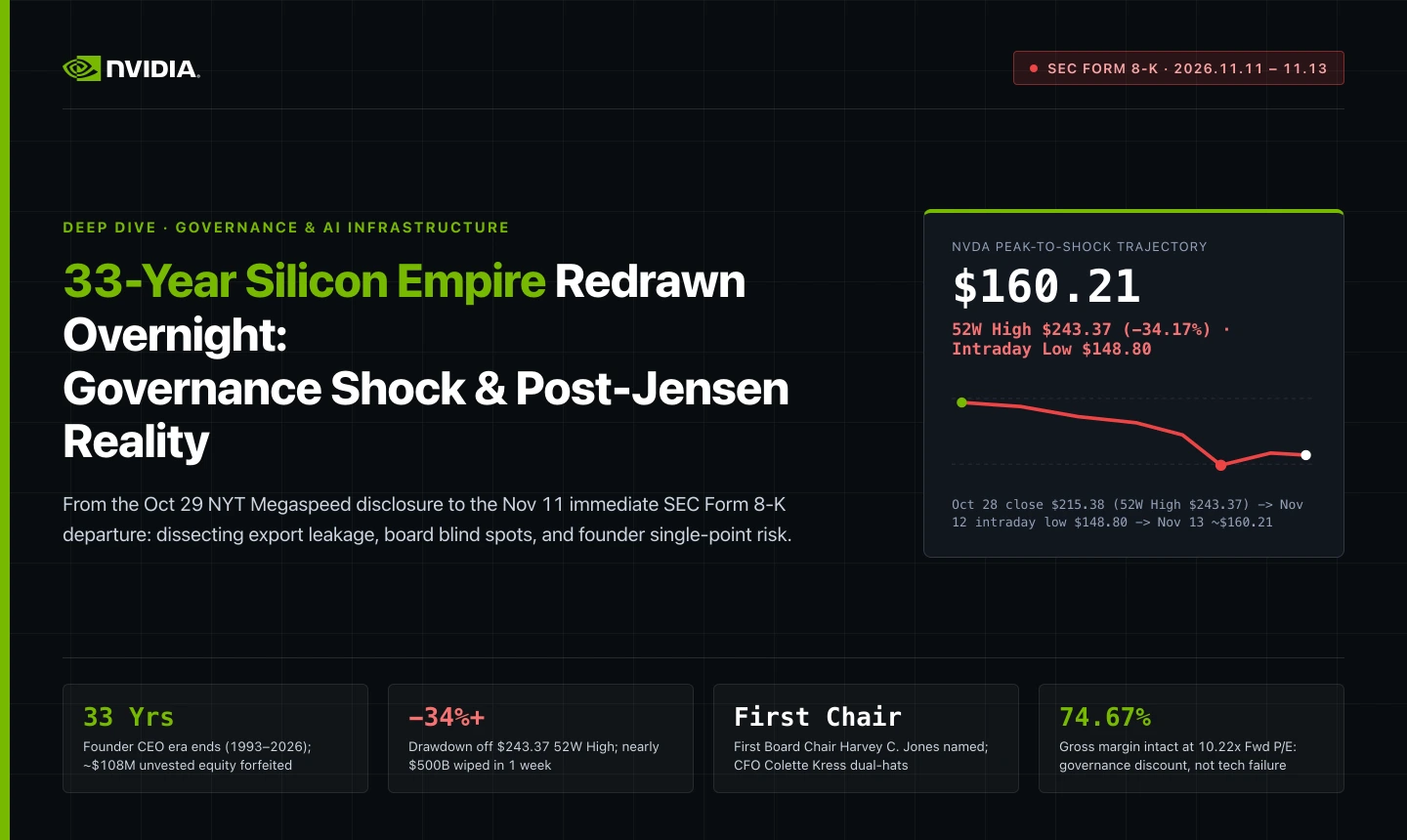
Figure 1: Original editorial cover. Key quantitative anchors of the November 11–13 transition—from the end of a 33-year founder-CEO tenure and >34% peak-to-intraday drawdown to NVIDIA's first independent Board Chair.
I. Background: The Filing That Ended Silicon Valley's Longest Founder Reign
For the past four years, Jensen Huang and his trademark black leather jacket served as the human shorthand for the global AI buildout. Just two weeks ago, on October 28, 2026, NVIDIA (NASDAQ: NVDA) closed at $215.38—not far off its $243.37 52-week peak—with sell-side desks debating nothing more existential than Blackwell rack yields and the Vera Rubin tape-out schedule.
Then came November 12, 2026. NVIDIA Newsroom posted a brisk press release titled NVIDIA Announces CEO Transition, backed simultaneously by a legally binding SEC Form 8-K. There was no transitional advisory role, no phased retirement window, and no ceremonial co-CEO handover. The Board accepted Huang's resignation as President, CEO, and director effective immediately.
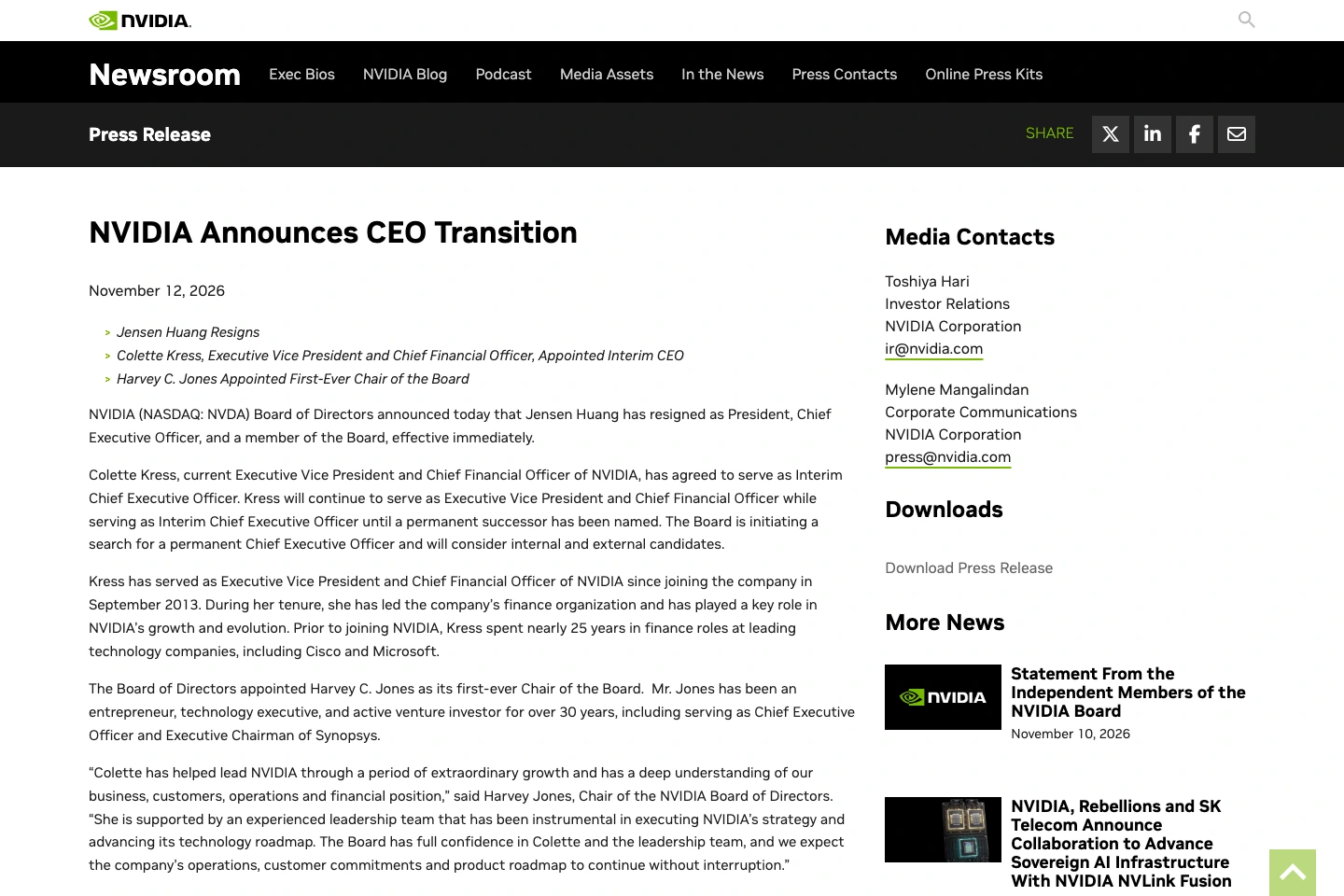
Figure 2: Primary source screenshot from NVIDIA Newsroom on November 12, 2026, formally naming Colette Kress as Interim CEO and Harvey C. Jones as first-ever Chair of the Board.
Under Item 5.02 of the Form 8-K signed by 59-year-old EVP and Chief Financial Officer Colette M. Kress (who has overseen NVIDIA's finances since September 2013), the filing also broke a 33-year governance singularity: appointing 73-year-old Harvey C. Jones—a Board member since 1993, former CEO and Executive Chairman of Synopsys, and Managing Partner of Square Wave Ventures—as NVIDIA's first-ever Chair of the Board.
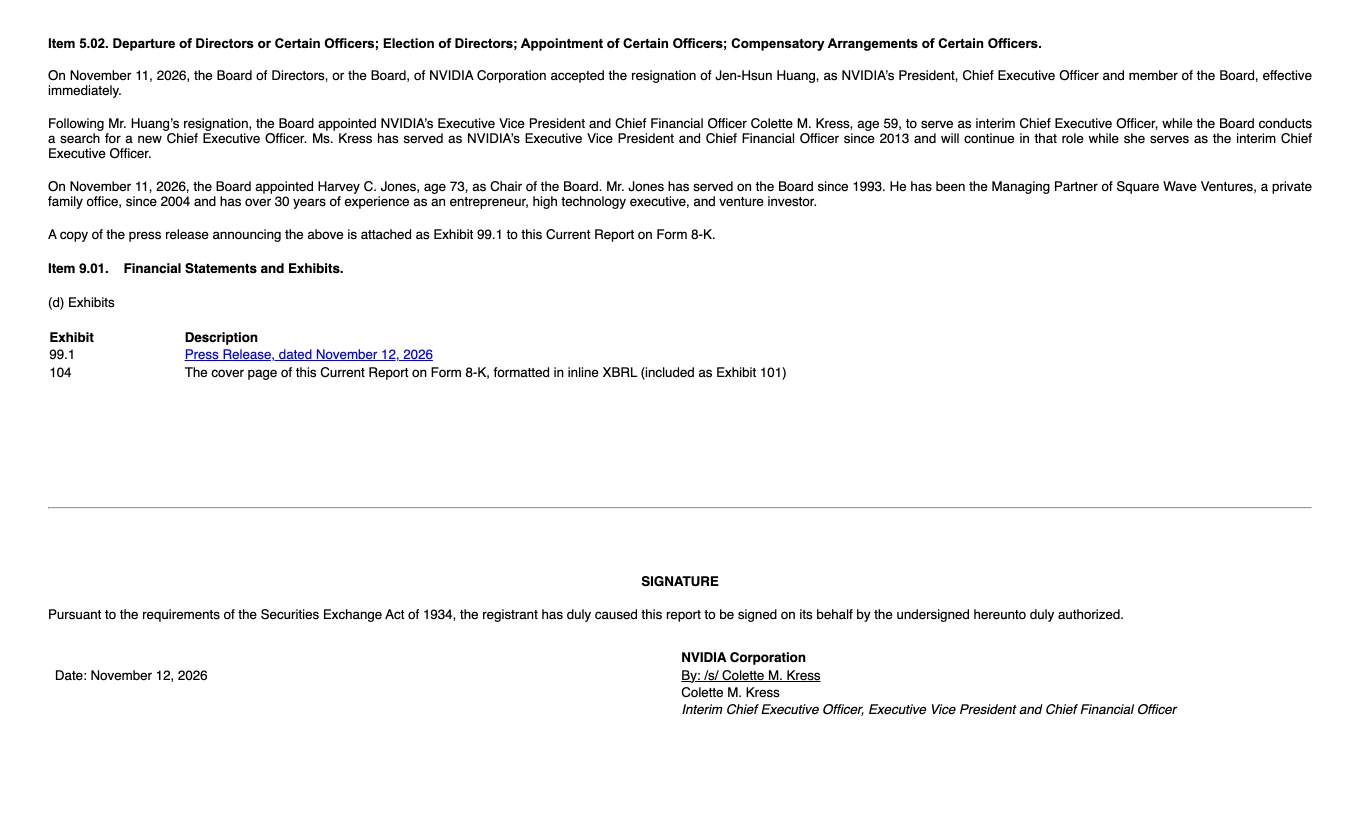
Figure 3: Official SEC EDGAR Form 8-K (Accession 0001045810-26-000082) Item 5.02 and signature block confirming November 11 board acceptance and Kress's dual-hat interim appointment.
The immediate question among engineers and institutional allocators alike is straightforward: How does a company running ~$303 billion in annual revenue and a 74.67% gross margin flip from public confidence to overnight ouster in just 72 hours? Answering that requires tracing all 16 days chronologically.
II. Manifestations: Inside the 16-Day Escalation (Oct 28 – Nov 18)
Overlaying official filings, investigative reporting, and intraday tape reveals a clear three-stage escalation loop: a geopolitical export trigger sparked outside counsel, independent directors locked down legal liability, and a second internal-reporting revelation snapped corporate containment.
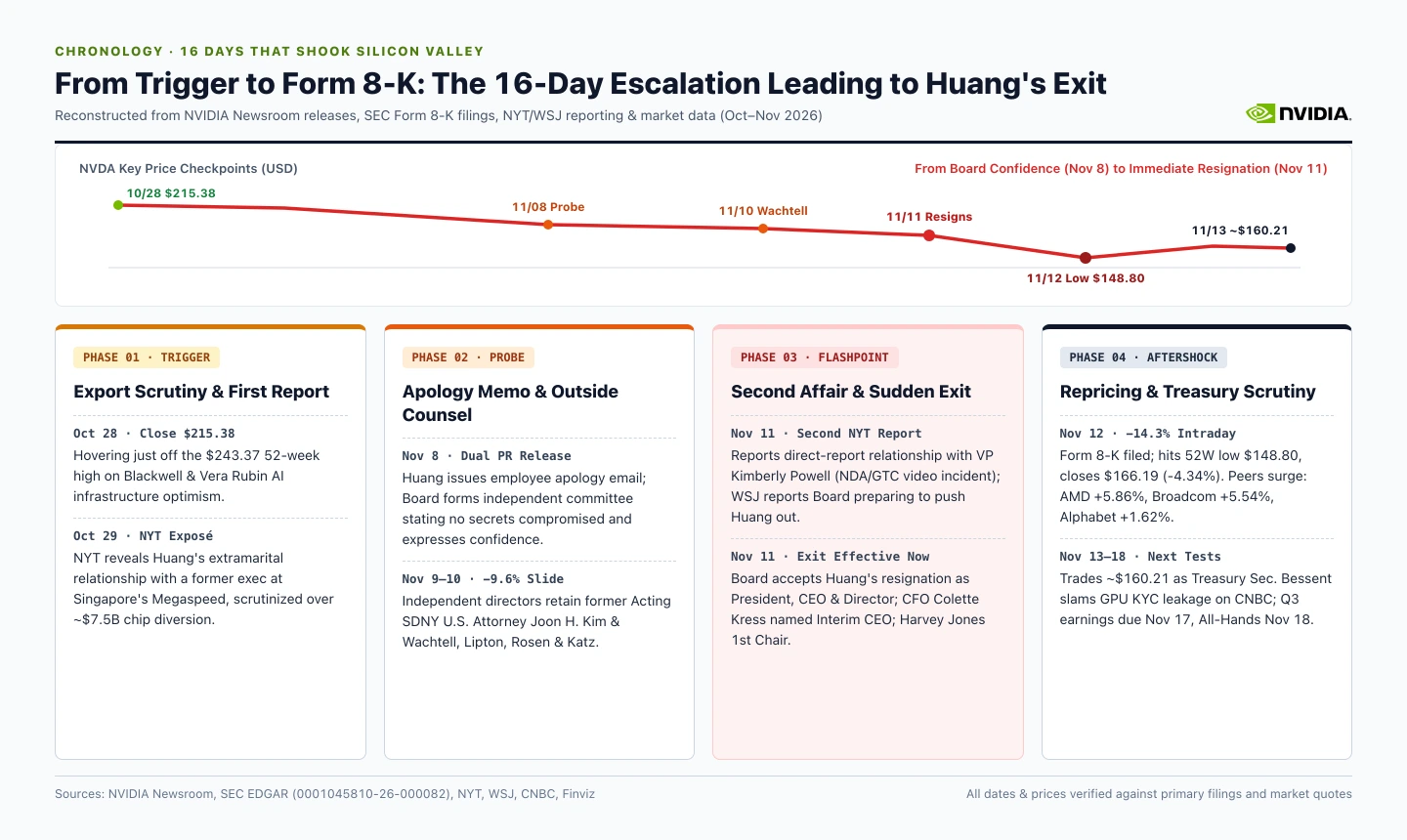
Figure 4: Original timeline reconstruction pairing NVDA stock trajectory with official Board milestones from October 28 through the upcoming November 17–18 events.
Phase 1 (Oct 29 – Nov 8): Geopolitical Spark and Initial Containment
- The Oct 29 Trigger: The New York Times reported an extramarital relationship between Huang and Alice Huang, a former executive at Singapore-based customer Megaspeed International. What alarmed Washington was the national-security nexus: U.S. investigators had scrutinized Megaspeed over an estimated $7.5 billion GPU routing network linked to restricted high-end NVIDIA accelerators (spanning H100, H200, and Blackwell lines), following early-2025 Singapore enforcement probes into false declarations.
- The Nov 8 Dual Releases: On Sunday, November 8, NVIDIA published Huang's employee email (A Message to Our Company), where he wrote plainly:
I was unfaithful to my wife. My actions hurt her and our children. There is no excuse for what I did. I am deeply sorry.Minutes alongside it, the Board published a companion statement acknowledging reporting that Huang had been"the target of a foreign intelligence effort"and forming an independent review committee—yet crucially stressing the Board had "no reason to believe that either national security or NVIDIA secrets were compromised" and affirming "confidence in Jensen and his leadership team."
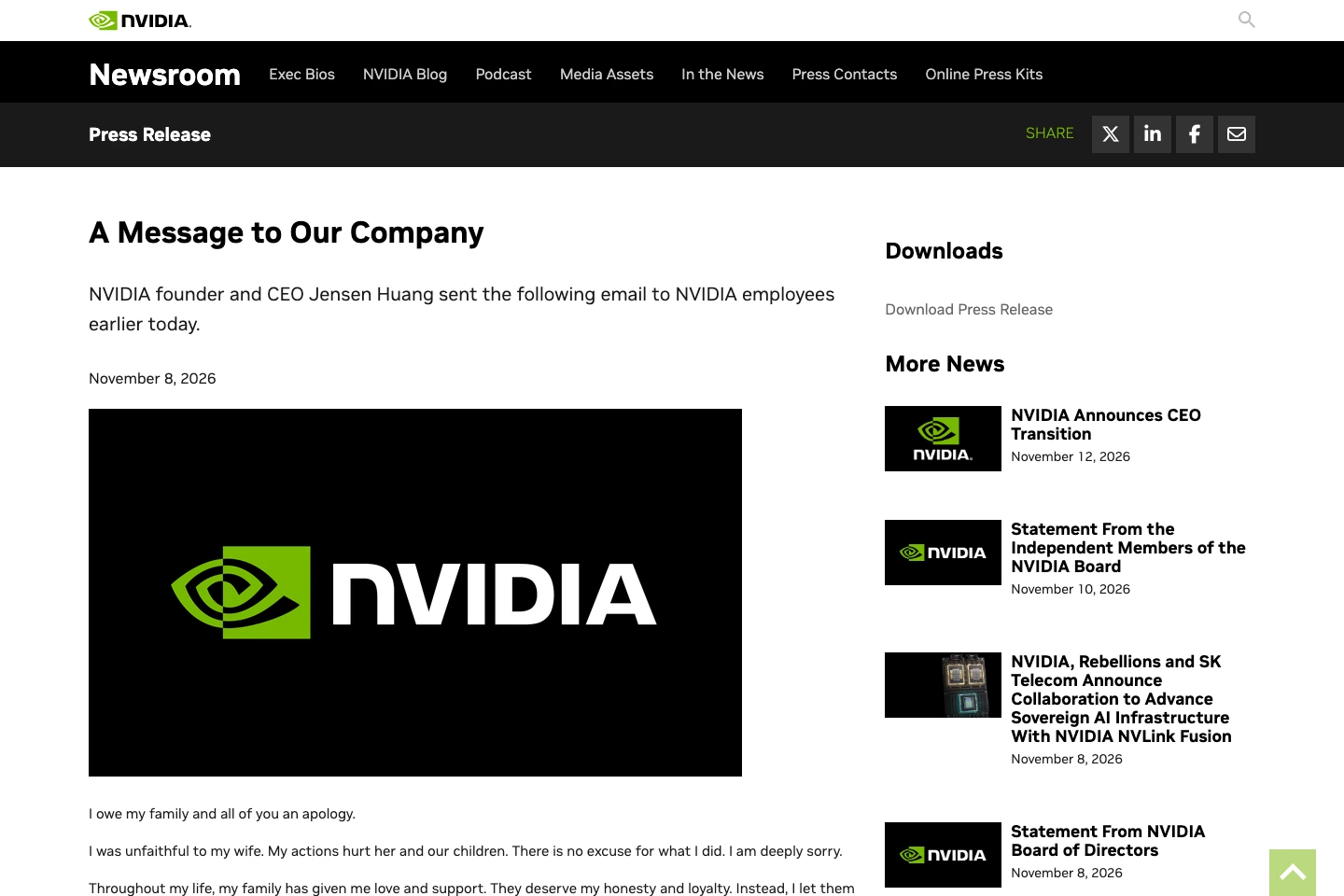
Figure 5: Authentic screenshot of Jensen Huang's November 8 public apology memo posted on NVIDIA Newsroom supporting the Board inquiry.
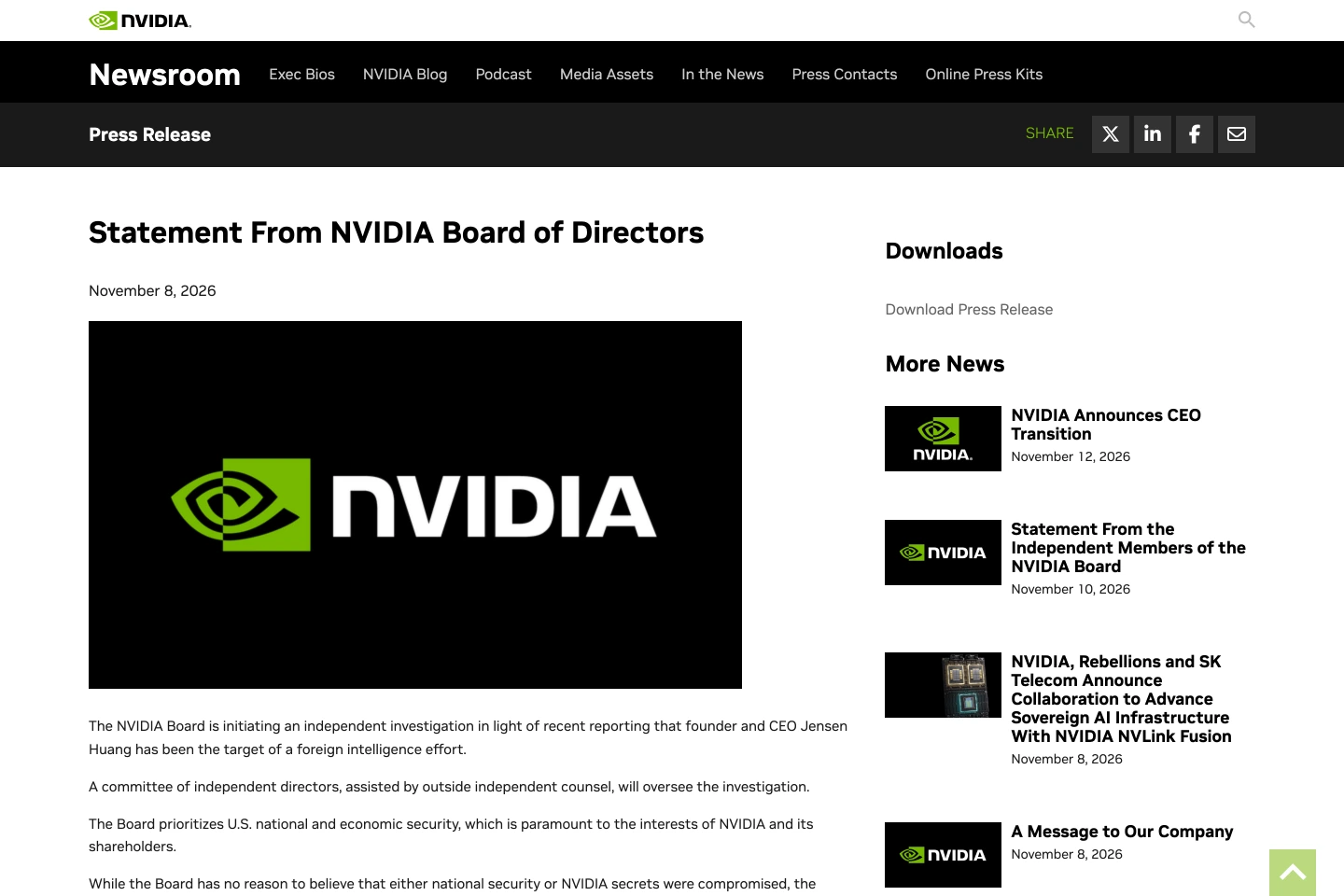
Figure 6: Authentic screenshot of the November 8 Board statement, illustrating how confidence remained intact until outside prosecutorial counsel entered and secondary disclosures hit.
Phase 2 (Nov 9 – Nov 11): Outside Prosecutors Enter & Corporate Memory Flips
After NVDA slipped 9.6% across November 9–10, independent Board members retained former Acting U.S. Attorney for the Southern District of New York Joon H. Kim alongside Wall Street crisis powerhouse Wachtell, Lipton, Rosen & Katz on November 10. In Delaware corporate governance, retaining an ex-SDNY chief and Wachtell signals an inflection point: directors shift immediately from reputational defense to insulating personal fiduciary duty.
One day later—on November 11—the second shoe dropped. Citing five NVIDIA employees, The New York Times reported a separate workplace relationship involving Kimberly Powell (NVIDIA VP of Healthcare and Life Sciences, a 2008 hire reporting under CEO purview), alongside accounts of affectionate behavior caught on video at a San Jose hotel during March GTC and security personnel approaching the bystander with an NDA. As The Wall Street Journal reported the Board preparing to oust Huang, the Board formally accepted his immediate resignation that same day. Almost instantaneously, NVIDIA's Exec Bios directory rewrote corporate memory: Kress became top-billed Interim CEO, while Huang shifted down into Founders in strict past tense—stating he "previously served as president, chief executive officer, and a member of the board of directors."

Figure 7: Authentic screenshot of NVIDIA's updated Exec Bios page. Colette Kress leads Company Officers while Huang's biography shifts to past tense under Founders.
Phase 3 (Nov 12 – Nov 13): Market Shock, $108M Forfeiture, and Treasury Criticism
On Thursday, November 12, NVDA sank up to 14.3% intraday to a 17-month low of $148.80 before closing down 4.34% (-$7.54) at $166.19 (~$4.01T market cap). Yet the pressure did not stop on Day One. By mid-morning Friday, November 13 (~10:30 AM EST), NVDA traded near $160.21 (-3.60%) on Finviz (~$3.86T market cap, down 34.17% off its 52-week peak) as U.S. Treasury Secretary Scott Bessent went live on CNBC's Squawk Box to declare there was "a lot of leakage in the system", faulting Commerce (BIS) inaction over Megaspeed's absence from the Entity List while questioning NVIDIA's shell-company due diligence.
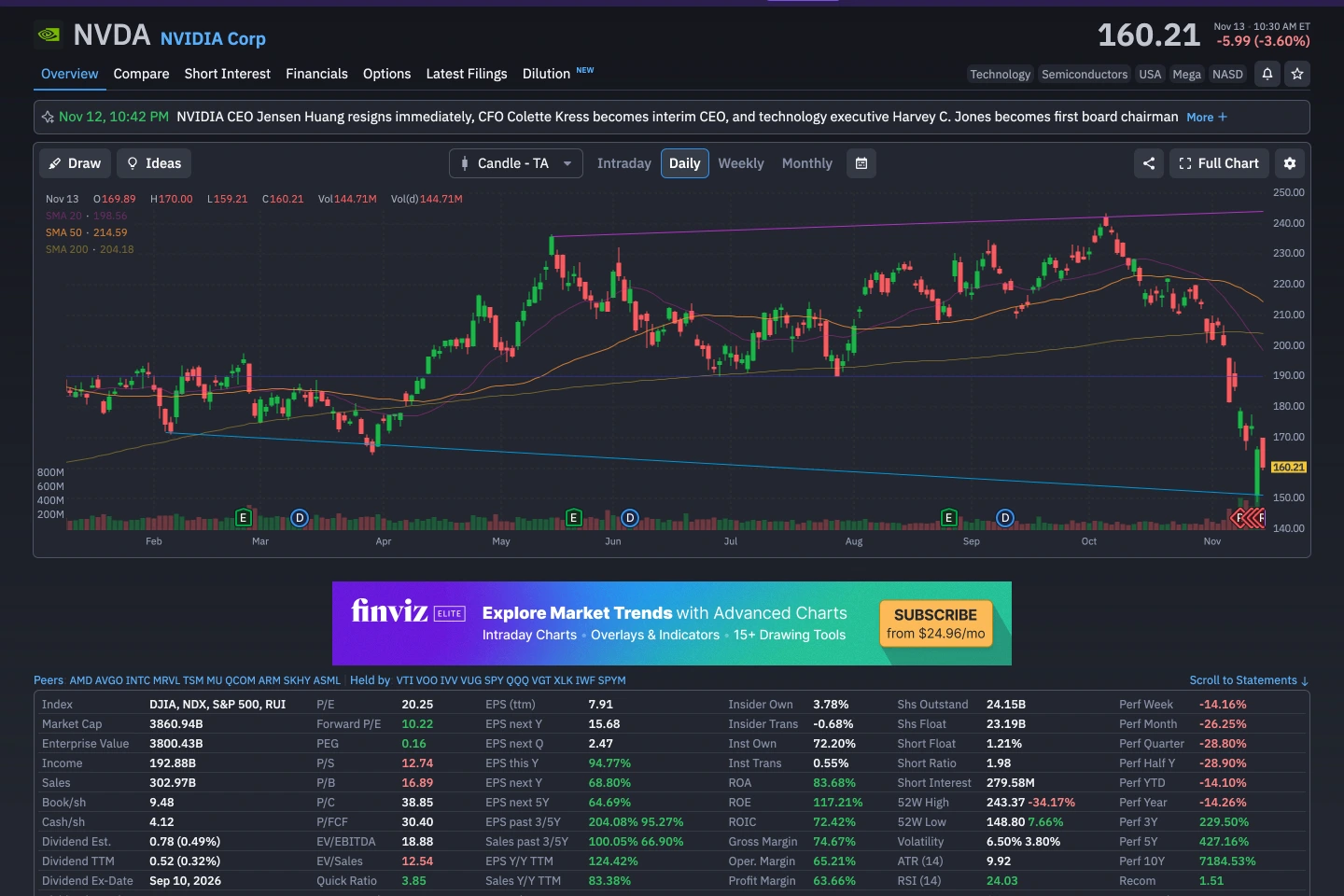
Figure 8: Live Finviz NVDA chart and financial snapshot captured November 13. While the stock sank into oversold territory (RSI 24.03), fundamentals show $302.97B sales, $192.88B income, 74.67% gross margin, and a compressed 10.22x Forward P/E.
Beneath the stock ticker lay an extraordinary structural split: on November 12, capital flooded straight into silicon rivals—AMD +5.86%, Broadcom +5.54%, Alphabet +1.62%. Yet inside NVIDIA, an anonymous survey of 232 employees cited in tech press showed 88% wanted Huang to stay, only 11% preferred a voluntary resignation, and merely 1% favored forced removal. Under standard continuous-service equity rules, Huang forfeited roughly $108 million in unvested awards with zero golden parachute.
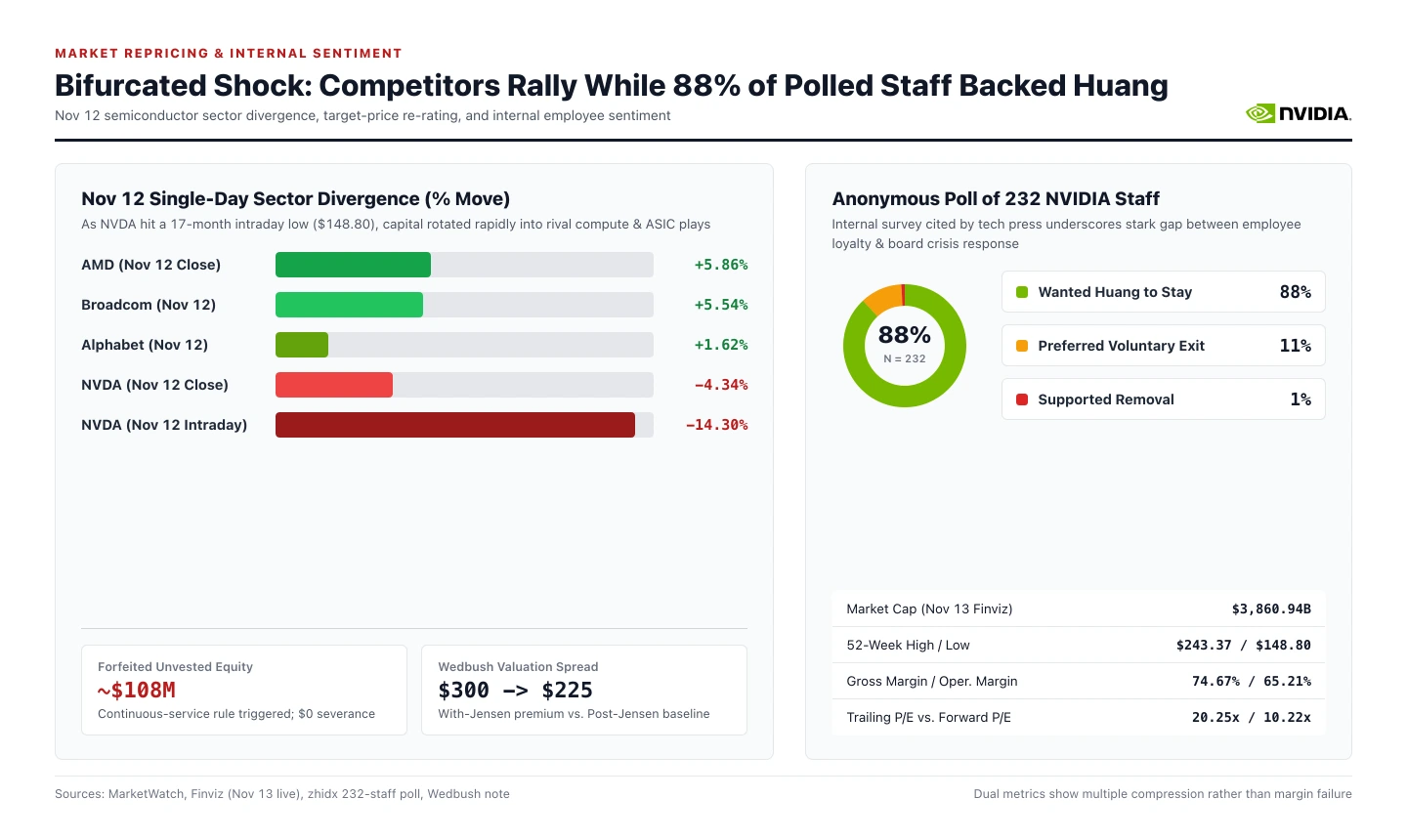
Figure 9: Original market & sentiment visualization contrasting competitor inflows against the 88%-loyalty internal survey and Wedbush's $300-vs-$225 valuation spread.
III. Root Causes Demystified: Two Everyday Analogies Anyone Can Grasp
To understand why a 3-day boardroom pivot occurred without turning the story into gossip, strip away the legal jargon and look through two everyday analogies simple enough for a fifth-grader yet faithful to corporate and export law.
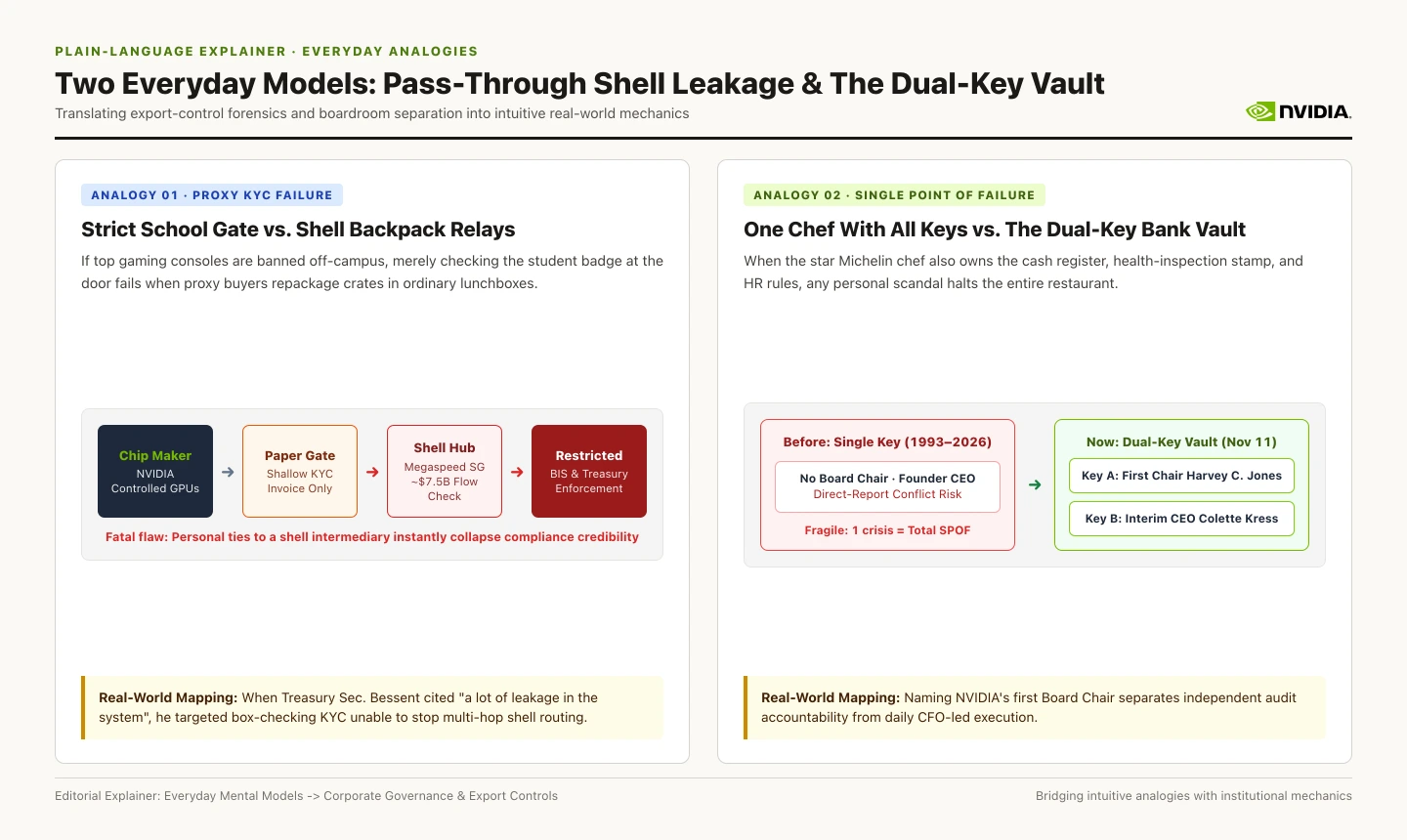
Figure 10: Original plain-language visual analogies translating multi-hop GPU diversion (left) and single-key founder concentration risk (right).
Root Cause 1: "The Strict School Gate vs. Proxy Backpack Relays" (Shallow KYC)
Everyday Analogy: Suppose a school bans bringing top-end gaming consoles off campus. The gate guard diligently checks every student's school ID and paper receipt—zero exceptions on paper. Yet savvy brokers hire regular students to unbox the consoles, pack them inside plain lunchboxes and canvas backpacks, walk straight through the gate, and ship them elsewhere. Now imagine auditors later discover the gate director had an undisclosed personal relationship with the former manager of that backpack-relay shop. Overnight, a thousand clean receipts become worthless.
Institutional Reality: That exact breakdown explains Treasury Secretary Bessent's phrase—"a lot of leakage in the system." Paperwork-level Know-Your-Customer checks (invoice verification on intermediaries) cannot stop multi-hop cloud leasing or pass-through shell networks in hubs like Singapore. Once executive personal ties intersect an entity already under intelligence and BIS scrutiny, compliance stops being a technical checklist and becomes a political liability—prompting lawmakers like Sen. Chuck Schumer to demand answers directly before Congress.
Root Cause 2: "One Master Chef Holding All Keys vs. The Dual-Key Bank Vault" (SPOF Governance)
Everyday Analogy: Picture a celebrated three-star restaurant where one genius chef has served for 33 years not just as head cook, but also as purchasing boss, payroll judge, and safety inspector—carrying every key in the building on one ring. As long as everything runs cleanly, speed is unmatched. The hidden fragility appears the instant that chef crosses an internal rule—say, an inappropriate relationship with a direct report under his pay scale plus using restaurant security guards to hand NDAs to witnesses. There is no separate auditor holding the second key to guarantee customers the kitchen is independent. The only way to save the restaurant's license is to replace the master ring with a two-key vault.
Institutional Reality: Prior to November 11, NVIDIA had never appointed an independent Board Chair in 33 years of operation. Combining external national-security scrutiny with internal direct-report and NDA boundary allegations crossed an un-insurable fiduciary threshold under Delaware corporate law. Splitting the Chair of the Board (Harvey C. Jones) away from Interim CEO & CFO (Colette Kress) installs a permanent structural firewall between executive execution and independent oversight.
Root Cause 3: Confusing "Founder Mystique" With "Silicon Physics"
For three years, Wall Street priced NVIDIA not merely as an earnings juggernaut, but with an extra Founder Mystique Premium—quantified starkly by Wedbush analyst Dan Ives valuing NVDA at $300 with Huang versus $225 without him. When panic hit, algorithms sold both executive uncertainty and the entire hardware moat as if they were one asset. They are not.
IV. System Architecture Breakdown: Why Global GPU Clusters Never Paused
To verify whether NVIDIA is facing an existential operational crisis or an upper-layer governance reset, inspect the company like a production distributed system split into three decoupled planes:
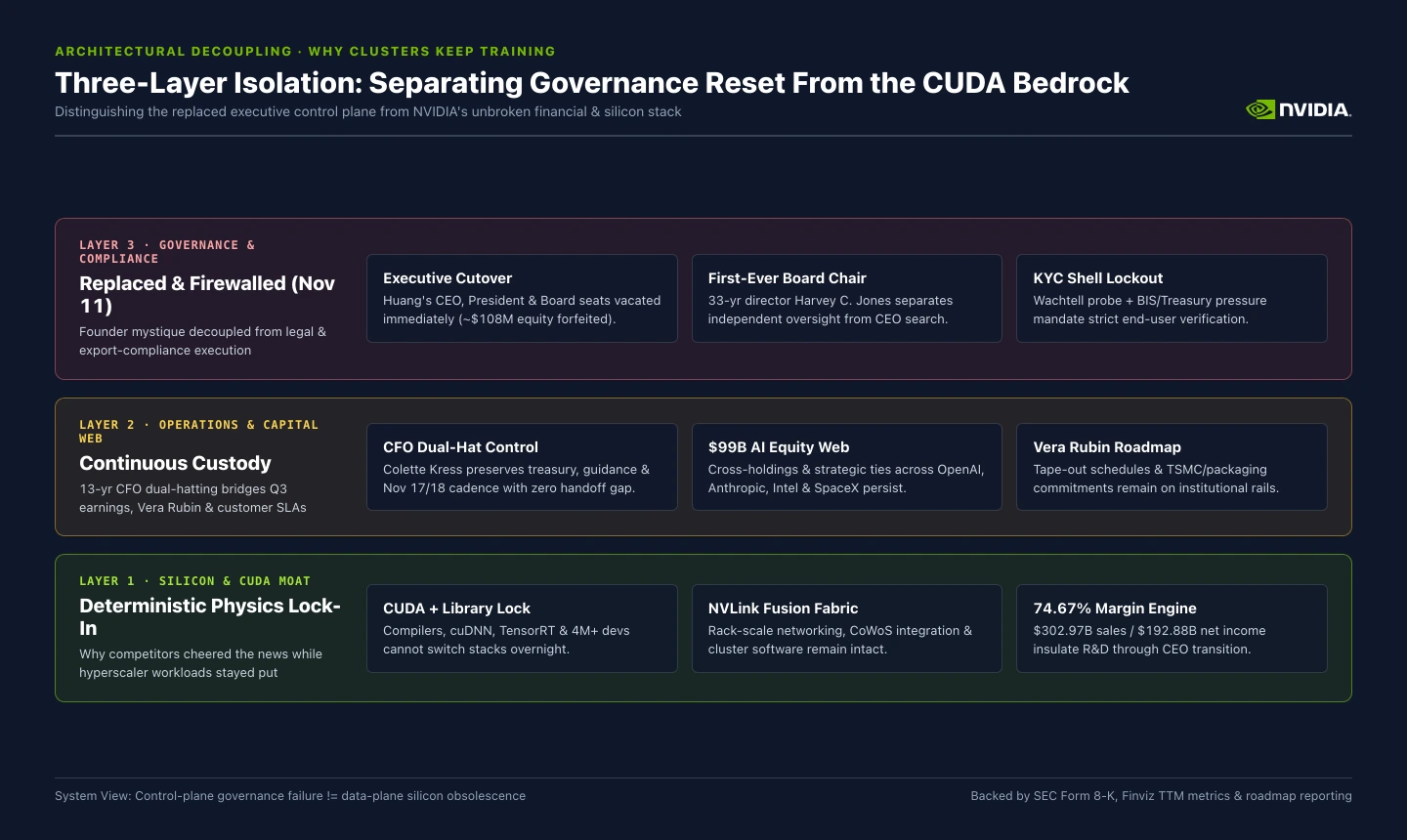
Figure 11: Original architectural isolation model showing control-plane executive replacement (top) decoupled cleanly from custody operations (middle) and hardware-software physics (bottom).
- Layer 3 (Replaced & Firewalled — Governance & Compliance Control Plane):
Huang's complete exit from executive authority and Board governance—combined with ~$108M forfeited awards and Jones/Wachtell oversight—quarantines personal compliance risk from corporate continuity so NVIDIA can reset regulatory trust with BIS and Treasury. - Layer 2 (Continuous Custody — Treasury, Partnerships & Execution Cadence):
Colette Kress brings nearly 25 years of finance tenure across Texas Instruments, Microsoft, and Cisco before her 13 years as NVIDIA CFO—crucially stewarding an estimated $99 billion strategic equity web spanning OpenAI, Anthropic, Intel, and SpaceX. Scheduling the employee All-Hands for November 18 (9:00 AM PT) immediately after Q3 FY27 earnings on November 17 guarantees uninterrupted Blackwell scaling and Vera Rubin roadmap ownership. - Layer 1 (Unbroken Bedrock — Silicon, NVLink Fusion & CUDA Moat):
As Swissquote analyst Ipek Ozkardeskaya noted, computing and networking lock-in does not vanish overnight. With trailing twelve-month revenue at $302.97B, net income at $192.88B, and operating margin at 65.21%, NVDA's drop to ~$160 compressed its Forward P/E to 10.22x. Rivals popped on portfolio hedging—not because frontier AI labs rewrote CUDA kernels between Wednesday night and Thursday morning.
V. Industry Polarization & Historical Mirrors
Across Silicon Valley and Beijing tech media, the verdict over the past 48 hours exposes a sharp cultural fault line between institutional governance orthodoxy and founder-driven engineering loyalty.
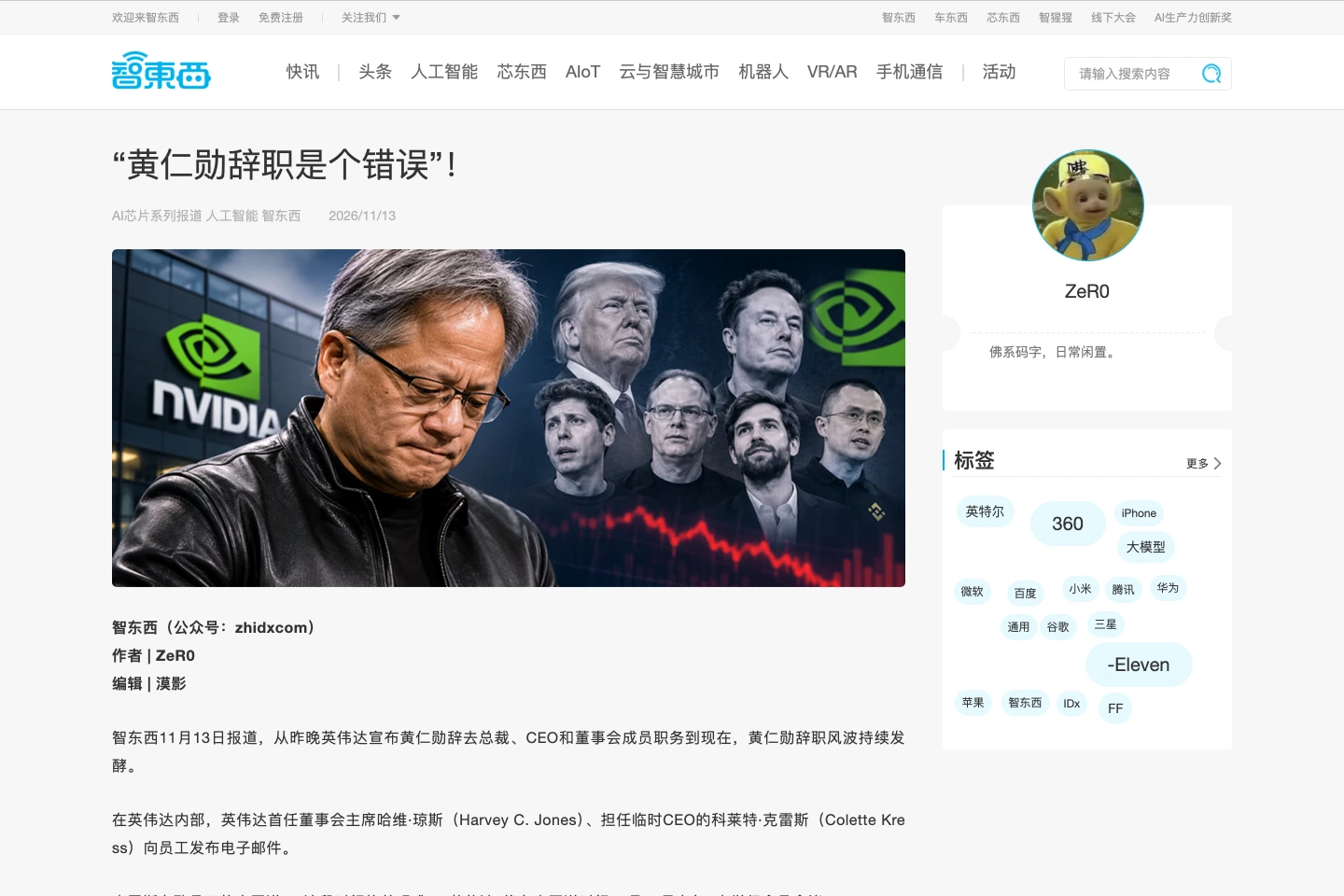
Figure 12: Industry reaction coverage capturing Silicon Valley reactions and the stark divide between Wall Street discipline and engineering sentiment.
- Founder & Builder Backlash: Elon Musk publicly tweeted that hiring Huang
"It would be an honor if I could"while warning against boards ousting founders like Steve Jobs at Apple or Travis Kalanick at Uber; Lex Fridman labeled it"a grave mistake"; Epic Games CEO Tim Sweeney called it"A sad day for NVIDIA, developers, the United States, and humanity"; Hugging Face CEO Clément Delangue pledged an accelerated push for open-source AI; and Donald Trump even tossed out Tim Cook's name as a playful "legend replaces a legend" remark. - The Governance Turning Point: Analysts noted that losing the black-leather-jacket aura forced NVIDIA to adopt its first Board Chair in 33 years—yet picking the wrong permanent replacement could repeat two cautionary tales from tech history: HP and Intel.
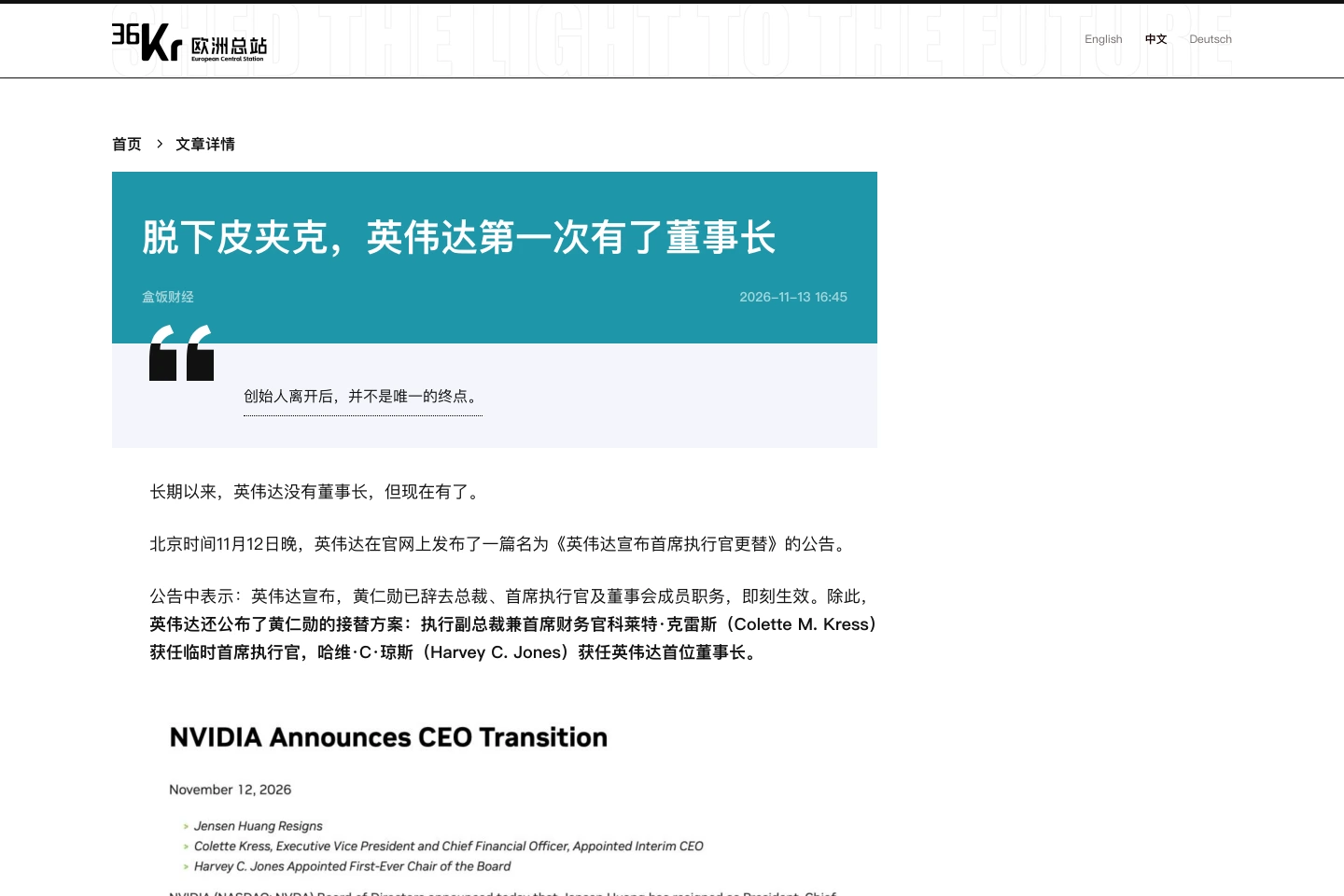
Figure 13: Commentary highlighting the historic institutional shift as NVIDIA installs its first Board Chair.
VI. Navigating Post-Jensen Reality: Four CEO Paths & Engineering Playbook
This analysis focuses on corporate governance, semiconductor supply chains, and AI workload architecture rather than OS workstation troubleshooting, so no local host scripts are needed here. Instead, here is the strategic decision matrix both NVIDIA's Board and external AI infrastructure teams now face.
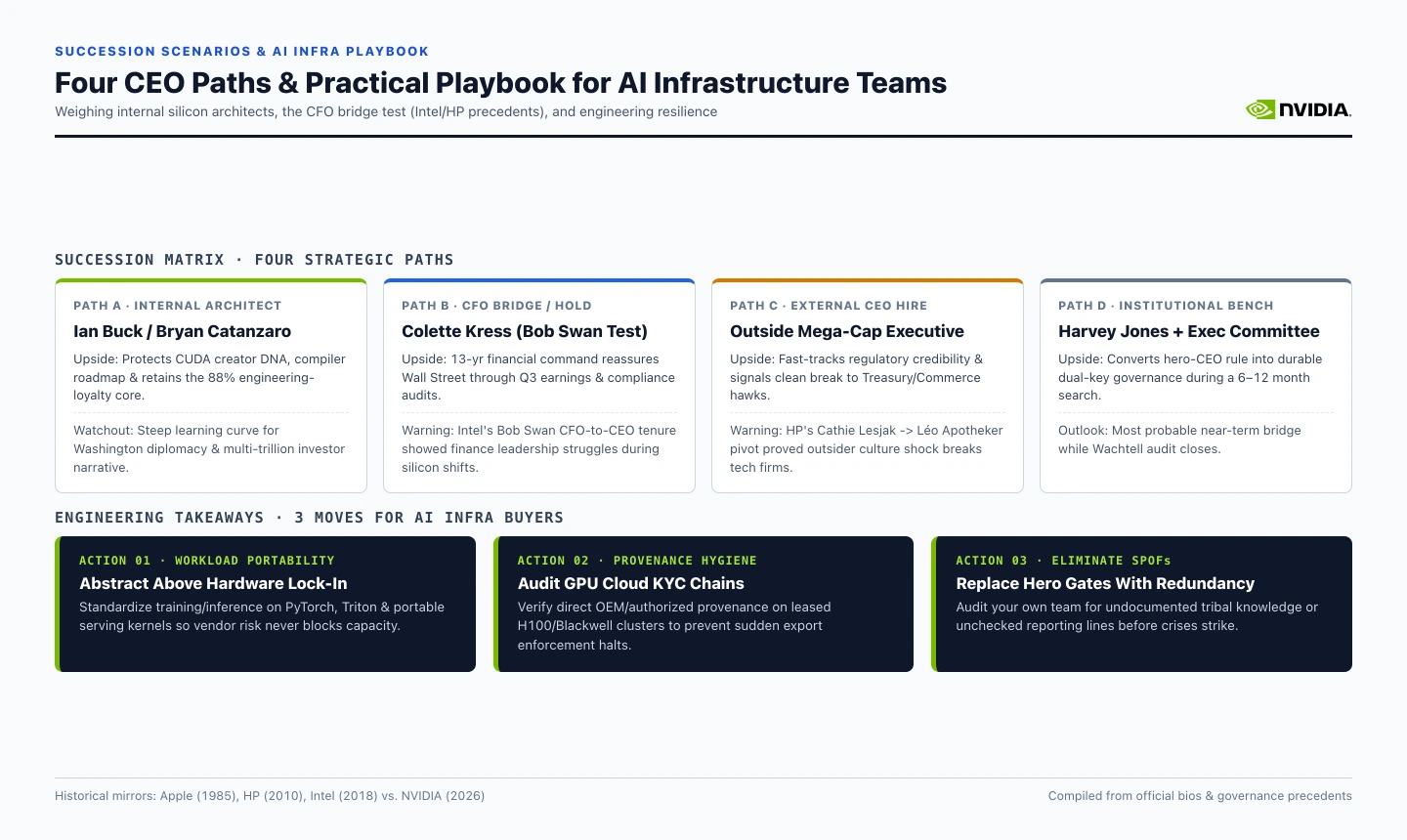
Figure 14: Original succession matrix and engineering playbook balancing technical-founder preservation against regulatory credibility.
1. NVIDIA's Board Search: Avoiding the HP and Intel Traps
- Do Not Repeat HP's Outsider Rejection (2010): When HP briefly leaned on CFO Cathie Lesjak as interim chief and then bypassed internal leaders for former SAP chief Léo Apotheker, engineering culture collapsed alongside shareholder value. If NVIDIA imports a pure compliance generalist, retaining the 88% of engineers loyal to Huang's builder ethos becomes an uphill battle.
- Respect Intel's CFO-to-CEO Warning (2018): While Colette Kress is widely trusted by institutional finance, Intel's permanent elevation of CFO Bob Swan underscored how dangerous finance-first leadership can become across multi-year silicon process transitions. Letting Kress steady Q3 earnings and overhaul KYC compliance while pairing Board Chair Harvey Jones with a deep technical successor—names like CUDA co-architect Ian Buck or VP of Applied Deep Learning Research Bryan Catanzaro—preserves core silicon velocity.
2. Three Practical Moves for AI Infrastructure & Engineering Teams
- Move 1 — Decouple Above Vendor Lock-In: Keep training and serving pipelines standardized on PyTorch, Triton, vLLM, and portable kernel abstractions. Multi-vendor portability turns hardware supply volatility or pricing power shifts from an existential outage into an orchestration config change.
- Move 2 — Audit Cloud & Reseller KYC Provenance: Treasury scrutiny means compliance risk cascades down into cross-border GPU leasing and distributor chains. Verify direct OEM authorization and end-user compliance before signing long-term off-prem cluster contracts.
- Move 3 — Eliminate Organizational Single Points of Failure: Whether running a 10-person startup or a multi-billion compute stack, inspect your own approval gates for undocumented tribal knowledge, unreviewed direct-report exceptions, and hero-architecture bottlenecks before a crisis enforces them for you.
VII. Deep Q&A: 6 Sharp Questions Every Reader Is Asking
Q1: Why did NVDA drift further down toward ~$160 on Nov 13 even after Huang already resigned?
A: Thursday's initial drop priced out the founder premium; Friday morning's slip reflected secondary regulatory overhang after Treasury Secretary Bessent criticized "a lot of leakage in the system" and Commerce delays around Megaspeed. Market participants are hedging potential tighter export licensing, expanded Entity List designations, or compliance fines ahead of Q3 earnings guidance on November 17.
Q2: Why did the Board express confidence on November 8 and accept an immediate exit just three days later?
A: On November 8, directors treated the Megaspeed link as an external compliance & personal apology issue with no evidence of stolen secrets. Once ex-SDNY prosecutor Joon H. Kim and Wachtell took the helm on November 10 and secondary reporting on November 11 detailed a direct-report executive relationship plus security/NDA handling at GTC, containment ceased to be legally defensible for an independent public board.
Q3: Will AMD or custom hyperscaler ASICs immediately break NVIDIA's CUDA dominance?
A: Not in the next 12 to 24 months. Competitor pops on Nov 12 were classic capital rotation—no hyperscaler can refactor multi-thousand-GPU training stacks off CUDA overnight. Over a 3-to-5-year horizon, however, losing NVIDIA's singularly persuasive founder removes psychological friction for cloud giants accelerating TPU, Trainium, Maia, and ROCm diversification.
Q4: Could Jensen Huang return to NVIDIA years later like Steve Jobs returned to Apple in 1997?
A: It makes a compelling narrative, but modern reality is far steeper. When Jobs left Apple in 1985, personal computers were not national-security chokepoints overseen simultaneously by Treasury, Commerce, and Senate committees. Until regulatory inquiries and export probes fully close without residual liability, bringing Huang back into an executive or Board capacity carries extreme compliance hurdles.
Q5: What actually happens to the ~$108 million in unvested equity awards?
A: Standard equity grant continuous-service clauses govern termination: unvested RSUs and PSUs are forfeited back to the company plan immediately upon separation, with zero severance package. Still, given the vested equity accumulated over 33 years as co-founder, Huang remains among the wealthiest technology founders globally.
Q6: What are the two critical checkpoints to watch next week?
A: First, Q3 FY27 earnings on Tuesday, November 17 (1:20 PM PT release, 2:00 PM PT call)—where Kress and leadership must pair revenue execution with concrete KYC hardening and CEO search milestones. Second, the November 18 (9:00 AM PT) All-Hands, which will test whether NVIDIA retains the loyalty of that 88% engineering cohort under post-founder governance.
Bottom Line: No durable computing institution should depend forever on one individual's personal irreplaceability. November 11 delivered a brutal, multi-hundred-billion-dollar institutional stress test—ending Silicon Valley's longest founder-CEO era while hard-coding NVIDIA's first independent Board Chair into governance bedrock. The black leather jacket left center stage, but the physics of AI compute demand—and the scrutiny over who builds and controls it—is only entering its next act.