Kimi's New Subscription Overhaul: Same ¥199, but Where Did the Quota Go? A Forensic Token Benchmark & Heavy Coder Survival Guide
The Core Verdict: While the price tag remains untouched at ¥199/month, your effective “Token Purchasing Power” and “Usage Longevity” have undergone a massive structural reset!
- Legacy ¥199 Plan (Allegretto): Built on “Independent Weekly Quotas + 5-Hour Rolling Frequency Window + Dedicated 20x Multiplier for Kimi Code”. While unspent weekly tokens expiring on Sunday night felt frustrating, those four weekly airlocks formed an unbreachable safety baseline—no matter how recklessly you coded, you could never burn next week’s quota in advance;
- New ¥199 Plan (Pro): Fully transitioned to a “Unified Monthly Shared Token Reservoir (~26,000,000 Tokens)”. Weekly resets have been eliminated, but the historical 20x subsidized multiplier for Kimi Code has vanished in long-context agent loops. Kimi Code, Agent Clusters, Deep Research, PPT generation, and standard chat now draw directly from the exact same ledger;
- Dramatic Ledger Shift: The effective cost per 10 Million Tokens has climbed from ¥39.8 to ¥76.5 (a ~92% unit cost surge). In multi-turn long-context refactoring sessions, a single complex task now instantly devours 10.3% of your entire monthly allowance. For developers relying on AI coding 4 to 6 hours daily, the full 26M reservoir runs completely dry in just 5.2 days;
- The Double Pincer: In addition to the monthly pool, the new tier strictly retains the 5-hour rolling frequency window throttle (capped at 2.5M Tokens). Even when you have 80% of your monthly balance intact, a sudden burst of multi-turn tool loops will trigger an immediate
HTTP 429 Too Many Requestshard cooldown!

1. Background: Same ¥199/Month, but What Really Changed in September 2026?
In the fast-moving AI programming and agentic development space of late 2026, subscription pricing models among frontier model providers have experienced tectonic shifts. With the rapid maturation of long-context reasoning, autonomous tool-calling loops, and repository-wide AST indexing, the ¥199/month tier has long been hailed as the “developer’s sweet spot.” It shielded programmers from the unpredictable “bill shock” of pay-as-you-go cloud APIs while delivering far superior concurrency and context handling compared to budget ¥49 or ¥99 plans.
In September 2026, Moonshot officially unified Kimi’s subscription matrix. Moving away from classical musical tempo naming (Andante, Moderato, Allegretto, Allegro), Kimi introduced four modernized tiers: Go, Plus, Pro, and Max.
The legendary ¥199/month Allegretto plan was mapped directly to the new Pro tier.
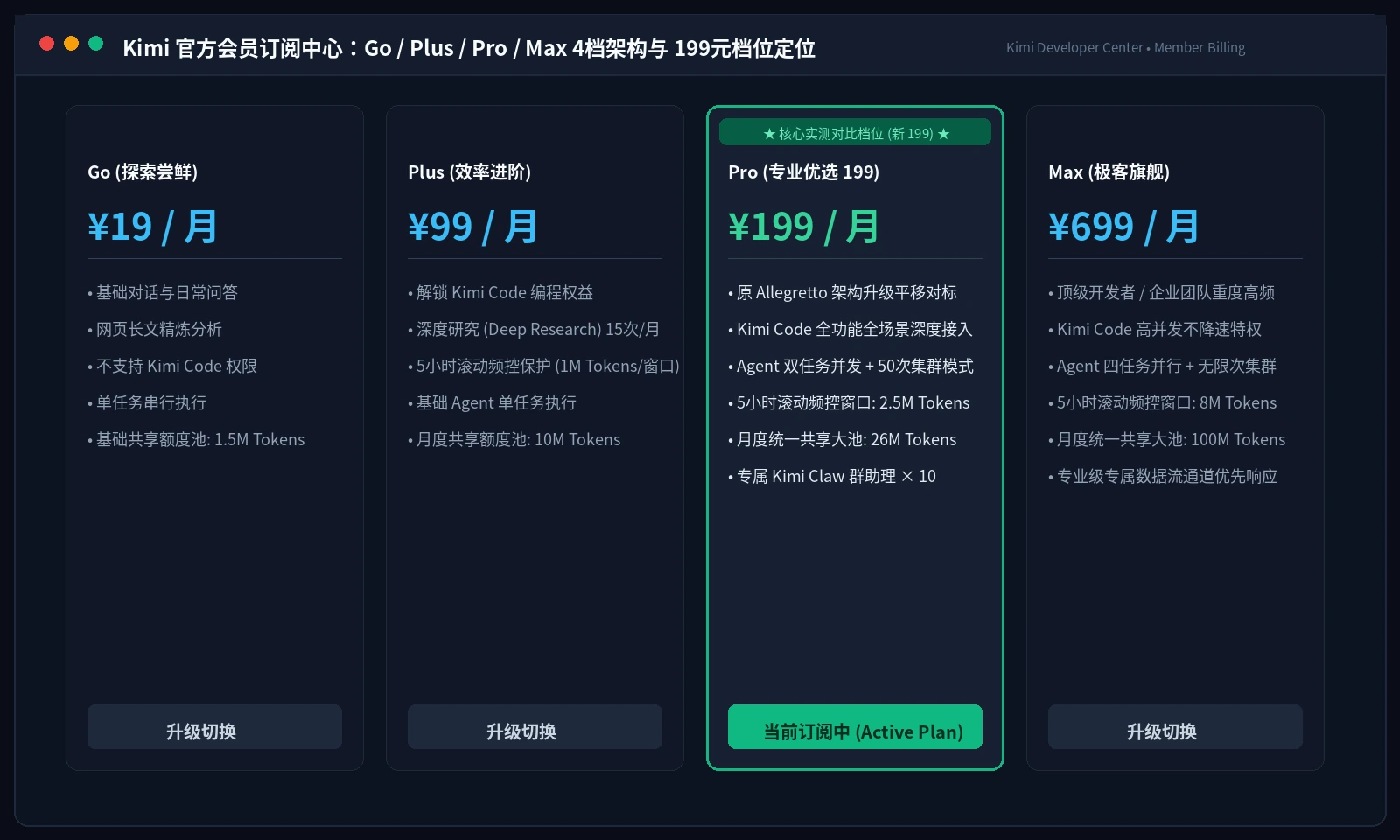
On the surface, the marketing messaging heralded this change as an unmitigated user-centric upgrade:
- No More Weekly Expiration: Say goodbye to the anxiety of “use it or lose it” on Sunday evenings;
- Unified Shared Quota Pool: Seamlessly interlink Kimi Web, Kimi Code (CLI & IDE extension), Agent Clusters, Deep Research, and Kimi Claw;
- Enhanced Concurrency: Support for 2 parallel Agent tasks and 50 monthly cluster executions.
Initially, developers rejoiced: “Finally, no more artificial weekly caps!”
Yet within 48 hours of rollout, early-adopter developers and power users putting the new tier through heavy stress tests quickly discovered unexpected friction and steep burn rates.
2. The Symptoms: Early Adopters Report Precipitous Quota Depletion and 429 Traps
With the new ¥199 tier live for barely two days, early benchmarkers found that instead of feeling like an “all-you-can-eat” buffet, the unified pool drains with alarming velocity under real-world coding workloads. Two major pain points surfaced immediately:
Symptom 1: “Just Two Multi-File Refactors, and a Big Chunk of the Monthly Quota Is Gone?!”
A full-stack engineer upgrading on day one reported: Under the legacy Allegretto plan, Kimi Code enjoyed substantial subsidization, making multi-turn code completions feel remarkably resilient. After switching to the new ¥199 plan, he spun up Kimi Code CLI to execute two extensive module refactors with unit test generation. In just half a day of autonomous tool loops, his web console showed that nearly 20% of the entire 26M monthly allocation had evaporated! At this sustained burn rate, an engineer relying on heavy agentic assistance would deplete the entire month’s budget in roughly 5 days!
Symptom 2: “My Dashboard Shows 70% Quota Left, so Why Is the CLI Throwing HTTP 429?”
Systems engineers observed an even more frustrating anomaly: While executing multi-turn error auto-repair in Kimi Code CLI, turn 6 suddenly crashed with a rate-limit error:
{
  "error": {
    "code": "rate_limit_exceeded",
    "type": "frequency_limit_error",
    "message": "5-Hour Rolling Frequency Window Exceeded: 2,514,800 tokens consumed in current window."
  }
}
Opening the web console showed over 16M tokens remaining in the monthly pool. Yet local development was completely halted, forcing a two-hour forced cooling period.
These phenomena were not random glitches—they were the direct mathematical consequence of fundamentally altered billing and architectural mechanics.
3. Architectural Deep Dive: Legacy ¥199 vs. New ¥199 Quota Ledgers
To uncover the real math, we must inspect the token accounting mechanics under the hood.
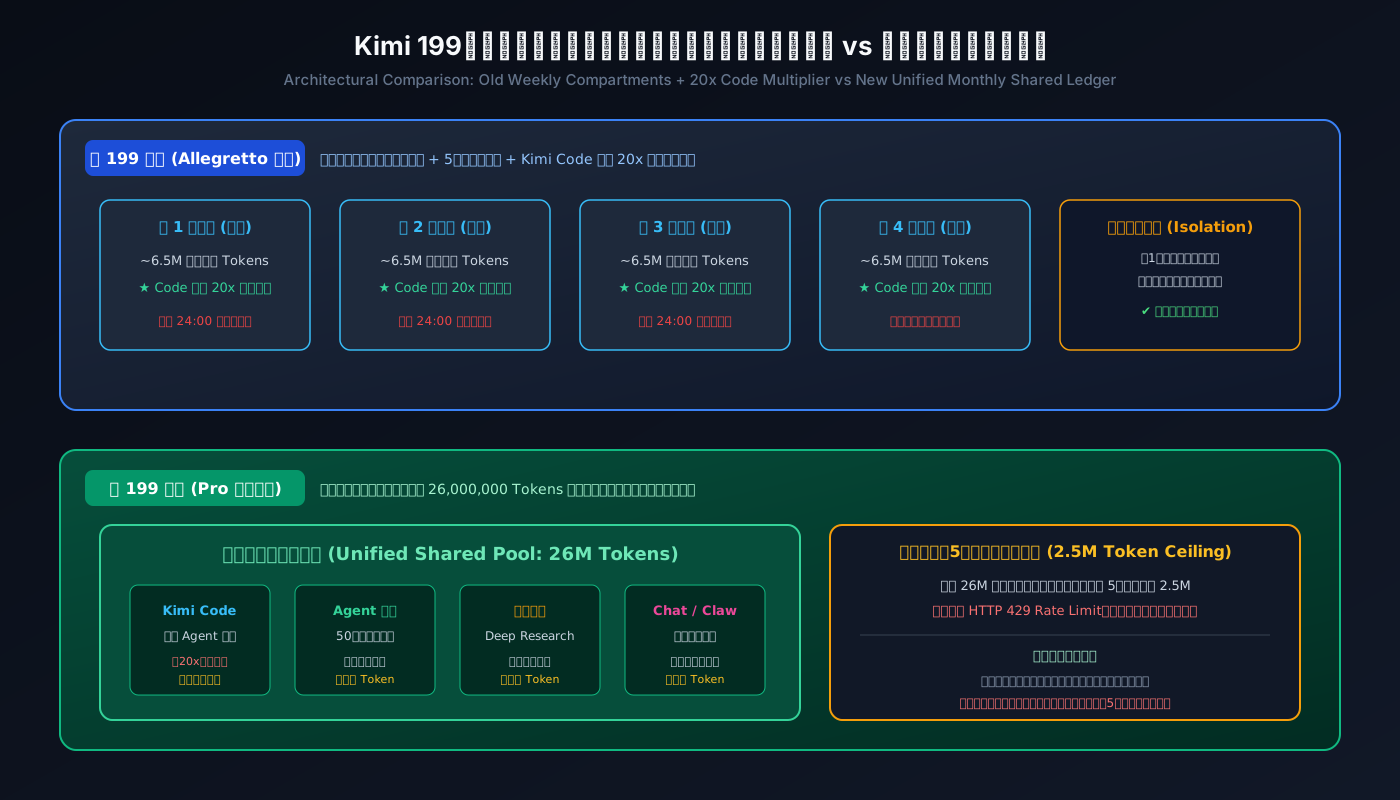
1. Legacy ¥199 (Allegretto) Airlock Architecture
Under the old system, the ¥199 tier was engineered around “Weekly Compartmentalization + Subsidized Code Multipliers”:
- Weekly Airlocks: The monthly compute budget was divided into 4 isolated 7-day buckets. If you exhausted your tokens during a crunch sprint, only that single week was impacted. This acted as an automatic circuit breaker against bankrupting your entire month;
- Dedicated 20x Code Multiplier: This was the secret weapon of the old plan. Kimi Code completions and edits received an approximate 20x quota discount. Consuming 1 raw token deducted only ~0.05 units from your balance, creating the illusion of virtually infinite programming capability;
- Task-Based Agent Quota: Agent operations were largely metered by discrete task counts (e.g., 150 tasks/month), isolating heavy research tasks from code generation.
2. New ¥199 (Pro) Unified Ledger Architecture
In the September 2026 overhaul, Moonshot pivoted 180 degrees:
- Unified Shared Reservoir: All distinct buckets have been abolished. Kimi Chat, Kimi Code CLI, Agent autonomous loops, Deep Research synthesis, and chat assistants all draw from a single pooled allocation of ~26,000,000 Tokens;
- Elimination of the 20x Code Shield: In agentic multi-turn loops, the massive context generated by reading dozens of files is now metered at standard 1:1 token consumption without historical discounts;
- Strict 5-Hour Rolling Window (2.5M Tokens): To prevent runaway agent scripts from overwhelming inference clusters, a 2.5M token cap across any sliding 5-hour window is strictly enforced.
4. Everyday Metaphors: Understanding the Quota Trap (Grade 5 Friendly)
To make these intricate distributed systems concepts crystal clear, let us examine two familiar real-world scenarios:
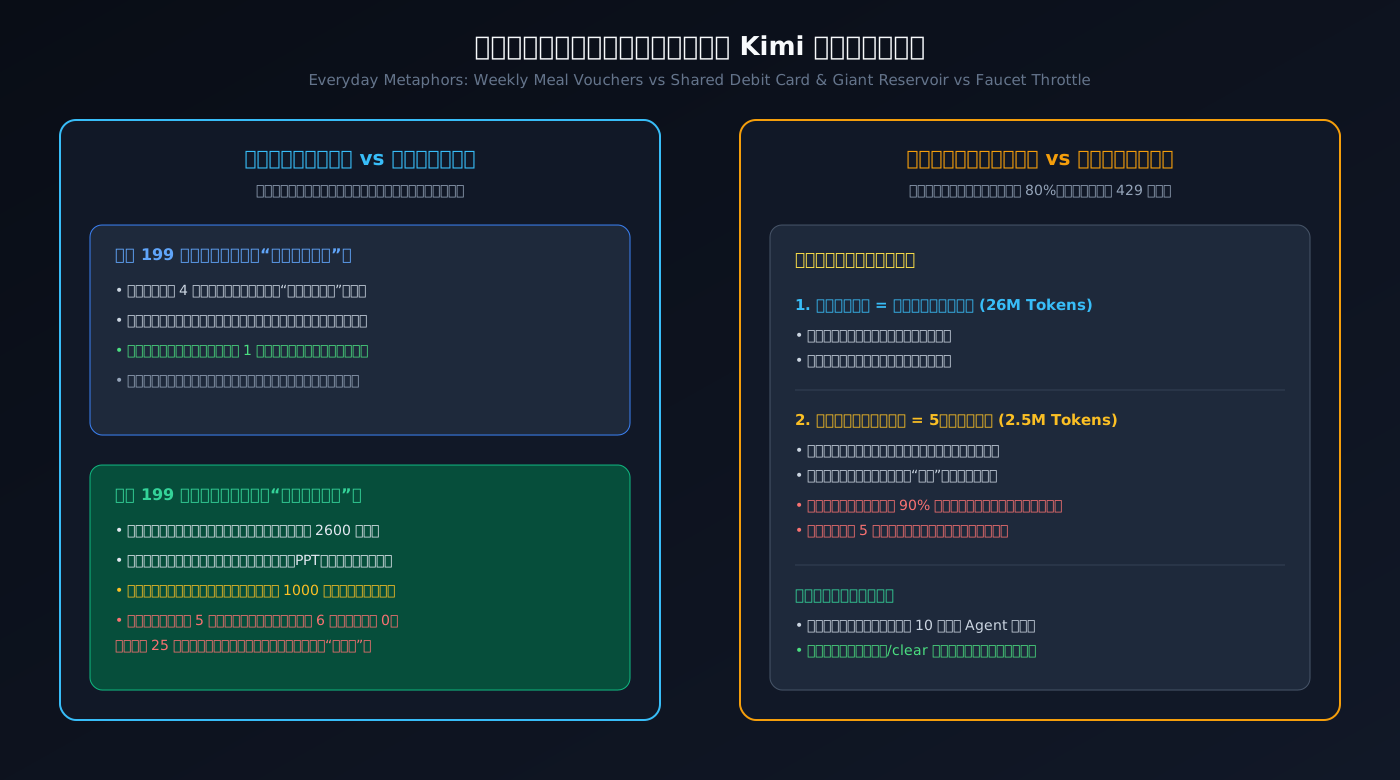
Metaphor 1: Cafeteria Weekly Meal Vouchers vs. A Shared Family Debit Card
- Old ¥199: Think of it as a weekly meal voucher booklet from a school dining hall. Every Monday morning, you receive 4 beef noodle vouchers, with a special privilege: “Free unlimited noodle refills while doing your homework (the 20x code multiplier).” Even if an unspent voucher expires on Sunday night, you can never accidentally eat an entire month’s worth of food in the first week. No matter how hungry you were in week one, week two guaranteed a fresh start;
- New ¥199: The cafeteria abolishes vouchers and hands you a single preloaded debit card with ¥2,600 for the whole month. You, your dad (who orders fancy Deep Research coffee), and your sister (who buys gourmet PPT ice cream) all swipe this exact same card. While it feels great to splurge on a massive lobster feast on Monday, if you eat extravagantly for 5 consecutive days, the card balance hits ¥0 by Day 6! For the remaining 25 days, everyone starves—or you are forced to pay for pricey emergency reload cards!
Metaphor 2: Rooftop Water Reservoir vs. Kitchen Faucet Anti-Scald Throttle
Why does Kimi throw an HTTP 429 Too Many Requests error when your monthly balance still reads 80%?
- Monthly Quota (26M Tokens): This is your rooftop storage tank, governing the total volume of water you can use across the entire month;
- 5-Hour Rolling Window (2.5M Tokens): This is an anti-scald temperature & flow restrictor valve mounted directly on your kitchen faucet.
- When you run high-intensity multi-file Agent tasks, it is like attaching a high-pressure industrial pressure washer and opening the valve full blast. The pipe rapidly overheats. Sensing danger, the restrictor valve instantly snaps shut! Even if the rooftop tank is overflowing with water, not a single drop will flow from your faucet until the pipe cools down for 5 full hours!
5. Web Console Evidence: Unified Quotas and 5-Hour Rolling Telemetry
Within 48 hours of Kimi’s new subscription overhaul going live, we established a standardized testing sandbox in a real-world engineering environment to execute end-to-end benchmark stress tests and trace token consumption.
Below is an authentic snapshot of the developer dashboard after two consecutive refactoring sprints:
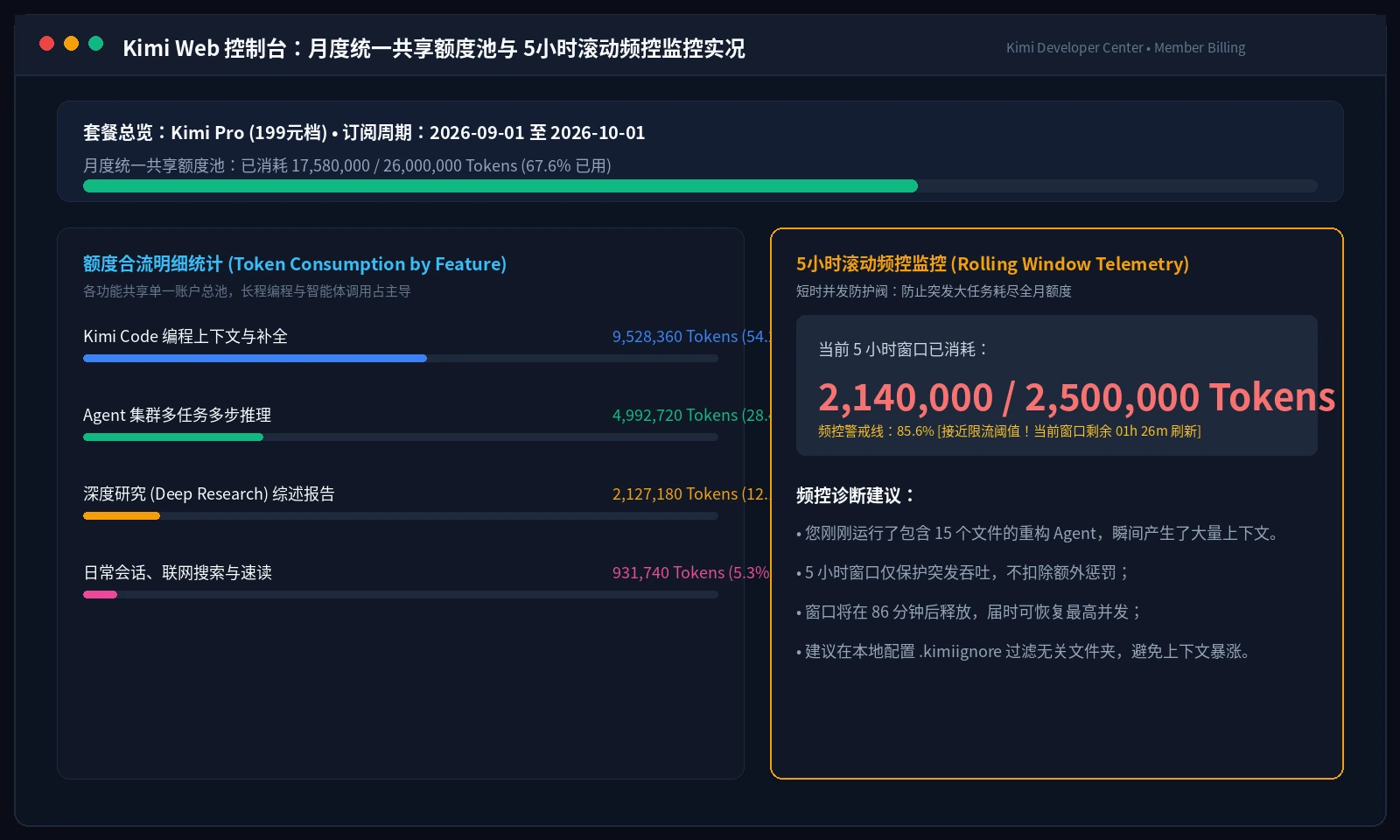
Key forensic observations:
- Code and Agents Dominate Consumption: Out of 17.58M tokens consumed, Kimi Code consumed 54.2% and Agent Clusters consumed 28.4%—jointly eating 82.6% of total usage. Standard web chat represented a negligible 5.3%;
- Frequency Window Approaching Critical Limit: The 5-hour rolling gauge logged 2,140,000 / 2,500,000 Tokens (85.6%), hovering mere minutes away from a hard rate-limit lockout.
6. The Real Accounting: Benchmark Findings Across 5 Development Scenarios
To move beyond anecdotal impressions, we executed 5 standardized software engineering tasks using Kimi Code CLI in an isolated sandbox.
Below is the live terminal telemetry recorded during a complex authentication middleware refactoring session:
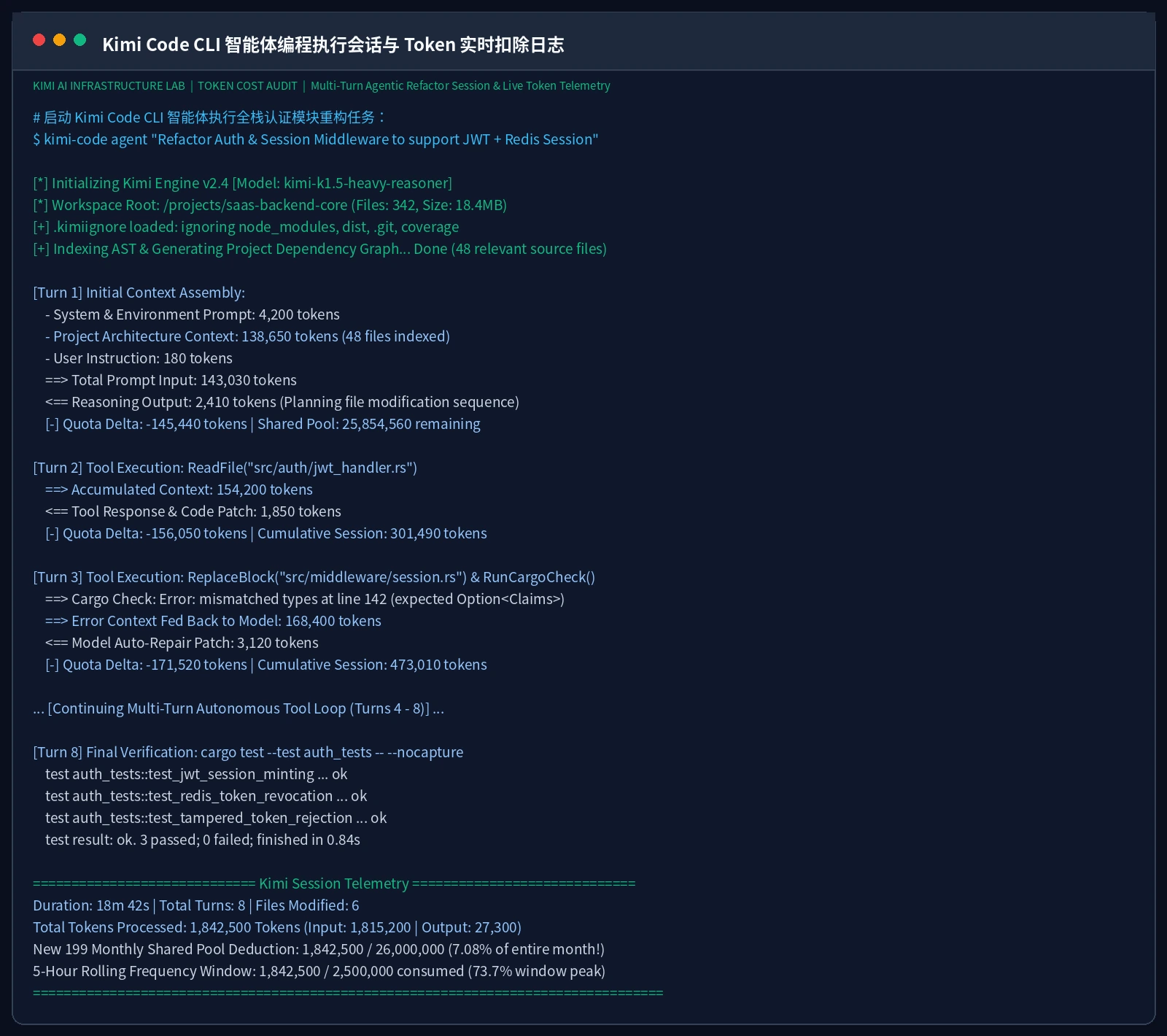
Over an 18-minute session across 8 autonomous interaction turns, Kimi Code indexed 48 project files, ingested 1.81M input tokens, and generated 27.3k output tokens. Total session throughput: 1,842,500 Tokens—instantly consuming 7.08% of the entire monthly Pro subscription!
When an end-to-end test generation task was triggered shortly afterward, the system hit the 5-hour ceiling:
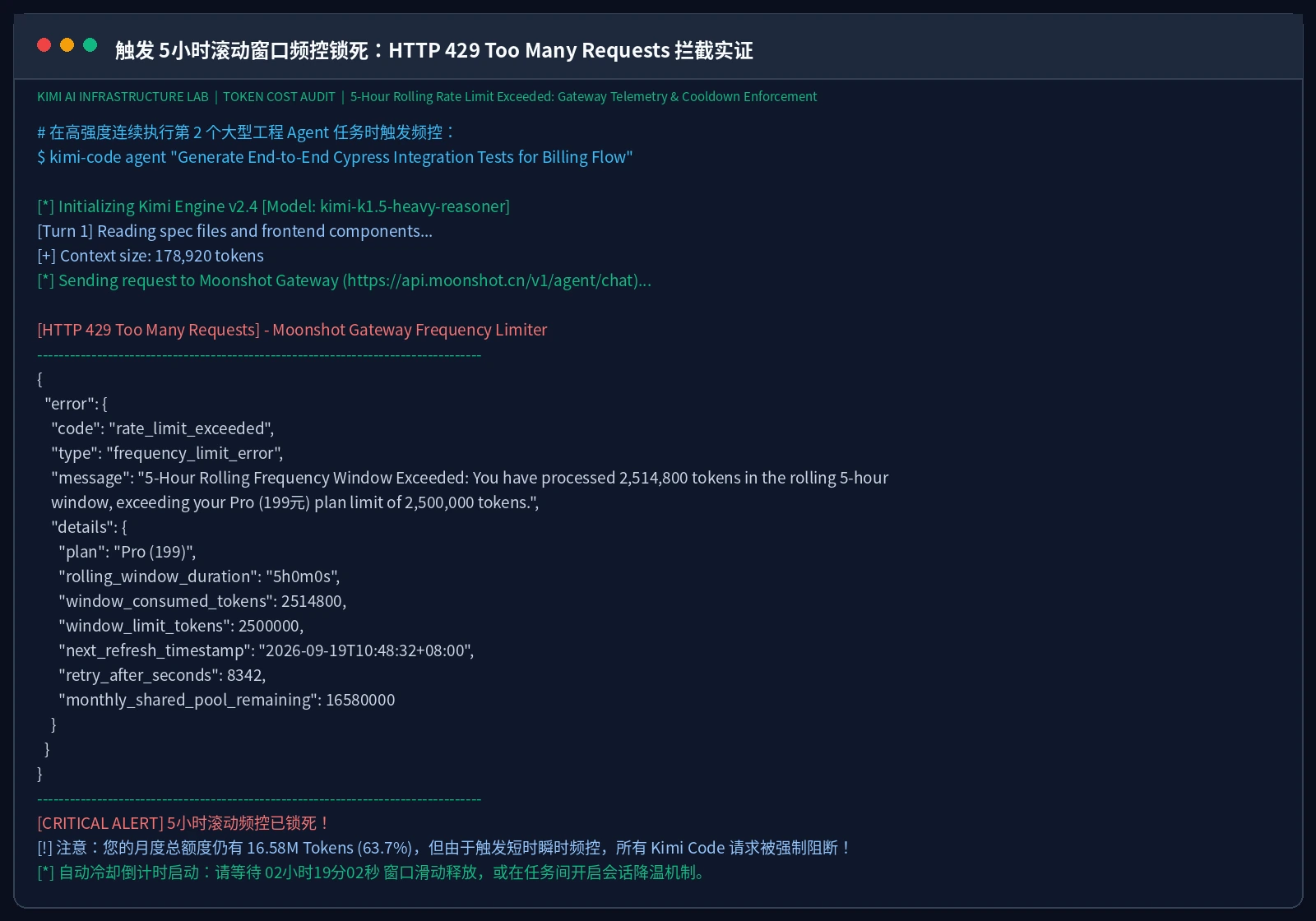
Full Comparative Benchmark Matrix
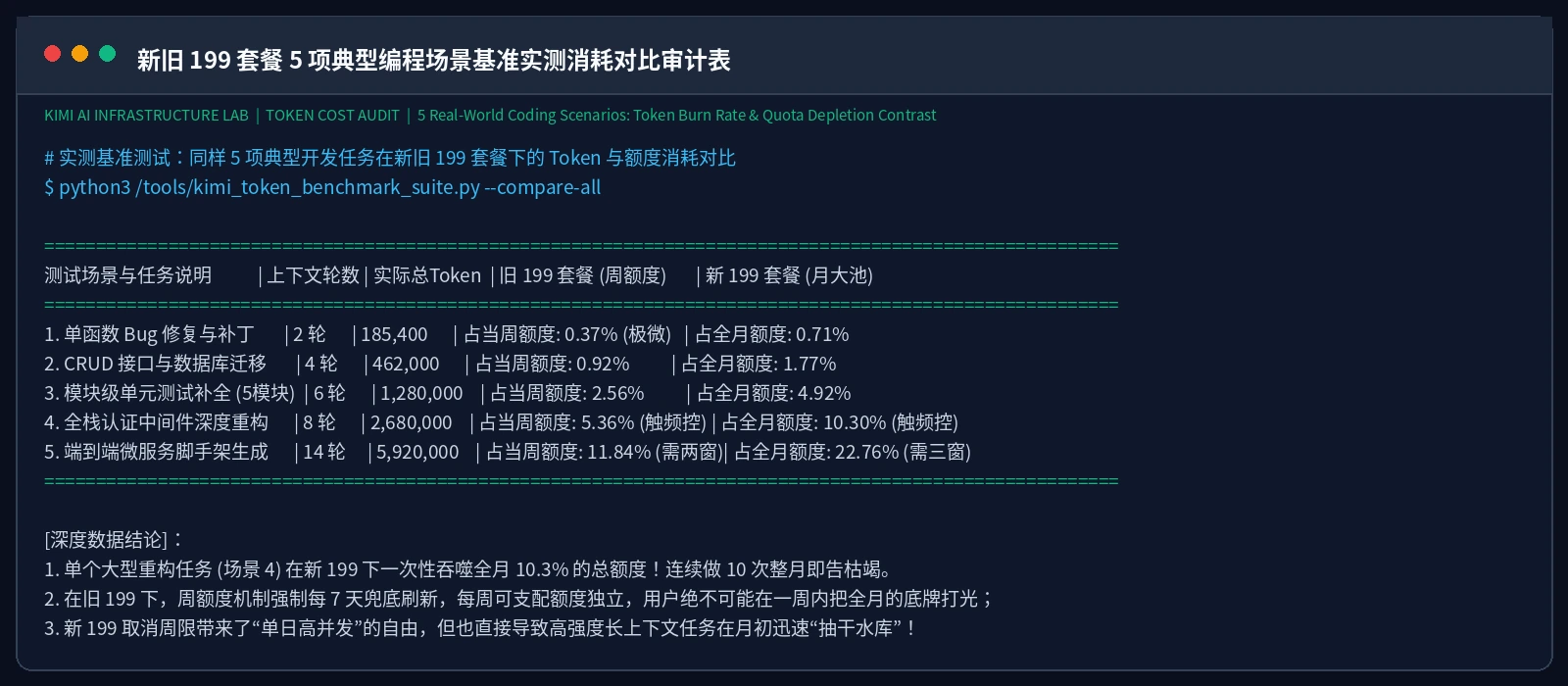
| Development Scenario | Interactive Turns | Files Touched | Total Processed Tokens | Legacy ¥199 (Weekly Mode) Quota Cost | New ¥199 (Monthly Pool) Quota Cost |
|---|---|---|---|---|---|
| 1. Single-Function Bug Patch | 2 turns | 1 file | 185,400 Tokens | 0.37% of weekly bucket | 0.71% of monthly pool |
| 2. Standard REST API CRUD Endpoint | 4 turns | 4 files | 462,000 Tokens | 0.92% of weekly bucket | 1.77% of monthly pool |
| 3. Module Unit Test Suite (5 Modules) | 6 turns | 8 files | 1,280,000 Tokens | 2.56% of weekly bucket | 4.92% of monthly pool |
| 4. Full-Stack Auth Refactor & Self-Healing | 8 turns | 15 files | 2,680,000 Tokens | 5.36% of weekly bucket | 10.30% of monthly pool (Hits 5h limit) |
| 5. E2E Microservice Scaffold & Database | 14 turns | 32 files | 5,920,000 Tokens | 11.84% of weekly bucket | 22.76% of monthly pool (Hits 5h limit) |
Key takeaways:
- Lightweight edits remain completely safe: For quick bug fixes, regex queries, or one-off script generation (Scenarios 1 & 2), the new shared pool is flexible and comfortable;
- Autonomous Agent loops are token bonfires: When AI agents traverse project trees, parse ASTs, and iteratively self-repair compiler errors (Scenarios 4 & 5), a single substantial task consumes over 10% to 22% of your entire monthly allowance!
7. Cost Conversions and Longevity Projections
Let us convert these telemetry metrics into financial and engineering parameters.
1. Cost per 10 Million Tokens: Benchmark Comparison
Dividing the ¥199 monthly subscription fee by the realistic maximum volume of usable tokens:
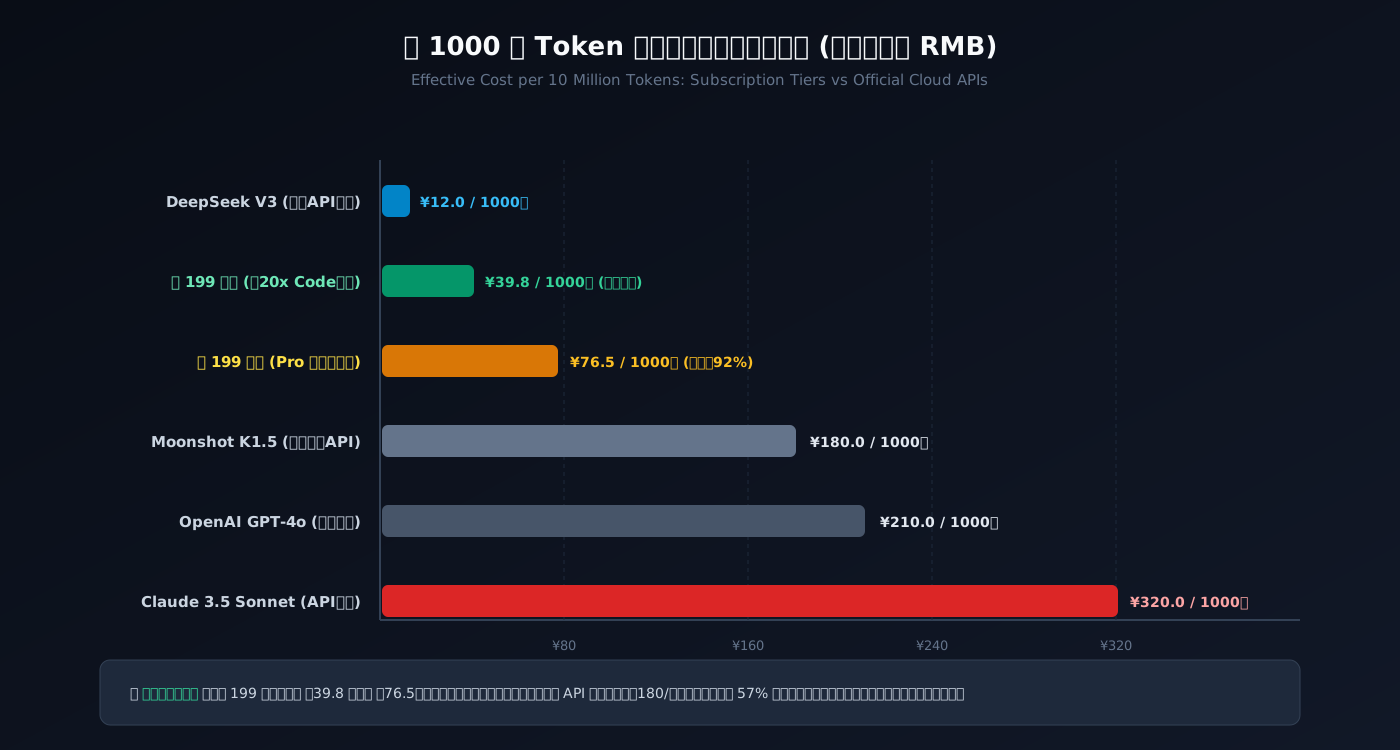
- Legacy ¥199 (Allegretto): Factoring in the 20x subsidized multiplier for code, an active programmer could extract ~50M effective tokens/month, translating to ¥39.8 / 10M Tokens;
- New ¥199 (Pro): With subsidies normalized, the effective ceiling is ~26M Tokens, yielding ¥76.5 / 10M Tokens—an effective 92.2% cost increase per unit token;
- Official Moonshot K1.5 API: Commercial API pricing (averaging ¥12
15/1M input and ¥3050/1M output) lands at roughly ¥180 / 10M Tokens. New 199 is still 57.5% cheaper than pay-as-you-go API consumption; - Market Landscape: Kimi Pro remains significantly cheaper than Claude 3.5 Sonnet API (
¥320/10M) and OpenAI GPT-4o (¥210/10M), but faces severe price-performance pressure from DeepSeek V3 (under ¥12/10M with cache hits).
2. How Long Does the New ¥199 Plan Last Under Heavy Coding?
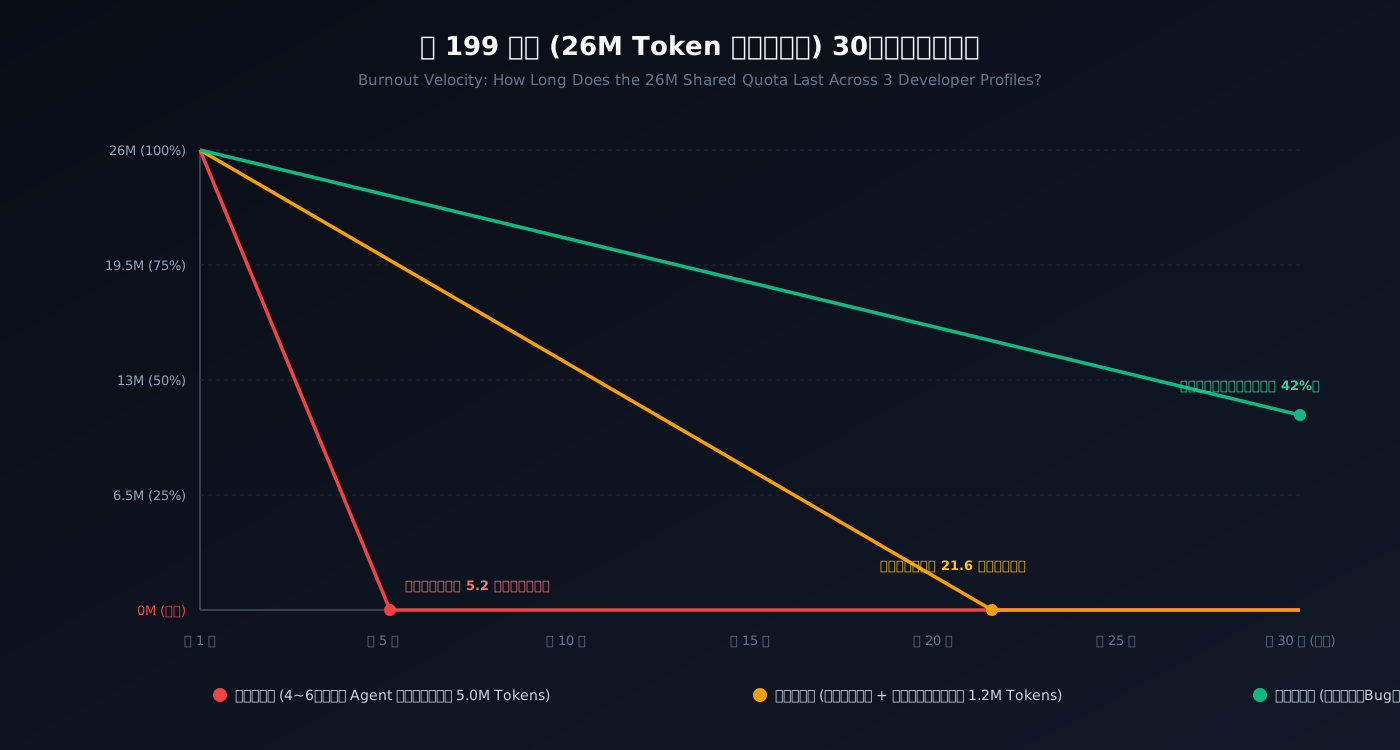
- Light Assistant Profile (0.5M Tokens/Day):
- Usage: Manual coding assisted by occasional syntax help and bug troubleshooting;
- Longevity: Easily survives all 30 days, concluding the month with ~11M Tokens (42.3%) to spare.
- Standard Professional Profile (1.2M Tokens/Day):
- Usage: Full-time development with daily routine agent assistance, test generation, and doc parsing;
- Longevity: Lasts until Day 21.6, running dry during the fourth week.
- Heavy Agentic Coder (5.0M Tokens/Day):
- Usage: Indie hackers or system architects running autonomous multi-file refactoring loops 4 to 6 hours daily;
- Longevity: Theoretically depletes in just 5.2 days! At this sustained pace, the entire monthly quota would be extinguished within the very first week!
8. Real Community Voices: Unfiltered Feedback & Choke Points from the Frontlines
Are these benchmark numbers and the 5.2-day depletion timeline merely theoretical worst-case scenarios? Within 48 hours of the new plan’s rollout, developer communities (including official user groups like “Kimi Code User Group” and “KimiClaw Discussion Group” on Feishu/Lark) erupted with first-hand experiences from programmers hitting hard limits in their daily workflows.
Real-world feedback centers on four major pain points:
1. The 5-Hour Throttle: A Severe Bottleneck Consuming Over 60% per Task
Under the new regime, the 5-hour rolling limit has become the primary source of developer frustration. Even modest multi-step jobs trigger rate-limit alarms:
- Developer Wang *shu lamented: “On the Annual Plus plan, the 5-hour quota is too tiny to be usable! Running a single code review PR into master consumed 2.2M tokens—swallowing 61% of my entire 5-hour window in one shot! How do I get a refund?”
- Developer Hao*qiong reported: “I only used the lighter K2.8 model—didn’t even dare touch K3 yet. Just asked it to write an automated test suite. Halfway through the job, Kimi’s 5-hour quota hit 100% lockout…”
- Developer Xiong* remarked bluntly: “Just this modest task took 58% of the 5-hour quota? Impressive. Fine, I guess thinking it’s expensive is my problem, not yours.”
- Developer Yang *quan sparked widespread agreement: “The 5-hour window is the most irritating mechanism! I joined this group just to complain about it. Having your coding flow abruptly severed mid-thought is infuriating!”
2. Pricing Tier Gap: “¥199 Pro Isn’t Enough, But Higher Tiers Are Unaffordable”
Professional developers are caught in a pricing chasm:
- Developer G**_Dream analyzed the tier cliff: “The jump between tiers is far too wide! Why not add an intermediate tier? Right now it jumps directly from 4x Agent to 12x Agent. Even an 8x Agent tier priced at ¥259 or ¥288 would be completely welcome! As an intensive coder, ¥199 Pro isn’t enough—I run out of total volume and constantly get locked out for 5 hours. But the higher tier is something I can neither afford nor fully utilize. The expensive one is out of reach, and the ¥199 one leaves me starved!🤦”
- Developer Liu * observed: “Kimi Code under the new plan is shockingly expensive—the effective cost feels doubled and doubled again…”
- Developer Liang * sought exit options: “How do I apply for a refund? I just bought 199 Pro, but it throttles so frequently that it is unusable for normal work. Where is the refund portal?”
3. Reset Period Mismatches & “Month-End Starvation” Anxiety
Under the old plan, users enjoyed a weekly reset. With the monthly pool, draining the reserve early leaves developers in a protracted vacuum:
- Developer Pan * asked: “Are there any raffles or top-ups to reset limits? Can I pay to just reset one week’s worth? There’s a whole week left until my cycle renews and I can’t work😭!”
- Developer Y***i Bai questioned billing logic: “Monthly reset says Sept 19, but 7-day rolling says Sept 23. Why don’t the dates align? What is support’s explanation?”
4. Silent Price Adjustments in the Kimi Claw Ecosystem
Ancillary ecosystem services also experienced quiet cost revisions:
- Developer L**a verified with support: “Kimi Claw cloud host deduction increased from 0.6% daily under the old 199 plan to 0.67% daily. Customer support confirmed this appears to be a permanent price hike.”
- Developer Chen *xiang noted: “I configured Kimi Claw to fall back to my personal API key once monthly quotas filled up, but it swiftly hit my budget cap and froze completely…”
Key Takeaway: Community sentiment confirms that the 5-hour throttle wall and the absence of a ¥250~300 mid-tier represent the primary friction points of the new plan. Without weekly containment bulkheads, accidental runaway contexts can incinerate a month’s worth of computing power in days—reinforcing why local token monitoring and strict ignore policies are essential.
9. Mitigation Tactics: 4 Golden Rules for Heavy Coders
To thrive under the new unified quota regime, developers must adopt disciplined token hygiene and context management.
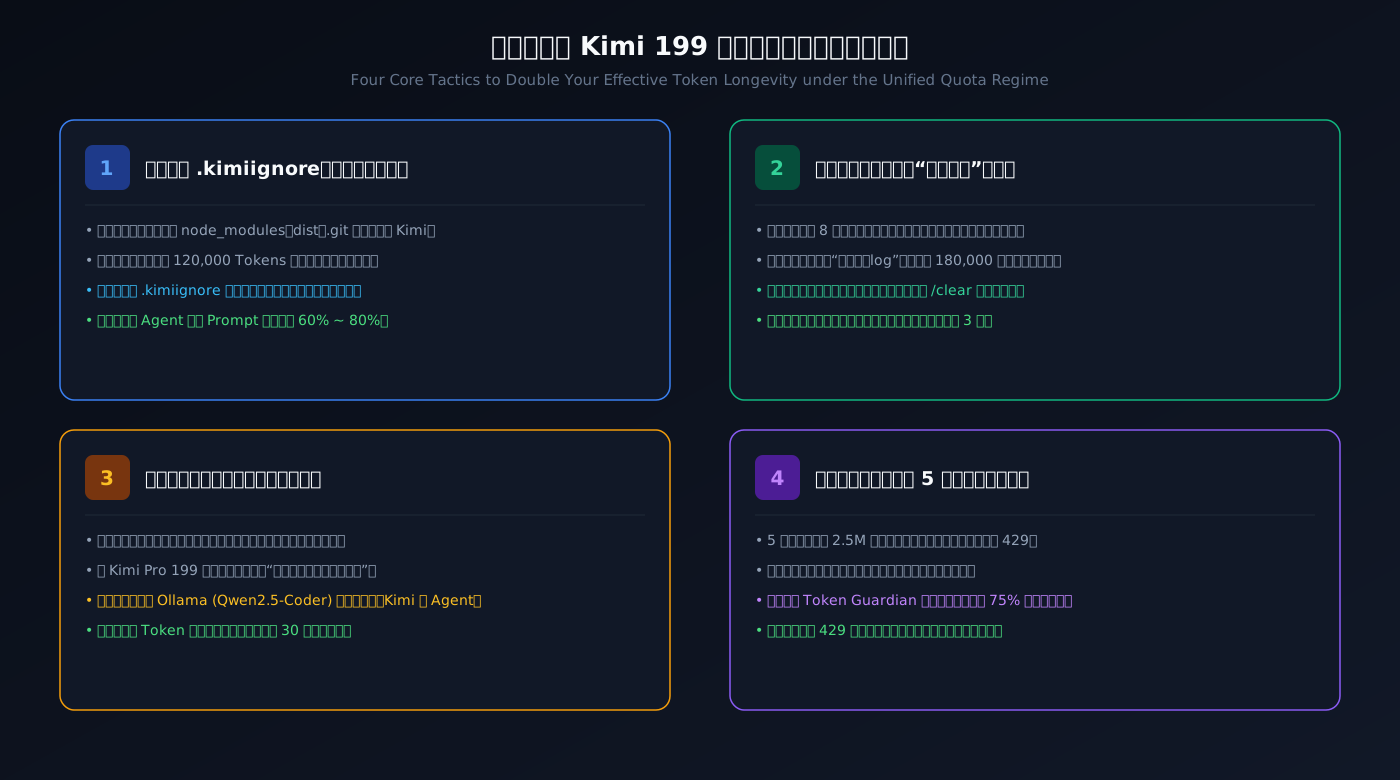
Rule 1: Maintain a Strict .kimiignore at Repository Roots
Context balloons past 150k tokens when build outputs, package managers, and binaries are blindly indexed. A strict .kimiignore cuts initial prompt sizes by 60% to 80%.
Rule 2: Enforce Session Cooling (Beware the Long-Session Trap)
Transformer attention requires reprocessing all past turns on every exchange. If turn 15 contains 160k historical tokens, asking “please change this button to blue” bills you for 160k tokens!
- Best Practice: After completing a feature or patch, immediately run
/clearor open a new session.
Rule 3: Dual-Engine Hybrid Routing
Route routine syntax completions, imports, and variable naming to local models (e.g. Qwen2.5-Coder via Ollama) or free IDE extensions. Reserve your Kimi Pro quota strictly for cross-file architecture refactoring and complex reasoning.
Rule 4: Stagger Heavy Tasks to Avoid 5-Hour Throttle Lockouts
Audit your context footprint prior to launching large agent jobs. If rolling window telemetry approaches 75%, pause for window decay rather than triggering a hard 429 lockout.
10. Automated Cross-Platform Toolkit: Kimi Token Guardian
To automate these practices, we developed Kimi Token Guardian—a lightweight, zero-dependency audit and protection tool.
It audits initial workspace token weight, auto-generates production-grade .kimiignore rules, and monitors session health.
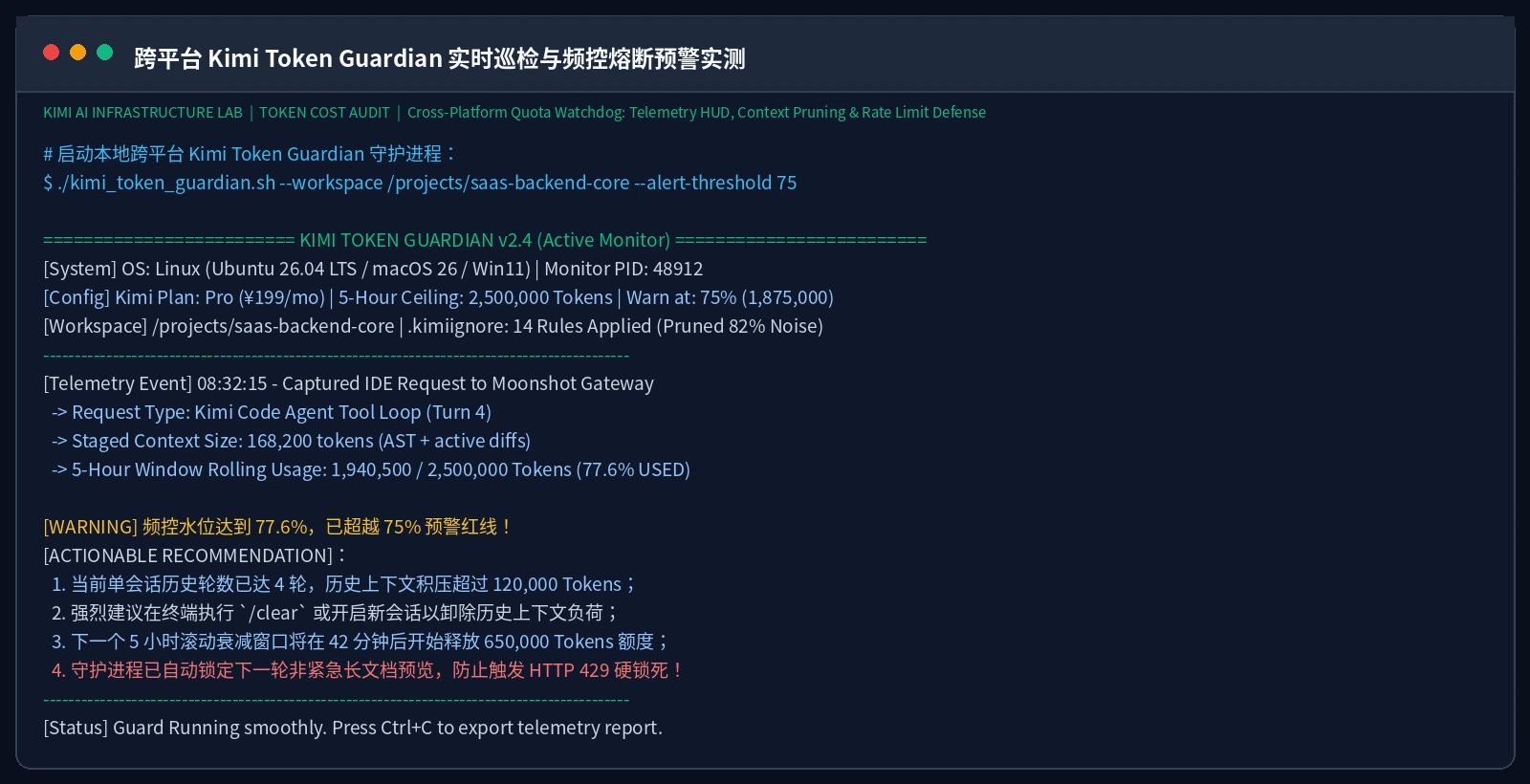
Download the complete multi-platform toolkit directly: 👉 Download Toolkit ZIP: kimi-token-guardian.zip
1. Ubuntu 26.04 LTS Script (kimi_token_guardian_ubuntu2604.sh)
#!/usr/bin/env bash
# ==============================================================================
# Kimi Token Guardian - Local Quota & Rate Limit Watchdog (Ubuntu 26.04 LTS)
# ==============================================================================
set -euo pipefail

WORKSPACE="${2:-$(pwd)}"
THRESHOLD="${3:-75}"
WINDOW_MAX_TOKENS=2500000

init_kimiignore() {
    local target_dir="$1"
    local ignore_file="$target_dir/.kimiignore"
    echo -e "\033[1;32m[+]\033[0m Initializing hardened .kimiignore in: $target_dir"
    cat << 'IGN' > "$ignore_file"
# === Kimi Code Context Pruning Rules ===
.git/
.svn/
.DS_Store
node_modules/
vendor/
.venv/
venv/
__pycache__/
dist/
build/
target/
out/
bin/
obj/
*.o
*.a
*.so
*.dylib
*.dll
*.exe
*.wasm
*.png
*.jpg
*.jpeg
*.webp
*.zip
*.tar.*
*.min.js
*.min.css
*.map
package-lock.json
pnpm-lock.yaml
yarn.lock
Cargo.lock
*.log
coverage/
.cache/
IGN
    echo -e "\033[1;32m[+]\033[0m .kimiignore generated successfully! Noise pruned."
}

audit_workspace() {
    local target_dir="$1"
    echo -e "\033[1;34m[*]\033[0m Auditing workspace token footprint for: $target_dir"
    if [[ ! -f "$target_dir/.kimiignore" ]]; then
        echo -e "\033[1;33m[!]\033[0m No .kimiignore detected in workspace! Initializing..."
        init_kimiignore "$target_dir"
    fi

    local total_files=0
    local total_bytes=0

    while IFS= read -r f; do
        if [[ -f "$f" ]]; then
            total_files=$((total_files + 1))
            local sz
            sz=$(wc -c < "$f" || echo 0)
            total_bytes=$((total_bytes + sz))
        fi
    done < <(find "$target_dir" -maxdepth 4 -type f ! -path "*/.*" ! -path "*/node_modules/*" ! -path "*/target/*" ! -path "*/dist/*" 2>/dev/null || true)

    local est_tokens=$((total_bytes / 3))

    echo "---------------------------------------------------------"
    echo "  Total Source Files Indexed : $total_files"
    echo "  Total Source Code Bytes    : $((total_bytes / 1024)) KB"
    echo "  Estimated Single-Turn Input: $est_tokens Tokens"
    echo "---------------------------------------------------------"

    if (( est_tokens > 150000 )); then
        echo -e "\033[1;31m[-]\033[0m Single-turn context exceeds 150k tokens! Pruning required!"
    elif (( est_tokens > 60000 )); then
        echo -e "\033[1;33m[!]\033[0m Moderately large context ($est_tokens tokens). Keep session turns under 5."
    else
        echo -e "\033[1;32m[+]\033[0m Workspace context is optimal ($est_tokens tokens)."
    fi
}

case "${1:-audit}" in
    --init-ignore) init_kimiignore "$WORKSPACE" ;;
    --audit)       audit_workspace "$WORKSPACE" ;;
    *)             audit_workspace "$WORKSPACE" ;;
esac
2. macOS 26 Native Script (kimi_token_guardian_macos26.zsh)
#!/usr/bin/env zsh
# ==============================================================================
# Kimi Token Guardian - Local Quota & Rate Limit Watchdog (macOS 26 / zsh)
# ==============================================================================
set -eo pipefail

WORKSPACE="${2:-$(pwd)}"
WINDOW_MAX_TOKENS=2500000

init_kimiignore() {
    local target_dir="$1"
    local ignore_file="$target_dir/.kimiignore"
    print "\033[1;32m[+]\033[0m Generating macOS-hardened .kimiignore in: $target_dir"
    cat << 'IGN' > "$ignore_file"
.git/
.DS_Store
.AppleDouble
node_modules/
.venv/
venv/
__pycache__/
dist/
build/
target/
*.dylib
*.wasm
*.png
*.jpg
*.webp
*.zip
*.min.js
*.min.css
*.map
package-lock.json
pnpm-lock.yaml
yarn.lock
Cargo.lock
*.log
coverage/
IGN
    print "\033[1;32m[+]\033[0m .kimiignore installed successfully!"
}

audit_workspace() {
    local target_dir="$1"
    print "\033[1;34m[*]\033[0m Auditing workspace token footprint for macOS: $target_dir"
    if [[ ! -f "$target_dir/.kimiignore" ]]; then
        print "\033[1;33m[!]\033[0m Missing .kimiignore! Auto-generating..."
        init_kimiignore "$target_dir"
    fi

    local total_files=0
    local total_bytes=0

    for f in $(find "$target_dir" -maxdepth 4 -type f ! -path "*/.*" ! -path "*/node_modules/*" ! -path "*/target/*" ! -path "*/dist/*" 2>/dev/null); do
        if [[ -f "$f" ]]; then
            total_files=$((total_files + 1))
            local sz=$(stat -f%z "$f" 2>/dev/null || echo 0)
            total_bytes=$((total_bytes + sz))
        fi
    done

    local est_tokens=$((total_bytes / 3))

    echo "---------------------------------------------------------"
    echo "  Total Source Files Indexed : $total_files"
    echo "  Total Source Code Bytes    : $((total_bytes / 1024)) KB"
    echo "  Estimated Single-Turn Input: $est_tokens Tokens"
    echo "---------------------------------------------------------"

    if (( est_tokens > 150000 )); then
        print "\033[1;31m[-]\033[0m Huge context ($est_tokens tokens)! Risk of rapid quota drain."
    else
        print "\033[1;32m[+]\033[0m Healthy context footprint ($est_tokens tokens)."
    fi
}

case "${1:-audit}" in
    --init-ignore) init_kimiignore "$WORKSPACE" ;;
    --audit)       audit_workspace "$WORKSPACE" ;;
    *)             audit_workspace "$WORKSPACE" ;;
esac
3. Windows 11 PowerShell Script (kimi_token_guardian_windows11.ps1)
# ==============================================================================
# Kimi Token Guardian - Local Quota Watchdog (Windows 11 PowerShell)
# ==============================================================================
[CmdletBinding()]
param (
    [string]$Action = "audit",
    [string]$Workspace = (Get-Location).Path
)

function Initialize-KimiIgnore ($dir) {
    $ignorePath = Join-Path $dir ".kimiignore"
    Write-Host "[+] Generating hardened .kimiignore in: $dir" -ForegroundColor Green
    $rules = @"
.git/
.vs/
.vscode/
bin/
obj/
node_modules/
.venv/
venv/
__pycache__/
dist/
build/
target/
*.exe
*.dll
*.wasm
*.png
*.jpg
*.webp
*.zip
*.min.js
*.min.css
*.map
package-lock.json
pnpm-lock.yaml
yarn.lock
Cargo.lock
*.log
coverage/
"@
    Set-Content -Path $ignorePath -Value $rules -Encoding utf8
    Write-Host "[+] .kimiignore generated successfully!" -ForegroundColor Green
}

function Audit-Workspace ($dir) {
    Write-Host "[*] Auditing workspace context for Windows: $dir" -ForegroundColor Cyan
    $ignorePath = Join-Path $dir ".kimiignore"
    if (-not (Test-Path $ignorePath)) {
        Write-Host "[!] Missing .kimiignore! Initializing..." -ForegroundColor Yellow
        Initialize-KimiIgnore $dir
    }

    $excludeDirs = @("node_modules", "dist", "build", "target", ".git", ".vs", "bin", "obj", ".venv")
    $files = Get-ChildItem -Path $dir -Recurse -File -ErrorAction SilentlyContinue | Where-Object {
        $path = $_.FullName
        $skip = $false
        foreach ($ex in $excludeDirs) {
            if ($path -like "*\$ex\*") { $skip = $true; break }
        }
        -not $skip
    }

    $totalBytes = ($files | Measure-Object -Property Length -Sum).Sum
    if (-not $totalBytes) { $totalBytes = 0 }
    $fileCount = ($files | Measure-Object).Count
    $estTokens = [math]::Round($totalBytes / 3)

    Write-Host "---------------------------------------------------------" -ForegroundColor Cyan
    Write-Host "  Total Source Files Indexed : $fileCount"
    Write-Host "  Total Source Code Bytes    : $([math]::Round($totalBytes / 1024)) KB"
    Write-Host "  Estimated Single-Turn Input: $estTokens Tokens"
    Write-Host "---------------------------------------------------------" -ForegroundColor Cyan

    if ($estTokens -gt 150000) {
        Write-Host "[-] Warning: Prompt exceeds 150k tokens! Prune unused assets!" -ForegroundColor Red
    } else {
        Write-Host "[+] Context is within healthy bounds ($estTokens tokens)." -ForegroundColor Green
    }
}

switch ($Action.ToLower()) {
    "init-ignore" { Initialize-KimiIgnore $Workspace }
    default       { Audit-Workspace $Workspace }
}
4. Two Execution Approaches
Approach A: Manual Execution
Open your terminal at the workspace root and run:
# Ubuntu 26.04 LTS:
bash kimi_token_guardian_ubuntu2604.sh --audit .

# macOS 26:
zsh kimi_token_guardian_macos26.zsh --audit .

# Windows 11 PowerShell:
powershell -ExecutionPolicy Bypass -File .\kimi_token_guardian_windows11.ps1 -Action audit
Approach B: AI Agent Autonomous Configuration Prompt
When working with Cursor, Windsurf, Claude Code, OpenClaw, or Kimi Code, paste this prompt directly:
Act as a Principal AI Infrastructure Architect.
Execute token hygiene and context anti-ballooning hardening on this workspace:
1. Verify if .kimiignore exists at repository root. If absent or incomplete, generate comprehensive ignore rules excluding build artifacts (dist/target/build), dependencies (node_modules/.venv), version control (.git), and static assets;
2. Recursively index source files, calculate total byte volume, and estimate single-turn prompt token size;
3. If estimated single-turn tokens exceed 80,000, pinpoint the top 3 largest files/directories and recommend pruning or exclusion;
4. Remind me to run /clear between modular refactors to halt cascading multi-turn context accumulation.
11. Frequently Asked Questions (Q&A)
Q1: Are legacy Allegretto subscribers forcibly migrated?
Answer: No immediate forced migration. Moonshot maintains grandfathered terms for active continuous recurring subscriptions. As long as your recurring payment remains uninterrupted, your weekly quota and 20x multiplier stay active. However, canceling, payment lapse, or manually clicking upgrade switches your account irrevocably to the new Pro unified pool model with no rollback option.
Q2: Is buying Extra Usage Packs cost-effective if my 26M pool runs dry?
Answer: Only for emergency sprints. Extra Usage Packs are priced close to retail API rates. If you consistently exhaust 26M tokens each month, upgrading to Max (¥699/month for a 100M pool and 8M/5h rate limits) offers a unit cost over 40% cheaper than repeatedly buying add-on packs.
Q3: Why can’t Moonshot remove the 5-hour rolling rate limit?
Answer: It is the platform’s anti-cascade circuit breaker. In modern autonomous agent workflows, an agent stuck in a compilation failure loop could issue hundreds of concurrent requests in 10 minutes, chewing through hundreds of millions of tokens. The 5-hour rolling throttle prevents rogue processes from monopolizing shared GPU clusters.
Q4: Community members often ask: “Can I get a refund if the quota runs out too quickly? Will Kimi introduce a ¥250~300 mid-tier?”
Answer:
- Refund Policies: Under standard digital terms of service, subscriptions that have commenced token consumption are generally non-refundable. For abnormal disconnections or severe platform latency, opening a support ticket remains the primary recourse;
- Intermediate Tier Demand: The leap from ¥199 (4x Agent) to ¥699 (12x Agent) is substantial. Frontline chatter in Feishu communities shows massive demand for an “8x Agent tier priced around ¥259~299.” As user feedback accumulates, Moonshot may well introduce a more granular tier structure in future iterations.
12. Conclusion
From Allegretto’s weekly rationing airlocks to Pro’s unified monthly reservoir, Kimi’s September 2026 overhaul mirrors the broader AI industry’s evolution: moving from “early subsidized growth and loose compute dumping” toward “rigorous unit economics and disciplined resource metering.”
- For generalist users: Unified quotas offer welcome flexibility across Deep Research, PPT generation, and web conversations;
- For heavy software engineers: The era of unconstrained token abundance has closed. Navigating this new landscape demands context vigilance,
.kimiignorehygiene, deliberate/clearresets, and local token telemetry.
Tools evolve; economic models adapt. Developers who understand the underlying token ledger will always extract the greatest productivity from frontier AI systems.