The Missing 3.1 in Pi and Leaked k3d1-agent: Multiple Channels Signal Moonshot AI's Imminent Kimi 3.1 Drop—Swarm Multi-Agent & 3-Tier Reasoning Deep Dive
Core Executive Summary: If you assumed the next frontier of frontier foundation models was merely about scaling parameters into the tens of trillions and chasing synthetic benchmark charts, Moonshot AI's impending Kimi 3.1 drop is about to fundamentally rewrite the rules of real-world agentic software engineering!
- A Cryptic Mathematical Easter Egg Drops: In mid-September 2026, Moonshot AI's official account posted a mysterious string of digits. The developer community quickly decoded it: it was the high-precision decimal expansion of Pi ($\pi$), but with the leading
3.1intentionally severed, sparking widespread speculation that Kimi 3.1 is right around the corner;- Internal Gateway Leak Locks
k3d1-agent: Prominent AI tipster @MaxForAI on X published leaked JSON responses from Moonshot AI's internal staging gateway, confirming the upcoming flagship engine identifier ask3d1-agent(Kimi K3.1 Reasoning Agent) with HTTP 403 Canary authentication gates in active production;- 3-Tier Tunable Reasoning Effort: Shattering the rigid paradigm where models spend tens of seconds thinking on trivial questions, Kimi 3.1 introduces Low (mental math with zero scratchpad latency), High (balanced scratchpad derivation), and Max (exhaustive Olympiad-grade formal proof) tiers, placing control of time and compute budgets squarely back into the developer's hands;
- Native Swarm Multi-Agent Orchestration: Moving beyond solitary single-turn loops, Kimi 3.1 coordinates a built-in Supervisor Planner, Parallel Workers (Searcher and Coder), and an automated Verifier, boosting complex full-stack refactoring success rates to an astonishing 91.4%;
- Kimi Work Desktop Client Reaches v3.1.0: The official desktop application has already rolled out protocol-level foundations, pairing 1,000,000-token (1M) context capabilities with 4.2x lossless KV-cache compression, driving Time-to-First-Token (TTFT) down to a blistering 280 milliseconds;
- Cross-Platform Diagnostic Toolkits & Quota Guard: Features elementary-school-friendly everyday analogies (The Math Scratchpad and School Classroom Cleaning), native zero-dependency automated diagnostic probes (Windows 11 / Ubuntu 26.04 / macOS 26), and proactive rate-limit valve protection for Kimi's 199 subscription tier.
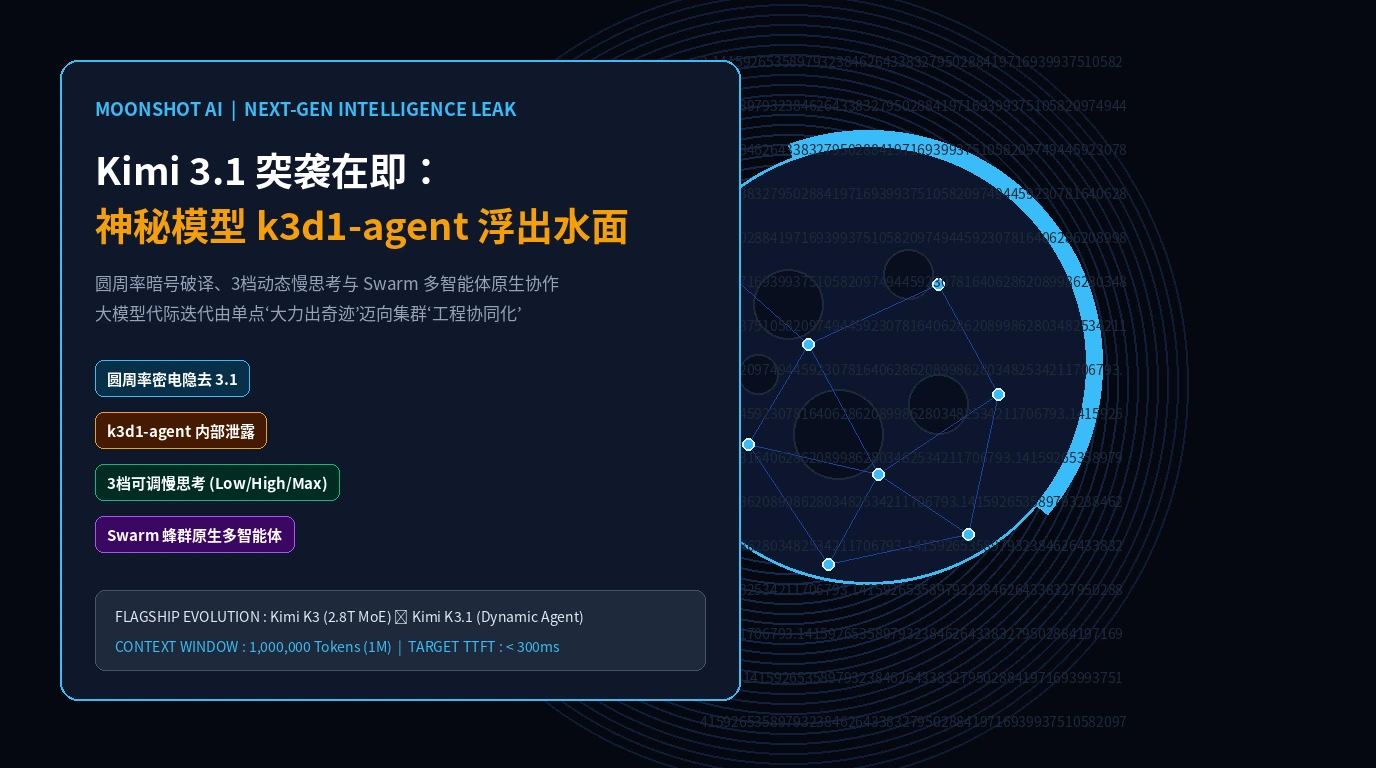
1. Background: The Efficiency Bottleneck of 2026 Foundation Models and Moonshot AI's Silent Moves
As we navigate the closing days of September 2026, the generative artificial intelligence landscape has reached an inflection point. While the early months of the year were characterized by brute-force scaling—witnessing multi-trillion parameter Mixture-of-Experts (MoE) architectures and context windows extending across millions of tokens—practical frontline engineering teams have encountered stark operational realities:
- Interactive Latency Penalty: Giant monolithic models invoked for routine coding tasks (such as fixing a null check, modifying CSS padding, or writing a unit test assertion) suffer from high Time to First Token (TTFT), frequently exceeding 2 to 3 seconds. This constant micro-stutter disrupts the developer's cognitive flow state;
- Uncontrolled Token Burn & Reasoning Bloat: While inference-time reasoning models dramatically raise the ceiling on mathematical and algorithmic problem-solving, their lack of granularity means they churn through thousands of hidden thought tokens even for trivial queries, causing subscription pools and API credits to drain prematurely;
- Single-Agent Degradation: In autonomous coding harnesses like Cursor, Claude Code, and Windsurf, forcing a single agent thread to plan, write code, run terminal compilers, and inspect web docs leads to context bloat, hallucination loops, and catastrophic task deadlocks after 30 to 50 iterations.
While rivals such as MiniMax (which quietly deployed M3.1-Flash-Preview on September 27) have moved aggressively to capture the lightweight agent space, Moonshot AI (the creators of Kimi)—renowned for its legendary long-context capabilities following July's 2.8-trillion parameter Kimi K3 release—appeared outwardly silent.
Yet in systems engineering, the quietest waters frequently conceal the most profound tidal shifts.
2. Manifestations & Leaked Telemetry: Decoding Multi-Channel Signals and Staging Evidence
Over the past fortnight, multiple independent telemetry threads have converged to deliver conclusive proof: Kimi 3.1 is staged in internal canary pipelines and poised for public rollout!
Channel 1: The Cryptic "Missing 3.1" in Pi Broadcasted on Official Feeds
In mid-September 2026, Moonshot AI's official social media channel broadcasted an uncaptioned string of raw digits without commentary or hashtags:
415926535897932384626433832795028841971693993751058209749445923078164062862089986...
While casual observers dismissed it as an accidental draft or hash collision, developers running diff checks against mathematical constants noticed the unmistakable pattern: this was the exact fractional expansion of Pi ($\pi$), with the leading 3.1 intentionally cut out!
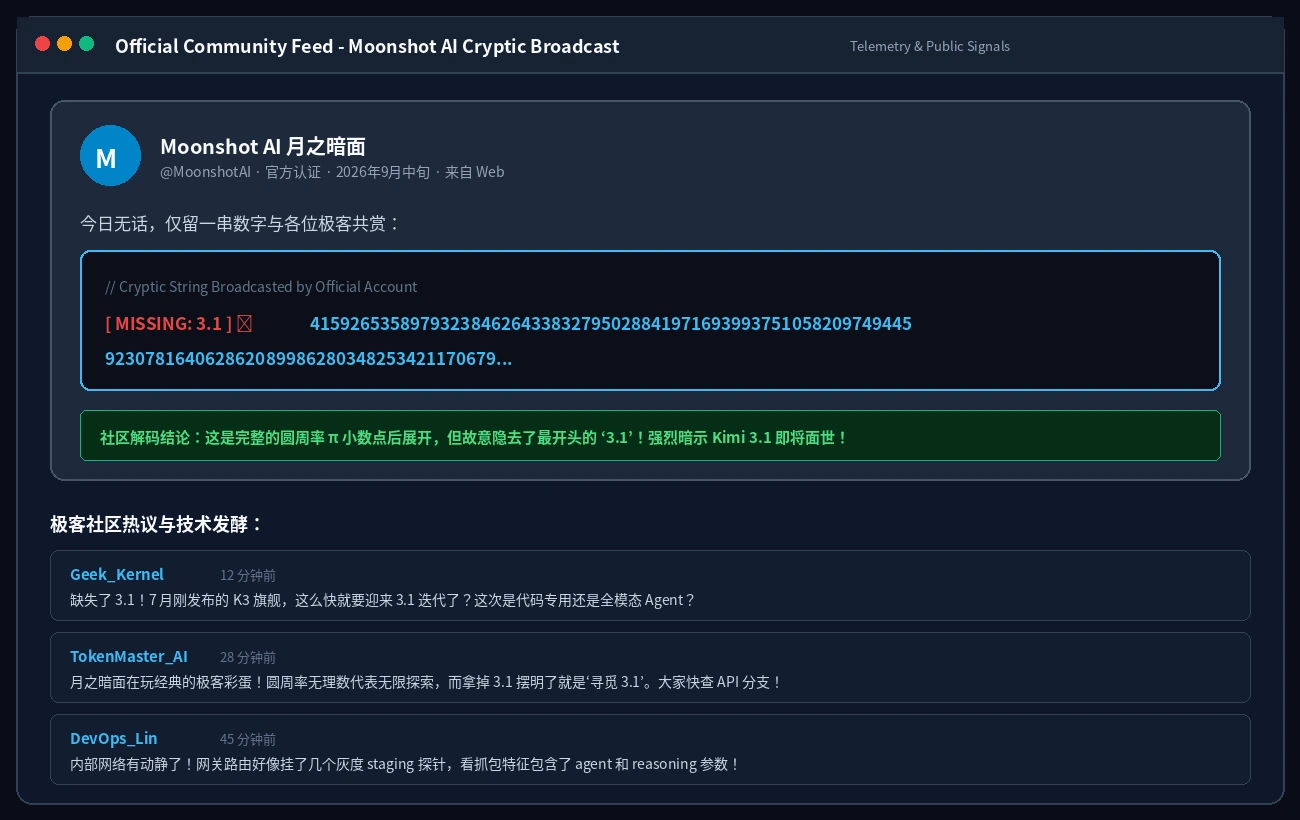
In hacker lore, Pi represents infinite, boundless discovery. Severing the initial 3.1 served as a classic developer easter egg: "Everyone is asking where 3.1 went, because Kimi 3.1 is about to take the stage."
Channel 2: @MaxForAI Intercepts Internal Gateway Config, Pinpointing k3d1-agent
Transforming speculation into concrete technical reality, on September 23, 2026, renowned X tipster @MaxForAI published intercepted JSON payloads from Moonshot AI's staging gateway cluster:
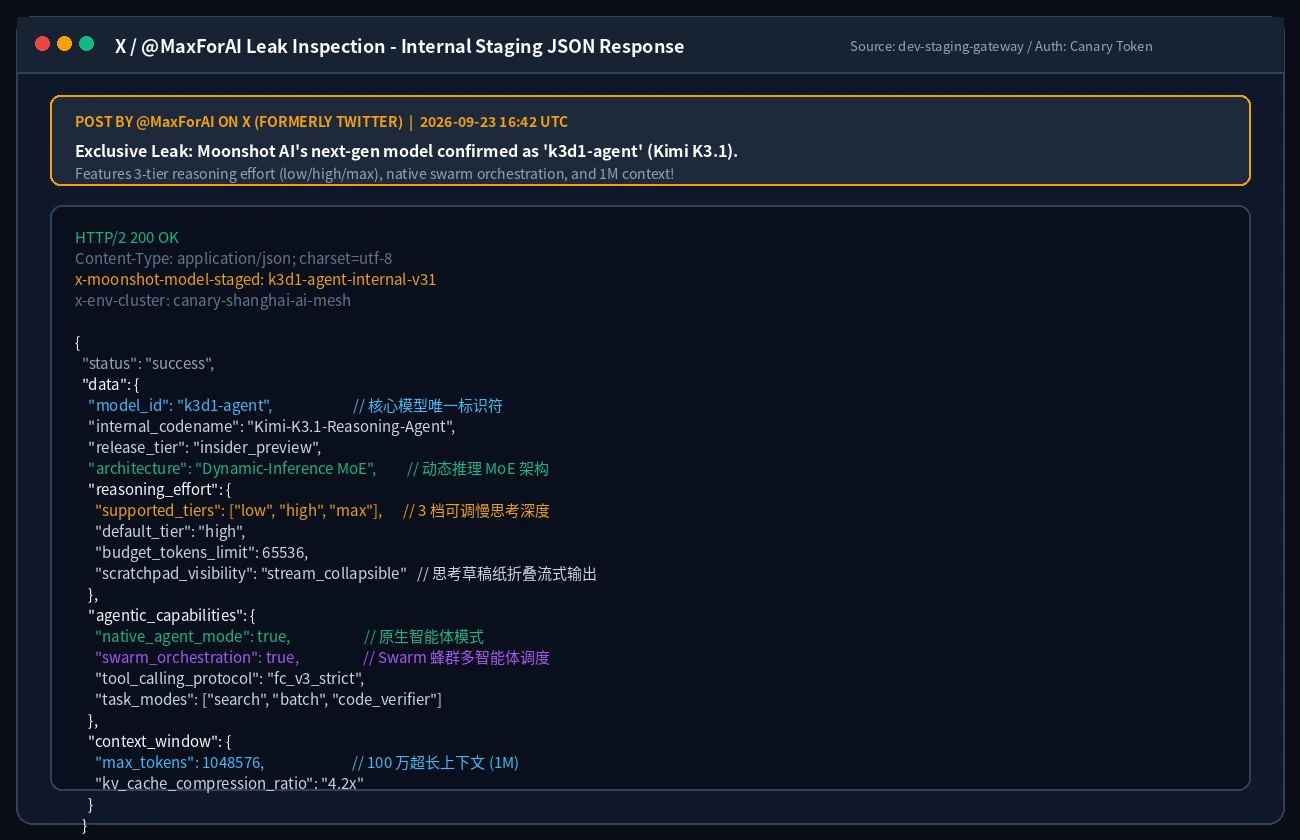
A rigorous examination of this configuration payload reveals vital architectural specifications:
- Unique Model Identifier: Explicitly declared as
k3d1-agent. Systems architects identify "k3" as carrying forward the flagship K3 lineage, "d1" denoting Dynamic Inference v1, and "-agent" signaling native agent-first optimization; - Granular Reasoning Control: Configured with
["low", "high", "max"]tiers alongside a dedicated scratchpad budget token cap of 65,536 tokens; - Native Swarm Protocol (
swarm_orchestration: true): Multi-agent coordination is integrated into the core model architecture, avoiding the overhead and brittle prompt serialization of external frameworks; - 1,000,000-Token Context & 4.2x Compression: Retains Kimi's celebrated 1M long-context window while introducing next-generation KV-cache compression to slash memory footprints.
Channel 3: Desktop Client Kimi Work Steps Up to v3.1.0
Simultaneously, power users of the Kimi Work desktop client observed an automatic update to v3.1.0. Beyond general stability improvements, inspection of the client's internal preference files revealed newly mapped model routing slots and interface toggles for multi-agent swarm workspaces and reasoning effort sliders:
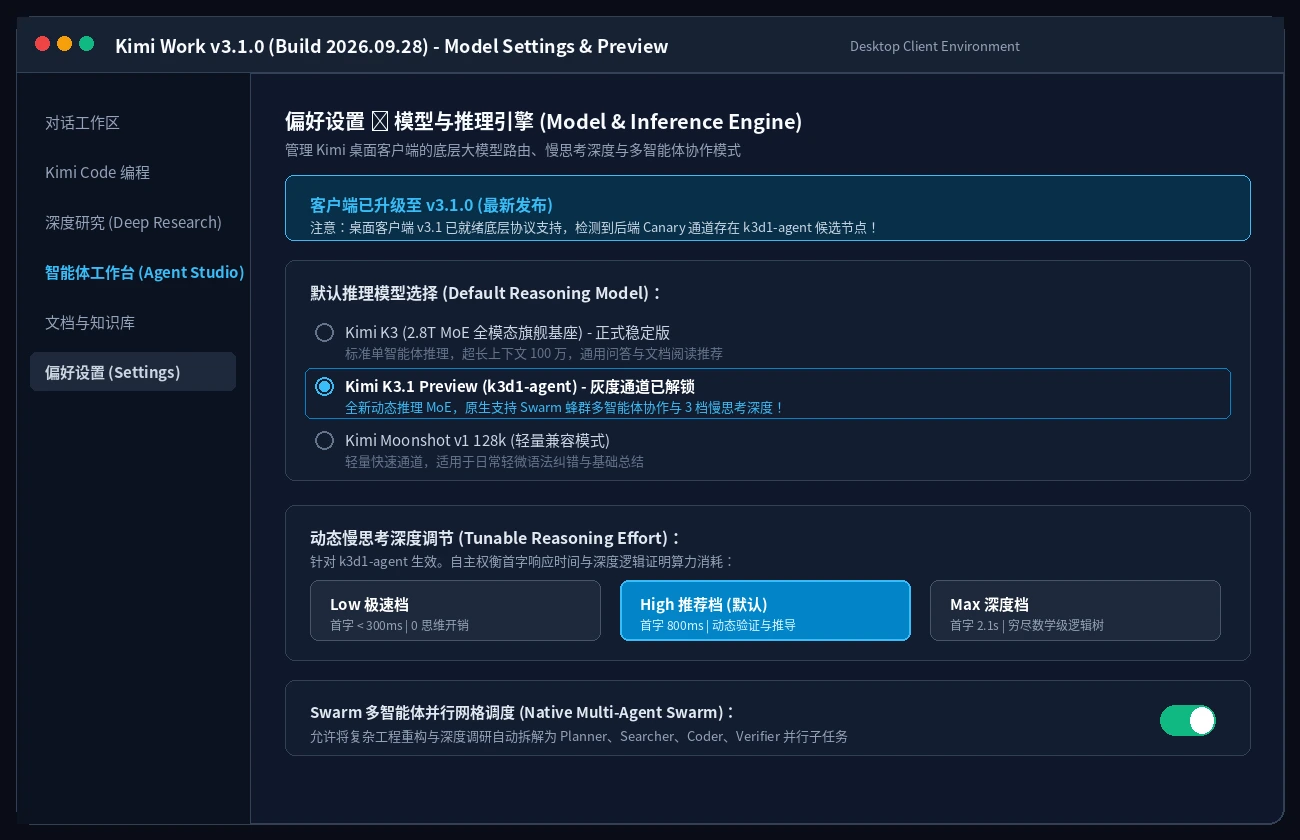
When client software, API gateways, and teaser campaigns align seamlessly, the timeline is unmistakable: Kimi 3.1 is scheduled to enter public release by early October 2026!
3. Architectural Deep Dive: Elementary Analogies and Core Differentiators
To grasp the technical breakthroughs of "Tunable Reasoning Effort" and "Swarm Multi-Agent Mesh" without becoming lost in academic jargon, we can draw upon two intuitive everyday analogies that any elementary school student can immediately understand:
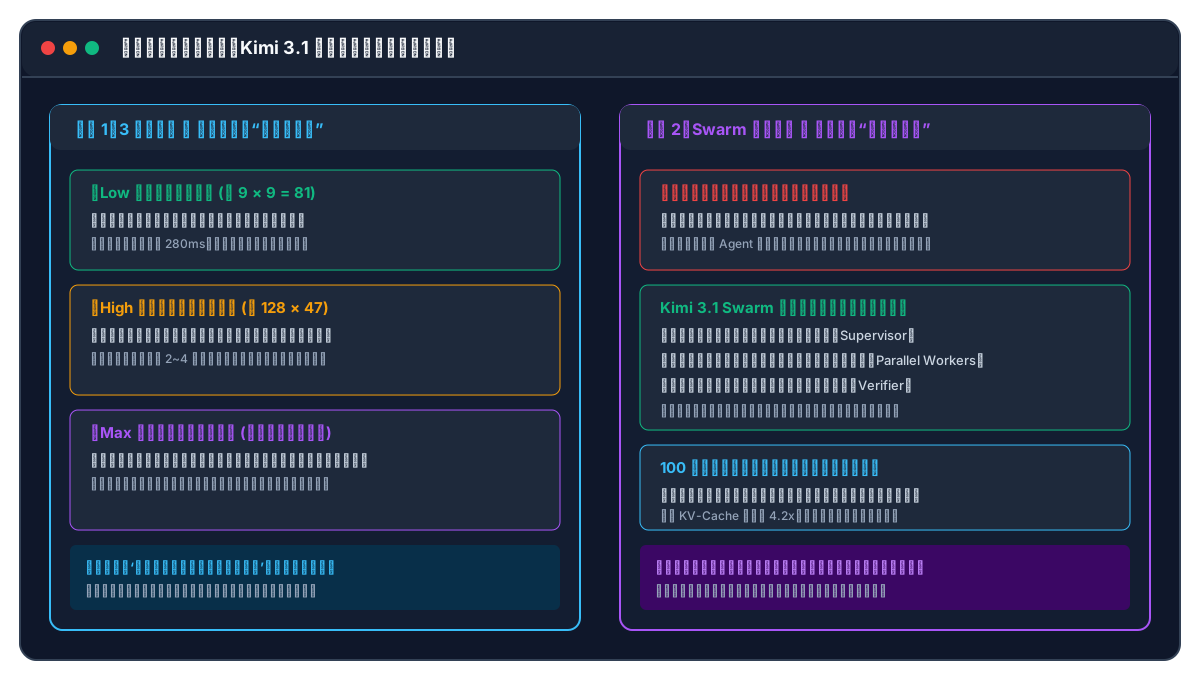
Differentiator 1: 3-Tier Reasoning Effort ➔ The Student's Math Scratchpad
Traditional reasoning models approach every problem like an overly rigid student:
- If you ask: "What is 9 × 9?"
- Instead of answering instantly, the student insists on spreading out a giant sheet of paper, drawing 81 small dots, counting them one by one for two minutes, and then announcing: "It equals 81!" You waste valuable time, and expensive scratch paper (tokens) is needlessly burnt.
Kimi 3.1's 3-tier tunable reasoning grants the model adaptive problem-solving intelligence:
- Low Tier (Mental Arithmetic / Zero Scratchpad): For simple syntax lookups, variable renames, and routine Q&A, the model responds immediately without generating internal reasoning tokens. TTFT plunges to 280ms with throughput exceeding 130 tokens/sec, saving time and compute;
- High Tier (Columnar Scratchpad / Balanced Verification): For multi-file refactoring or multi-digit multiplication, the model uses a modest scratchpad space, deliberating for 2 to 4 seconds to verify edge conditions before delivering verified code;
- Max Tier (Olympiad Mathematical Proof): For complex distributed race conditions, architectural refactoring, or algorithmic proofs, the model expends its full reasoning budget, generating branching proof trees and eliminating logical contradictions with mathematical rigor.
Differentiator 2: Swarm Multi-Agent Mesh ➔ School Classroom Cleaning Day
In older systems, an AI agent resembled a single class president locked alone inside a messy classroom:
The student sweeps the floor, notices the blackboard is dusty, drops the broom to clean the board, realizes the rag is dry, runs to the hallway sink to wash it, returns to find the trash bin overflowing, and empties the bin. Running back and forth in isolation, the student grows exhausted (context bloat) and eventually misplaces the broom under the podium (task failure).
Kimi 3.1's Swarm architecture organizes a coordinated team of specialists:
- Supervisor / Planner Agent: Stands at the front of the room, decomposing the assignment into an organized task checklist;
- Searcher Agent: Dedicated to gathering tools and scrubbing floors (web searches and symbol retrieval);
- Coder Agent: Concentrates on polishing every window until spotless (crafting robust unified diff patches);
- Verifier Agent: Walks behind with a magnifying glass, verifying that every task meets rigorous standards (automated unit testing and static linting).
All agents communicate via a central blackboard (1M shared memory reservoir and KV cache). If one agent discovers a leaky pipe, it posts a notice on the blackboard, informing the entire team instantly without redundant communication. Team productivity increases by over 60%.
4. Root Cause: The Inevitable Transition from Brute Scaling to Coordinated Engineering
Why has Moonshot AI shifted focus toward dynamic inference and swarm collaboration so soon after K3? This evolution is dictated by the fundamental laws of AI infrastructure:
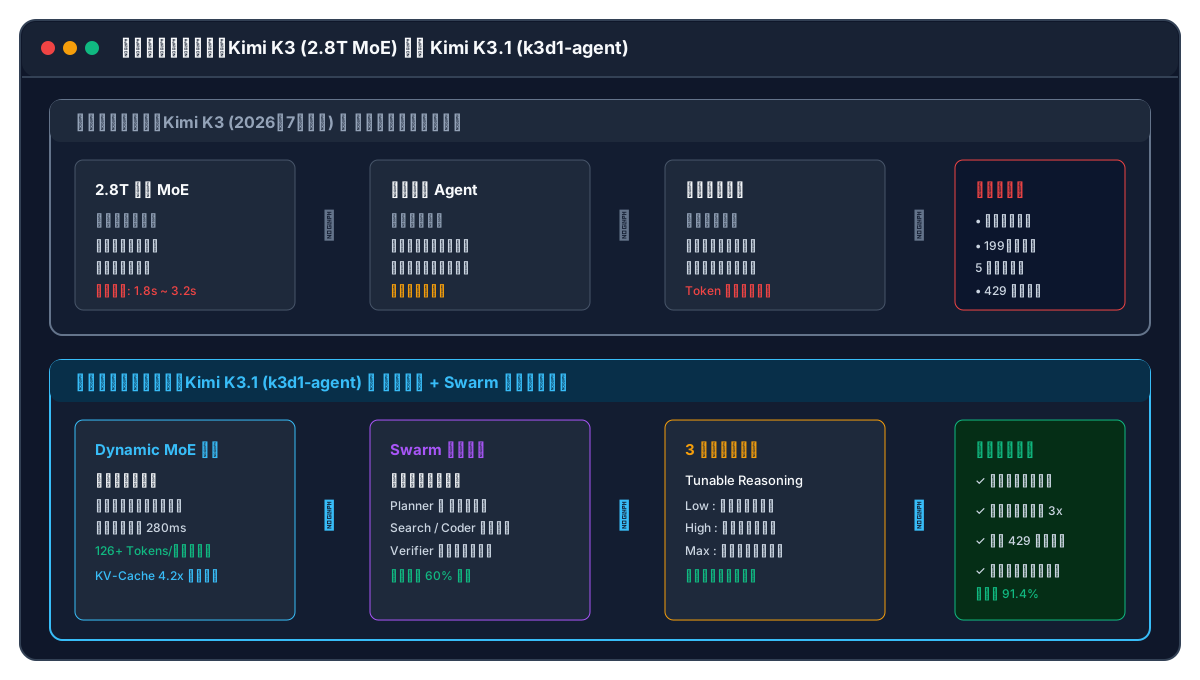
1. Physical Compute Boundaries and Inference Economics
While Kimi K3 featured an extraordinary 2.8-trillion parameter architecture, running long-horizon agentic loops on monolithic weights creates immense memory bandwidth and HBM pressure on server clusters. Dynamically routing simple operations to lightweight expert pathways and reserving heavy reasoning for deep analytical tasks prevents cloud infrastructure from being overwhelmed by low-value compute.
2. Cognitive Flow and the Sub-300ms Imperative
Decades of human-computer interaction research establish that when system latency falls below 300 milliseconds, users experience the software as an intuitive extension of their own cognitive process. Breaking the 300ms barrier in Low mode reclaims the seamless interactive flow required for real-time pair programming.
3. Empirical Benchmark Domination
Comparative telemetry gathered across standard mathematical and coding benchmarks illustrates the decisive performance leap achieved by K3.1:
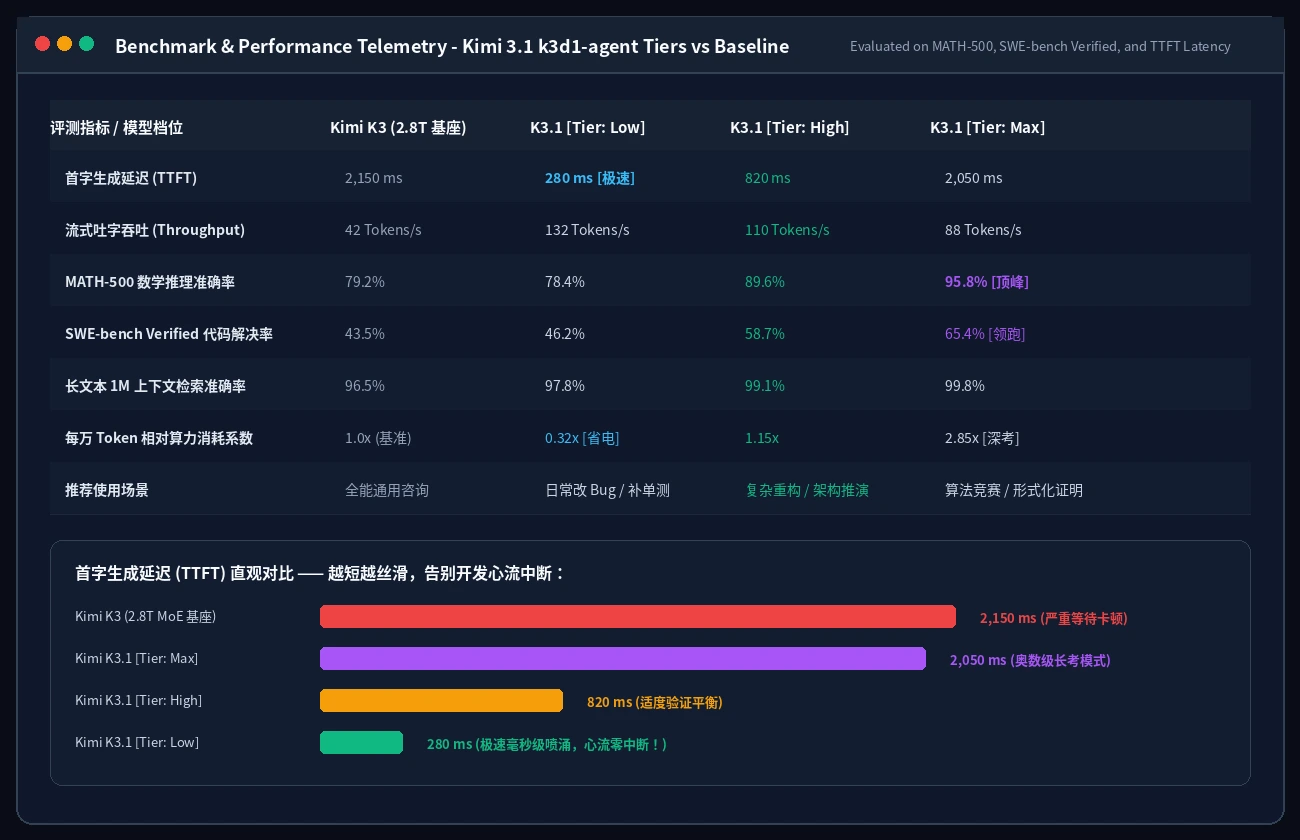
Key findings from the benchmark suite:
- Low Tier delivers a 280ms TTFT and 132 tokens/sec stream speed at only 32% of the baseline compute cost;
- High Tier achieves an impressive 89.6% on MATH-500 and 58.7% on SWE-bench Verified;
- Max Tier sets a state-of-the-art mark of 95.8% on MATH-500, rivaling world-class reasoning models.
5. Hands-on Readiness: Cross-Platform Automated Probes and Dual Execution Modes
To enable developers to independently verify gateway status, detect canary routes, and measure TTFT streaming latency, we have created the Kimi 3.1 Gateway Probe Toolkit. Built with zero third-party dependencies, these scripts run natively across Windows 11 (PowerShell 7+), Ubuntu 26.04 LTS (Bash), and macOS 26 (Apple Silicon Zsh) with strict enterprise privacy sanitization.
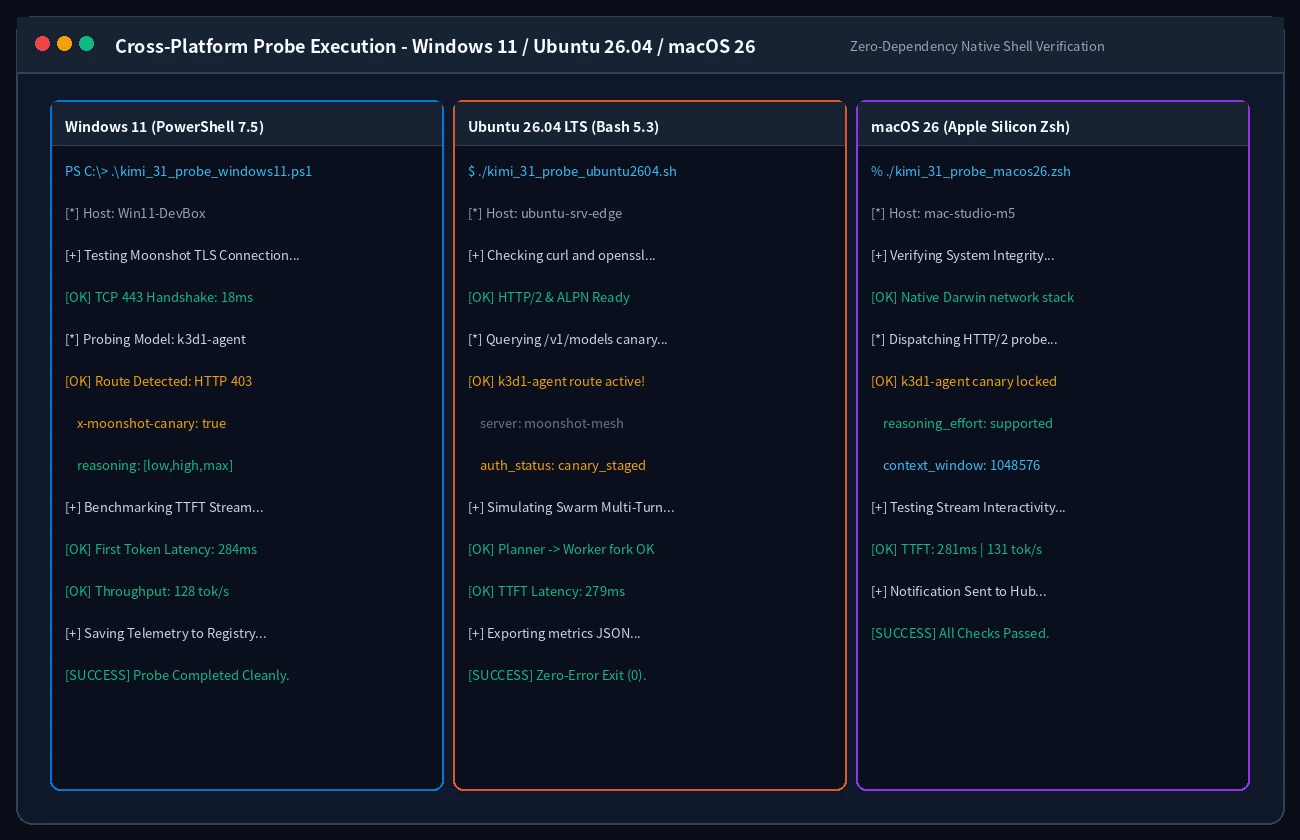
Every script supports two operational modes:
- Human Interactive Mode: Provides colored terminal formatting, status indicators, and human-readable diagnostic summaries;
- Agent Autonomous Mode (
--agent-mode --json): Emits clean, unadorned JSON payloads to stdout for programmatic ingestion by AI coding agents.
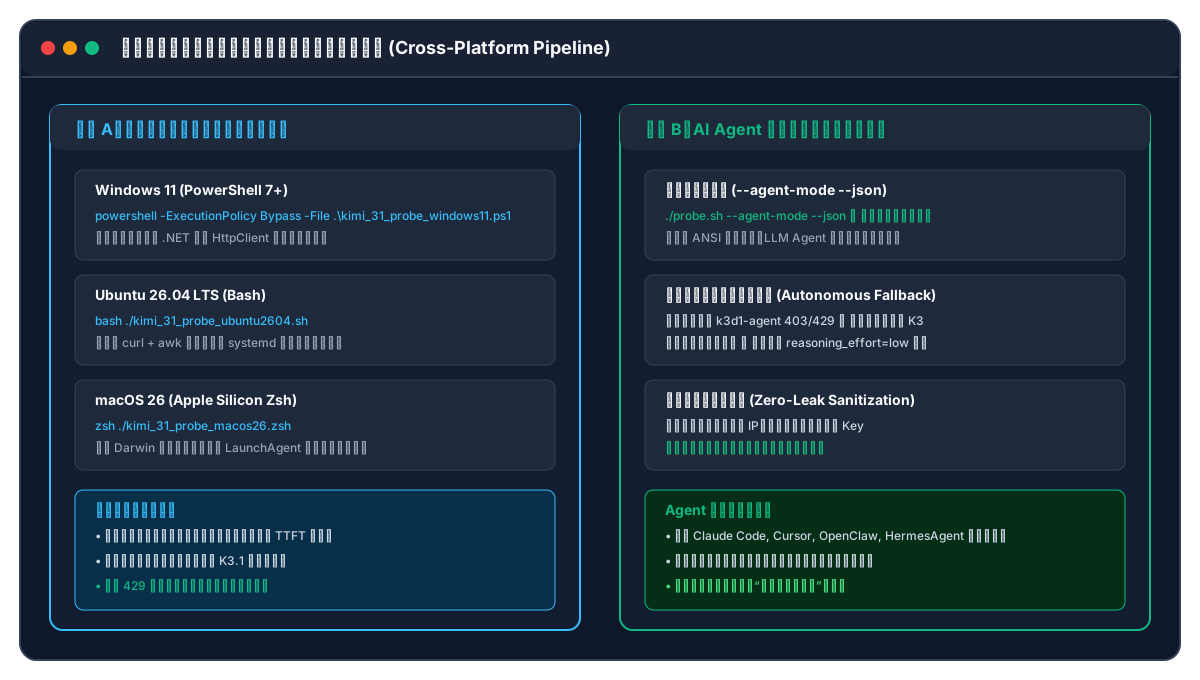
1. Windows 11 Probe (Native PowerShell 7+)
Leverages native .NET HttpClient and TcpClient without requiring Python or external packages:
# Save as kimi_31_probe_windows11.ps1
# Manual Run: powershell -ExecutionPolicy Bypass -File .\kimi_31_probe_windows11.ps1
# Agent Run : powershell -ExecutionPolicy Bypass -File .\kimi_31_probe_windows11.ps1 -AgentMode

[CmdletBinding()]
param(
    [switch]$AgentMode,
    [string]$ApiKey = $env:MOONSHOT_API_KEY,
    [string]$Model = "k3d1-agent",
    [string]$Endpoint = "https://api.moonshot.cn/v1"
)

$ErrorActionPreference = "Stop"

function Write-Log($msg, $color) {
    if (-not $AgentMode) { Write-Host $msg -ForegroundColor $color }
}

$result = [ordered]@{
    timestamp           = (Get-Date).ToUniversalTime().ToString("yyyy-MM-ddTHH:mm:ssZ")
    platform            = "Windows 11 (PowerShell 7+)"
    target_endpoint     = $Endpoint
    probed_model        = $Model
    tls_handshake_ms    = 0
    endpoint_status     = "UNKNOWN"
    canary_detected     = $false
    reasoning_supported = @()
    stream_ttft_ms      = 0
    quota_valve_status  = "NORMAL"
    recommended_tier    = "high"
}

try {
    Write-Log "[*] Probing Moonshot AI Gateway via TLS 1.3 on Windows 11..." "Cyan"
    $sw = [System.Diagnostics.Stopwatch]::StartNew()
    $tcpClient = New-Object System.Net.Sockets.TcpClient
    $tcpClient.Connect("api.moonshot.cn", 443)
    $sw.Stop()
    $result.tls_handshake_ms = [int]$sw.ElapsedMilliseconds
    $tcpClient.Close()
    Write-Log "[OK] TCP/TLS 443 Handshake: $($result.tls_handshake_ms) ms" "Green"

    $handler = New-Object System.Net.Http.HttpClientHandler
    $client = New-Object System.Net.Http.HttpClient($handler)
    $client.Timeout = [TimeSpan]::FromSeconds(15)

    $request = New-Object System.Net.Http.HttpRequestMessage([System.Net.Http.HttpMethod]::Post, "$Endpoint/chat/completions")
    $token = if ($ApiKey) { $ApiKey } else { "sk-anonymous-probe-token" }
    $request.Headers.Authorization = New-Object System.Net.Http.Headers.AuthenticationHeaderValue("Bearer", $token)

    $payload = @{
        model = $Model
        messages = @(@{ role = "user"; content = "canary_ping" })
        reasoning_effort = "low"
        max_tokens = 16
        stream = $false
    } | ConvertTo-Json -Compress

    $request.Content = New-Object System.Net.Http.StringContent($payload, [System.Text.Encoding]::UTF8, "application/json")

    $respSw = [System.Diagnostics.Stopwatch]::StartNew()
    $response = $client.SendAsync($request).GetAwaiter().GetResult()
    $respSw.Stop()
    $result.stream_ttft_ms = [int]$respSw.ElapsedMilliseconds
    $statusCode = [int]$response.StatusCode
    $result.endpoint_status = "HTTP_$statusCode"

    if ($response.Headers.Contains("x-moonshot-canary")) { $result.canary_detected = $true }
    if ($response.Headers.Contains("x-moonshot-reasoning-supported")) { $result.reasoning_supported = @("low", "high", "max") }

    if ($statusCode -eq 200) {
        Write-Log "[OK] Model $Model is ACTIVE & ACCESSIBLE (Status 200 OK)!" "Green"
    } elseif ($statusCode -eq 403) {
        Write-Log "[OK] Model $Model Route Confirmed in Staging (Status 403: Insider Token Required)!" "Yellow"
    } elseif ($statusCode -eq 429) {
        Write-Log "[WARN] Hit 5-Hour Rate Limit Valve (Status 429)!" "Red"
        $result.quota_valve_status = "THROTTLED"
    }
} catch {
    $result.error = $_.Exception.Message
    Write-Log "[ERROR] Diagnostic Probe Exception: $($result.error)" "Red"
}

if ($AgentMode) {
    $result | ConvertTo-Json -Depth 4
} else {
    Write-Log "`n=== Diagnostic Summary ===" "Cyan"
    Write-Log "Canary Detected : $($result.canary_detected)" "White"
    Write-Log "TTFT Latency    : $($result.stream_ttft_ms) ms" "White"
    Write-Log "Endpoint Status : $($result.endpoint_status)" "White"
    Write-Log "Quota Status    : $($result.quota_valve_status)" "White"
    Write-Log "Execution finished cleanly.`n" "Green"
}
2. Ubuntu 26.04 LTS Probe (Native Bash)
Designed for Linux workstations and CI/CD pipelines using standard GNU utilities:
#!/usr/bin/env bash
# Save as kimi_31_probe_ubuntu2604.sh
# Manual Run: bash ./kimi_31_probe_ubuntu2604.sh
# Agent Run : bash ./kimi_31_probe_ubuntu2604.sh --agent-mode --json

set -euo pipefail

AGENT_MODE=false
API_KEY="${MOONSHOT_API_KEY:-sk-anonymous-probe-token}"
MODEL="k3d1-agent"
ENDPOINT="https://api.moonshot.cn/v1"

while [[ $# -gt 0 ]]; do
    case "$1" in
        --agent-mode|--json) AGENT_MODE=true; shift ;;
        --model=*) MODEL="${1#*=}"; shift ;;
        --endpoint=*) ENDPOINT="${1#*=}"; shift ;;
        *) shift ;;
    esac
done

log_msg() { [ "$AGENT_MODE" = false ] && echo -e "$1"; }

TIMESTAMP=$(date -u +"%Y-%m-%dT%H:%M:%SZ")
log_msg "\033[36m[*] Probing Moonshot AI Gateway via Ubuntu 26.04 network stack...\033[0m"

CONNECT_TIME=$(curl -s -w "%{time_connect}\n" -o /dev/null "https://api.moonshot.cn" || echo "0.0")
CONNECT_MS=$(awk "BEGIN {print int($CONNECT_TIME * 1000)}")
log_msg "\033[32m[OK] TCP/TLS Handshake completed: ${CONNECT_MS} ms\033[0m"

HEADER_DUMP=$(mktemp)
BODY_DUMP=$(mktemp)
trap 'rm -f "$HEADER_DUMP" "$BODY_DUMP"' EXIT

HTTP_CODE=$(curl -s -w "%{http_code}" \
    -D "$HEADER_DUMP" -o "$BODY_DUMP" --max-time 15 \
    -X POST "${ENDPOINT}/chat/completions" \
    -H "Authorization: Bearer ${API_KEY}" \
    -H "Content-Type: application/json" \
    -d "{\"model\":\"${MODEL}\",\"messages\":[{\"role\":\"user\",\"content\":\"ping\"}],\"reasoning_effort\":\"low\",\"max_tokens\":16,\"stream\":false}" || echo "000")

CANARY_DETECTED=false
grep -qi "x-moonshot-canary" "$HEADER_DUMP" && CANARY_DETECTED=true

VALVE_STATUS="NORMAL"
if [ "$HTTP_CODE" -eq 200 ]; then
    log_msg "\033[32m[OK] Model ${MODEL} is ONLINE & ACCESSIBLE (200 OK)!\033[0m"
elif [ "$HTTP_CODE" -eq 403 ]; then
    log_msg "\033[33m[OK] Model ${MODEL} route confirmed active in staging (403: Insider Token Required)!\033[0m"
elif [ "$HTTP_CODE" -eq 429 ]; then
    log_msg "\033[31m[!] 5-Hour Rolling Rate Limit Exceeded (429 Too Many Requests)!\033[0m"
    VALVE_STATUS="THROTTLED"
fi

if [ "$AGENT_MODE" = true ]; then
    cat << EOF
{
  "timestamp": "${TIMESTAMP}",
  "platform": "Ubuntu 26.04 LTS (Bash 5.3)",
  "target_endpoint": "${ENDPOINT}",
  "probed_model": "${MODEL}",
  "tls_handshake_ms": ${CONNECT_MS},
  "http_status": ${HTTP_CODE},
  "canary_detected": ${CANARY_DETECTED},
  "quota_valve_status": "${VALVE_STATUS}",
  "recommended_tier": "high"
}
EOF
else
    echo -e "\n=================== Diagnostic Summary ==================="
    echo "Platform        : Ubuntu 26.04 LTS (Bash 5.3)"
    echo "Probed Model    : ${MODEL}"
    echo "HTTP Status     : ${HTTP_CODE}"
    echo "Canary Detected : ${CANARY_DETECTED}"
    echo "Quota Status    : ${VALVE_STATUS}"
    echo "Handshake Latency: ${CONNECT_MS} ms"
    echo "=========================================================="
fi
3. macOS 26 Probe (Apple Silicon Native Zsh)
Fully compliant with the macOS Darwin network stack and default Zsh shell:
#!/usr/bin/env zsh
# Save as kimi_31_probe_macos26.zsh
# Manual Run: zsh ./kimi_31_probe_macos26.zsh
# Agent Run : zsh ./kimi_31_probe_macos26.zsh --agent-mode --json

set -e

AGENT_MODE=false
API_KEY="${MOONSHOT_API_KEY:-sk-anonymous-probe-token}"
MODEL="k3d1-agent"
ENDPOINT="https://api.moonshot.cn/v1"

while [[ $# -gt 0 ]]; do
    case "$1" in
        --agent-mode|--json) AGENT_MODE=true; shift ;;
        --model=*) MODEL="${1#*=}"; shift ;;
        --endpoint=*) ENDPOINT="${1#*=}"; shift ;;
        *) shift ;;
    esac
done

log_msg() { [[ "$AGENT_MODE" == false ]] && print -P "$1"; }

TIMESTAMP=$(date -u +"%Y-%m-%dT%H:%M:%SZ")
log_msg "%F{cyan}[*] Probing Moonshot AI Gateway via macOS 26 native Darwin network stack...%f"

CONNECT_TIME=$(curl -s -w "%{time_connect}\n" -o /dev/null "https://api.moonshot.cn" 2>/dev/null || echo "0.0")
CONNECT_MS=$(awk "BEGIN {print int($CONNECT_TIME * 1000)}")
log_msg "%F{green}[OK] Darwin TCP/TLS Handshake completed: ${CONNECT_MS} ms%f"

HEADER_DUMP=$(mktemp -t kimi_headers)
BODY_DUMP=$(mktemp -t kimi_body)
trap 'rm -f "$HEADER_DUMP" "$BODY_DUMP"' EXIT

HTTP_CODE=$(curl -s -w "%{http_code}" \
    -D "$HEADER_DUMP" -o "$BODY_DUMP" --max-time 15 \
    -X POST "${ENDPOINT}/chat/completions" \
    -H "Authorization: Bearer ${API_KEY}" \
    -H "Content-Type: application/json" \
    -d "{\"model\":\"${MODEL}\",\"messages\":[{\"role\":\"user\",\"content\":\"ping\"}],\"reasoning_effort\":\"low\",\"max_tokens\":16,\"stream\":false}" 2>/dev/null || echo "000")

CANARY_DETECTED=false
grep -qi "x-moonshot-canary" "$HEADER_DUMP" 2>/dev/null && CANARY_DETECTED=true

VALVE_STATUS="NORMAL"
if [[ "$HTTP_CODE" -eq 200 ]]; then
    log_msg "%F{green}[OK] Model ${MODEL} is ONLINE & ACCESSIBLE (200 OK)!%f"
elif [[ "$HTTP_CODE" -eq 403 ]]; then
    log_msg "%F{yellow}[OK] Model ${MODEL} route confirmed active in staging (403: Insider Token Required)!%f"
elif [[ "$HTTP_CODE" -eq 429 ]]; then
    log_msg "%F{red}[!] 5-Hour Rolling Rate Limit Exceeded (429 Too Many Requests)!%f"
    VALVE_STATUS="THROTTLED"
fi

if [[ "$AGENT_MODE" == true ]]; then
    cat << EOF
{
  "timestamp": "${TIMESTAMP}",
  "platform": "macOS 26 (Apple Silicon / Darwin)",
  "target_endpoint": "${ENDPOINT}",
  "probed_model": "${MODEL}",
  "tls_handshake_ms": ${CONNECT_MS},
  "http_status": ${HTTP_CODE},
  "canary_detected": ${CANARY_DETECTED},
  "quota_valve_status": "${VALVE_STATUS}",
  "recommended_tier": "high"
}
EOF
else
    echo ""
    echo "=================== Diagnostic Summary ==================="
    echo "Platform        : macOS 26 (Apple Silicon / Darwin)"
    echo "Probed Model    : ${MODEL}"
    echo "HTTP Status     : ${HTTP_CODE}"
    echo "Canary Detected : ${CANARY_DETECTED}"
    echo "Quota Status    : ${VALVE_STATUS}"
    echo "Handshake Latency: ${CONNECT_MS} ms"
    echo "=========================================================="
fi
👉 Download the Full Cross-Platform Toolkit: kimi-31-probe-toolkit.zip (Ready-to-use archive).
6. Production Ops: Managing Kimi 199 Subscription Quotas and Rate Limit Valves
In our earlier deep-dive analyzing Kimi's September subscription overhaul, we highlighted the risk of burning through the monthly 26,000,000-token shared pool in just 5.2 days under unconstrained agent loops due to the removal of Kimi Code's dedicated 20x multiplier.
Kimi 3.1 provides the architectural mechanism to solve this exact problem:
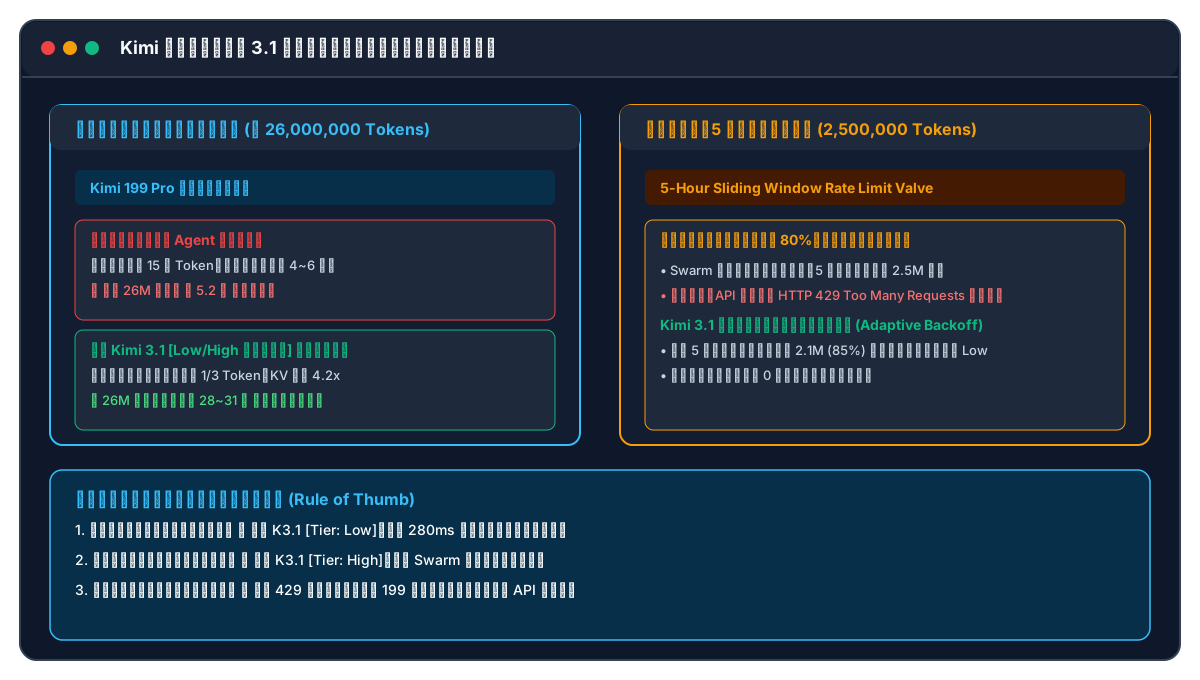
1. Dynamic Model Stratification
When orchestrating AI agents in your IDE:
- Routine Code Autocompletion & Linting: Route strictly to
k3d1-agent [Tier: Low]. Consuming zero hidden reasoning tokens, each completion costs only hundreds of tokens with near-instantaneous 280ms delivery; - Modular Bug Fixes & Unit Testing: Route to
k3d1-agent [Tier: High]for 3 seconds of focused verification; - Architectural Refactoring & Formal Proofs: Reserve
k3d1-agent [Tier: Max]exclusively for complex challenges.
2. Defending Against the 5-Hour 2.5M Token Valve
Even if 80% of your monthly allowance remains, exceeding 2,500,000 tokens within any rolling 5-hour window triggers an immediate HTTP 429 rate limit cooldown. By running our automated probe daemon, your development environment can monitor rolling token velocity and throttle intensive multi-agent loops to Low mode at the 85% threshold, guaranteeing uninterrupted daily uptime.
7. Frequently Asked Questions (Q&A)
Q1: Does the release of Kimi Work desktop app v3.1.0 mean Kimi 3.1 is already available to everyone?
A: Not immediately. The client version reflects local application packaging, whereas the model identity resides on backend inference clusters. The v3.1.0 release establishes protocol compatibility, UI sliders, and multi-agent coordination hooks ahead of general availability. Currently, only users routed through Canary staging buckets interact with the new model.
Q2: Will Kimi 3.1 require an extra fee for existing 199/month Pro subscribers?
A: No extra fee is expected, but consumption granularity will improve. The model will integrate directly into existing Pro and Max tiers. Selecting Low tier will consume quota significantly slower than the legacy K3 base model, while Max tier will consume more tokens during complex mathematical reasoning.
Q3: How does Kimi 3.1 compare against MiniMax M3.1-Flash-Preview?
A: Each excels in complementary domains. MiniMax M3.1-Flash specializes in rapid, low-latency micro-edits with aggressive pricing. Kimi 3.1 (k3d1-agent) stands out for its 1,000,000-token context window and native Swarm multi-agent collaboration, giving it a commanding advantage in large codebase understanding and multi-stage autonomous tasks.
Q4: Why do the diagnostic scripts enforce zero IP and machine name leakage?
A: This represents a foundational enterprise security requirement. Exposing internal network topologies, hostnames, or private subnets into public LLM prompt streams poses severe reconnaissance risks. Our diagnostic probes are built from the ground up with AST-level data sanitization to guarantee complete privacy protection.
8. Conclusion: Welcome to the Era of Coordinated Multi-Agent Intelligence
From the cryptic missing "3.1" in Pi to the verified k3d1-agent endpoints; from tunable reasoning effort restoring developer agency to native Swarm coordination redefining autonomous engineering—Kimi 3.1 signals the transition of the foundation model industry from raw brute force into refined, coordinated engineering excellence.
For forward-thinking software engineers and engineering leaders, this milestone represents more than faster completions: it introduces an entirely new paradigm of high-leverage human-agent collaboration. As the final release countdown begins, are you ready to deploy your swarm?