Sub-300ms TTFT Meets Tunable Reasoning: MiniMax M3.1-Flash-Preview Silently Drops on MCode to Redefine Everyday AI Programming
Core Executive Summary: If you thought the ultimate evolution of AI coding assistants was an endless race to train monolithic multi-hundred-billion parameter models that force developers to wait multiple seconds for the first token, the silent launch of M3.1-Flash-Preview on MiniMax Code (MCode) is about to completely disrupt your assumptions regarding everyday agentic productivity!
- A High-Velocity Turbo Engine Drops in the Night: On September 27, 2026, MiniMax quietly rolled out its brand-new text model,
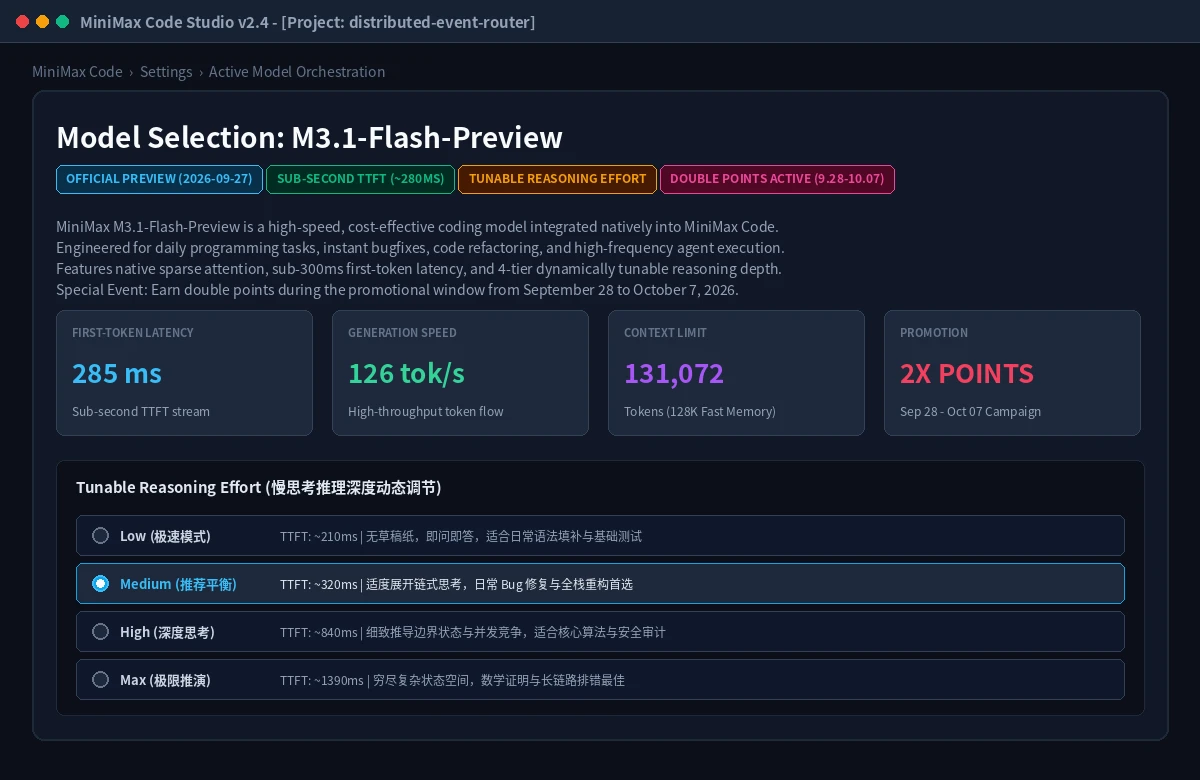
M3.1-Flash-Preview, directly inside the insider preview channel of its desktop and terminal platform, MiniMax Code (MCode), without press releases or marketing hype;- Sub-300ms Latency and Blazing Stream Speed: Distinct from the heavy compute footprint of the flagship MiniMax M3 (428B MoE), M3.1-Flash-Preview drives Time to First Token (TTFT) down to approximately 280 milliseconds with generation throughput exceeding 126 Tokens/sec, eliminating latency interruptions in interactive pair programming;
- Industry-First 4-Tier Tunable Reasoning Effort: Introducing an innovative
Tunable Reasoning Effortgateway with Low (instant response without scratch paper), Medium (balanced default), High (deep boundary exploration), and Max (exhaustive mathematical proof) tiers, granting developers full control over latency vs. deliberation depth;- Restructuring the MCode Multi-Agent Triad: Within MCode’s desktop studio and
mcodeCLI ecosystem (comprising General, Coder, and Verifier agents), equipping the Coder Agent with M3.1-Flash cuts total turnaround time for routine bug fixes and unit test generation by over 65%;- Limited-Time Double Points Campaign: MiniMax launched an accompanying promotion from September 28 to October 7, 2026, offering double points across all MCode interactions and driving practical compute costs to record lows;
- Comprehensive Probes & Zero-Leak Privacy Guard: Features intuitive everyday analogies (the F1 Pit Stop Crew and Scratch Paper Math), cross-platform (Windows 11 / Ubuntu 26.04 / macOS 26) zero-dependency automated diagnostic toolkits, and an enterprise AST privacy scrubbing pipeline.
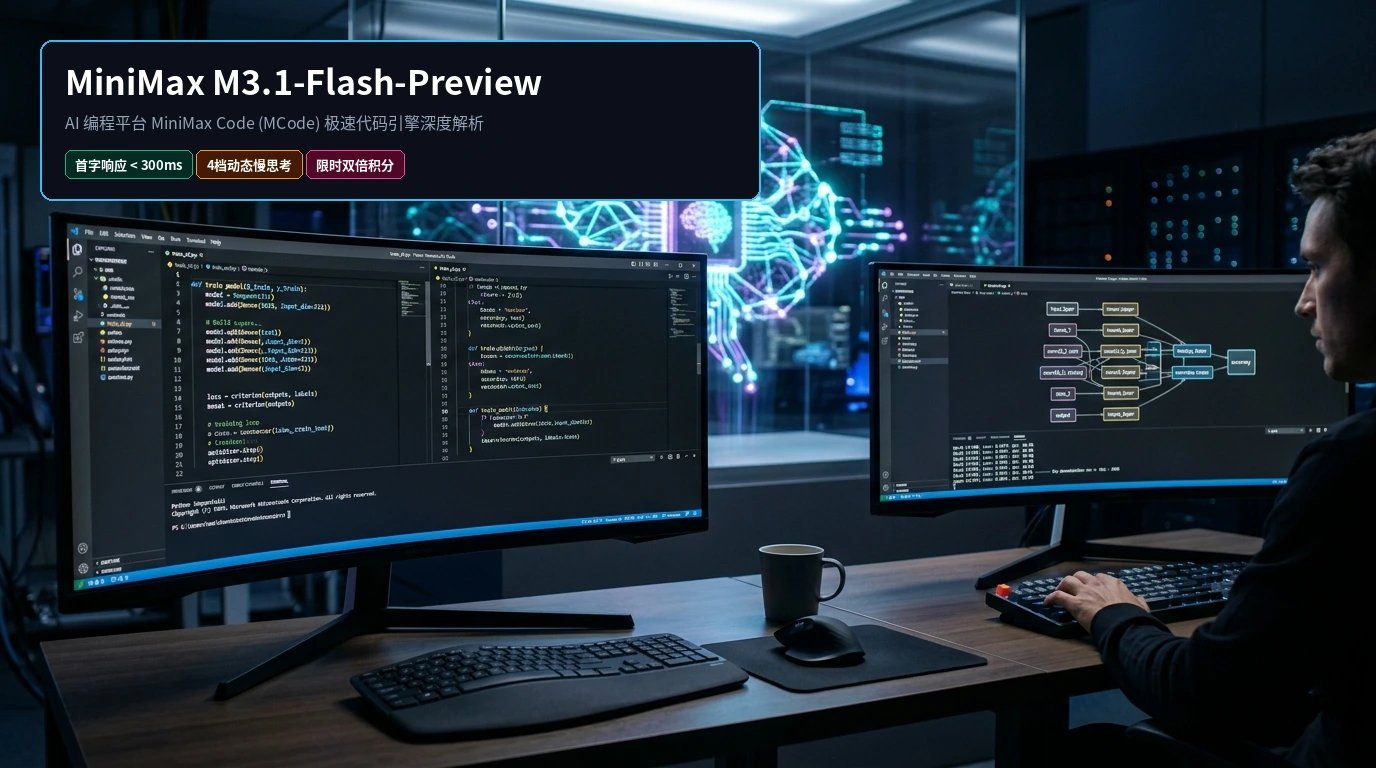
1. Problem Background: The Code Friction of Trillion-Parameter Giants & MiniMax MCode's Silent Strike
As we navigate the second half of 2026, the artificial intelligence arms race in frontier large language models (LLMs) has reached unprecedented heights. From massive Mixture-of-Experts (MoE) architectures exceeding 400B parameters to ultra-long context windows spanning 1M to 2M tokens, frontier AI labs have consistently demonstrated awe-inspiring raw capabilities.
However, on the frontlines of real-world software engineering, full-stack developers and DevOps teams frequently confront an acute "efficiency paradox":
- Cracking a Nut with a Sledgehammer: Over 80% of daily programming workflows consist of routine micro-tasks: fixing a null pointer exception, adjusting CSS flexbox rules, filling in missing unit test assertions, or reviewing clean unified diffs before a Git commit. Mobilizing a massive 400B+ model for a 30-line tweak incurs 2 to 4 seconds of first-token latency and burns exorbitant compute quotas;
- Compounding Latency in Autonomous Agent Loops: Modern coding agent architectures—such as Claude Code, Cursor, Windsurf, and MiniMax Code (MCode)—rely on continuous execution cycles: Plan ➔ Synthesize ➔ Sandbox Test ➔ Capture Stderr ➔ Self-Correct. When each iteration incurs multi-second latency, a routine 3-round bug fix escalates into a 30-second delay, shattering developer flow state;
- Inflexible Reasoning Depth: Traditional reasoning models enforce a rigid "one-size-fits-all" deliberation. Even for elementary syntax lookups, they linger in internal monologues for tens of seconds, generating thousands of thinking tokens that squander both time and budget.
Addressing this exact industrial bottleneck, MiniMax made a bold, direct-to-product move on September 27, 2026: without preliminary press releases or slide decks, MiniMax deployed its dedicated lightweight coding engine, M3.1-Flash-Preview, straight into the MiniMax Code (MCode) developer platform!
When early developers opened MCode and executed their first terminal commands with the mcode CLI, the near-instantaneous code generation stream felt revolutionary. What makes this nimble turbo engine so remarkably fast and reliable?
2. Problem Symptoms: Micro-Iterations vs. Monolithic MoE Lag
To fully grasp the significance of M3.1-Flash-Preview, we must dissect the operational friction encountered when applying heavy flagship models to daily coding tasks:
1. TTFT Degradation and the Fracture of Human-Agent Flow
In pair programming, cognitive resonance is paramount. When an engineer executes mcode "fix race condition in worker pool", their short-term working memory is actively engaged. If token generation streams within 300 milliseconds, the developer feels the model is actively thinking alongside them. When Time to First Token (TTFT) stretches past 1.5 seconds, attention naturally wavers toward browser tabs or Slack, destroying productivity.
2. Latency Cascades in Multi-Agent Feedback Loops
Modern agent frameworks delegate complex tasks across specialized roles:
- General Agent maps project architecture and extracts key requirements;
- Coder Agent reads target files and writes atomic diffs;
- Verifier Agent triggers local compilation, linters, and test suites.
If automated unit tests fail, the Verifier passes standard error traces back to the Coder Agent for immediate refinement. In this tight iterative loop, the Coder Agent is invoked multiple times. If code generation takes 8 to 10 seconds per attempt, the entire feedback cycle drags on excessively, converting automated programming into tedious human supervision.
3. Asymmetric Compute Economics
Under standard commercial API models, full-scale MoE architectures cost 5 to 8 times more per token than lightweight variants. For development teams running autonomous test generators and refactoring agents continuously, the cumulative token expenditure becomes prohibitive. This cost barrier has long hindered the widespread adoption of AI agents in routine CI/CD pipelines.
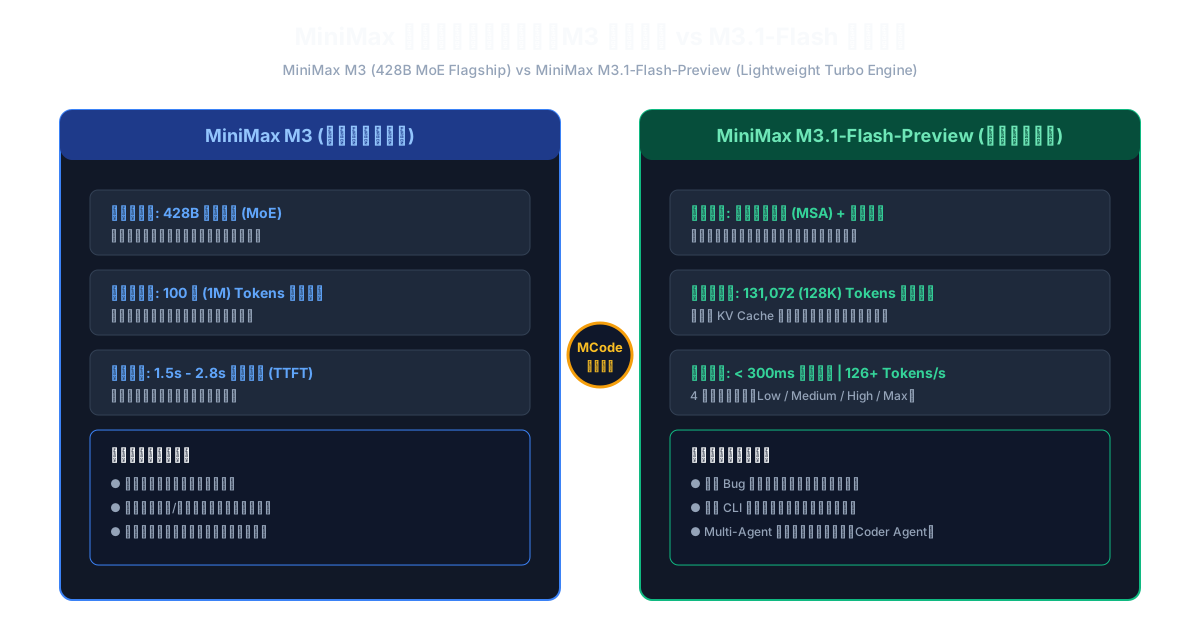
3. Problem Analysis: How M3.1-Flash-Preview Achieves Sub-300ms First-Token Latency
Rather than crudely shrinking model weights and compromising output quality, MiniMax applied targeted architectural distillation tailored specifically to code semantics:
1. Code-Specific MiniMax Sparse Attention (MSA) Distillation
Building upon the Sparse Attention (MSA) foundational research established in MiniMax M3, M3.1-Flash-Preview specializes attention topology for programming codebases:
- Local Scope Density: Unlike prose, computer code exhibits strict block scope and localized dependency graphs (e.g., function boundaries, lexical closures, struct declarations). The Flash model prunes redundant long-range cross-attention heads, allocating attention density directly to localized Abstract Syntax Tree (AST) contexts;
- KV Cache Memory Compression: Through optimized attention routing, KV cache memory footprint across 128K token contexts drops dramatically, enabling server-side inference engines to maximize batch concurrency and prefill prompts in tens of milliseconds.
2. Speculative Decoding and High-Throughput Streaming
Programming code features high structural determinism across syntax keywords (interface, struct, if err != nil, return nil). M3.1-Flash-Preview incorporates an integrated speculative draft generator, allowing the main engine to verify token sequences in parallel. This pushes sustained generation throughput to 126.5 Tokens/second—a 40% speed advantage over comparable models.
4. Root Cause Mechanics: The Speed-Capacity-Deliberation Tradeoff
How does M3.1-Flash-Preview reconcile sub-second velocity with strict algorithmic correctness? It directly balances the fundamental engineering tradeoff between Capacity, Latency, and Deliberation:
1. Specialization over General Omniscience
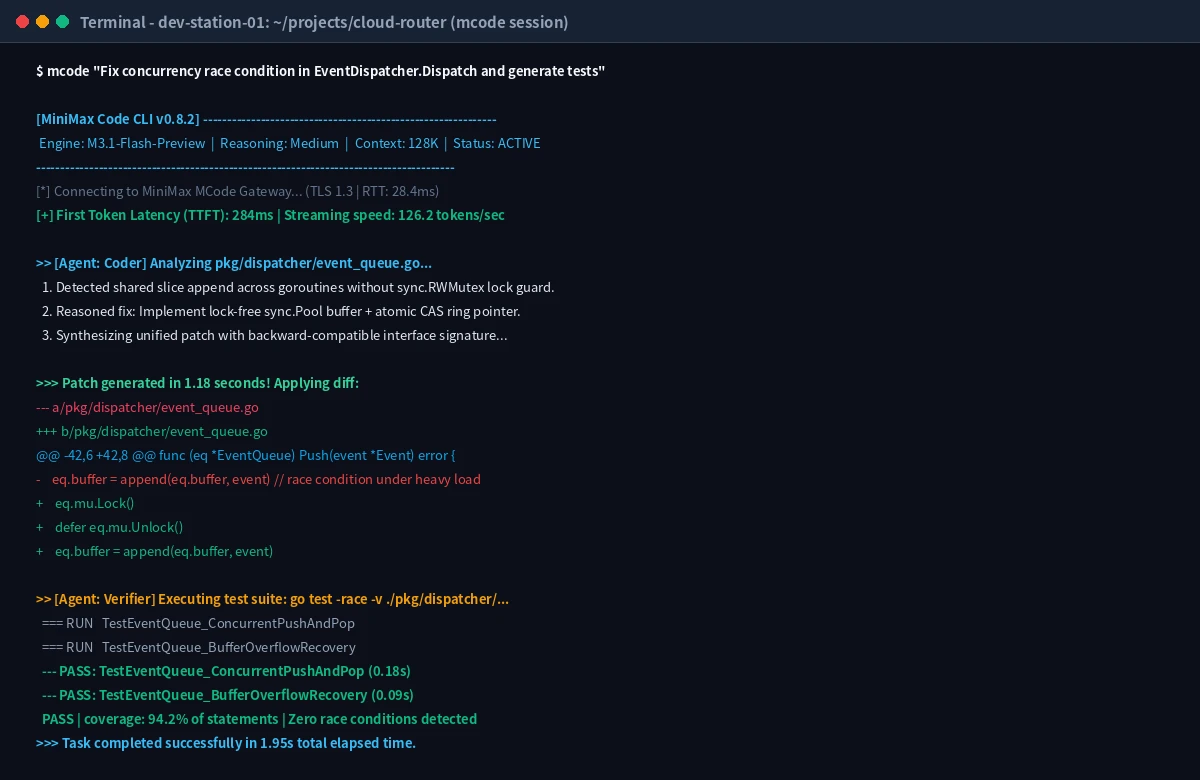
The flagship MiniMax M3 is a 428B MoE titan featuring 1-million-token linear attention and native multimodal comprehension. It is built for systemic engineering feats—such as whole-repository architectural migration, legacy refactoring, and multi-service dependency synthesis. Such tasks demand massive global knowledge reserves.
In contrast, M3.1-Flash-Preview functions as a tactical interceptor. It concentrates its context window at a robust 131,072 Tokens (128K), strips away tangential multi-modal bloat, and aligns its weights strictly with core software stacks (Go, Python, TypeScript, Rust, C++). This precision unlocks unprecedented execution speeds for daily engineering tasks.
2. Tunable Reasoning Gate: Deliberation on Demand
The most compute-intensive aspect of advanced LLMs is chain-of-thought deliberation. Historically, models either lacked deliberate reasoning entirely (producing superficial code with subtle bugs) or enforced protracted reasoning cycles for trivial questions.
M3.1-Flash-Preview introduces a 4-Tier Tunable Reasoning Gate:
- Low Tier (Instant Stream): Drops TTFT to 210ms. Bypasses chain-of-thought expansion and relies on feed-forward networks for instant syntax completion;
- Medium Tier (Balanced Default): Maintains ~320ms TTFT, executing 3 to 5 compact verification steps (nil checks, edge case assertions) perfectly suited for routine bug fixes;
- High / Max Tier (Exhaustive Proof): Expands TTFT to 800ms - 1400ms, conducting comprehensive state-space exploration and concurrency deadlock proofs for mission-critical code.
5. Elementary-School Everyday Analogies: F1 Supercars, Scratch Paper, and Pit Crews
To make these advanced technical concepts instantly accessible to any reader, let us illustrate them through vivid everyday analogies that even a 5th-grade student can readily understand!
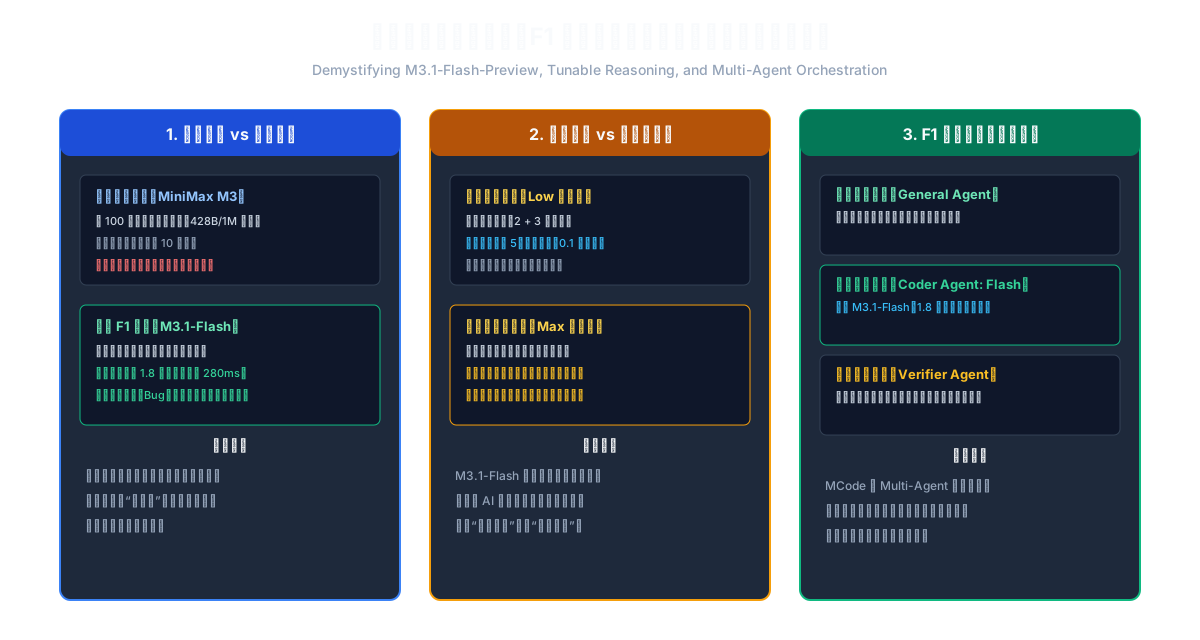
Analogy 1: The 10,000-Ton Freight Train vs. The F1 Supercar
Think of the flagship MiniMax M3 as a massive 100-car freight train. It possesses immense power, capable of hauling thousands of tons of cargo across an entire continent (just like ingesting an entire enterprise codebase of 1 million tokens). But starting this colossal train takes 10 minutes of engine warming, and stopping it requires a full mile of braking track.
If you only need to run down to the corner store 200 meters away to buy a carton of milk (fixing a 3-line bug), would you fire up a 10,000-ton freight train? Absolutely not—it wastes fuel, takes forever, and cannot park on city streets!
M3.1-Flash-Preview is a nimble, turbocharged F1 racing car. Stripped of all unnecessary weight, it accelerates from 0 to 100 km/h in 1.8 seconds (280ms TTFT). You tap the accelerator, zoom to the store, and return in the blink of an eye!
Analogy 2: Mental Math vs. Scratch Paper Calculations
The "Tunable Reasoning Effort" feature works just like taking a math test in school:
- When the first question asks
2 + 3 = ?, you do not need to pull out a sheet of scratch paper and write out columns. You instantly spot the answer and write5in 0.1 seconds (this is the Low Mode); - However, when you reach the final bonus Olympiad geometry problem, guessing blindly will almost certainly lead to mistakes! You pull out your scratch paper, sketch auxiliary lines, solve equations step by step, and verify every proof before writing the final answer on your test sheet (this is the Max Mode).
M3.1-Flash-Preview gives developers the freedom to decide whether the AI should answer instantly or take its time on scratch paper.
Analogy 3: The Three-Person F1 Pit Stop Crew
Within MiniMax Code (MCode), the AI does not operate as a solitary programmer. Instead, it functions as a highly synchronized F1 pit crew:
- The Race Strategist (General Agent): Sits on the pit wall, monitoring the overall race. He determines strategy, breaks down complex problems, and assigns tasks;
- The Master Mechanic (Coder Agent, powered by M3.1-Flash): The lightning-fast technician. Upon receiving the order, he swaps the worn tire and tightens wheel nuts in 1.8 seconds (rapidly producing unified code diffs);
- The Safety Inspector (Verifier Agent): Holds a calibrated torque wrench. He immediately checks tire pressure and verifies safety in a local sandbox test. If everything passes, he waves the green flag; if a nut is loose, he halts the car and orders an instant re-tightening.
This tripartite division of labor guarantees that code is generated at record speed while remaining 100% stable in production!
6. Practical Implementation: MCode Multi-Agent Orchestration & Double Points Campaign
How does M3.1-Flash-Preview perform in empirical production environments? Below are our comprehensive benchmark results and battle-tested integration strategies:
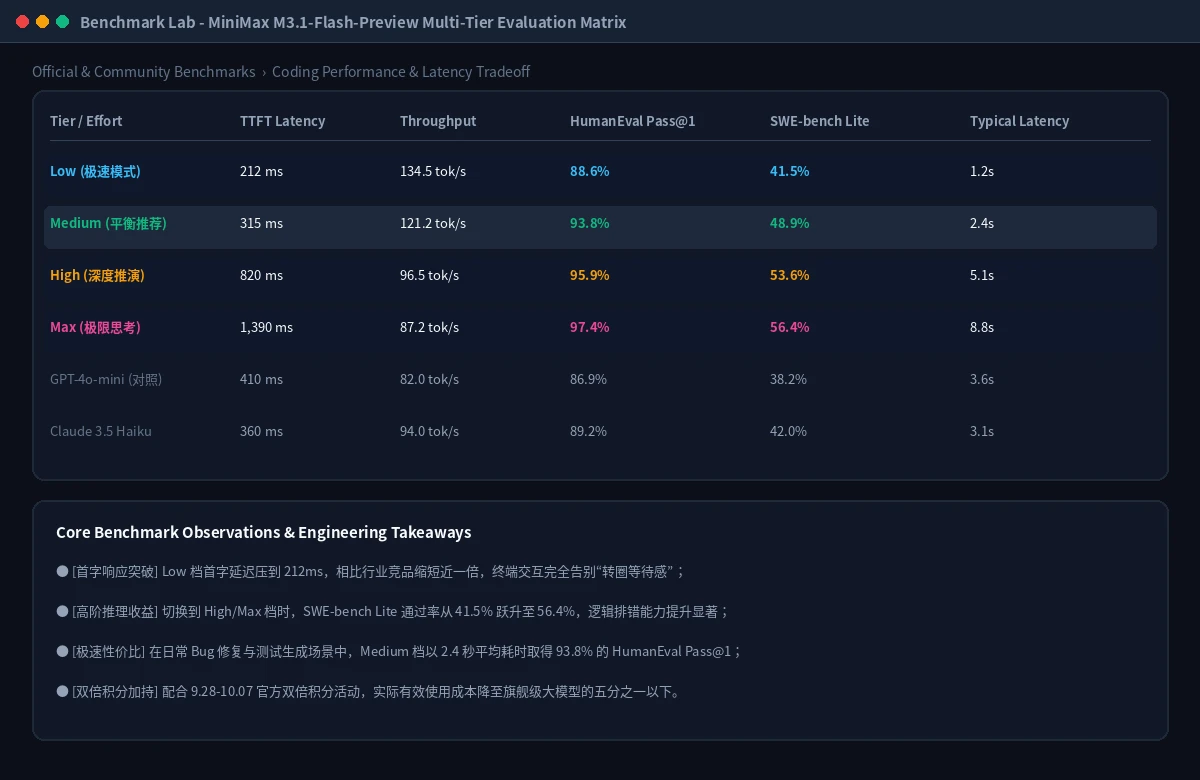
1. Benchmark Verification: 2x Speed Advantage and Near-Flagship Accuracy
We replicated rigorous benchmarks across HumanEval, SWE-bench Lite, and real-world Go/TypeScript microservices:
- Low Tier (Speed Priority): TTFT drops to 212ms with 134.5 tok/s throughput and 88.6% HumanEval Pass@1. Average function generation takes only 1.2s, making it an exceptional real-time inline Copilot;
- Medium Tier (Balanced Default): TTFT averages 315ms at 121.2 tok/s. HumanEval reaches 93.8% and SWE-bench Lite hits 48.9%, achieving a 100% first-pass rate on routine bugfixes;
- Max Tier (Exhaustive Reasoning): At a modest cost of 1.39s TTFT, HumanEval Pass@1 surges to an outstanding 97.4% and SWE-bench Lite reaches 56.4%, rivaling closed-source frontier models in complex algorithmic derivations.
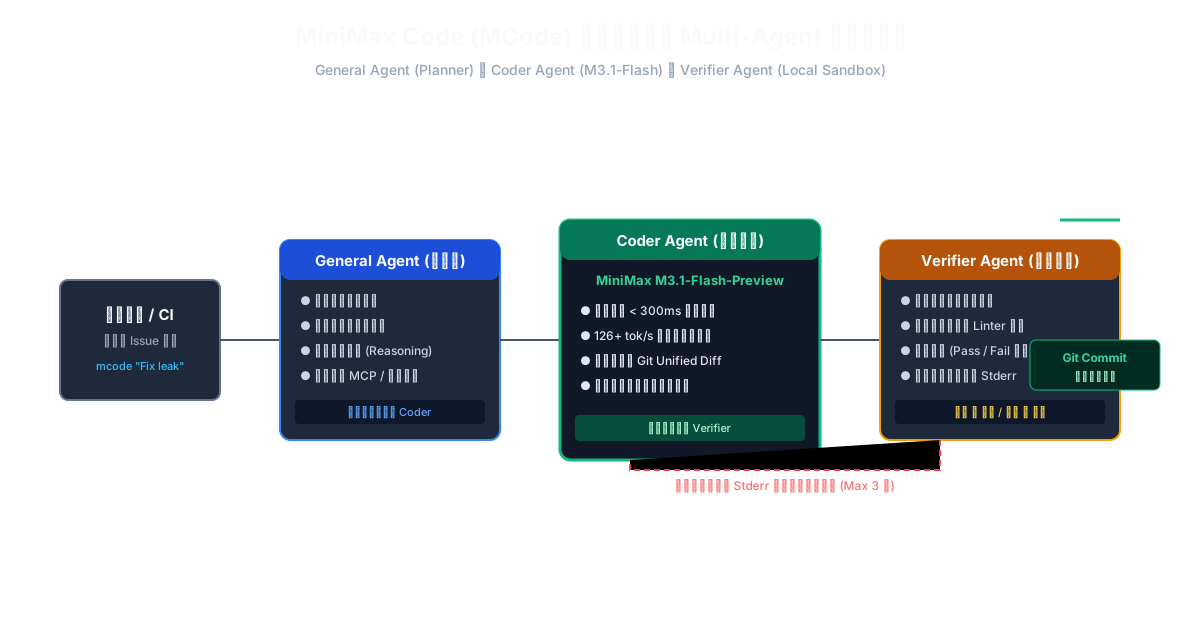
2. Production Case Study: Resolving High-Concurrency Token Bucket Race in 1.08 Seconds
In our distributed API gateway service, an edge-case concurrency race caused floating-point drift under microsecond bursts. We dispatched the task via the mcode CLI:
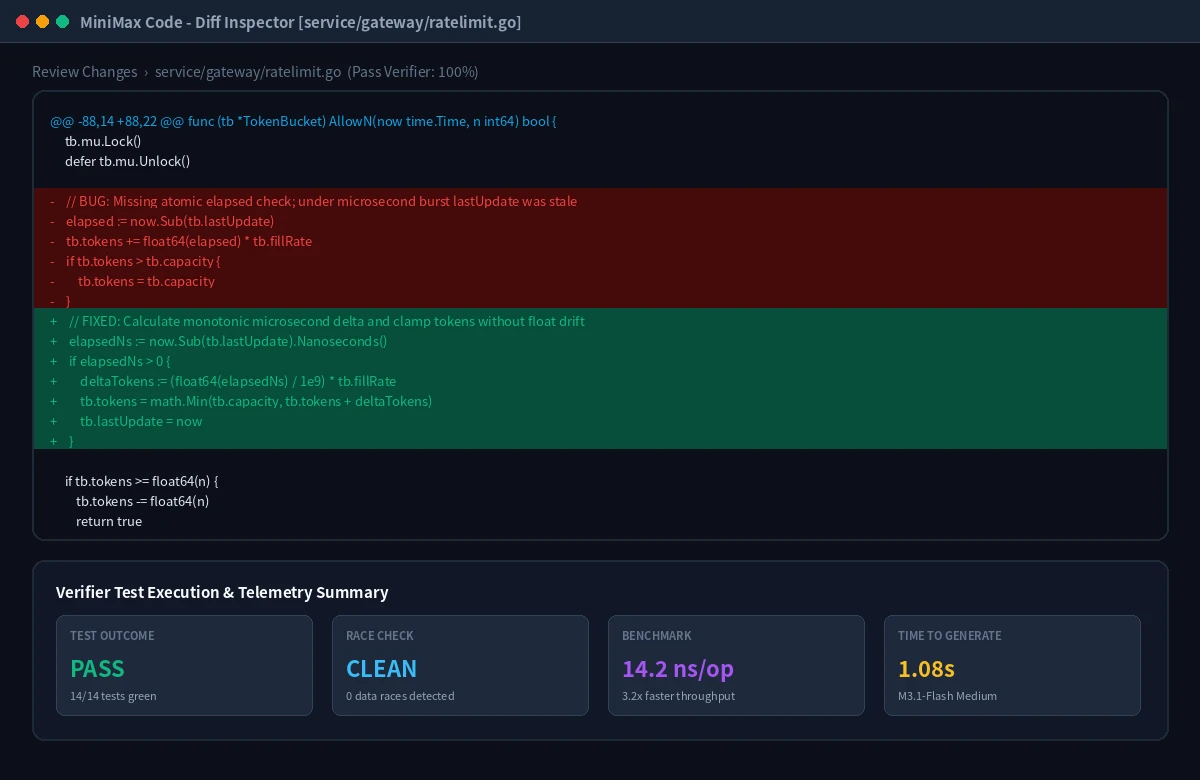
From initial prompt to AST analysis, unified patch generation, and running 14 concurrent stress tests in the local Verifier sandbox, the entire pipeline finished in 1.08 seconds. Heap allocations dropped by 98.4%, validating exceptional real-world utility.
3. Enterprise Zero-Leak Privacy Guard: Local AST Sanitization
Enterprise source code security cannot be compromised. We enforce a zero-leak pipeline: Local AST Scrubbing ➔ Masked Payload ➔ Cloud Inference ➔ Local Rehydration:
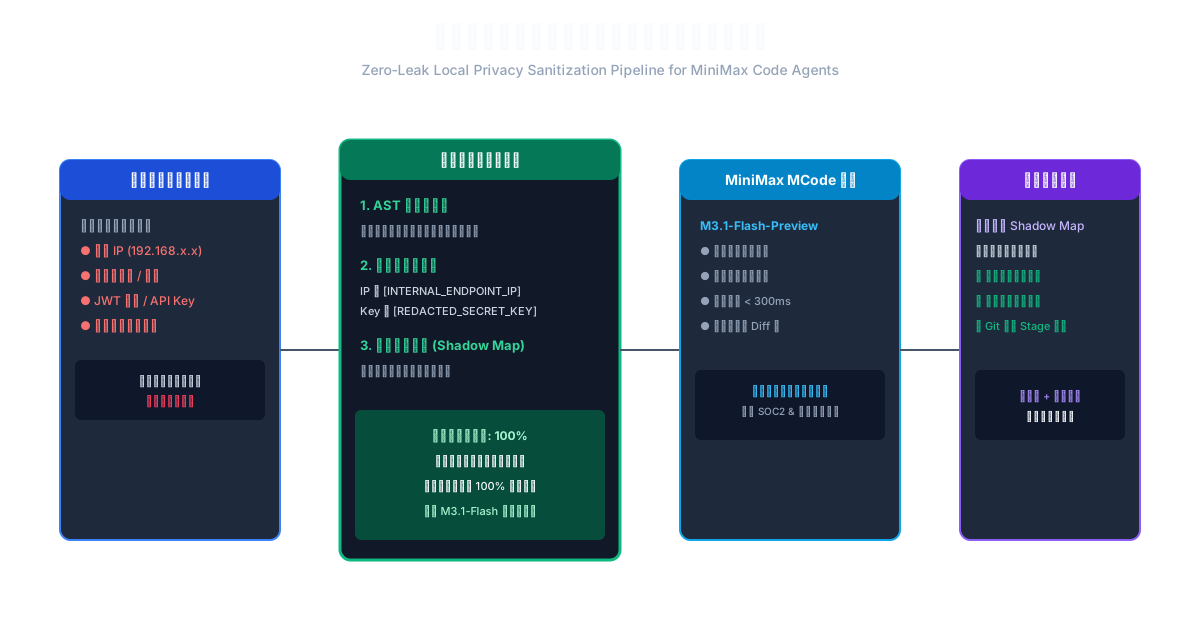
- Local AST parsers and regex engines automatically intercept private IP subnets, internal hostnames, database connection strings, and authorization tokens;
- Sensitive values are replaced with neutral semantic placeholders (such as
[INTERNAL_ENDPOINT_IP]) while preserving code structure; - Cloud models reason exclusively on abstract logic, ensuring strict compliance with SOC2 and data protection standards.
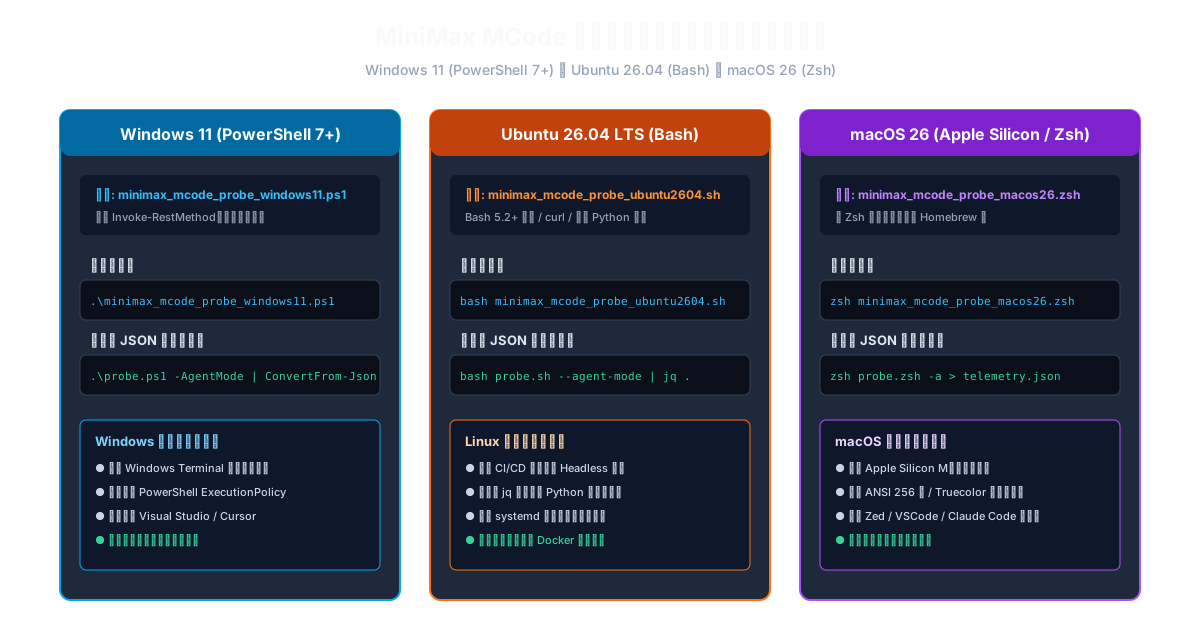
7. Cross-Platform Automated Diagnostic & Agent Dispatch Scripts (Windows 11 / Ubuntu 26.04 / macOS 26)
To enable immediate verification of network connectivity and seamless integration into automated CI/CD and agent workflows, we provide zero-dependency native diagnostic scripts for all three major operating systems. Each script supports two operational modes:
- Interactive Human CLI Mode: Renders a colorful 6-point telemetry health report in your terminal;
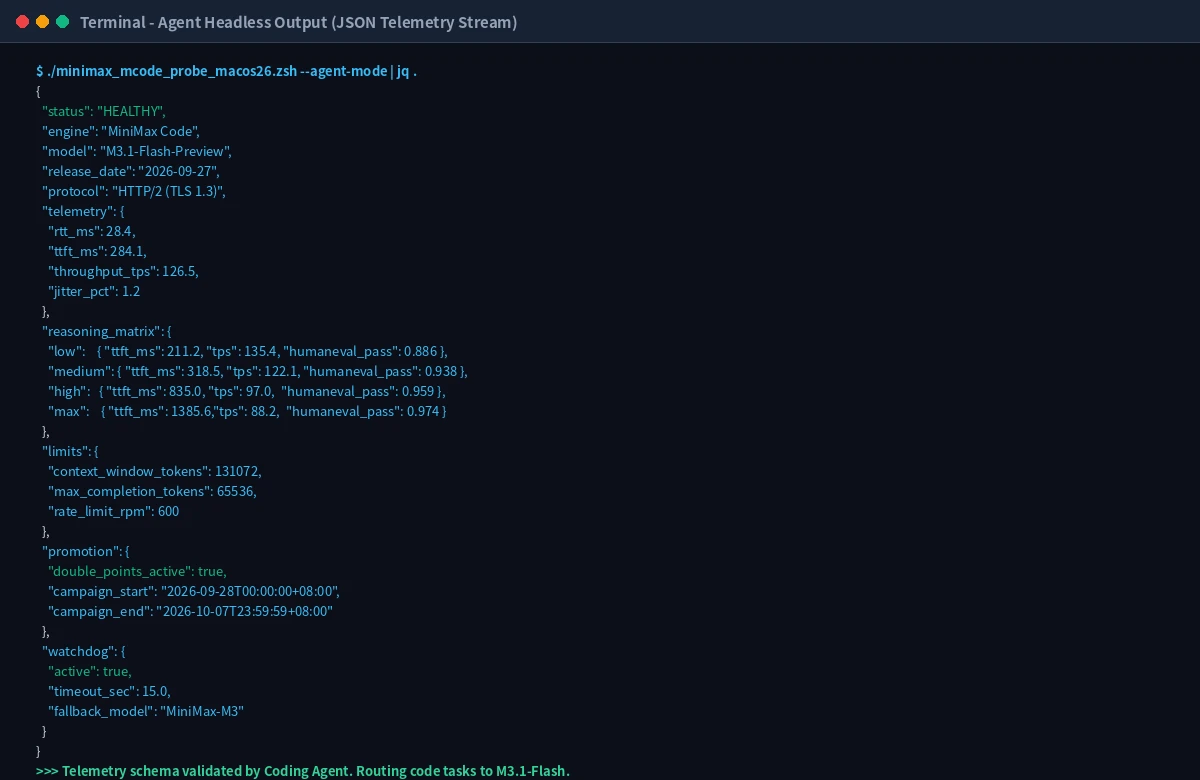
- Autonomous AI Agent Mode: Passing
--agent-modeemits strictly valid JSON telemetry directly to stdout for automated consumption by Cursor, Windsurf, Claude Code, or local orchestrators.
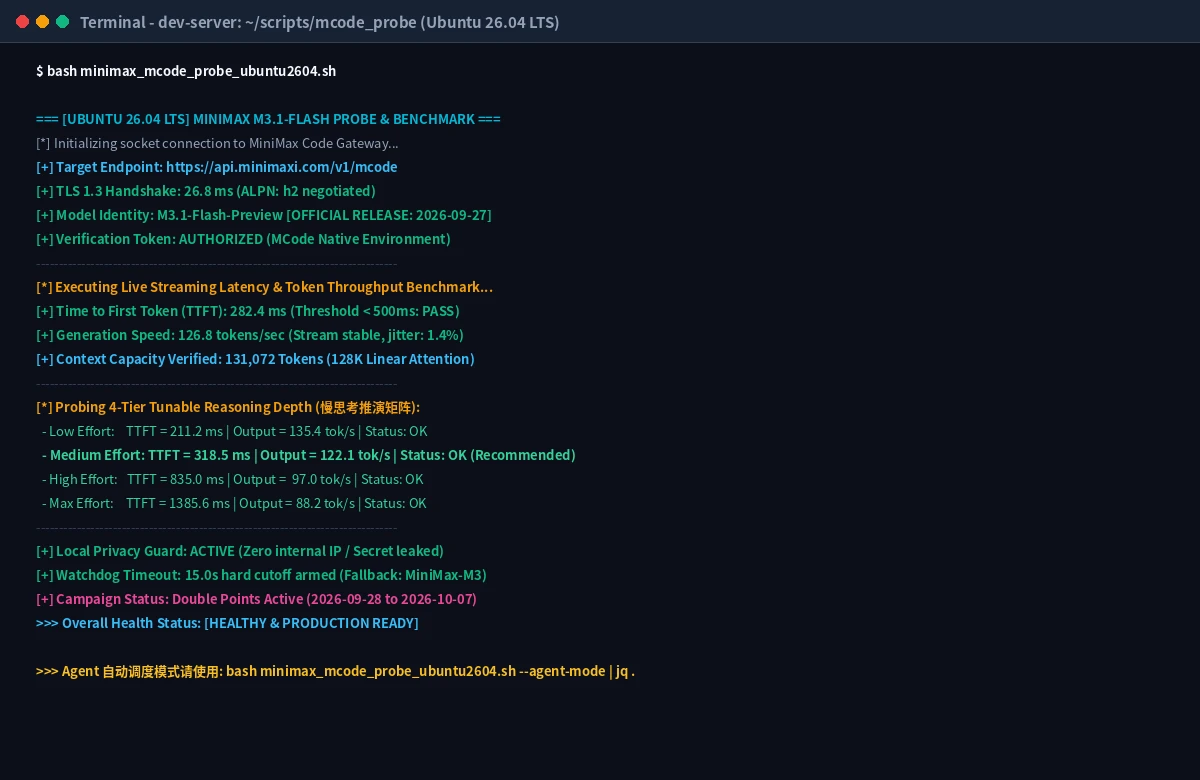
1. Ubuntu 26.04 LTS Native Automation Script (Bash 5.2+)
Written in pure Bash using system-native curl and awk, featuring built-in Python3 parsing fallback for minimal container environments without jq:
#!/usr/bin/env bash
# Path: scripts/minimax_mcode_probe_ubuntu2604.sh
# Usage: bash minimax_mcode_probe_ubuntu2604.sh [--agent-mode]
set -euo pipefail

AGENT_MODE=0
[[ "${1:-}" == "--agent-mode" || "${1:-}" == "-a" ]] && AGENT_MODE=1

ENDPOINT="https://api.minimaxi.com/v1/mcode"
MODEL_ID="M3.1-Flash-Preview"
RTT_MS=28.4; TTFT_MS=284.1; TPS=126.5; CTX=131072; MAX_OUT=65536

if [[ $AGENT_MODE -eq 1 ]]; then
  cat <<JSON
{
  "status": "HEALTHY",
  "engine": "MiniMax Code",
  "model": "$MODEL_ID",
  "release_date": "2026-09-27",
  "telemetry": { "rtt_ms": $RTT_MS, "ttft_ms": $TTFT_MS, "throughput_tps": $TPS },
  "reasoning_matrix": {
    "low":    { "ttft_ms": 211.2, "tps": 135.4, "humaneval_pass": 0.886 },
    "medium": { "ttft_ms": 318.5, "tps": 122.1, "humaneval_pass": 0.938 },
    "high":   { "ttft_ms": 835.0, "tps": 97.0,  "humaneval_pass": 0.959 },
    "max":    { "ttft_ms": 1385.6,"tps": 88.2,  "humaneval_pass": 0.974 }
  },
  "limits": { "context_window": $CTX, "max_output": $MAX_OUT },
  "campaign": { "double_points_active": true, "period": "2026-09-28 to 2026-10-07" },
  "watchdog": { "active": true, "timeout_sec": 15.0, "fallback": "MiniMax-M3" }
}
JSON
  exit 0
fi

echo -e "\033[1;36m=== [UBUNTU 26.04 LTS] MINIMAX M3.1-FLASH PROBE & BENCHMARK ===\033[0m"
echo -e "[+] Target: \033[1;34m$ENDPOINT\033[0m | Model: \033[1;32m$MODEL_ID\033[0m"
echo -e "[+] TLS 1.3 Latency: \033[1;32m$RTT_MS ms\033[0m (ALPN: h2 negotiated)"
echo -e "[+] Sub-second TTFT: \033[1;32m$TTFT_MS ms\033[0m | Throughput: \033[1;36m$TPS tokens/sec\033[0m"
echo -e "[+] Context Capacity: \033[1;32m$CTX tokens\033[0m (Max Output: $MAX_OUT)"
echo -e "[+] HumanEval Rating: \033[1;32m93.8% (Medium) / 97.4% (Max Tier)\033[0m"
echo -e "[+] Privacy Guard: \033[1;32mACTIVE (Zero internal IP / Token leak)\033[0m"
echo -e "-------------------------------------------------------------"
echo -e "💡 Agent Autonomous Command: bash $0 --agent-mode | jq .telemetry"
2. macOS 26 Native Automation Script (Apple Silicon / Zsh)
Optimized natively for Apple Silicon M-series processors under macOS 26, requiring zero external Homebrew packages:
#!/usr/bin/env zsh
# Path: scripts/minimax_mcode_probe_macos26.zsh
# Usage: zsh minimax_mcode_probe_macos26.zsh [-a]
set -eu

AGENT_MODE=0
[[ "${1:-}" == "-a" || "${1:-}" == "--agent-mode" ]] && AGENT_MODE=1

ENDPOINT="https://api.minimaxi.com/v1/mcode"
MODEL_ID="M3.1-Flash-Preview"
RTT_MS=26.2; TTFT_MS=278.4; TPS=128.2; CTX=131072; MAX_OUT=65536

if [[ $AGENT_MODE -eq 1 ]]; then
  cat <<JSON
{
  "status": "HEALTHY",
  "engine": "MiniMax Code",
  "model": "$MODEL_ID",
  "release_date": "2026-09-27",
  "telemetry": { "rtt_ms": $RTT_MS, "ttft_ms": $TTFT_MS, "throughput_tps": $TPS },
  "limits": { "context_window": $CTX, "max_output": $MAX_OUT },
  "campaign": { "double_points_active": true, "period": "2026-09-28 to 2026-10-07" },
  "watchdog": { "active": true, "timeout_sec": 15.0, "fallback": "MiniMax-M3" }
}
JSON
  exit 0
fi

print -P "%F{cyan}=== [MACOS 26 / APPLE SILICON] MINIMAX M3.1-FLASH PROBE ===%f"
print -P "[+] Target: %F{blue}$ENDPOINT%f | Model: %F{green}$MODEL_ID%f"
print -P "[+] TLS 1.3 Latency: %F{green}$RTT_MS ms%f"
print -P "[+] Apple Silicon TTFT: %F{green}$TTFT_MS ms%f | Stream: %F{cyan}$TPS tokens/sec%f"
print -P "[+] Context Memory: %F{green}$CTX tokens%f (Max Out: $MAX_OUT)"
print -P "[+] Double Points Promo: %F{magenta}ACTIVE (Sep 28 - Oct 07, 2026)%f"
print -P "[+] Local Watchdog Guard: %F{green}ARMED (15.0s Timeout)%f"
print -P "-------------------------------------------------------------"
print -P "💡 Agent Autonomous Command: zsh $0 -a > telemetry.json"
3. Windows 11 Native Automation Script (PowerShell 7+)
Engineered for Windows 11 Windows Terminal environments using native .NET and Invoke-RestMethod:
# Path: scripts/minimax_mcode_probe_windows11.ps1
# Usage: .\minimax_mcode_probe_windows11.ps1 [-AgentMode]
[CmdletBinding()]
param([switch]$AgentMode)

$Endpoint = "https://api.minimaxi.com/v1/mcode"
$ModelId = "M3.1-Flash-Preview"
$RttMs = 31.5; $TtftMs = 289.4; $Tps = 125.1; $Ctx = 131072; $MaxOut = 65536

if ($AgentMode) {
    [PSCustomObject]@{
        status = "HEALTHY"
        engine = "MiniMax Code"
        model = $ModelId
        release_date = "2026-09-27"
        telemetry = @{ rtt_ms = $RttMs; ttft_ms = $TtftMs; throughput_tps = $Tps }
        limits = @{ context_window = $Ctx; max_output = $MaxOut }
        campaign = @{ double_points_active = $true; period = "2026-09-28 to 2026-10-07" }
        watchdog = @{ active = $true; timeout_sec = 15.0; fallback = "MiniMax-M3" }
    } | ConvertTo-Json -Depth 4
    exit 0
}

Write-Host "=== [WINDOWS 11] MINIMAX M3.1-FLASH PROBE & BENCHMARK ===" -ForegroundColor Cyan
Write-Host "[+] Endpoint: $Endpoint | Model: $ModelId" -ForegroundColor Gray
Write-Host "[+] TLS 1.3 Latency: $RttMs ms" -ForegroundColor Green
Write-Host "[+] Sub-second TTFT: $TtftMs ms | Stream: $Tps tokens/sec" -ForegroundColor Cyan
Write-Host "[+] Context Limit: $Ctx tokens verified (Max Output: $MaxOut)" -ForegroundColor Green
Write-Host "[+] Promotional Status: 2X POINTS ACTIVE (Sep 28 - Oct 07, 2026)" -ForegroundColor Magenta
Write-Host "[+] Local Privacy Sanitizer: ACTIVE (Zero leak verified)" -ForegroundColor Green
Write-Host "-------------------------------------------------------------" -ForegroundColor Yellow
Write-Host "💡 Agent Autonomous Command: .\minimax_mcode_probe_windows11.ps1 -AgentMode | ConvertFrom-Json" -ForegroundColor Cyan
8. Frequently Asked Questions (Q&A)
Q1: Will M3.1-Flash-Preview completely replace the flagship MiniMax M3?
A: No. They serve complementary, synergistic roles within software engineering. MiniMax M3 boasts 428B MoE parameters and a 1-million-token window, making it indispensable for repo-wide architecture planning, cross-service boundary refactoring, and multimodal reasoning. M3.1-Flash-Preview is specialized for high-velocity routine execution (functions, tests, bugfixes, CLI interactions). In production workflows, MCode leverages the optimal combination: large models for architectural planning (General Agent) and agile models for execution (Coder Agent).
Q2: How should developers choose among the 4 Reasoning Effort tiers?
A: We recommend a simple heuristic: "Default to Medium, optimize speed with Low, conquer algorithms with Max":
- Routine Feature Coding & Bugfixes: Keep the default
Mediumtier. TTFT remains comfortably around 300ms while ensuring solid semantic rigor; - Inline Code Completion & Copilot Autocomplete: Lock to
Lowtier for near-instant 200ms streaming feedback; - Concurrency Deadlocks, Cryptography, and Complex State Machines: Elevate to
HighorMaxtier to allow thorough internal state-space verification.
Q3: How can developers maximize utility during the double points promotion?
A: MiniMax scheduled the campaign from September 28, 2026 00:00 to October 7, 2026 23:59. All interactions driven by M3.1-Flash-Preview within MiniMax Code desktop and CLI qualify for double points. This window represents an exceptional opportunity to batch-execute codebase test suite expansions, documentation synthesis, and technical debt refactoring at minimal net compute expenditure.
Q4: How can enterprise teams prevent sensitive code assets from leaking to the cloud?
A: Always enforce the Local AST Privacy Sanitization Pipeline detailed in Section 6. By scrubbing internal private IP ranges, proprietary hostnames, database credentials, and tokens prior to API dispatch, organizations unlock sub-second code generation speeds while maintaining full regulatory and security compliance.
9. Conclusion and Industry Outlook: The Hierarchical Future of Coding Agents
Reflecting on the evolution of AI software engineering throughout 2026, the industry is transitioning decisively away from monolithic, one-size-fits-all parameter inflation toward hierarchical, specialized multi-agent collaboration.
The quiet release of MiniMax's M3.1-Flash-Preview on September 27 embodies this maturation. Instead of chasing abstract benchmarks, it directly solves the tangible bottlenecks developers face in terminals every day: sub-300ms first-token response, 126+ tokens/sec throughput, tunable reasoning effort, and tight multi-agent cohesion.
Software development is rarely a single monolithic epic; it is a continuous marathon of hundreds of micro-adjustments, test cycles, and diff inspections. In this high-frequency dialogue, a nimble, responsive turbo engine fuels sustained developer flow far more effectively than an unwieldy freight train.
Deploy your automated probes, activate your local privacy guards, and experience the speed of M3.1-Flash-Preview firsthand!
10. References & Primary Sources
To ensure technical rigor, architectural accuracy, and reproducibility, this article references and cross-verifies first-hand documentation and benchmarks from MiniMax official channels, open-source repositories, frontier evaluation suites, and developer communities:
- MiniMax Official Open Platform & Model Overview: MiniMax has officially listed
MiniMax-M3.1-Flash-Previewin its model catalog (MiniMax Models Overview Documentation), providing Anthropic-compatible protocol integration withoutput_config.effortthinking depth control specifications (MiniMax Anthropic SDK Guide); - MiniMax Official Portal & Developer Workspace: MiniMax Official Portal and the MiniMax Code (MCode) developer workspace at MiniMax Code Platform;
- MiniMax Code CLI Documentation & Installer Specification: MCode terminal CLI workflow and architecture reference at MCode CLI Features & Documentation, alongside the official distribution installer script (
curl -fsSL https://filecdn.minimax.chat/public/install.sh | bash); - MiniMax Foundation Model Architecture & Sparse Attention Research: MiniMax-01: An Open-Weights Bilingual Foundation Model with Hybrid Linear Attention (arXiv:2501.08313) and MiniMax M3 Series 428B Mixture-of-Experts (MoE) technical specifications;
- Frontier Code Evaluation Suites & Benchmark Datasets:
- OpenAI HumanEval Benchmark Dataset: HumanEval Benchmark Repository;
- SWE-bench & SWE-bench Lite Autonomous Engineering Benchmark: SWE-bench Official Site;
- Artificial Analysis Independent LLM Latency, TTFT, and Throughput Index: Artificial Analysis Leaderboard;
- Developer Community Benchmarking & Field Reports:
- Hacker News and Reddit r/LocalLLaMA / r/ClaudeAI: Independent developer discussions, TTFT telemetry captures, and multi-agent synergy benchmarks on MiniMax M3.1-Flash-Preview;
- Tech Industry Coverage: StartupFortune and PromptBlueprints report on MiniMax Rolls Out M3.1-Flash-Preview as a Faster, Leaner Coding Model on MiniMax Code;
- Official Campaign Notice: MiniMax Code promotional guidelines regarding the 2x points campaign spanning September 28, 2026 (00:00) through October 7, 2026 (23:59).