Gemini 3.5 Is Not Just Faster: Google I/O Moves AI Into the Agent Era
The short version
The most important Google I/O 2026 announcement is not merely another chat model. Google is moving Gemini 3.5 into the action layer. The first public model, Gemini 3.5 Flash, is now part of the Gemini app, Search AI Mode, Google Antigravity, the Gemini API, Android Studio, Gemini Enterprise Agent Platform, and Gemini Enterprise. Google’s phrase is frontier intelligence with action. In practical terms, the model is meant to do more than answer: it is expected to operate across tools, code, files, search, and enterprise workflows.
This article is based on Google’s official public announcements and adds industry analysis on top of them. All images are from Google’s public blog posts. The article contains no private account information, internal network details, secrets, private system screenshots, or non-public data.
Figure 1: Google’s official Gemini 3.5 hero image. The story is not just model intelligence; it is intelligence connected to action.
1. What Google actually announced
On May 19, 2026, Google announced the Gemini 3.5 model family at I/O. The first model in the series is Gemini 3.5 Flash. Google’s official post describes Gemini 3.5 as a model family built for complex agentic workflows, with 3.5 Flash focused on agents, coding, and long-horizon tasks. Gemini 3.5 Pro is already being used internally at Google and is planned for release next month.
That distinction matters. Gemini 3.5 is the family name, but the model broadly available today is 3.5 Flash. Any serious discussion should avoid treating 3.5 Pro as already public.
The positioning of Flash has also changed. This is not framed as a small, cheap fallback model. Google calls it its strongest agentic and coding model yet, citing results on Terminal-Bench 2.1, GDPval-AA, MCP Atlas, and CharXiv Reasoning. In this launch, Flash is the high-throughput engine for real agent workloads.
The rollout is aggressive. Google is not limiting 3.5 Flash to a narrow developer preview. It is being placed into consumer, developer, enterprise, and search surfaces at the same time: Gemini app, AI Mode in Search, Antigravity, Gemini API, AI Studio, Android Studio, Gemini Enterprise Agent Platform, and Gemini Enterprise.
Figure 2: Google’s Gemini 3.5 blog header. The model family is explicitly framed around complex agentic workflows.
2. The real theme is action, not chat
Much of the model race over the last two years has been about answer quality: better reasoning, more natural writing, stronger multimodality, longer context windows. Gemini 3.5 changes the emphasis. Google’s launch language repeatedly points to agentic tasks, long-horizon tasks, subagents, tool calling, coding, and production-ready applications.
That is the important shift: the industry is moving from “answer the question well” to “finish the work”.
A model that only answers questions remains a consultation window. A workflow-changing model must read context, break down tasks, call tools, write code, run code, check results, repair errors, keep state, and complete a loop under user supervision. By tying 3.5 Flash to Antigravity, Managed Agents, Search agents, and Gemini Spark, Google is saying that the model is the engine, while the product is the agent runtime.
Speed matters because agent systems are not single-turn conversations. A real task may require dozens or hundreds of model calls: planning, searching, reading files, generating code, running tests, debugging, and reporting. If every step is slow, the product feels broken. If every step is expensive, enterprises will not deploy it broadly. Google says 3.5 Flash is four times faster than other frontier models in output tokens per second and often less than half the cost for long-horizon tasks. Those claims still need independent long-term validation, but the direction is clear: the next race is about real tasks completed per unit of time and cost.
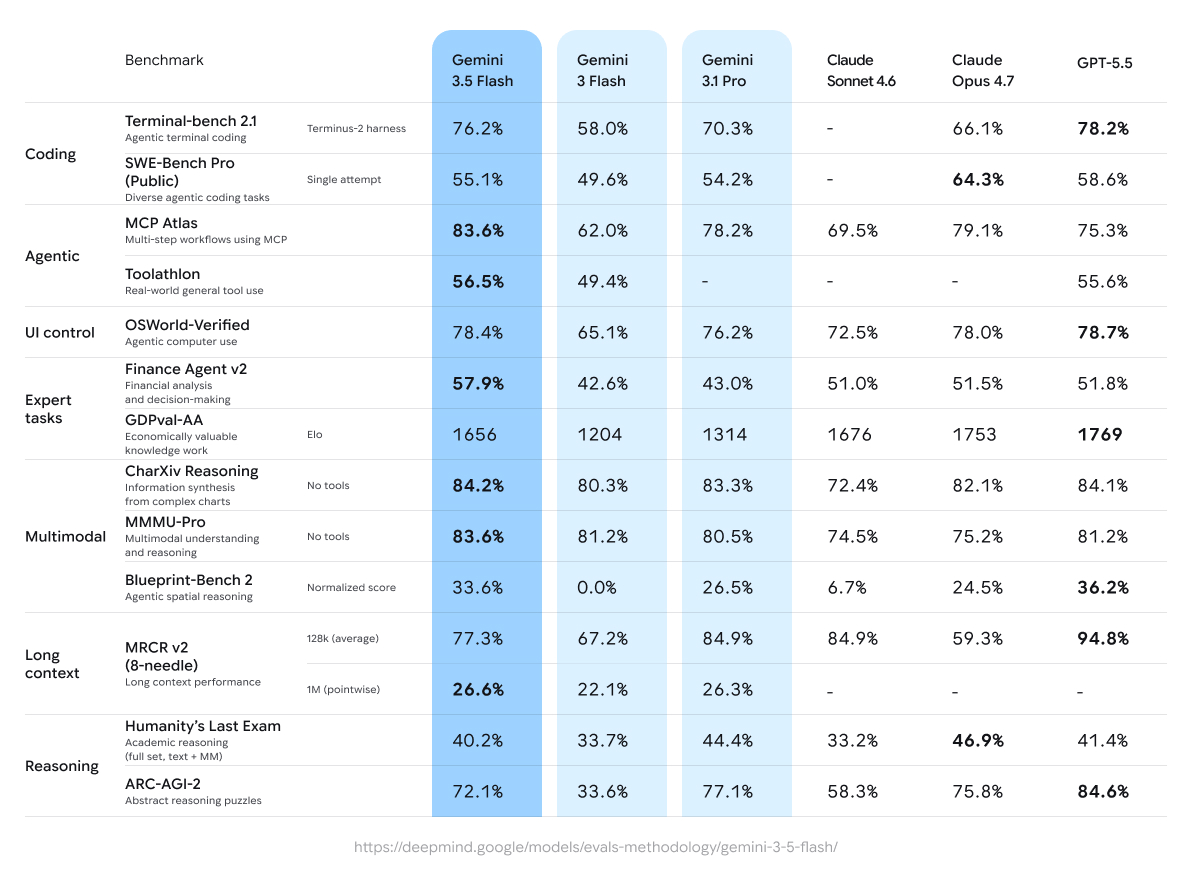
Figure 3: Google’s official Gemini 3.5 Flash benchmark graphic. Treat it as Google’s launch data, not as a substitute for independent production evaluations.
3. For developers: from copilot to coordinated agent teams
Developers are the most directly affected audience. Google’s developer announcement says the shift is from prompts to action. Around 3.5 Flash, Google introduced Antigravity 2.0, Antigravity CLI, Antigravity SDK, Managed Agents in the Gemini API, the Google AI Studio mobile app, and native Android app generation support.
The most important piece is Managed Agents in the Gemini API. Google says developers can start an agent with a single API call. That agent can reason, use tools, and execute code in an isolated Linux environment, and future interactions can resume the same files and state. In other words, Google is turning part of the agent runtime into infrastructure.
This could matter a lot. Building a serious coding agent used to require many layers: model API, tool protocol, shell sandbox, file storage, browser access, logs, permissions, rollback, and evaluation. Every team had to assemble its own harness. If Managed Agents matures, some of that complexity moves to Google. Developers can focus more on product experience, task definitions, domain knowledge, and safety policies.
It also concentrates ecosystem control. Whoever controls the model, tool protocol, runtime environment, and distribution surface can shape the default form of AI applications. In the old world, the IDE plugin was the entry point. In the new world, it may be an agent platform with project state and resumable task environments. This raises the bar for Cursor, Windsurf, Claude Code, OpenAI Codex, Replit, JetBrains, Warp, and similar tools. The question is no longer “who autocompletes code better?” but “who reliably finishes multi-file, multi-tool, multi-hour tasks?”
Figure 4: Google I/O 2026 developer highlights image. Antigravity, Managed Agents, and the Gemini API are the center of the developer-side story.
4. For Search: Google Search may become an on-demand app generator
Putting Gemini 3.5 Flash into Search AI Mode may be the most disruptive part of the launch. Google says Search is upgrading to Gemini 3.5 Flash as the default model for AI Mode and adding information agents, agentic booking, generative UI, and expanded Personal Intelligence.
This means Search is moving from finding pages to generating workspaces.
Traditional search indexes pages and ranks them. AI Overviews already aggregate parts of the answer. AI Mode turns search into a conversation. With 3.5 Flash and agentic coding, Google wants Search to generate the right interface for the question: tables, charts, simulations, timelines, trackers, and dashboards. Google gives examples such as visual science explanations, custom fitness trackers, and dashboards for recurring tasks.
If this works, the consequences are large.
First, web traffic distribution will keep changing. Users may not need to open ten pages and assemble the answer manually. Search can generate a usable interface in the result flow. Publishers will depend more on being cited, parsed, and used by agents, not only on receiving clicks.
Second, lightweight apps may be compressed. Budget sheets, workout plans, moving checklists, travel comparisons, purchase trackers, and study schedules can become generated mini-apps. They will not replace specialized professional tools, but they can absorb many low-frequency, one-off, personalized tool needs.
Third, advertising and commercial conversion will be redesigned. Google also announced agentic booking, shopping agents, and related commerce features. If Search can find services, compare prices, check availability, and even call businesses on your behalf, ads become part of an agent decision path rather than merely links beside keywords. That can improve efficiency, but it also raises questions about transparency and platform power.
Figure 5: Google’s official Search I/O 2026 image. With Gemini 3.5 Flash, Search AI Mode moves further toward agents and generative interfaces.
5. For consumers: Gemini Spark tests the idea of a 24/7 personal agent
On the consumer side, the important pieces are the Gemini app upgrade and Gemini Spark. Google says the Gemini app now has more than 900 million monthly users across more than 230 countries and over 70 languages, up from 400 million at last year’s I/O. That growth shows Google is no longer treating Gemini as an experiment. It is becoming a daily entry point.
Gemini Spark is described as a 24/7 personal AI agent. It is meant to help manage digital life and take action under user direction. Google is starting with trusted testers and plans to bring the beta to Google AI Ultra subscribers in the U.S. The Gemini app also adds Daily Brief, the Neural Expressive interface, a macOS app path toward Spark integration, and new voice experiences.
The industry significance is not that Google built another assistant. The significance is that Google controls unusually rich context surfaces: Gmail, Docs, Sheets, Slides, Calendar, Search, Photos, Android, Chrome, and Workspace. If Spark can safely connect those contexts with user permission, a personal agent becomes much more useful than a standalone chatbot.
The risk grows in parallel. The more proactive an agent becomes, the more permissions it needs. The more permissions it receives, the more users need auditability, revocation, confirmation, and boundaries. A good personal agent is not a black box that does everything. It should explain what it is about to do, why it wants to do it, what data it used, and how the user can undo or stop it. Google’s repeated emphasis on direction, transparency, choice, and control is not decoration; it is the adoption requirement.
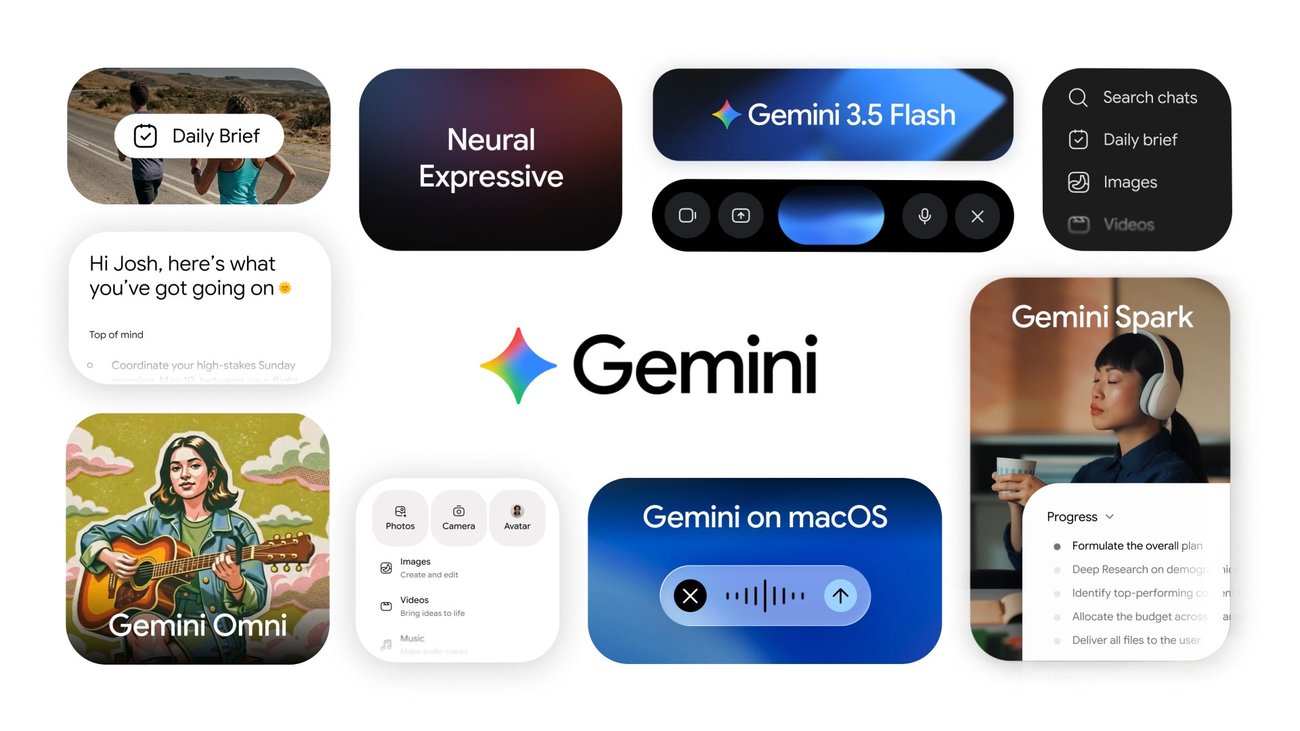
Figure 6: Official Gemini app image. Gemini 3.5 Flash, Gemini Spark, Daily Brief, and Gemini Omni form the consumer-side Gemini story.
6. For enterprises: automation moves from point productivity to process replacement
Google’s enterprise examples are direct. Shopify is using subagents for long-horizon data analysis. Macquarie Bank is piloting 3.5 Flash for 100-page-plus customer onboarding documents. Salesforce is integrating it into Agentforce. Ramp is using it for smarter invoice OCR and reasoning over historical patterns. Xero is using agents for multi-week workflows such as 1099 tax-form preparation. Databricks is using agentic workflows to monitor, retrieve, reason, diagnose, and propose fixes across data environments.
The common thread is not faster writing. It is process-level automation. Enterprise work is expensive because it spans systems, files, roles, approvals, and time. RPA handled stable click flows. Traditional machine learning handled narrow prediction tasks. Agentic models are trying to enter the middle: semi-structured workflows with messy context, judgment calls, and tool use.
If frontier-class Flash models can reliably support long-horizon tasks, the ROI calculation changes. Leaders will care less about the cost of a single call and more about how many labor hours, waiting days, and errors a workflow can remove. Price still matters, but latency, reliability, observability, permissions, audit logs, failure recovery, and human handoff become procurement criteria.
This is why Gemini Enterprise Agent Platform matters. Enterprises will not hand finance, sales, tax, compliance, or customer workflows to a raw model API. They need identity, data connectors, policies, logs, sandboxing, and compliance controls. Google’s full-stack advantage is that it can connect models, cloud, Workspace, Search, Android, browser surfaces, and enterprise platforms into one chain.
7. For the AI industry: the new competition unit is model plus tools plus runtime plus distribution
Gemini 3.5 Flash points to a broader industry shift: AI competition is moving from model leaderboard competition to full agent system competition.
The model still matters. Without strong reasoning, multimodality, coding, and tool use, an agent platform is empty. But the model is only one layer. The stronger position belongs to whoever can put the model inside daily user surfaces, provide reliable tool use and sandboxing, preserve state, coordinate subagents, execute long-running tasks, and give enterprises governance and auditability.
Google’s advantage is distribution: Search, Android, Chrome, Workspace, the Gemini app, Cloud, AI Studio, and Antigravity. OpenAI’s advantage is developer mindshare and product velocity. Anthropic’s advantage is long-context trust and tools like Claude Code. Meta has open-source leverage and massive distribution. xAI, Mistral, DeepSeek, and others will keep competing on performance, cost, openness, and regional adoption.
The signal from I/O is that Google does not want to be just another model provider. It wants Gemini 3.5 to become part of default search, default mobile flows, default office work, default developer tools, and default enterprise agent platforms. That is a heavy strategy, but if it works, it creates a deep moat.
For startups, this is both opportunity and warning. Managed Agents, Gemini API, AI Studio, and Antigravity SDK may lower the cost of building agent products. But generic agent entry points and simple generated tools may be absorbed by platforms. The durable opportunities will be vertical data, proprietary workflows, deep integrations, trusted evaluation, compliance delivery, and thoughtful human-agent collaboration.
8. Reasons to stay cautious
The launch is significant, but several points deserve caution.
First, official benchmarks are not long-term independent production results. Terminal-Bench, GDPval-AA, MCP Atlas, and CharXiv are useful signals, but real deployments must measure failure rates, recoverability, tool-call stability, long-running drift, context pollution, permission mistakes, and cost curves.
Second, more autonomy is not always better. Many workflows should be automated under human supervision rather than left unattended. Anything involving money, contracts, healthcare, law, production systems, or personal privacy needs approval points, rollback mechanisms, and logs.
Third, stronger platform integration increases lock-in. Managed Agents can be convenient, but if a critical workflow depends entirely on one platform’s runtime, tool protocol, sandbox, and permission model, migration becomes harder. Enterprises should keep data exports, task logs, and cross-model evaluation paths.
Fourth, availability will vary by geography, language, subscription tier, and rollout stage. “Announced” does not always mean every account can use every feature today.
9. My read: Gemini 3.5 is Google’s agent mobilization
If you look only at the name, Gemini 3.5 sounds like an interim update between Gemini 3 and Gemini 4. But the launch pattern says something bigger: Google is aligning Search, Gemini app, Antigravity, Gemini API, AI Studio, and enterprise products around agents.
So the real headline is not “Google released another model”. It is “Google is trying to turn AI from an answering machine into an execution system”.
That brings three likely changes.
First, speed and cost become strategic again. Not for leaderboard vanity, but because agents use many sequential calls. A Flash-class model that approaches flagship capability can become the workhorse of the agent era.
Second, application shape changes. Many software surfaces may become agent layers that generate interfaces, call tools, save state, and move tasks forward instead of relying only on menus, buttons, and forms.
Third, evaluation changes. We should stop asking only whether a model answered correctly. We should also ask whether it can compress a two-hour human task into twenty reliable minutes, with controlled errors, auditable steps, and acceptable cost.
Gemini 3.5 Flash may not win every scenario immediately, but it makes Google’s intent clear: the next round of AI competition is not just about smarter models. It is about reliable, affordable execution systems connected to the real world.
Sources
- Google: Gemini 3.5: frontier intelligence with action, May 19, 2026: https://blog.google/innovation-and-ai/models-and-research/gemini-models/gemini-3-5/
- Google: Building the agentic future: Developer highlights from I/O 2026, May 19, 2026: https://blog.google/innovation-and-ai/technology/developers-tools/google-io-2026-developer-highlights/
- Google: Introducing Managed Agents in the Gemini API, May 19, 2026: https://blog.google/innovation-and-ai/technology/developers-tools/managed-agents-gemini-api/
- Google: The Gemini app becomes more agentic, delivering proactive, 24/7 help, May 19, 2026: https://blog.google/innovation-and-ai/products/gemini-app/next-evolution-gemini-app/
- Google: A new era for AI Search, May 19, 2026: https://blog.google/products-and-platforms/products/search/search-io-2026/
- Google: I/O 2026: Welcome to the agentic Gemini era, May 19, 2026: https://blog.google/innovation-and-ai/sundar-pichai-io-2026/