We Guessed Wrong: Space Bunny Was Never Kimi. After 200 Trillion Anonymous Tokens, MiniMax M3.1 Flash Takes Off the Mask
On September 24 I wrote a post on this blog about a mystery stealth model called Space Bunny Alpha. Following the “Mid-Autumn Festival + rabbit + moon” clues, I put most of the suspicion on Moonshot AI’s Kimi.
Today we got the answer: I was wrong.
On October 19, 2026, MiniMax published its MiniMax M3.1 Flash launch post, and the second paragraph says: “Space Bunny, which processed more than 200 trillion tokens while operating anonymously, was an early version of MiniMax M3.1 Flash.” The OpenRouter page that used to say stealth now carries a yellow banner: this stealth model was developed and operated by MiniMax, revealed to be MiniMax M3.1 Flash.
This post does three things. It lays out the bunny’s 27-day story, it owns up to why we guessed wrong and how community detectives guessed right, and it looks at the release’s benchmarks, price and usage to see whether it is worth switching.
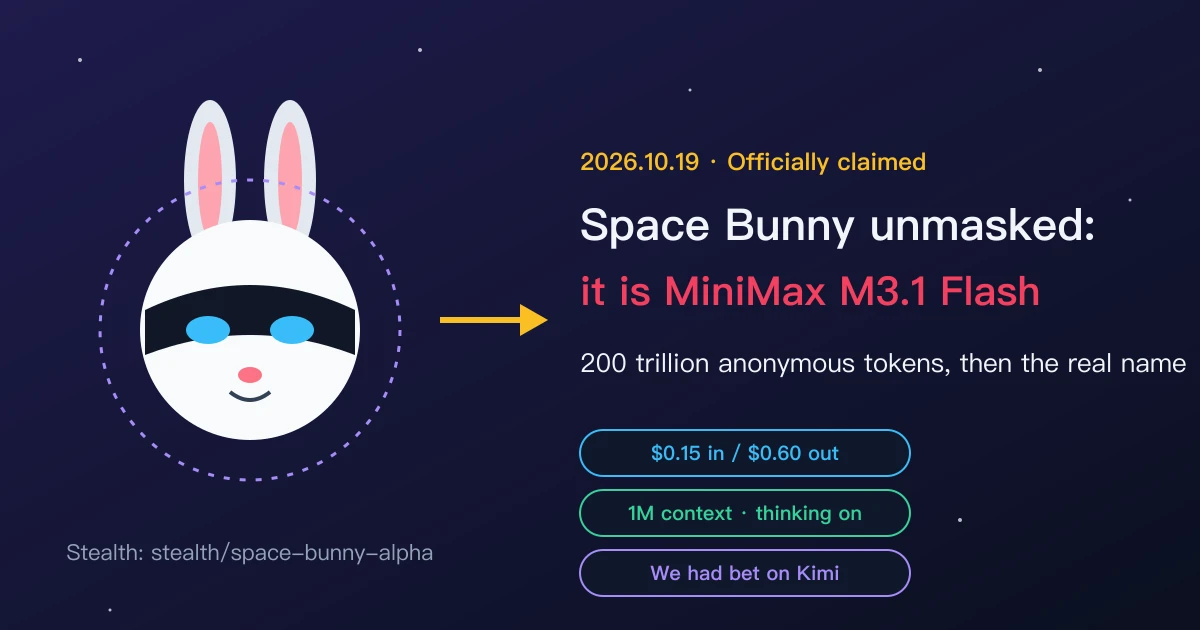
Figure 1: Original cover image. Left: the stealth listing stealth/space-bunny-alpha. Right: the identity revealed today.
1. What happened today: one sentence in an official blog post
Start with the hardest evidence. MiniMax’s news page has a new post titled “MiniMax M3.1 Flash: Redefining Agent Performance and Cost”, dated 2026-10-19. The opening says:
- MiniMax M3.1 Flash is officially rolling out today.
- Space Bunny processed more than 200 trillion tokens while anonymous, and it was an early version of M3.1 Flash.
- As a next-generation Flash model, it brings a generational leap in agentic tasks, coding, Computer Use and cybersecurity, with online inference nearly 3x faster and usage cost down 70%.
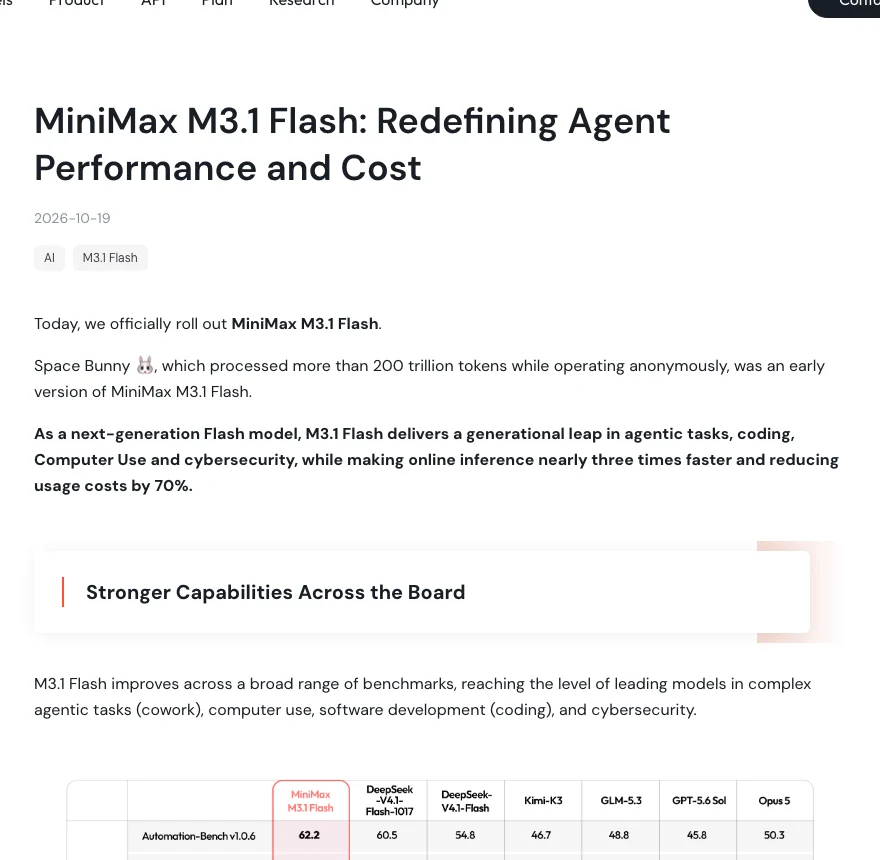
Figure 2: Real screenshot of the MiniMax blog (minimax.io/blog/minimax-m31f), captured 2026-10-19.
Before the blog post, the news broke on social media. According to afternoon flash reports from TechFlow and ChainCatcher, MiniMax’s official account posted a short video captioned “Welcome back, Space Bunny”. Most reports still hedged with “reportedly an early version of M3.1 Flash”, because the post itself did not spell it out. A few hours later the blog and API docs went live, and it was in black and white.
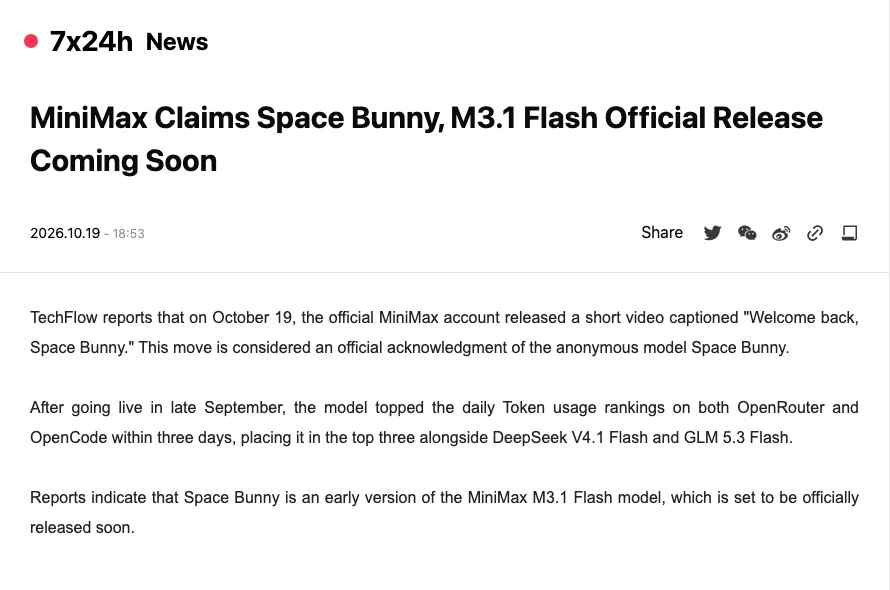
Figure 3: Real screenshot of a TechFlow 7x24h flash report, captured 2026-10-19. It also says Space Bunny topped the daily token usage charts on OpenRouter and OpenCode within three days of launch.
At the same time, the MiniMax developer docs added a banner, “The new-generation MiniMax M3.1 Flash is now available!”, the model list gained the GA model name MiniMax-M3.1-Flash, and the release notes got an October 19 entry.
2. Rewind: where did this space bunny come from?
If you missed the earlier chapters, here is the timeline.
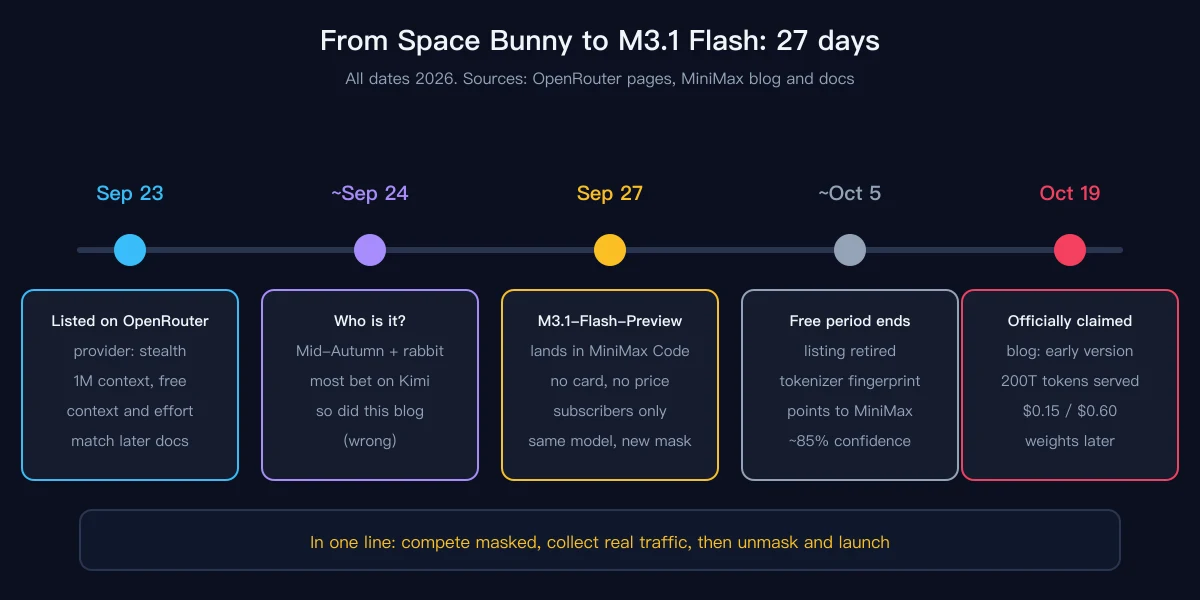
Figure 4: Original diagram. All dates are 2026. Sources: OpenRouter model pages, the MiniMax blog and docs.
- Sep 23: OpenRouter lists a model called Space Bunny Alpha. The provider column says stealth. It has a 1M context, accepts text, image and video, and costs nothing.
- The next few days: it climbs the usage charts. People start guessing who made it. With Mid-Autumn approaching and a rabbit in the name, many thought of the company named after the moon.
- Sep 27: MiniMax quietly ships M3.1-Flash-Preview inside its AI coding tool, MiniMax Code. No launch event, no model card, no public price. I wrote a hands-on post about it back then.
- Around Oct 5: Space Bunny’s free stealth period ends.
- Oct 19: MiniMax launches M3.1 Flash and claims Space Bunny.
The old OpenRouter page now has a yellow banner at the top. In short: this stealth model was developed and operated by MiniMax and has been revealed as MiniMax M3.1 Flash; the free stealth period is over, please use minimax/minimax-m3.1-flash instead.
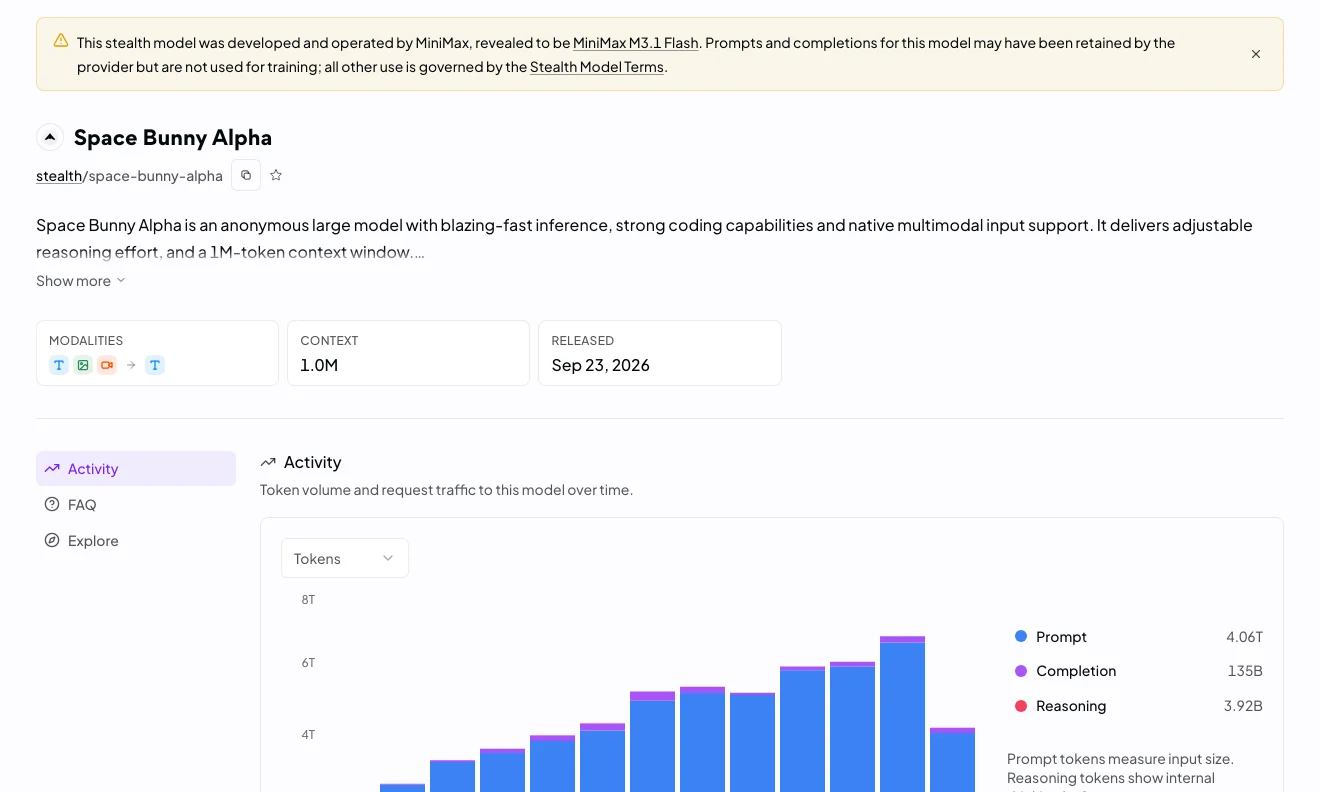
Figure 5: Real screenshot of the OpenRouter stealth/space-bunny-alpha page, captured 2026-10-19. The usage chart shows more than 4T (4 trillion) prompt tokens through OpenRouter alone during the stealth period.
A quick note on the numbers: OpenRouter shows just over 4 trillion, MiniMax says 200 trillion. These do not conflict. The 200 trillion is MiniMax’s own total across every channel, including OpenCode and MiniMax Code. OpenRouter is just one door.
3. Owning the miss: why we bet on Kimi
If you run a blog, you own what you published. Here is the top of my September 24 post.
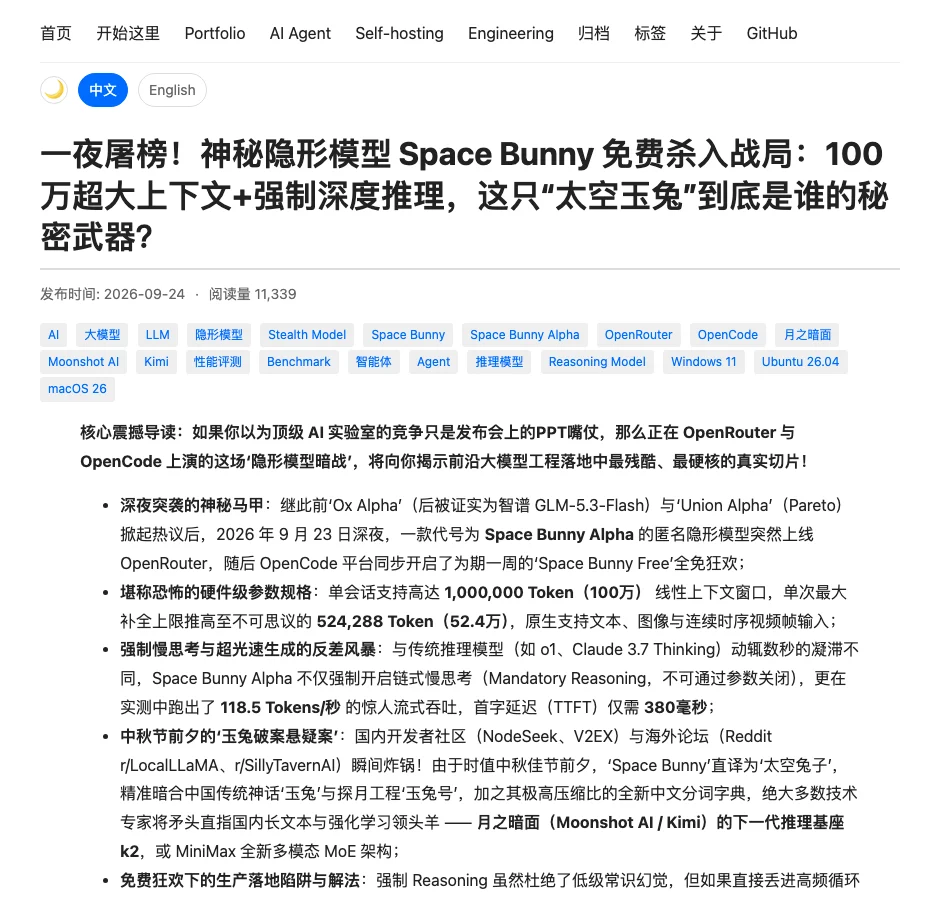
Figure 6: Real screenshot of this blog’s earlier Chinese post on Space Bunny, captured 2026-10-19. The tags still include Moonshot AI and Kimi.
The reasoning went like this:
- Name clue: Space Bunny, right before the Mid-Autumn Festival, evokes the Jade Rabbit on the moon.
- Brand clue: Moonshot AI’s name is literally about the moon.
- Capability clue: a 1M context window, and long context has long been Kimi’s signature.
To be fair, the old post did list “or MiniMax’s new multimodal MoE architecture” as an alternative, but most of the ink went to Kimi.
So where did it go wrong? I used clues that sound right instead of clues that can be measured. Names, holidays and brand associations are things a vendor can pick freely, or even use to mislead. What is hard to fake is the technical fingerprint underneath.
An analogy: a parcel with no sender arrives, and the wrapping paper has a moon on it, so you guess it is from your friend who lives in Moon Gardens. The reliable method is to look at the packing filler and how the tape is wrapped. Those are a sender’s habits, and habits are hard to change on short notice.
4. How the detectives cracked it: a single “hi”
While we were still debating the name, others were investigating with harder tools. The tech blog Codersera published an analysis before the reveal, concluding with about 85% confidence that Space Bunny was MiniMax-M3.1-Flash-Preview. Their strongest evidence came from a very simple experiment.
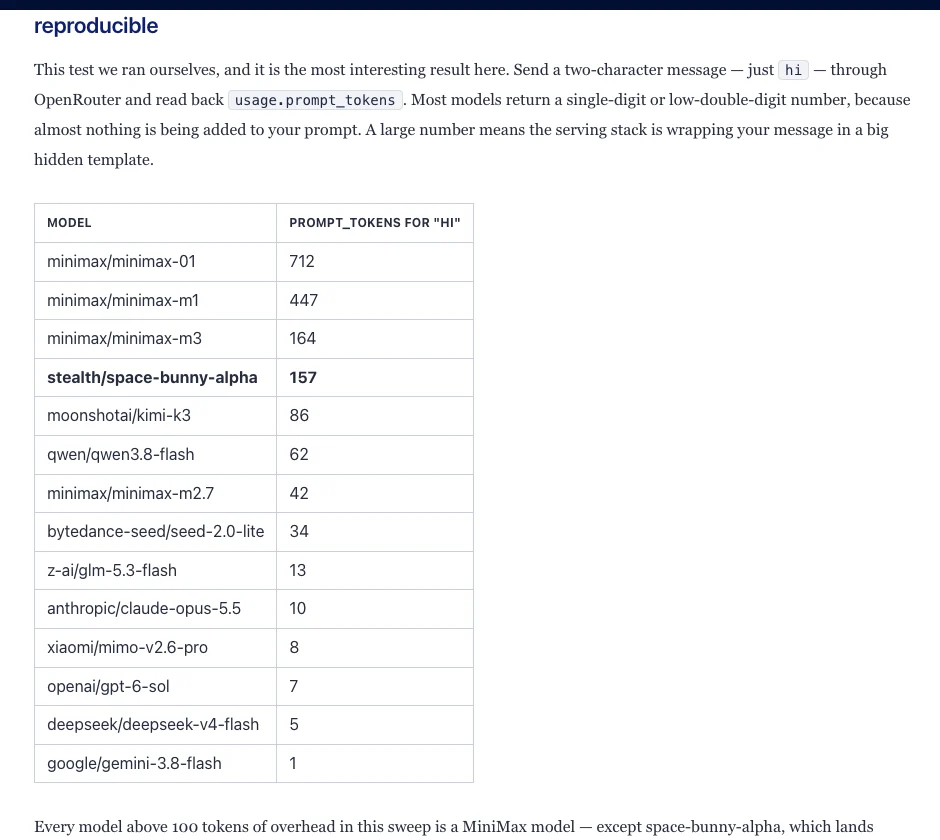
Figure 7: Real screenshot of Codersera’s article “Space Bunny Alpha Is Probably MiniMax M3.1-Flash”, captured 2026-10-19.
The method: send each model the two letters “hi” through OpenRouter and read prompt_tokens in the response.
“hi” is one word, so most models report single digits or low teens. The results:
- Every model above 100 is a MiniMax model: minimax-01 at 712, minimax-m1 at 447, minimax-m3 at 164.
- The only exception is space-bunny-alpha, at 157.
- Kimi K3 reads 86, GLM-5.3-Flash only 13, and Claude, GPT and Gemini sit in single or low double digits.
Why does “hi” become more than a hundred tokens? Because the server quietly wraps your message in a fixed template, such as system instructions and role markers. Every company’s wrapping paper has a different thickness, and models from the same company tend to keep the same habits.
In everyday terms: you buy one pen online. Some shops put it in a plastic bag, others add a thick manual and layers of foam. Without reading the sender label, you can weigh the parcel and get a good idea which shop shipped it. A “weight” of 157 is almost the same as MiniMax M3’s 164 and far from everyone else.
Supporting clues:
- A max output of 524,288 tokens is unique among 466 models on OpenRouter. The closest is MiniMax M3 at 512,000.
- Mandatory thinking, a five-level effort ladder (low to max) and a max default. That exact combination matches what the MiniMax docs later published.
- There was counter-evidence too: asked who it was, it sometimes said OpenAI and sometimes Claude. That shows asking a model “who are you” is close to worthless. Self-introductions are easily skewed by training data.
Today’s announcement proved that weighing the parcel works.
5. Why wear a mask first? What stealth models are for
A common question: if the model is good, why not just launch it? Why the anonymous listing?
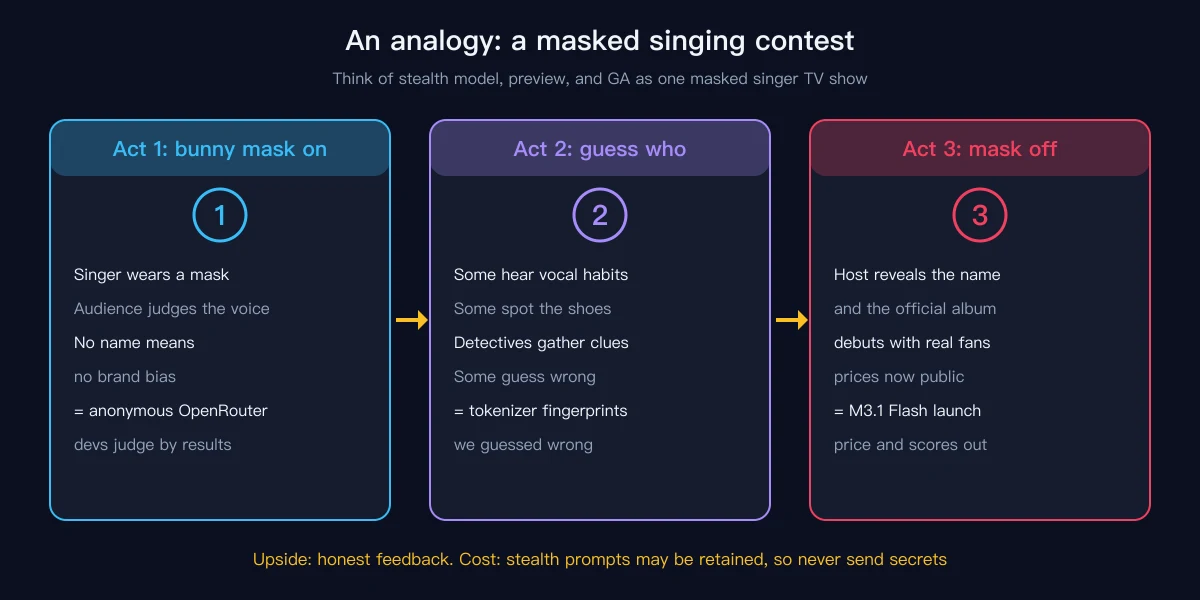
Figure 8: Original diagram. Stealth testing works like a masked singing show: judge the voice, guess the singer, then unmask.
Think of a masked singing TV show:
- Act 1, the mask goes on. The audience does not know who is singing and judges only the voice. For a model, developers who do not know the vendor are not swayed by a big-brand halo or a grudge. They use it, or not, purely on results.
- Act 2, the audience guesses. Some go by vocal habits, some by shoes. Some are right, some are wrong. That is the detective work from the last section, including our wrong guess.
- Act 3, the mask comes off. The host announces the name, and the singer debuts with the buzz built on stage. For MiniMax, that means launching with “200 trillion anonymous tokens, top of the usage charts within days” as the report card.
From an engineering view, the stealth period brings one very concrete benefit: a flood of real traffic. Lab benchmarks are fixed question sets, while real users throw in every kind of codebase, screenshot and long document. Community members also noted that Space Bunny got noticeably stronger around September 29 and showed a regression around October 1, when it stopped continuing long tasks on its own. That looks a lot like a vendor shipping updates during the stealth period and watching the feedback.
There is a cost every developer should remember. OpenRouter’s stealth model terms say prompts and completions may be retained by the provider (though not used for training). Whether it is Space Bunny or the next mystery animal, keep company code, keys and customer data out of it.
6. The GA report card: where it is strong and how to read it
The launch post includes a big comparison table against two DeepSeek V4.1 Flash builds, Kimi K3, GLM-5.3, GPT-5.6 Sol and Opus 5.
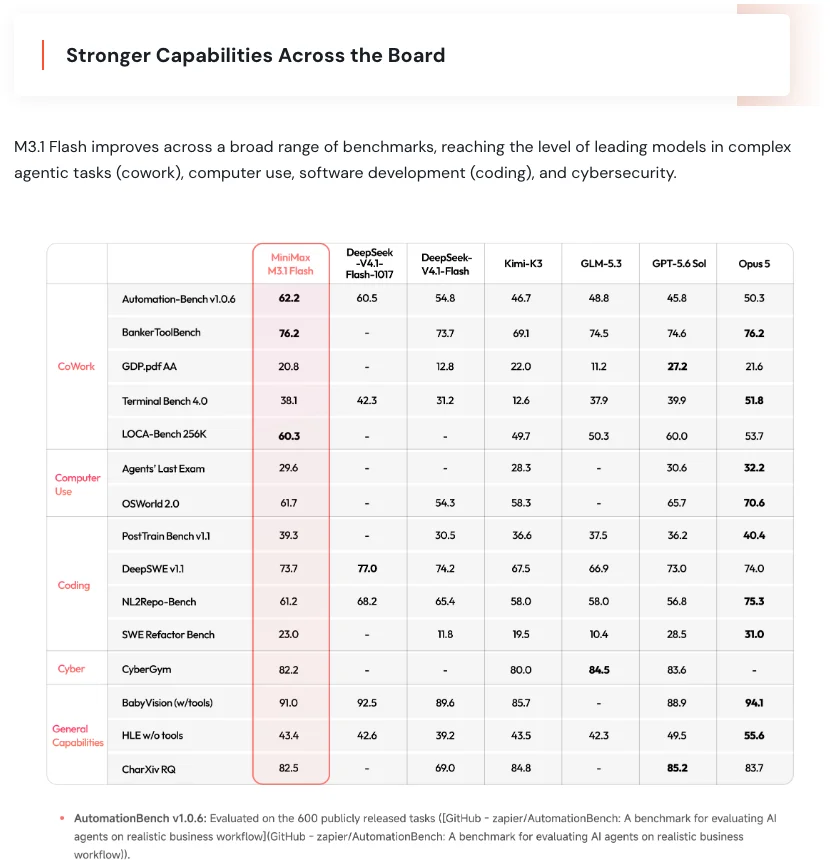
Figure 9: Real screenshot of the MiniMax launch post, captured 2026-10-19. All numbers are vendor-reported.
A few key numbers:
| Area | Benchmark | M3.1 Flash | Best in table |
|---|---|---|---|
| Complex office work | Automation-Bench v1.0.6 | 62.2 | 62.2 (M3.1 Flash) |
| Finance tool chains | BankerToolBench | 76.2 | 76.2 (tied with Opus 5) |
| Coding | DeepSWE v1.1 | 73.7 | 77.0 (DeepSeek V4.1 Flash 1017) |
| Computer use | OSWorld 2.0 | 61.7 | 70.6 (Opus 5) |
| Cybersecurity | CyberGym | 82.2 | 84.5 (GLM-5.3) |
| Long context | LOCA-Bench 256K | 60.3 | 60.3 (M3.1 Flash) |
How to read it? Three observations.
First, this is a Flash-tier model trading blows with last-generation flagships on many rows. It takes the top score in the table on Automation-Bench, BankerToolBench and LOCA-Bench. MiniMax also stresses that it ranks first among Chinese models on OSWorld and Agents’ Last Exam.
Second, check which generation it is compared against. The table uses Opus 5 and GPT-5.6 Sol, not Opus 5.5 and GPT-6 Sol from late September. Even so, Opus 5 still leads clearly on OSWorld, NL2Repo, SWE Refactor and more. The accurate summary is that it is very strong in the cheap and fast tier, not that it beats every top flagship.
Third, every number is self-reported. Independent evaluations will take days to weeks, and it is safer to cross-check them when they land.
The more interesting chart is the score versus cost one.
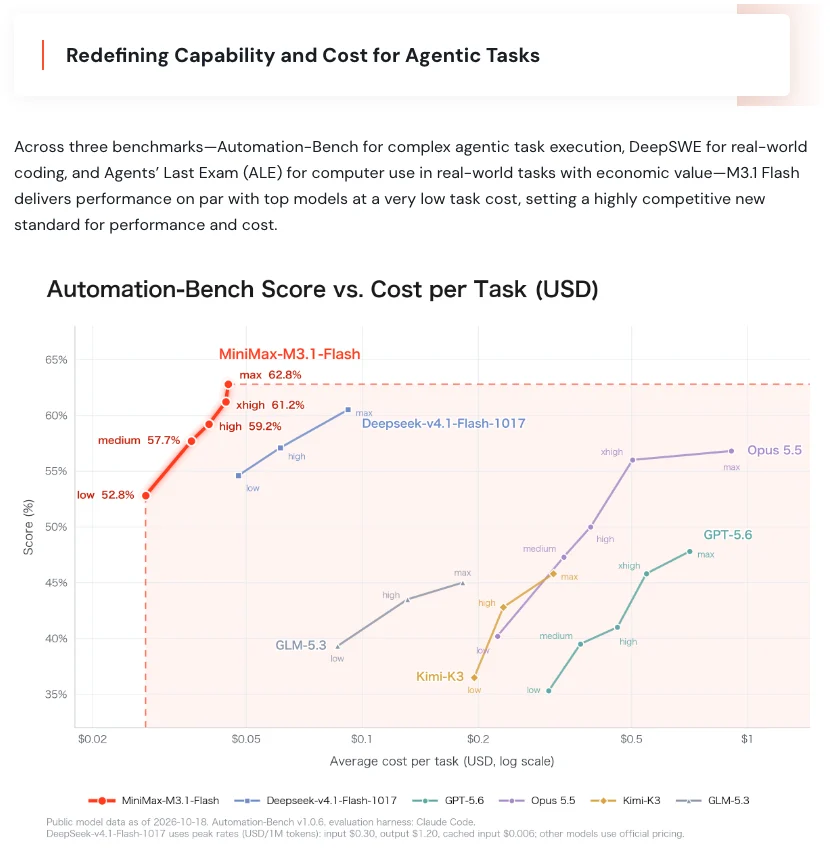
Figure 10: Real screenshot of the MiniMax launch post, captured 2026-10-19. The x-axis is average cost per task (log scale), the y-axis is Automation-Bench score.
The x-axis is how much one finished task costs on average. M3.1 Flash’s red line is squeezed against the left edge. Its five levels run from 52.8% at low to 62.8% at max, all at roughly $0.02 to $0.05 per task. Opus 5.5’s line mostly sits between $0.2 and $1, and GPT-5.6 starts above $0.3.
Think of taxis: every car gets you there. One ride costs 1 dollar, another costs 20. The pricey car is comfier and sometimes faster, but if you take hundreds of rides a day, the 1-dollar car wins. Agent workloads are exactly the hundreds-of-rides case, since one task can call the model dozens of times.
7. Thinking levels: you can shift gears, but you cannot switch the engine off
M3.1 Flash has one trait you must know: thinking is always on.
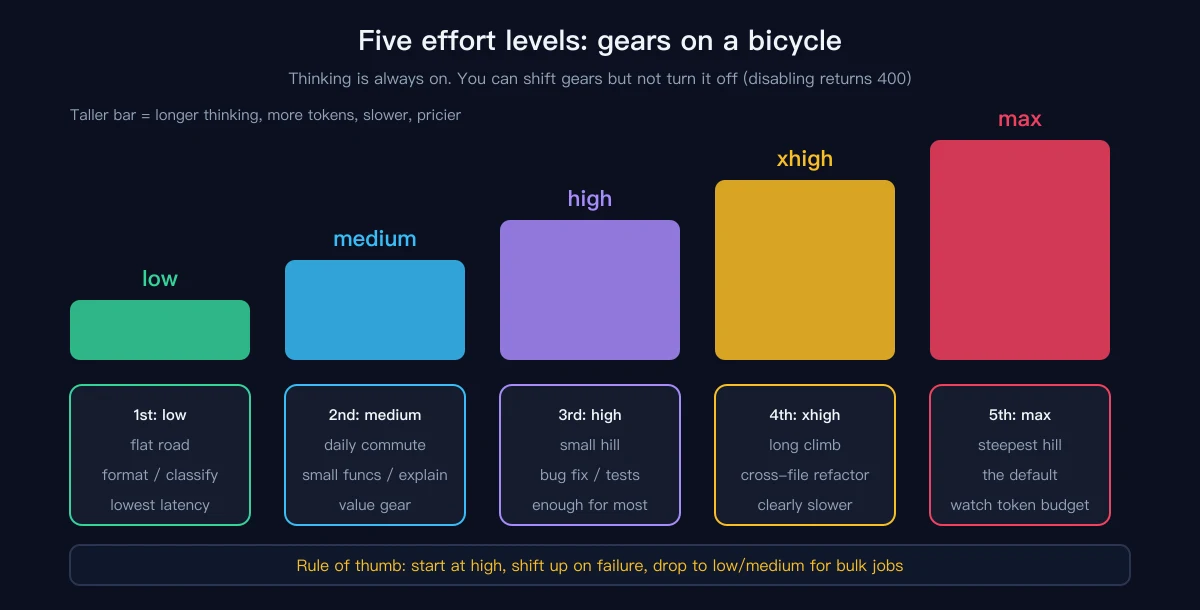
Figure 11: Original diagram. Higher gears think longer, produce more tokens, run slower and cost more.
Think of effort as bicycle gears:
- low is a flat road, fine for format conversion or classification.
- medium and high suit everyday functions and bug fixes.
- xhigh and max are for steep hills, such as cross-file refactors.
The catch: this bike has no neutral. The docs are clear that sending thinking: {“type”: “disabled”} or effort: “none” returns a 400 error with the message model “MiniMax-M3.1-Flash” requires adaptive thinking. To save time and money, shift down instead.
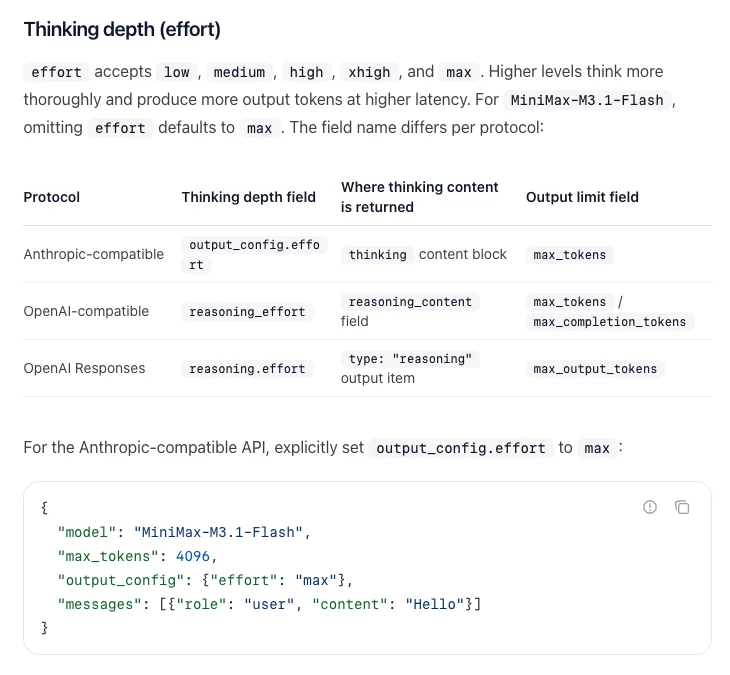
Figure 12: Real screenshot of the MiniMax docs Model Invocation page, captured 2026-10-19.
One more trap: if you omit effort, the default is max, the most token-hungry level. Many other vendors default to medium or high. If you migrate from another model and change nothing, your bill and latency may run higher than expected.
The field name also differs by protocol:
| Protocol | Effort field | Where thinking is returned |
|---|---|---|
| Anthropic-compatible (recommended) | output_config.effort | thinking content block |
| OpenAI Chat Completions compatible | reasoning_effort | reasoning_content field |
| OpenAI Responses | reasoning.effort | output item with type reasoning |
A minimal call, adapted from the docs (the key is a placeholder):
curl https://api.minimax.io/anthropic/v1/messages \
  -H "Authorization: Bearer <MINIMAX_API_KEY>" \
  -H "Content-Type: application/json" \
  -d '{
    "model": "MiniMax-M3.1-Flash",
    "output_config": {"effort": "high"},
    "max_tokens": 4096,
    "messages": [{"role": "user", "content": "Hello"}]
  }'
Because the endpoint is Anthropic-compatible, tools like Claude Code work after changing the base URL and model name, as described in my M Plan integration guide.
8. Price: $0.15 / $0.60, and how cheap that really is
The official price is flat, with no tiers and no long-context surcharge:
- Input: $0.15 per million tokens.
- Output: $0.60 per million tokens.
- Cached input: $0.015 per million tokens.
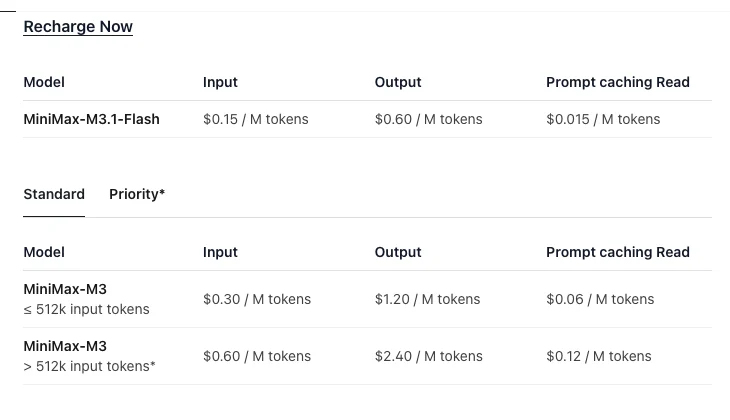
Figure 13: Real screenshot of the MiniMax pricing page, captured 2026-10-19.
Compare MiniMax M3 on the same page: $0.30 in and $1.20 out up to 512K input, doubling beyond that. M3.1 Flash is exactly half of M3’s short-context price, and the same price across the full 1M context.
How much is a million tokens? MiniMax estimates 1,000 tokens at roughly 750 English words, so a million tokens is about 750,000 words, several long novels. Reading all of that costs fifteen cents.
If you just want to kick the tires for free, OpenRouter also added a free variant today: minimax/minimax-m3.1-flash:free.
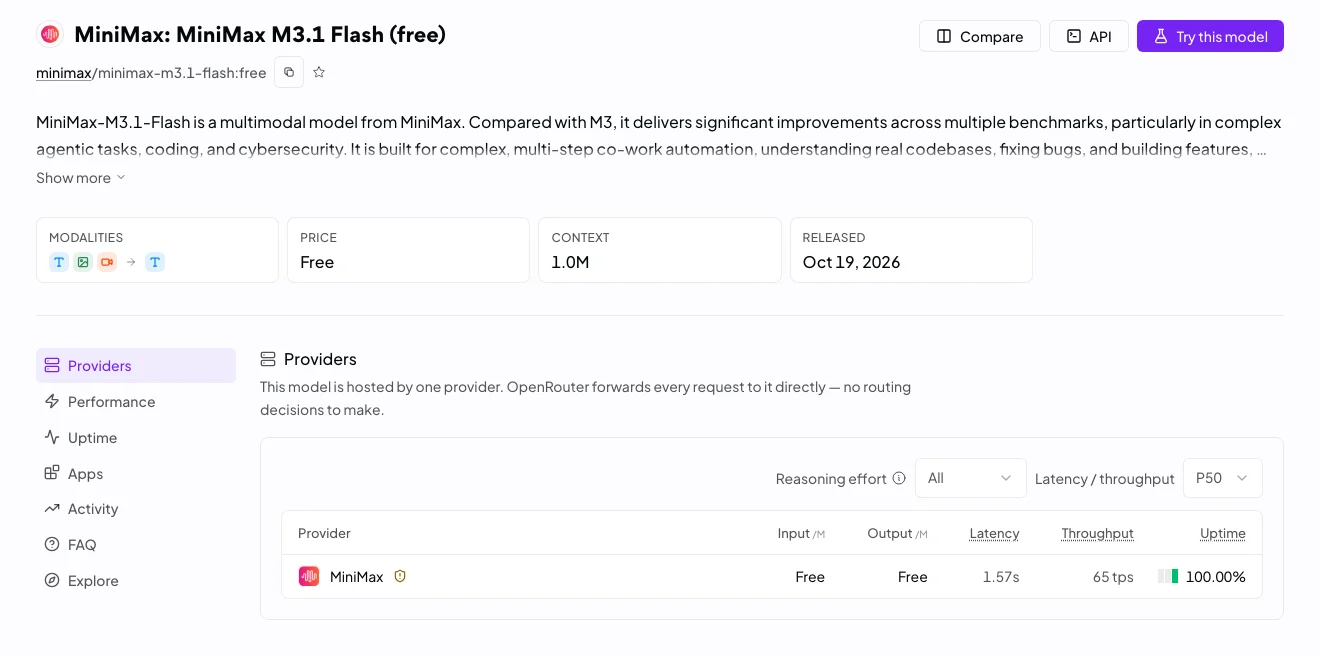
Figure 14: Real screenshot of the OpenRouter model page, captured 2026-10-19. It lists an October 19 release date and says “Open weights are planned”.
One detail: MiniMax says everyday output can exceed 200 tokens per second, with a median above 170. When I captured the page, the OpenRouter free tier showed a median of only about 64 to 65 tokens per second. Free channels usually queue and rate-limit, so do not equate them with the paid official endpoint.
9. Real cases you could already see during the preview
M3.1 Flash did not appear out of nowhere today. For the M3.1-Flash-Preview that landed in MiniMax Code on September 27, MiniMax built a guide page with four real task cases.
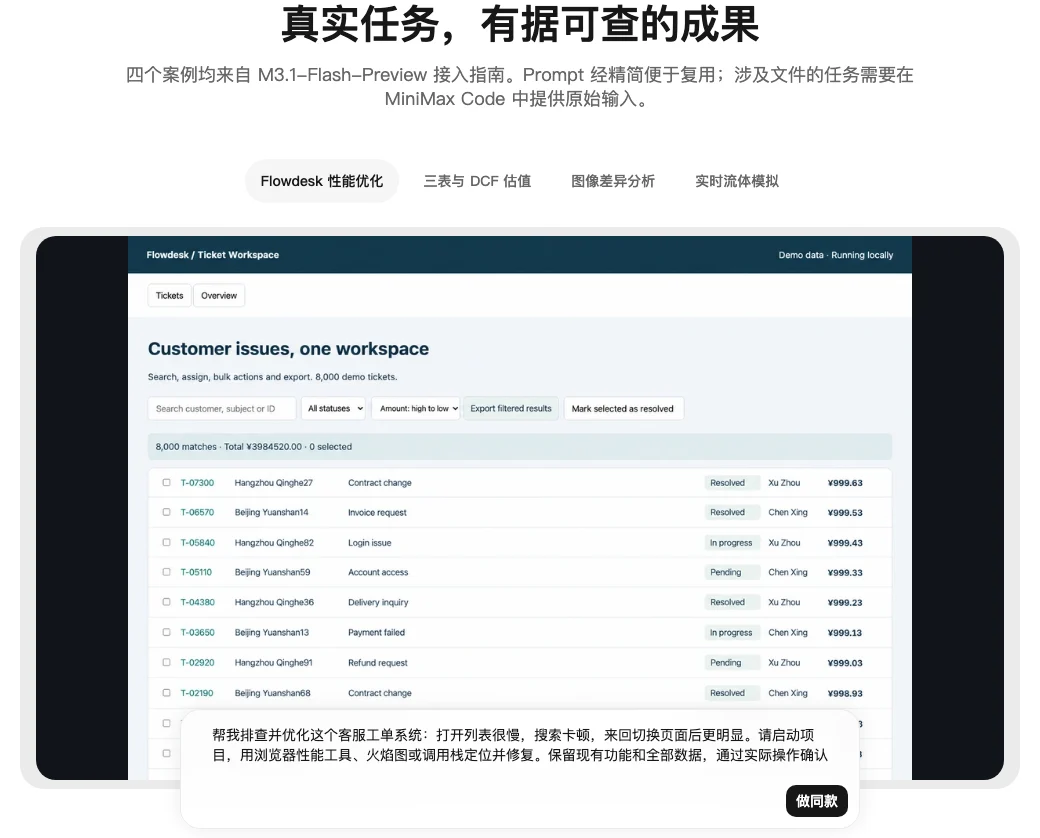
Figure 15: Real screenshot of the M3.1-Flash-Preview guide on MiniMax Agent Tools, captured 2026-10-19. The page is in Chinese; the task prompt asks the model to profile and fix a slow ticket system.
The most representative one is Flowdesk: a customer support ticket system with 8,000 records where the list loads slowly, search lags, and switching pages makes it worse. The model must run the project itself, find the bottleneck with browser performance tools and flame graphs, fix it, and report before and after. MiniMax’s numbers, as medians of three independent runs: from 15.265 seconds down to 0.045 seconds.
MiniMax is candid that this is a single constructed case and does not mean every task speeds up like that. The preview guide also lists architecture details: a mixture-of-experts design with about 428B total parameters and about 23B active, sparse attention and a native vision encoder. These come from preview-era material and are not repeated in the GA post, so label them as preview figures when you cite them.
10. Should I switch? Find your box
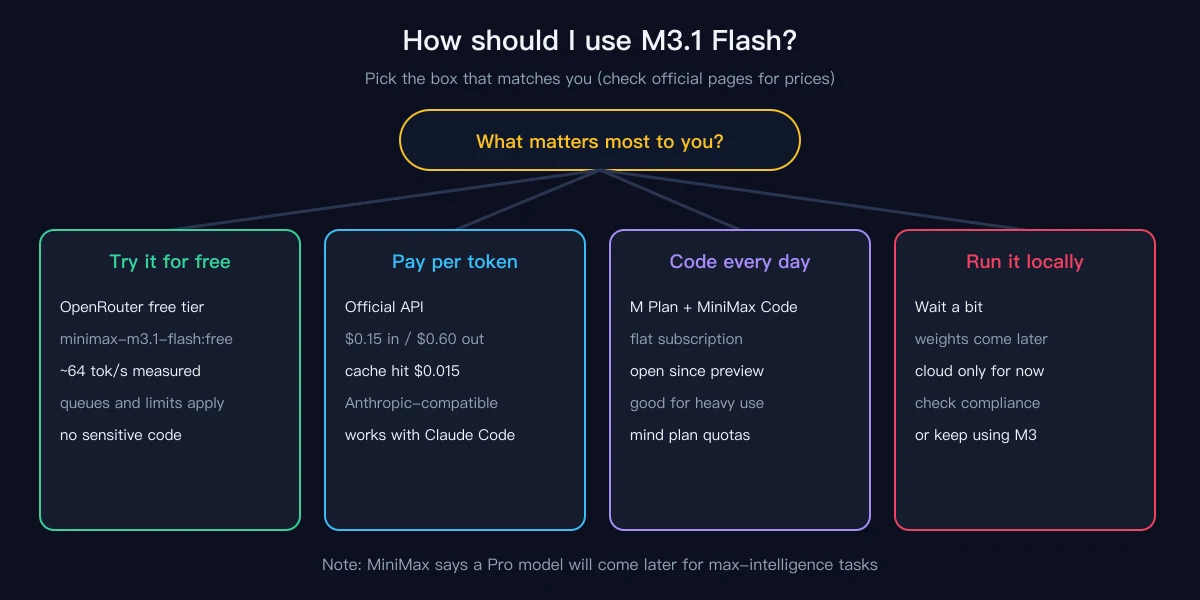
Figure 16: Original diagram. Check official pages for current prices and availability.
In short:
- Want to try it at zero cost: use the OpenRouter free tier, keep sensitive code out, and do not judge the speed too harshly.
- Pay per token for agents: use the official API, and move effort off the default max to the level you actually need.
- Code heavily every day: M Plan plus MiniMax Code, available since the preview.
- Must run locally: wait. MiniMax says weights come later; today it is cloud only.
11. Q&A
Q: Are Space Bunny and M3.1 Flash exactly the same model?
A: MiniMax’s word is “early version”. The stealth Space Bunny and today’s GA model are not necessarily the same weight snapshot, and there were likely several updates in between. The community notes about getting stronger around September 29 and regressing on some behavior around October 1 also suggest the version changed during the stealth period.
Q: Why did Space Bunny sometimes claim to be OpenAI or Claude?
A: A model’s self-introduction mostly comes from training data and the system prompt. Vendors usually strip branding during stealth tests, so the model may grab a common name from its training data. To identify a stealth model, do not ask “who are you”. Look at technical fingerprints such as the tokenizer, prompt overhead and parameter limits.
Q: Should I change the model name from M3.1-Flash-Preview to MiniMax-M3.1-Flash?
A: Yes. The GA name in the docs is MiniMax-M3.1-Flash. If your scripts or tool configs use the Preview name, change it while you are at it, and check that nothing sends thinking disabled or effort none, since both return 400.
Q: Is it open source?
A: The wording varies a bit. The launch post says model weights will be released later. The developer docs model list describes it as an open-weight model. OpenRouter says “Open weights are planned”. Put together: open weights are planned, but you cannot download them today.
Q: What about a Pro version?
A: The last line of the launch post says a Pro model that pushes the intelligence ceiling will come later. If your work depends on peak reasoning, it may be worth waiting.
Q: Will you delete the old post that guessed Kimi?
A: No. It stays as it was, as a record of a guess and its check, and this post is the correction. Being wrong in a tech post is fine. Being wrong and staying quiet is not.
12. Closing thoughts
Looking back over these 27 days, the Space Bunny story has a lesson for everyone:
- For vendors: compete masked, polish the model on real traffic, then launch with a report card. This is becoming standard practice. From Pixel Canary to Space Bunny, stealth listings are getting more common.
- For developers: when judging an unknown model, technical fingerprints beat names, and cost per task beats any single benchmark score.
- For bloggers: guess boldly, state how strong the evidence is, and correct yourself when you are wrong.
As for M3.1 Flash itself: in the “fast, cheap and good at agent work” lane, it is a strong option to try right now. Just remember to shift down from the default max.
Related reading:
- Space Bunny: a mystery stealth model with a 1M context (the old post this one corrects)
- MiniMax M3.1-Flash-Preview lands in MCode
- MiniMax M Plan launch and Claude Code / Cursor integration
- Pixel Canary stealth coding model analysis
References:
- MiniMax blog: MiniMax M3.1 Flash: Redefining Agent Performance and Cost
- MiniMax docs: Model Invocation, Pricing Overview
- OpenRouter: Space Bunny Alpha, MiniMax M3.1 Flash
- MiniMax Agent Tools: M3.1-Flash-Preview guide
- Codersera: Space Bunny Alpha Is Probably MiniMax M3.1-Flash
- TechFlow: MiniMax Claims Space Bunny, M3.1 Flash Official Release Coming Soon
- ChainCatcher: MiniMax officially claims Space Bunny