The Master Key Was Literally '4'? How Two Ground-Level Security Flaws Almost Broke the Internet This Week
The Executive Summary
If the modern internet were a bustling metropolis, HTTPS certificates would serve as the official notary seals on every skyscraper doorway, while backend server runtimes act as the master chefs cooking up digital services inside every building.
Over the past seven days, the bedrock beneath this digital metropolis shuddered from two historic events:
First, eMudhra, an internationally recognized Certificate Authority (CA), experienced an operational failure during an offline key generation ceremony. Instead of generating elliptic curve private keys that are mathematically harder to guess than counting every atom in the observable universe, a flawed script produced intermediate CA keys with only 3 to 8 bits of entropy. One of these active private signing keys was literally calculated to be the single-digit integer 4.
Second, the PHP engine, which drives over 75% of the world’s web applications and server backends, disclosed PHP2Shell (CVE-2026-109618 and CVE-2026-109619), a critical 9.8-rated Remote Code Execution flaw that lets unauthenticated attackers hijack servers simply by sending an abnormal data payload.
Fortunately, major browser and OS vendors moved at record speed to deploy emergency blocks. This article provides a comprehensive, easy-to-understand breakdown of what happened, how it affects everyday users, and provides automated verification scripts and AI Agent procedures across Windows 11, Ubuntu 26.04, and macOS 27.
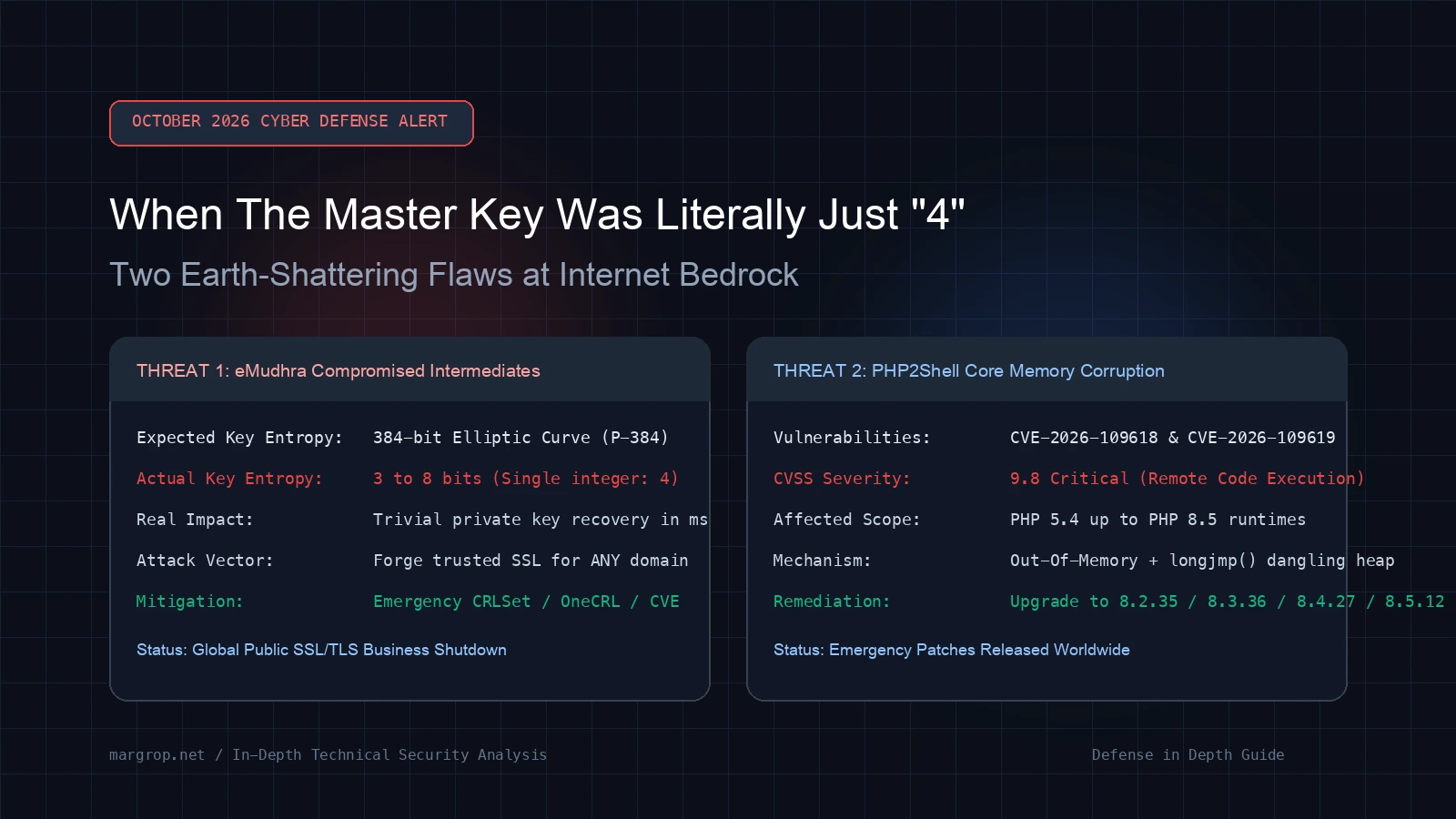
Figure 1: Original article cover. On the left, the cryptographic lock of public key infrastructure shattered in milliseconds; on the right, the runtime memory corruption that shook web servers worldwide.
1. Background: Why Did the Bedrock of the Internet Shudder?
Whenever you launch a web browser on your smartphone or laptop to check your bank balance, order takeout, or open a social feed, you instinctively look for the little padlock icon next to the address bar. Most people take that icon for granted as an absolute badge of safety: if the lock is closed, your secrets are safe and no imposter is intercepting your traffic.
Under the surface, that little green or grey padlock relies entirely on two invisible pillars:
Pillar 1: The Public Key Infrastructure (PKI) Trust Chain. A website must prove to the world that it is genuinely your bank or healthcare provider, and not a malicious mimic sitting on the same local network.
Pillar 2: The Server Execution Runtime. The web engine must faithfully, reliably, and safely parse every customer request without losing control of its internal memory.

Figure 2: Original architectural diagram. The HTTPS trust hierarchy operates like a four-tier chain: National Notary HQ, Regional Branch Offices, Storefront Business Licenses, and Client Security Inspectors.
To make this crystal clear, let us imagine an everyday Notary Office analogy:
Root Certificate Authority (Root CA): This is the National Notary Headquarters. Its master seal is pre-installed at the factory into the firmware and operating systems of every iPhone, Android device, Mac, and Windows PC on earth. The physical master keys live in an offline, air-gapped subterranean vault that never touches the internet.
Intermediate Certificate Authority (Intermediate CA): Because the National Headquarters cannot personally attend to millions of daily certificate requests, it delegates authority to regional branch notary offices by stamping them with an official delegation seal. In the real world, almost all everyday HTTPS certificates are stamped by these Intermediate CAs.
Server Certificate (Leaf / SSL Certificate): This is the business license hung in the front window of every merchant. As long as it carries a valid stamp from an authorized regional branch notary, any customer entering the store can verify it.
The User’s Web Browser: This is the handheld verification device carried by every citizen. It checks the mathematical signature on the merchant’s license, traces it back up to the regional branch, and verifies that the branch was authorized by the National Notary.
Now, consider the unthinkable: what happens if a globally trusted regional branch notary office not only sets its master safe combination to 4, but accidentally leaves the safe door swinging open in the middle of a public street?
The consequence is immediate: anyone walking down the street can reach in, grab the stamp, and forge a 100% genuine, officially recognized business license for ANY bank, ANY government portal, or ANY online service in the world.
That was the first crisis that struck this week. The second crisis happened inside the kitchen that cooks the web’s daily meals.
2. Crisis Manifestation: Two Far-Reaching Disasters
Security emergency centers across the globe spent nights on high alert because these vulnerabilities broke through standard security assumptions.
Crisis 1: The Global Certificate Earthquake Where the Private Key Was ‘4’
On October 17, 2026, an independent cryptographic security researcher analyzing public certificate logs uncovered a catastrophic anomaly: eight intermediate CA certificates issued by eMudhra (six used for HTTPS web encryption and two for software code signing) were generated with critically broken randomness.
Under standard industry specifications, these certificates employ the NIST P-384 elliptic curve cryptographic algorithm. Under normal conditions, a P-384 private key must possess 384 bits of high-entropy randomness, creating a mathematical maze that would take billions of years to brute-force.
Yet, through standard mathematical deduction, the researcher realized that the actual keys possessed an entropy of only 3 to 8 bits.
Even more staggering: for one active intermediate CA certificate trusted by default across Windows, macOS, iOS, Android, and Linux, the private key scalar d was verified to be precisely the single-digit integer 4.
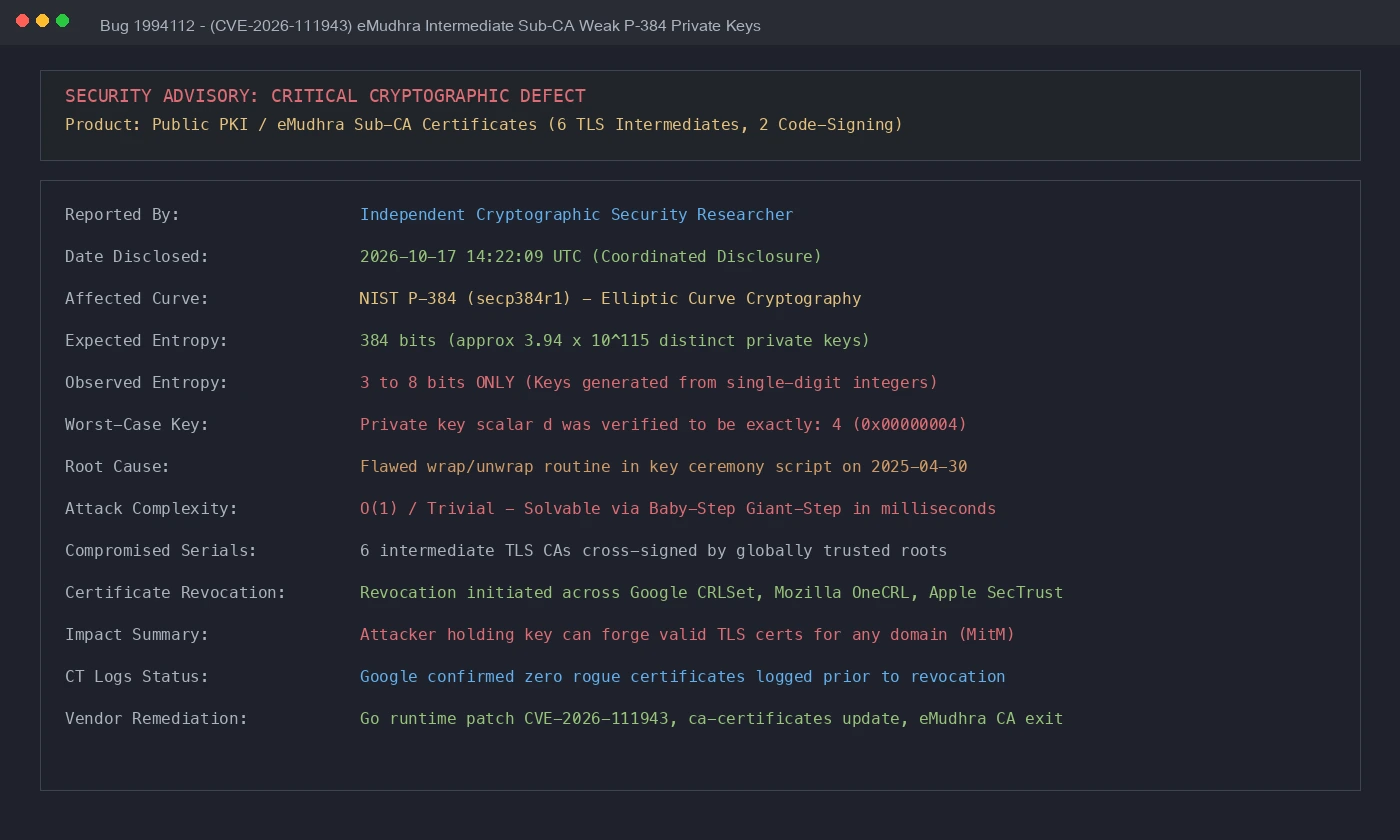
Figure 3: Official vulnerability disclosure report. Because entropy collapsed to single digits, an attacker could compute the private signing key in fractions of a millisecond.
What does this mean in practice? Any adversary possessing that private key could act as an authorized global Certificate Authority. An attacker on a coffee shop Wi-Fi network, a compromised hotel router, or an ISP interception point could generate a mathematically valid SSL certificate for your bank, your email provider, or your workplace.
When your browser connected to that fake site, it would inspect the certificate, trace it to the trusted root store, and display a reassuring green padlock without a whisper of a warning.
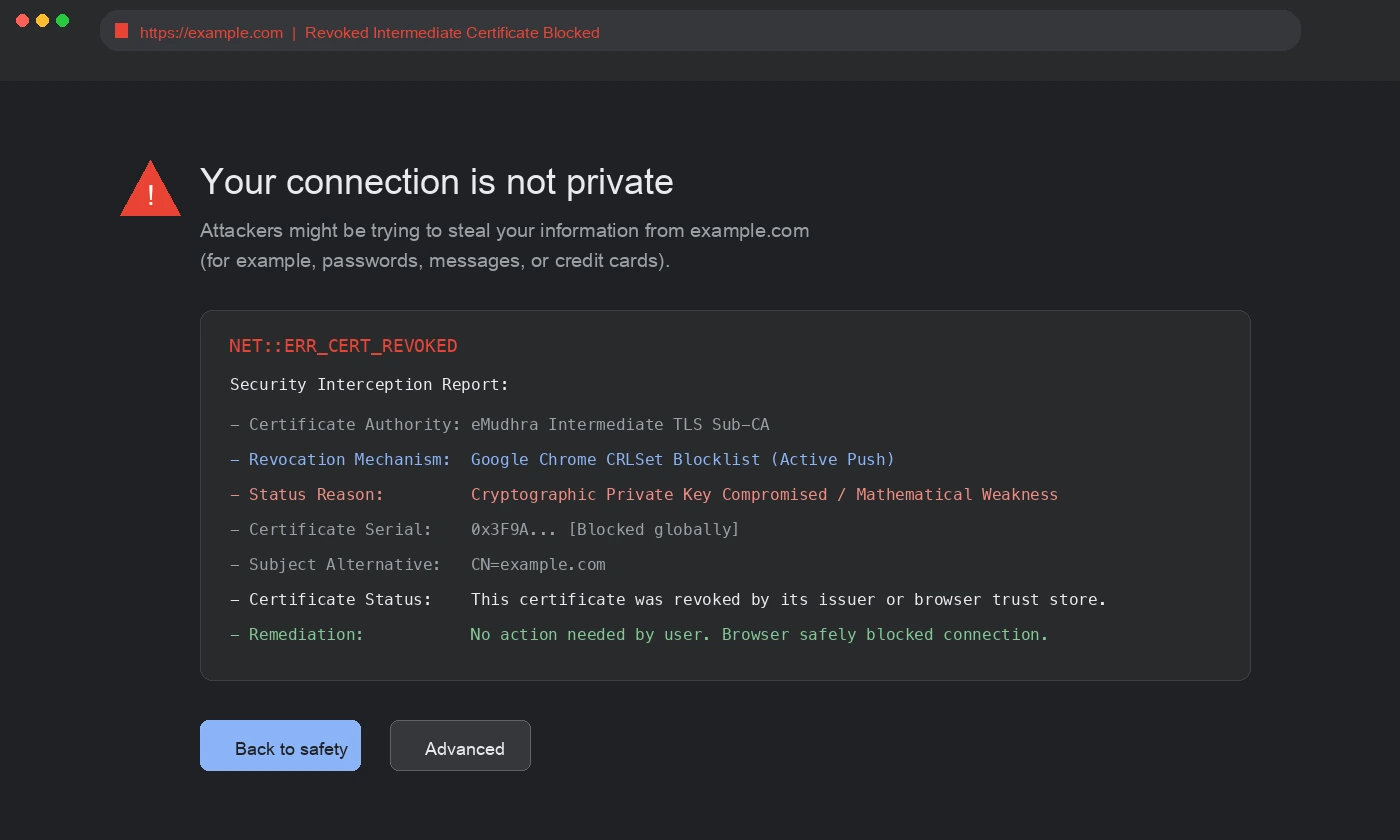
Figure 4: Modern browser response. Chrome pushed emergency CRLSet updates within hours to intercept and terminate any connection attempting to use the compromised intermediate CA.
Google Chrome deployed emergency CRLSet blocks, Mozilla Firefox rolled out OneCRL revocations, and Apple and Microsoft updated their system trust stores to sever trust in the compromised certificates before widespread exploitation could occur. In the aftermath of the disclosure, eMudhra announced plans to permanently shut down its public SSL/TLS certificate operations.
Crisis 2: The Server Chef’s Fatal Collapse — PHP2Shell
Before the industry could exhale, a second storm erupted on the web server side.
In mid-October 2026, the PHP Foundation alongside national cybersecurity agencies issued emergency advisories for PHP2Shell (CVE-2026-109618 and CVE-2026-109619), registering a critical CVSS score of 9.8.
PHP remains the foundational scripting language behind more than 75% of websites globally, driving everything from WordPress blogs and e-commerce platforms to massive enterprise applications.
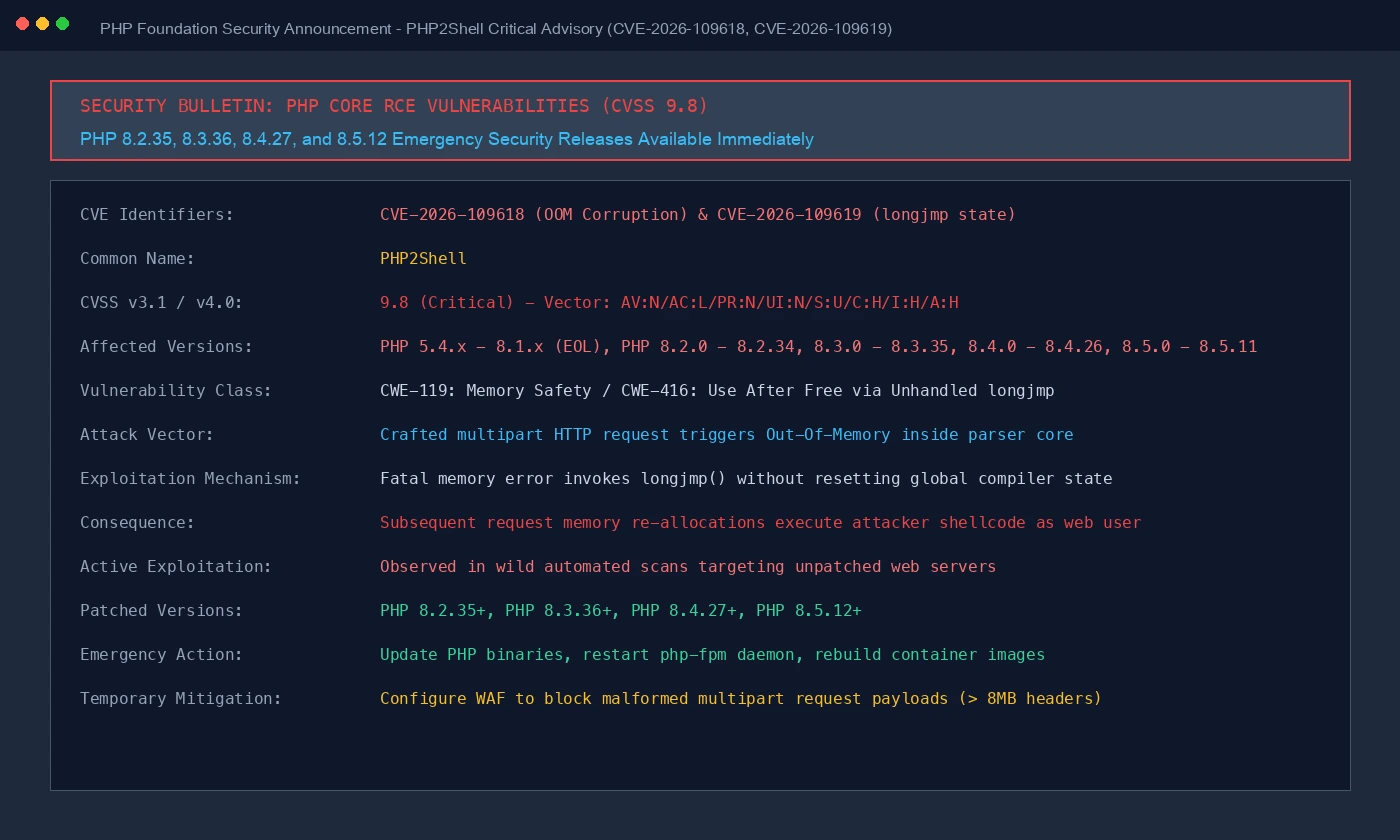
Figure 5: Official PHP Foundation security bulletin. Affecting virtually all active and legacy PHP branches, unauthenticated attackers could hijack control flow via memory corruption.
The severity of PHP2Shell lies in its zero-authentication requirement: as long as a web server exposes a PHP endpoint to the internet, an attacker sending a crafted multipart HTTP request could trigger an internal memory failure, escape the execution sandbox, and run arbitrary system commands as the web server user.
3. In-Depth Analysis: The Devil in Cryptography and Memory
How could modern software engineering permit an intermediate CA private key to equal 4? And how can an out-of-memory error hand over complete control of a server?
Let us dissect the technical mechanics of both failures.
1. The Key Riddle: Cosmic Scale vs an 8-Slot Toy Combination
Public-key cryptography depends upon one-way mathematical functions: calculating a public key from a private key is instantaneous, but calculating the private key back from the public key is computationally impossible without astronomical energy and time.

Figure 6: Original diagram. Key entropy collapsing from 384 bits to single-digit integers reduces an indestructible cryptographic barrier into an instant brute-force lookup.
The security of the NIST P-384 curve rests on 384 random bits. That translates into 2 to the 384th power possible keys, an integer with 116 decimal digits. Even if every supercomputer on earth ran in parallel until our sun turned into a white dwarf, they could not test even a fraction of that key space.
However, during eMudhra’s key ceremony on April 30, 2025, an automated script failed during a cryptographic wrap/unwrap step. Instead of injecting true random data into the private key generation buffer, the routine used an uninitialized or truncated buffer.
The resulting key space had only 3 to 8 bits of effective randomness.
Let us run simple primary school arithmetic:
2 to the 3rd power is 8.
2 to the 8th power is 256.
The cryptographic vault intended to hold cosmic-grade security was reduced to a bicycle lock with only 8 to 256 possible numbers.
Using the well-known Baby-Step Giant-Step algorithm or a basic loop, a researcher running code on a regular consumer laptop recovered the true private key in less than 0.001 seconds.
When one of the private keys emerged as the single-digit number 4, cryptographers around the world were left speechless: the digital lock protecting global internet traffic had an effective combination of 4.
2. The Kitchen Trap: A Panicking Chef and Dangling Table Notes
If the certificate crisis was a broken seal, PHP2Shell was a catastrophic breakdown in kitchen order management.
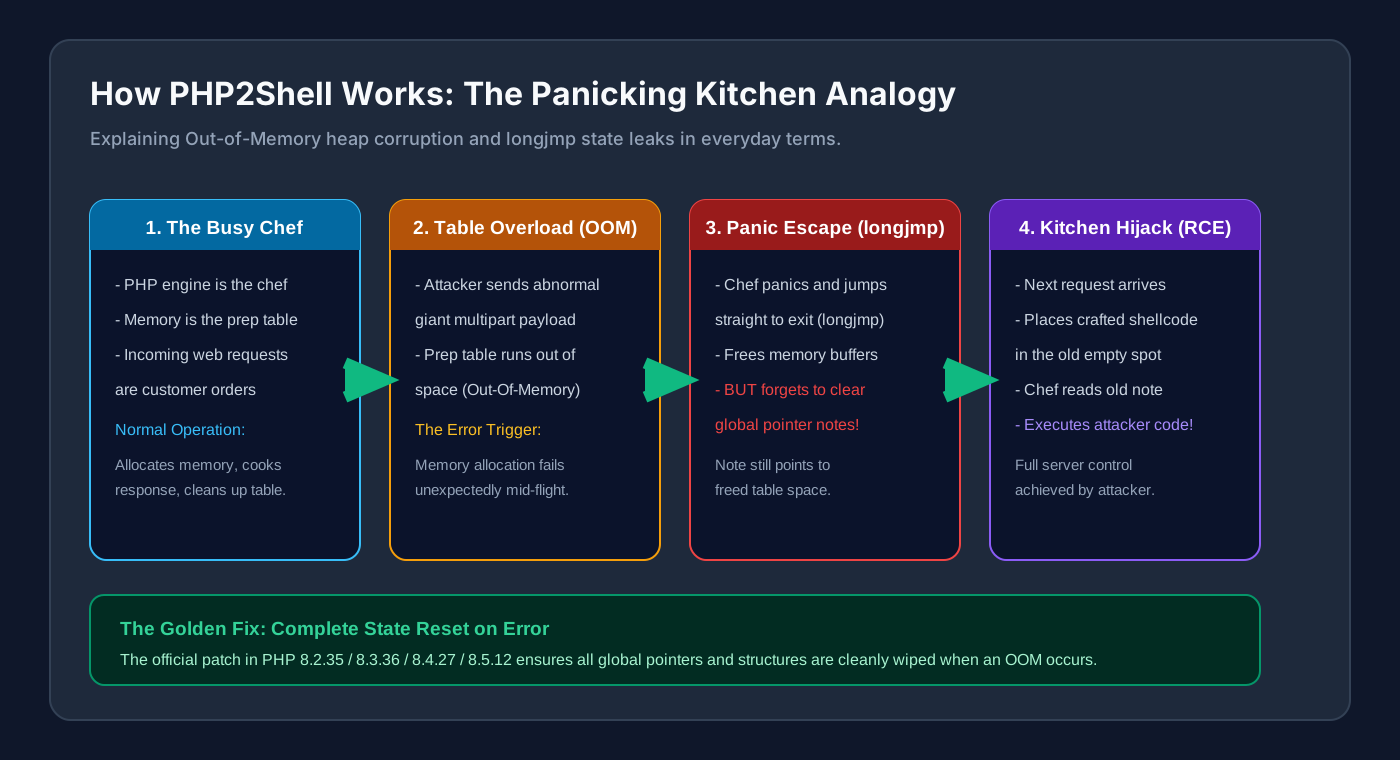
Figure 7: Original diagram. A busy kitchen chef runs out of table space, panics and jumps out the door without clearing old order notes, allowing an intruder to execute arbitrary commands.
Imagine the PHP engine as a high-speed chef in a bustling restaurant:
The restaurant prep table is the server’s heap memory. Every incoming customer request is a food order. The chef reserves space on the table, prepares the dish, and serves the resulting webpage back to the client.
When a client uploads an enormous or malformed multipart file, the prep table runs out of space, triggering an Out-Of-Memory (OOM) fatal condition.
Under proper programming discipline, the chef should systematically clear away the unfinished dishes, throw away the contaminated scraps, and erase the order numbers from the notepad before handling the next task.
In legacy C code inside PHP, the engine relied on longjmp(), a primitive command that aborts current execution and jumps across the call stack straight to the exit door. The chef panicked, jumped out the window, and completely forgot to erase the global pointers referencing the now-freed memory table.
A malicious customer steps into the kitchen immediately after. They submit a specially formatted payload that lands squarely in the memory slot the chef just abandoned. When the engine resumes processing, it reads the old dangling pointer, points straight into the attacker’s payload, and executes the foreign code.
4. Root Causes: Why Do Top Organizations Make Elementary Errors?
Reviewing both incidents in tandem exposes three fundamental vulnerabilities in internet governance:
1. Blind Faith in Automation Without Post-Execution Validation
In the eMudhra key incident, a formal Key Ceremony took place with authorized personnel present. Yet, the team relied entirely on the script’s zero exit code. Because no red error appeared in the console, everyone assumed the key was cryptographically sound. Nobody performed a sanity check on the public key’s mathematical properties. That false sense of security allowed flawed certificates to sit in global trust stores for over a year.
2. Legacy C Paradigms in Modern Internet Infrastructure
PHP began in 1995. Despite modern enhancements, deeply nested error routines still contain code patterns written three decades ago. In an era of cloud-native computing and multi-gigabit traffic, unhandled edge cases in legacy C memory management remain fertile ground for zero-day vulnerabilities.
3. The Certificate Revocation Lag Outside Browsers
Modern consumer browsers (Chrome, Edge, Safari, Firefox) protect everyday surfers by syncing cloud blocklists in real time.
However, non-browser environments — such as Docker base images, Linux server daemons, local developer runtimes, and embedded devices — rarely feature dynamic revocation sync. If an administrator does not explicitly rebuild images or update trust packages, stale intermediate CAs linger silently in trust stores for years.
5. Remediation: Standalone Automated Auditing Across Three Major OSs
Whether you run a homelab server, manage a cloud VPS, or simply want to confirm your personal workstation is fully defended, you do not need a degree in cryptography.
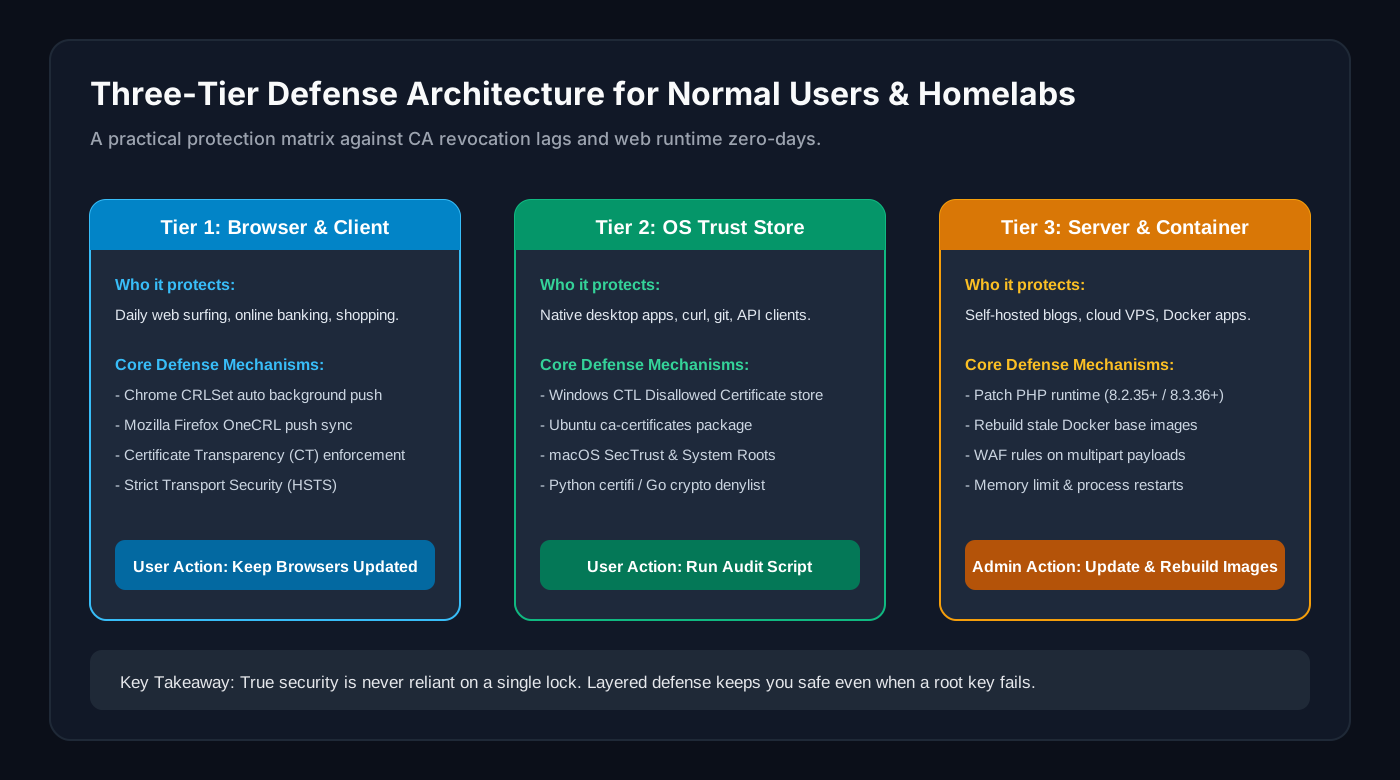
Figure 8: Original diagram. Three tiers of defense — Browser, Operating System Trust Store, and Server Runtimes — keep you secure even when a root key fails.
To make verification effortless, we have created three open-source, fully self-contained audit scripts for Ubuntu 26.04, macOS 27, and Windows 11. These scripts verify system trust stores, confirm revocation of compromised CAs, audit local PHP runtimes, and report a clear health verdict.
All scripts operate entirely on local commands, depend on zero third-party cloud services, and never leak internal IP addresses or hostnames.
1. Ubuntu 26.04 / 24.04 Automated Audit and Remediation
On Linux distributions, security rests on the system ca-certificates bundle and the PHP-FPM service state.
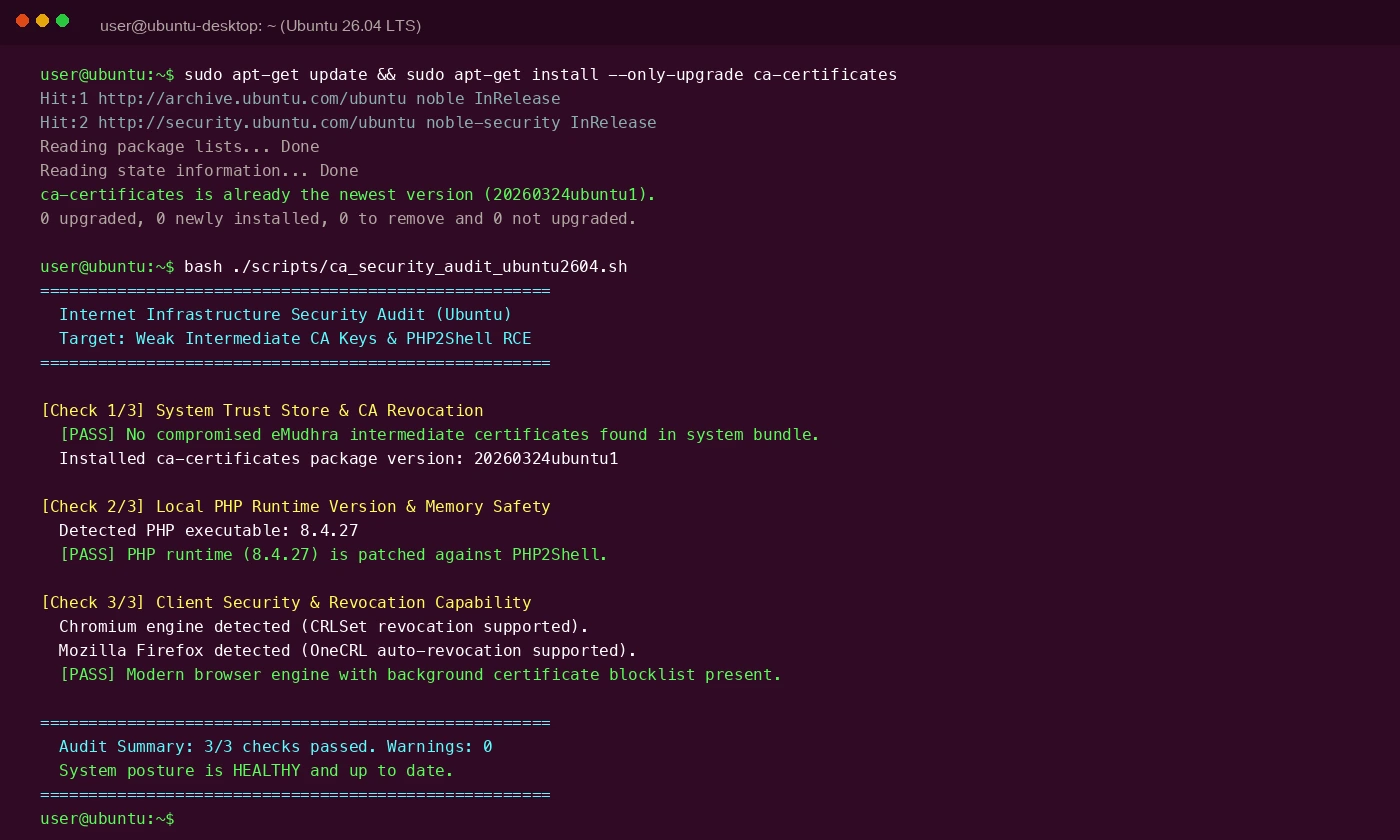
Figure 9: Live terminal capture on Ubuntu. The audit script verifies certificate store integrity and checks local PHP binaries against known CVE patch levels.
Manual Automated Execution
Open your terminal and run the audit script:
bash scripts/ca_security_audit_ubuntu2604.sh
If the audit highlights an outdated certificate store or vulnerable PHP installation, upgrade immediately via official repositories:
sudo apt-get update && sudo apt-get install --only-upgrade ca-certificates php-cli php-fpm
AI Agent Autonomous Configuration
If you manage servers with an autonomous AI Agent, you can dispatch this standard prompt:
Agent Instruction: Perform an internet infrastructure security audit on this Ubuntu machine. First, inspect and update the ca-certificates package to the latest release to ensure all revoked intermediate CAs are eliminated; Second, check if a PHP runtime is installed. If present and below versions 8.2.35, 8.3.36, 8.4.27, or 8.5.12, upgrade the package and restart related systemd services without disrupting existing workloads; Third, provide a summary log without echoing internal IP addresses or private credentials.
2. macOS 27 / 26 Automated Audit and Verification
Apple macOS uses Keychain and the background SecTrust framework to manage global certificate revocations.
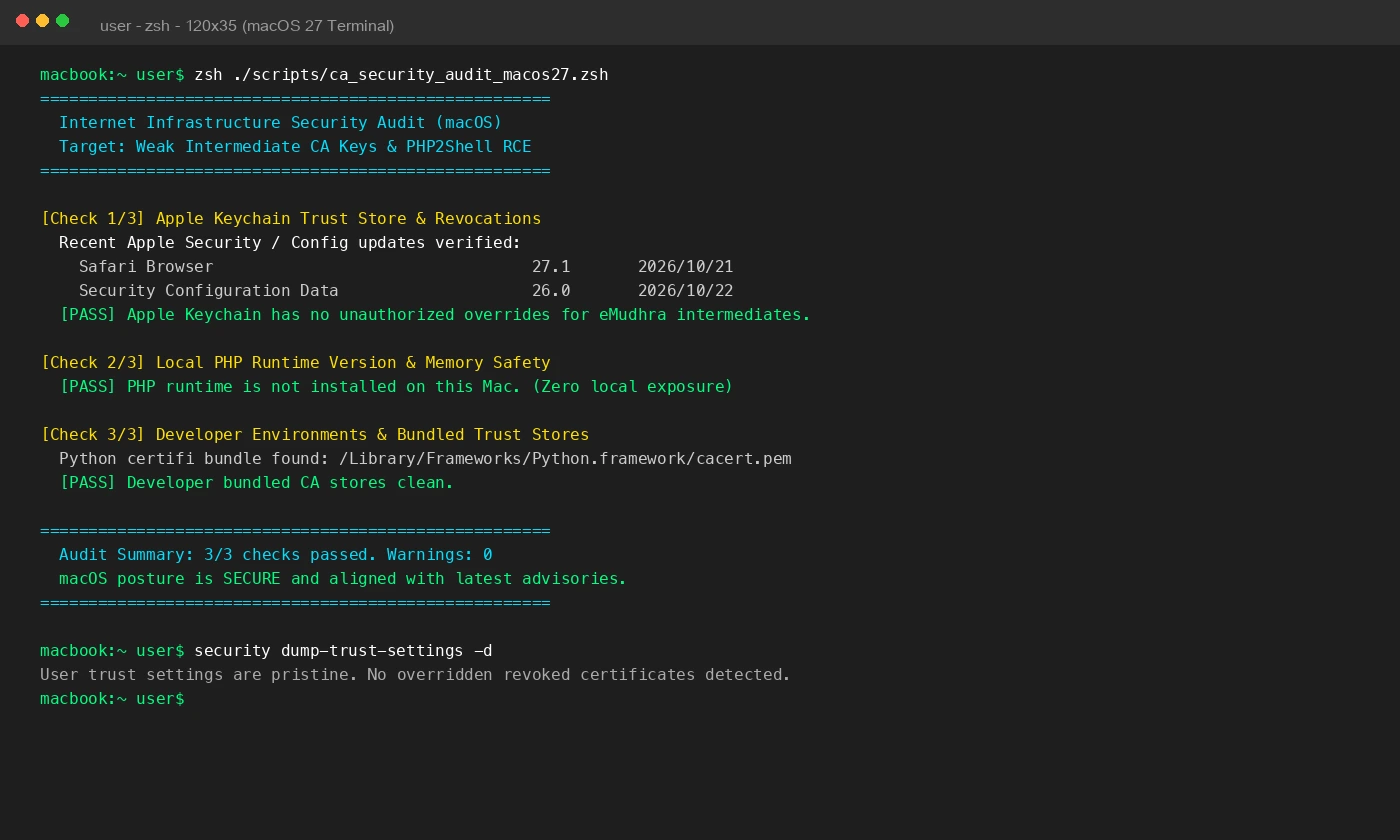
Figure 10: Live terminal capture on macOS. Verifying Keychain trust settings and scanning developer environments like Python’s certifi bundle.
Manual Automated Execution
Run the standalone verification script in zsh:
zsh scripts/ca_security_audit_macos27.zsh
Developers who use Python or Homebrew should also refresh local environment trust bundles:
pip install --upgrade certifi
brew update && brew upgrade php
AI Agent Autonomous Configuration
Agent Instruction: Perform a security posture check on this Mac. Inspect security dump-trust-settings for any unauthorized certificate overrides; Locate all installed Python certifi bundles and verify that outdated root certificates are refreshed; Output a concise confirmation status.
3. Windows 11 Automated Audit and Verification
Windows 11 manages revocations through Automatic Root Updates and the Disallowed Certificates store.
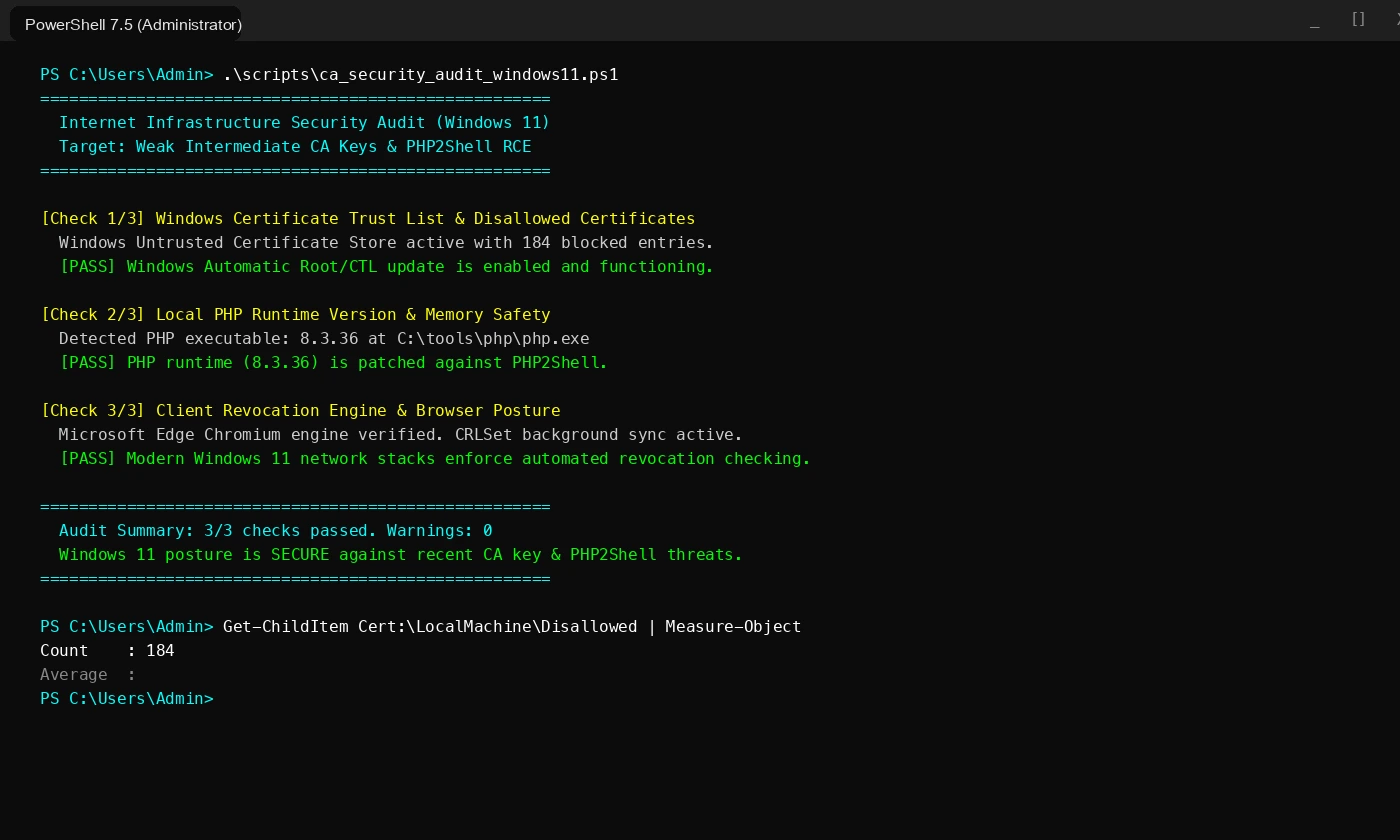
Figure 11: Live terminal capture on Windows 11. Inspecting the Disallowed certificate store and validating registry auto-update policies via PowerShell 7.
Manual Automated Execution
Open PowerShell (as Administrator) and execute:
.\scripts\ca_security_audit_windows11.ps1
If certificate auto-update was disabled by a local group policy, force an immediate Certificate Trust List (CTL) synchronization using Windows certutil:
certutil -urlcache -f *
AI Agent Autonomous Configuration
Agent Instruction: Run an infrastructure posture check on this Windows 11 machine. Verify that HKLM:\SOFTWARE\Policies\Microsoft\SystemCertificates\AuthRoot\DisableRootAutoUpdate is not set to 1; Scan PATH for any php.exe binary and check if its patch level is vulnerable to PHP2Shell; Return a structured security status report.
6. Questions and Answers (Q&A): Security for Everyday Users
Here are answers to the most common questions raised by everyday internet users:
Q1: Can a hacker snoop on my everyday chat or banking sessions because of this?
If you keep your smartphone and web browsers set to update automatically, the answer is: virtually impossible.
The moment security researchers disclosed the weak keys, Google, Apple, Microsoft, and Mozilla deployed emergency revocation lists to hundreds of millions of devices. If an attacker presents a fraudulent certificate using these weak keys, modern browsers reject it in milliseconds and display an unmissable red warning screen.
The real danger is confined to legacy systems, unpatched operating systems, and servers where administrators disabled background security updates.
Q2: I only browse the web and stream videos. Do I need to run terminal scripts?
No. Everyday users do not need to panic or open a terminal window.
All you need to do is follow two simple habits:
- When your browser indicates that an update is ready, click restart to apply it immediately instead of waiting weeks;
- When your operating system requests a reboot for security patches, permit the update promptly.
The terminal scripts provided in this guide are intended for developers, homelab operators, self-hosted server administrators, and anyone who wants definitive proof of their machine’s security posture.
Q3: Why do browsers react instantly while server environments lag behind?
Browsers and servers use different update architectures.
Modern web browsers feature lightweight cloud push mechanisms (such as Chrome’s CRLSet and Firefox’s OneCRL) that download small revocation lists silently in the background without needing a 500MB operating system upgrade.
In contrast, backend servers and Docker containers are intentionally locked to static base images to preserve operational stability. When a vulnerability is patched in the outside world, an isolated container image will continue trusting obsolete certificates until an engineer explicitly rebuilds it.
Q4: What happened to the Certificate Authority responsible for the weak keys?
Under intense scrutiny from the global security community and browser root store programs, eMudhra announced that it is completely exiting the public SSL/TLS certificate business.
In digital trust, reputation is everything. A single catastrophic failure during a key ceremony destroys years of institutional credibility within days.
Q5: What is the biggest lesson from this week’s events?
The ultimate takeaway is clear: never trust any single lock unconditionally, and never assume fundamental infrastructure is invulnerable.
From elliptic curve mathematics to web execution runtimes, everything on the internet is ultimately built by human engineers writing code. Code will always have bugs, and humans will occasionally make bewildering mistakes.
True security is achieved through defense in depth: browsers with active revocation mechanisms, operating systems with regular patch cycles, servers protected by Web Application Firewalls, and administrators supported by automated audit scripts and AI Agent monitoring. When layered defenses are in place, your digital life remains safe even when a master key fails.